
In 2019, I took a strong homemade edible and attended a concert by the Mountain Goats. For what it’s worth, this was actually something I did twice in quick succession - a few days after seeing them in London I was already in Dublin the day of their concert there, and it had worked well the first time - but the London date probably made the stronger impression.
I must have combined music and altered states at some point in the past - the Pink Floyd phase is a rite of passage - but I hadn’t for some years before this and it would be fair to say that it blew my head off. I’ll spare you the specifics of the tin foil and peanut butter, since I clearly barely understood them myself, and move you swiftly past the venue security, eyes averted, to a place in the middle of the crowd. Not the front row - often claimed by the many dedicated people who follow the band from city to city, waiting in line hours early in all weathers, and without whose bootleg tapes much of the fandom as we know it today wouldn’t exist in its current form1 - but the middle, surrounded by warm bodies recognising a song we all knew.
We were at the Shepherd’s Bush Empire - a sizeable London venue for a band which had started on such a self-contained, ‘insular’ scale that its driving member was ‘adamant that we would never tour.’ As John Darnielle describes the process of releasing his first tape (efforts towards which must have been what the neighbours could hear in ‘Done Bleeding,’ as I mentioned last time), the underlying attitude that ‘it doesn’t care if you like it’ was so strong that when it ‘got one very bad local review,’ its creator said to himself: ‘Well, who are you? I didn’t ask you to listen to this.’
The audience for this limited release, which aimed only to do ‘something interesting at the intersection of poetry and music,’ wasn’t solely Darnielle himself, but also those few people who were ‘already … sort of sympathetic to me’ on the local scene. Since then, and especially since the release of the reputation-making record The Sunset Tree, things had clearly progressed, and a niche act grounded in the DIY traditions of post-punk Southern California had found a room full of people ‘sympathetic to’ its music thousands of miles away. Now one of the best-known songs from The Sunset Tree, fourteen years after its release (and so about half my lifetime), was being played in that room, and I was listening to it.
I’d come to the show with my friend Lydia, who I’d known since 2008 and who took this unexpected curveball in our evening very patiently. I also ran into somebody I knew a little from work who I’d previously been slightly scared of and said god-knows-what to them; years on from this, perhaps understandably, I feel like we know each other a little better. These are some of the contextual details I remember about the show, most of which was a joyous blur to me - I hadn’t looked up recordings from the night until this point in writing the piece, when I needed to remind myself how many band members were even present (two; John and multi-instrumentalist Matt Douglas, with members of support act Laura Cortese and the Dance Cards contributing fuller arrangements to some later songs.)
Because what I remember, and I suppose what has always seized me most about the Mountain Goats, was the feeling - the intensity that shot through my zonked-out body when Darnielle sang the second verse of ‘Up The Wolves’ which most directly lays out the song’s message:
There’s gonna come a day when you feel better
You’ll rise up free and easy on that day
And float from branch to branch, lighter than the air
Just when that day is coming
Who can say?
Who can say?
Given its placement on its parent album, much of the song is grounded in its writer’s own context. Dreams of revenge and escape are challenged through comparisons from classical myth and what sound like plotlines from a wildly escalating B-movie: ‘I’m gonna get myself in fighting trim … I’m gonna kill all the judges.’ But I’ll refer again to Helena Fitzgerald’s assessment that Darnielle’s material is often felt so personally because each invested listener makes it, as she does, ‘personal to myself… [t]he vulnerability we take away from it is our own.’
One element that serves this is how the song begins by facing outwards. Later verses foreground a first-person speaker who embodies the adolescent Darnielle in heightened form, wanting to ‘tell the neighbours what’s been going on’ and then get away from all of them, toppling all authority figures in the process - but before that, as had also happened in ‘Mole,’ second-person address is used to externalise and widen the scope of the experience.
This flipping of “I” and “you,” Darnielle observes in his recently published book of annotated lyrics, This Year, is ‘something I do a lot’ - to ‘row against the tide’ of an ‘indiscreet age’ is one explanation he gives (p.228, about ‘Rescue Breathing’), but another is perhaps visible in the play of pronouns that concludes the entry on ‘Your Belgian Things,’ pp. 200-1: ‘Either you metamorphose and leave your toxic carapace behind, or you don’t make it. Do it again: Either I metamorphosed and left my toxic carapace behind, or I didn’t make it. This song works out as many versions of this sentence as I can tolerably stand.’ Whoever you are, whatever your life has been like, you will have your own ghosts, you will struggle with forgiveness, but you will, some day, feel better.
That message, carried along as it was by propulsive chords and floating keys and strings, was something I needed to hear that day. I’d been feeling pretty bad for a few years beforehand, anything but ‘free and easy,’ to the point where ‘better’ was starting to feel very hard to imagine, where I’d lost touch with the person I wanted to be, both for myself and for the people around me. 2019 offered an opportunity to put myself back together, to do things differently, to try to build a life and a self I could be happier about. Self-reflection was part of this (to which those little parcels of tin foil made their own important contribution), but facing outwards was something I found useful, too.
That spring I tried to consciously pay attention to the shifting natural world for the first time as an adult, calling my parents to ask when I ought to look out for signs of spring. I’d spent the first week of the city living in the Rotunda - a flashy high-rise filled with serviced apartments I could never have afforded otherwise, due to a placement associated with the Birmingham laureateship. It couldn’t have come at a better time, since I had no idea where else to go, though it was unnerving being so high up and surrounded by such big windows. This provided space to write the first clutch of many poems about the history of the city I loved and had spent four years in, as I contemplated a move to a new part of town.
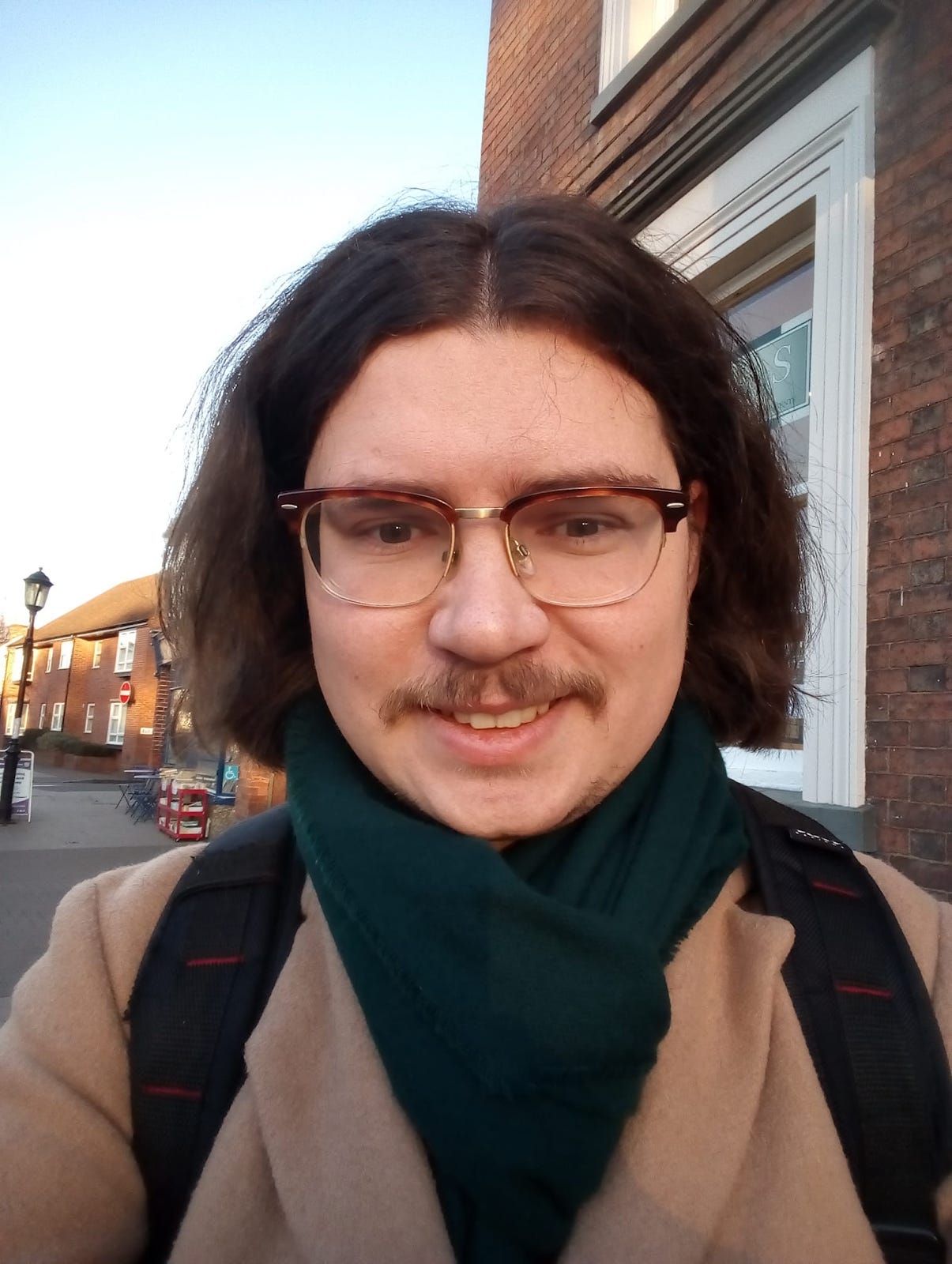
I ended up subletting a room from an old friend, Miles, who was the only person I’d known in Birmingham before moving there and who by this point had been in my life for fifteen years. We stayed up late eating take-out pizza and talking about the Mountain Goats, among other things, and the world moved on. I grew a moustache - I’ll leave it to you to determine if it was one reflective of my true spirit. I kept running. I read a poem for the President of Ireland, one of those I’d written during my week on the eighteenth floor, and he was nice about it and shook my hand, and I got to tell my dad. I wrote another poem called ‘Attachment Clown,’ which I didn’t perform for the President of anywhere, but was probably equally indicative of where my head was at.
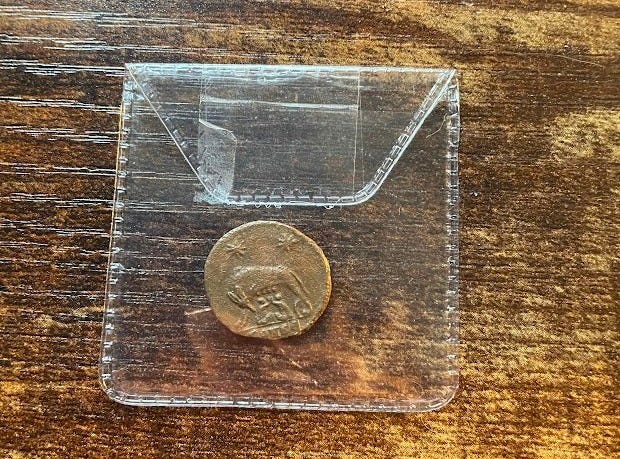
By the autumn, I was in a relationship with the woman who is now my wife, with whom I’ve now built a life which, allowing for the general cares and concerns of our mid-thirties, the constraints of late capitalism and the constant drumbeat of alarming world news, is freer and easier than anything I’ve ever known. On my desk right now is a Roman coin she bought me for Christmas, whose reverse face bears a design of Romulus, Remus, and the wolf that raised them. I’d thought before about getting this image tattooed, then questioned that idea when I learnt it had previously been co-opted by neo-Fascists; but these days I’m inclined to think a symbol is what you make of it, that the worst people to identify with something don’t deserve a definitive say in what it means for anyone else.
But at the time she was living in Texas, while I had a teaching job in Ireland, which paid two days a week, and was weighing up whether I could even afford to move to Dublin, one of the most expensive cities in Europe. I still had teaching in Birmingham, too, so for a few weeks I was flying back and forth on Ryanair to give a course on early modern literature and the environment. This seemed like it couldn’t be sustainable for long, but one benefit was that it put me in the Irish capital the day John and Matt played the Button Factory: November 20th, five days after the London gig. I cancelled my flight, and booked tickets for the night ferry home.
It wasn’t the boat my grandfather rode over from Ireland, but I’d already made my own bad decision or two, and seeing the Mountain Goats seemed like a good one. The music they’d released that year hadn’t been my favourite of the band’s work, but the duo tour format made for a wide-ranging setlist, and both shows that autumn reminded me how much of this music I loved, and by proxy, how long it had been in my life.
It was there in 2017, when I sat at the double desk in our home office and processed the fact that the four bonus tracks I’d just paid for on the iTunes deluxe edition of Goths were ambient remixes. The desk was bought second-hand from the office of a law firm closing down in the wake of high-profile misconduct allegations, and when an old man saw us manoeuvering it in the street he said ‘You’ll never forget the day you carried a desk across the Jewellery Quarter’ - and I never have.
This music was there too in Bristol, in 2015, when I had stood near the front of the crowd in the Trinity Centre - a gig which, researching this episode, I found had been reviewed by friend of the show Fiona Bowler, who wrote ‘I’ve been to a lot of gigs where you feel like you’re in a sea of people, but this concert was intimate, friendly, and welcoming … like the best karaoke I’d ever been to.’ And yet, I remember trying afterwards to explain the strange feeling that, although this was as close as I ever came to transcendent experience, there was still something inside holding me back. But it had been in my life before that too; in the strictly temporal sense, it had always been there, though in 1991 I’d neither have had the knowledge nor the wherewithal to buy one of a small run of tapes from Dennis Callaci.
Recorded over old stock from Rhino Records where the Shrimper founder worked, the Mountain Goats’ music was always a case of making what you wanted to see in the world even if you had only limited resources available, refashioning the given and the mundane into something which shone brightly enough to its creator that he didn’t care if anybody else was looking. Many of us who have responded to that signal flare going up have, in turn, made it part of the ways we make and refashion ourselves. Any art that you hold inside you deeply enough becomes part of you, part of the core that goes with you even when everything around you changes.
I felt lighter than the air that night in London, even though Darnielle was singing the words in the future tense. I was elated. I was crying. I was off my face. But I was grounded, too, by something which I’d gripped to my heart so tightly that it was there for me - because it had always been - when I needed to find the language, the feeling, the energy by which to ascend.
More than perhaps I realised at the time, the poem I read for Michael D. Higgins’ presidential visit was invested in these ideas of re-emergence and renewal that I’d been mulling over in my own life, in my hopeful walks around the small park behind my house on the Pershore Road that connected with a patch of woodland, and a sliver of the River Rea, and eventually all the way to Cannon Hill Park. I had got a Mountain Goats tattoo already, the one you see at the top of the newsletter: ‘Pale green things.’ Whatever they look like for you, wherever you are, may they come up through the cracks soon this springtime.2
Text within this block will maintain its original spacing when published
                                                            Beorma
                 ‘This is as good a place as any’ — our beer-headed chief,
                      fording the trickling river, thumped down a stake.
                                Thick forest and thin soil. We scraped
                                    out dwellings, built a dyke, a gate,
                                         raised cows and killed them.
                                            Salt for stubborn winters
                                                dragged us through:
                                                 more above ground
                                                        than not.
                                                            Life;
                                                           death,
                                                        and then
                                                      a better life.
                                                  The glitter under
                                                the torn-back earth.
                                              The streets spreading
                                          like roots, like heated iron:
                                     something sharp and gathering.
                         The wince of tracks, the steam erupting forth,
                     careening into neon, glass. As good a place as any.
This week, Richard is getting into crocuses and snowdrops.
A special shoutout here to Stormclouds522, whose tape today’s instalment draws on, and always and forever to Liz, Kyle and Emerald.
Comments
Nothing yet. Say the first thing.
Sign in to join the conversation.