
Andy Burnham’s victory in Makerfield was remarkable.
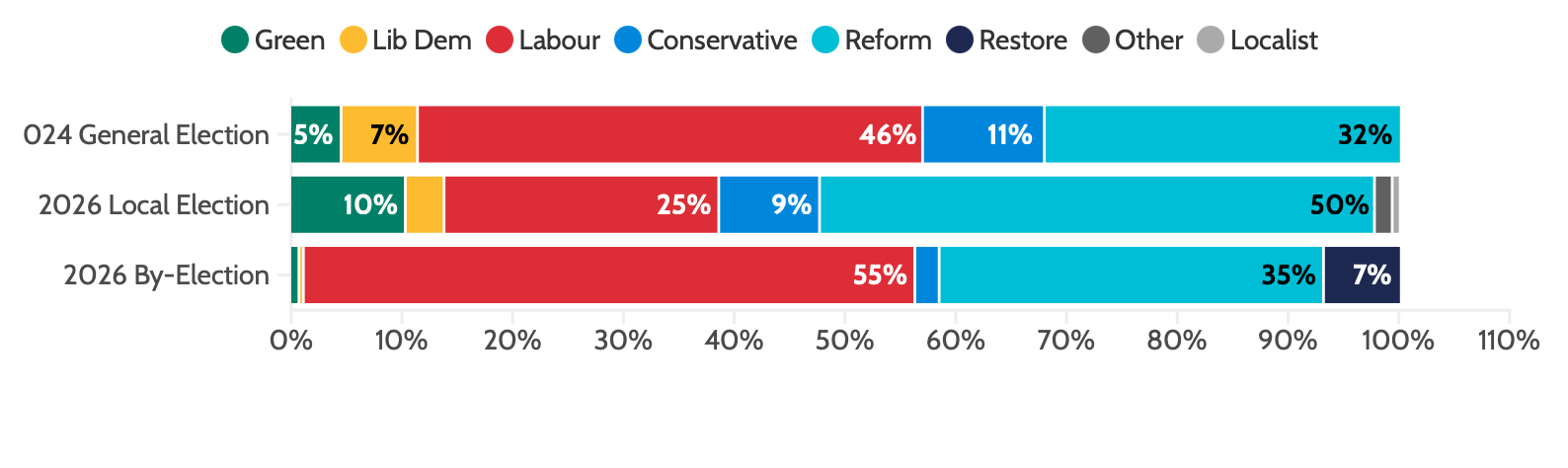
Only a few months ago, Reform UK won 50% of the vote in the local council elections across the wards that make up the constituency. Labour won just 25%. In the by-election, Burnham reversed that position dramatically: Labour surged to 55%, while Reform fell back to 35%.
For Labour, defeating Reform so emphatically is clearly good news and one that will give hope to many across the party that Labour is capable of defeating Reform at a General Election. That hope is well-founded but for it to be realised we must avoid drawing the wrong lessons from what occurred yesterday.
The immediate temptation may be to see Makerfield as evidence that Labour can win back voters from Reform by signalling a move rightwards. But the evidence suggests that Burnham’s victory appears to have been won less through large-scale switching from Reform to Labour, and more through uniting the progressive vote and remobilising Labour’s own voters.
Without full voter-flow data, it is impossible to know exactly what happened. But polling data from Convergent (whose constituency poll came closest to the actual result), gives us a strong indication. That poll suggested that only 5% of Reform’s 2024 general election voters switched to Labour, alongside 8% of the 2024 Conservative vote — amounting to just under 1,000 voters overall. At the same time, it estimated that Labour lost 11% of its 2024 voters to Reform, around 2,000 voters.
If those estimates are correct, it would suggest that the net movement between the left and right blocs since the general election actually ran from left to right, not the other way around. Burnham may well have suffered a net loss among direct Labour-Reform switchers.
Since the General Election, Reform has increased its national vote share by around 12 points enabling the big Reform win in the local elections in May. It is theoretically possible that Burnham got his 20-point lead principally by winning back people who had voted Labour in 2024 and had switched to Reform in those council elections only a few weeks ago. But this is not what the evidence suggests.
Labour increased its vote by around 10,000 between the local elections and the by-election. Maybe half of this came from progressive parties. The Greens and Liberal Democrats together won fewer than 500 votes in the by-election - around 5,000 fewer than they had won in May. It is reasonable to assume that most of those voters moved to Labour.
Meanwhile, the right-wing bloc - Reform, the Conservatives and Restore — lost around 3,000 votes between the local elections and the by-election. That means, at most, 3,000 of Labour’s gains could have come from direct switching from the right. This suggests that a substantial part of Labour’s increase came from Labour-leaning voters who had not turned out in the council elections.
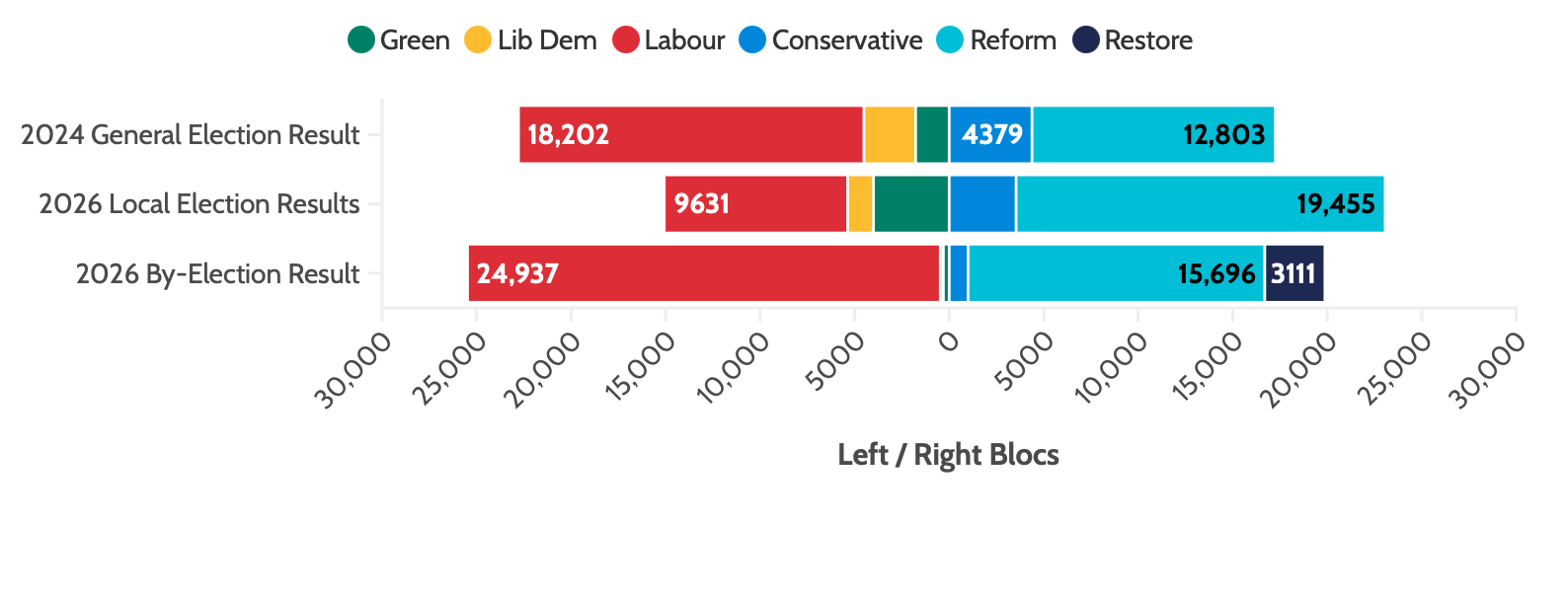
The turnout figures support this interpretation. Turnout in Makerfield rose by around 7,000 between the local elections and the by-election. Extraordinarily for a by-election, turnout was actually higher than at the General Election. This strongly suggests Burnham succeeded in mobilising significant numbers of people who had stayed home in May, and even some who had not voted in 2024.
This fits closely with ThinkLabour’s own polling nationally, which found that in constituencies like Makerfield the largest single destination for Labour’s 2024 voters is currently “Don’t Know” — 15% of them.
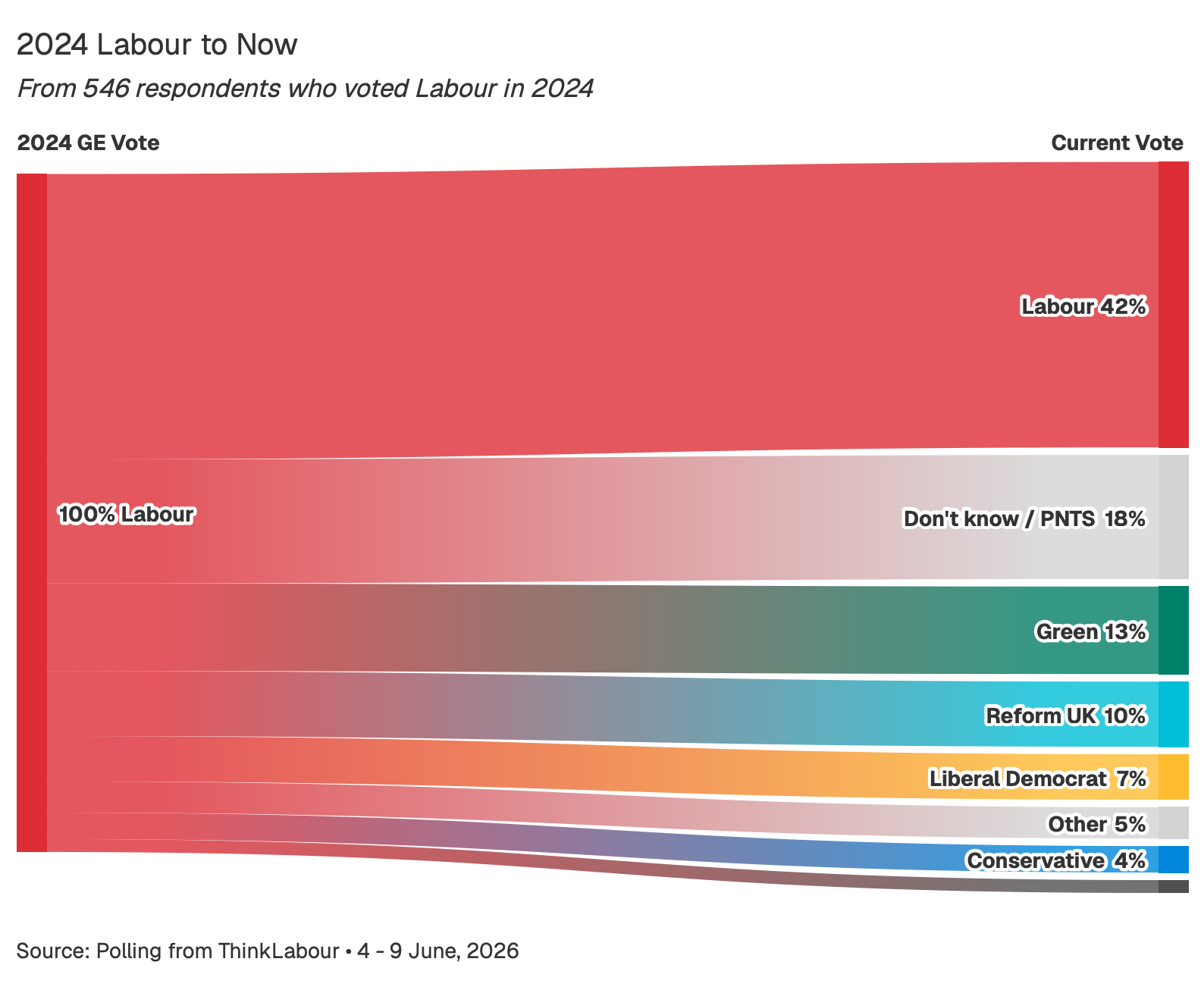
It is reasonable to assume many of these voters sat out the local elections but felt motivated to turn out for Burnham. That would imply that a large majority of Labour’s vote increase came from progressive switchers or from people who had not voted in the local elections at all.
ThinkLabour’s report Who Is Labour For? argued that Labour’s route to a second term lies less in chasing voters lost to the right on questions of values, and more in rebuilding a broad progressive coalition while winning back more transactional right-leaning voters through delivery and credibility.
That is almost exactly in line with how Burnham appears to have won so handsomely.
First, he is clearly seen as a politician of the left. His support for public ownership of essential services gives progressive voters confidence that he reflects their values.
Second, he has built a strong reputation for standing up for Greater Manchester against central government, particularly during the Covid pandemic. This has created a powerful sense that he is on the side of the people he represents.
Third, he is widely seen as a successful mayor. Under Burnham, Manchester has seen sustained economic growth and highly visible improvements in public transport. For more transactional voters, this matters.
This combination - values, representation and delivery - appears to have allowed Burnham to unite progressives, remobilise disengaged Labour voters, and pull back at least some voters from Reform.
Reform has always been beatable. They now stand at 27% in the national polls down from a peak of 32% last year. The reason successive constituency-level MRP studies (polling techniques used to predict public opinion at a highly localised level) continue to show Reform emerging as the largest party is not because Reform is overwhelmingly popular but because the progressive bloc remains fragmented.
In many seats, the combined Labour, Green, Liberal Democrat, SNP and Plaid Cymru vote would be enough to defeat Reform. But where those votes are either unable to determine who the strongest challenger is, or are unwilling to vote for them, Reform can come through the middle.
But In three successive by-elections now, the anti-Reform vote has successfully coalesced behind a progressive candidate: Plaid Cymru in Caerphilly, the Greens in Gorton and Denton, and now Labour in Makerfield. Makerfield matters because it is the first time Labour has been the vehicle through which that anti-Reform coalition has been assembled.
Burnham managed this not by shifting right but by being seen to be clear about his principles and therefore persuading progressive voters that Labour was the natural home for anti-Reform voters.
For Labour, the strategic implication is clear. The path to beating Reform is not primarily through chasing right-wing votes. Such strategies usually feel inauthentic to Reform-curious voters and simultaneously make Labour’s progressive base question what Labour stands for. It is through rebuilding a larger progressive coalition, while persuading more transactional voters that Labour can stand up for them and deliver in office.
This is the route to beating Reform and winning a second term for Labour. Whoever leads Labour in a few months’ time would do well to recognise that.
No posts
Comments
Nothing yet. Say the first thing.
Sign in to join the conversation.