
Look around and you'll see an ocean of B2B niches with products all doing pretty much the same thing. Sure, the nuances and feature names differ. Some even have the occasional breakthrough function.
But really, what's the fundamental difference between B2B tech products these days? What is so groundbreaking about New Product A that renders Old Product B obsolete?
This sameness carries over to the content we produce too. We talk about pain points. We write BOFU demand capture pieces.
We do tool comparison "reports" without getting too fangirl-like about the competition.
We do the same KW research and compete over the same spots in SERPs.
My question is: If our product is the same as the competition, and we talk similarly about the same things, what is our content even doing?
Content marketing is not a creative pursuit. The assets we produce help our companies and clients sell their products and earn revenue.
I feel silly for spelling that out, but unfortunately, many CMs obsess over word choices far too much to recognize this.
At some point in B2B content marketing, we convinced ourselves that addressing pain points was the best way to capture a prospect's attention. This approach made sense from 2015 to roughly 2020.
Google's SERPs were not too crowded and in plenty of B2B niches, SEO was wide open.
Liking this so far? Let me interrupt with the obligatory “please share” request.
Add a dash of playbook copying and poor data analysis, and companies convinced themselves that “pain point SEO” was the best way to boost revenue. But these days, creating such content is a waste of money and time.
I mean, look at the example below of four FP&A platforms talking about the same thing since Annual Operating Plan is a high volume, low keyword difficulty search phrase related to a pain point:
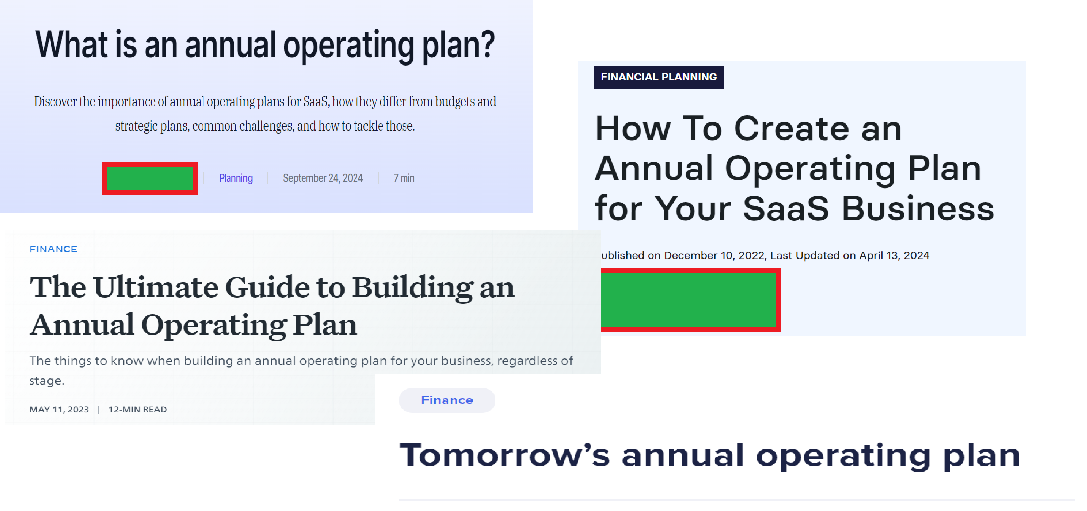
You can see the logic behind these pieces:
Company A figured out that Annual Operating Plans are a pain point.
It gained a first-mover advantage and search volumes increased.
Company B noticed this volume and moved next.
It siphoned traffic by adding nuances.
Company C noticed A and B getting traffic.
C moved because it could not be left behind and added some more words.
Finally, D caught onto what was going on, creating a mish-mash of A, B, and C.
D's content gets a little traffic, just enough to justify its agency's bill.
Notice that in this chain, A is the only company with even a hope of turning all that traffic into revenue. B might convert some due to differentiating its content early in the cycle.
C and D have almost no hope of differentiating content and capturing revenue.
Now, let's make this example more interesting.
Company E enters the FP&A fray and is looking to build content. No one knows E exists, aside from its VCs. E knows all the pain points its audience faces but, given the scenario above, has no hope of standing out through content.
This puts E in a Catch-22.
No one will read E's content since no one knows who they are.
No one will know who E is unless they produce content.
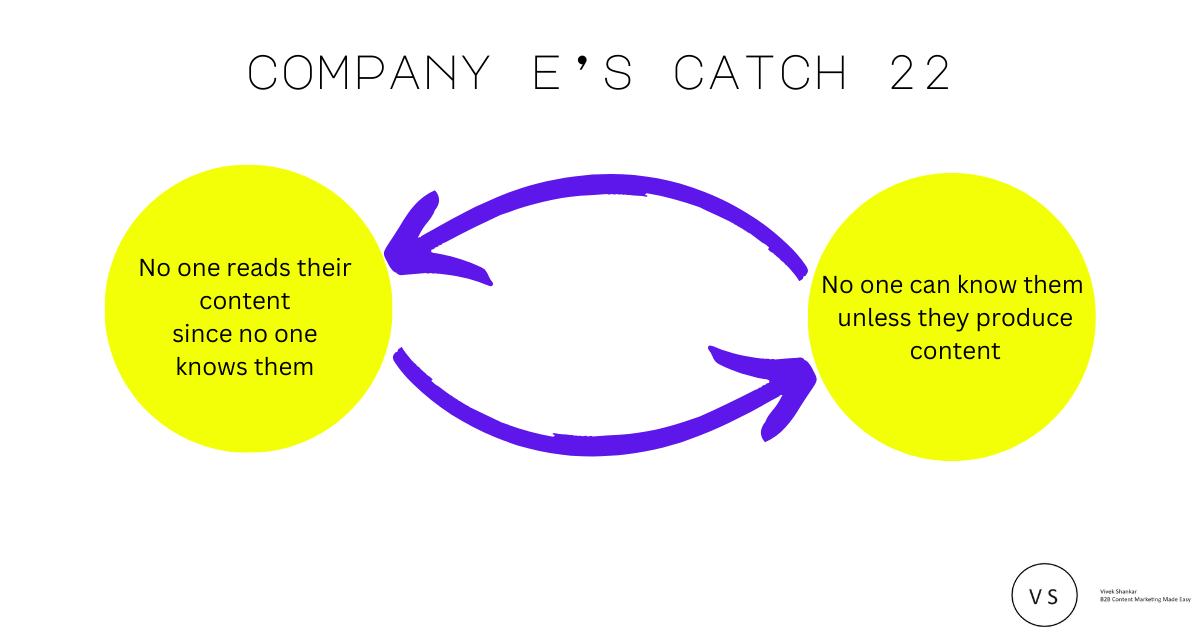
A frighteningly large number of companies are in E's situation. They're late entrants in crowded niches or mature companies that have exhausted pain point SEO.
Legacy content playbooks don't tell them much.
What should Company E do?
The average content marketing influencer might consider Company E's situation easy to solve. "Simple," they'll yell. "Differentiate content. Talk to SMEs. Talk to customers. Talk to sales. Explore different angles."
As an impartial mud slinger, here's me saying these things.
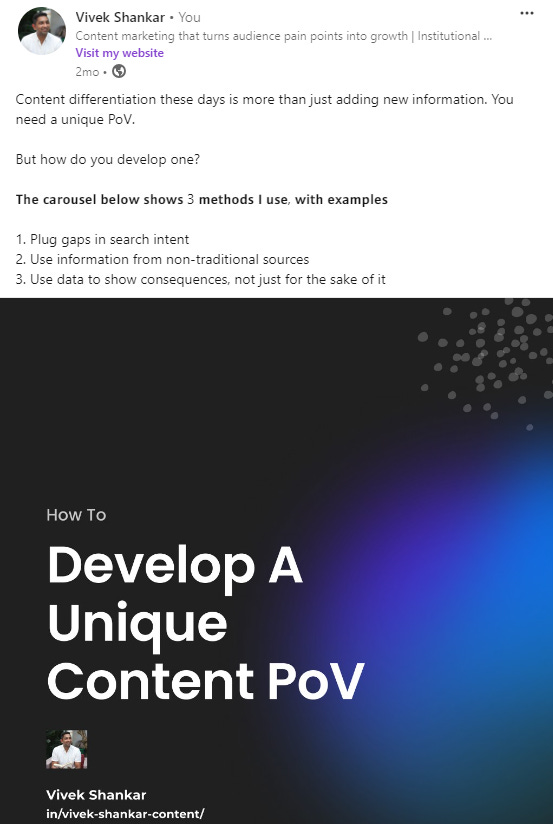
Practically though, every marketer knows that differentiating at the content level doesn't yield the results we want. It usually leads to great content gathering dust in zero-traffic hell.
So: What should Company E do?
Let's use one of Charlie Munger's favourite mental models—an analogous thought experiment—to see if we can help Company E.
You're walking through a market and searching for, I don't know, potatoes. Everyone knows what a potato is and no one really cares about a red potato versus a brown one.
Disagree with my potato stance? Let the world know.
(Some people are passionate about sweet potatoes, but sweet potatoes are not potatoes and hence disqualified from this experiment.)
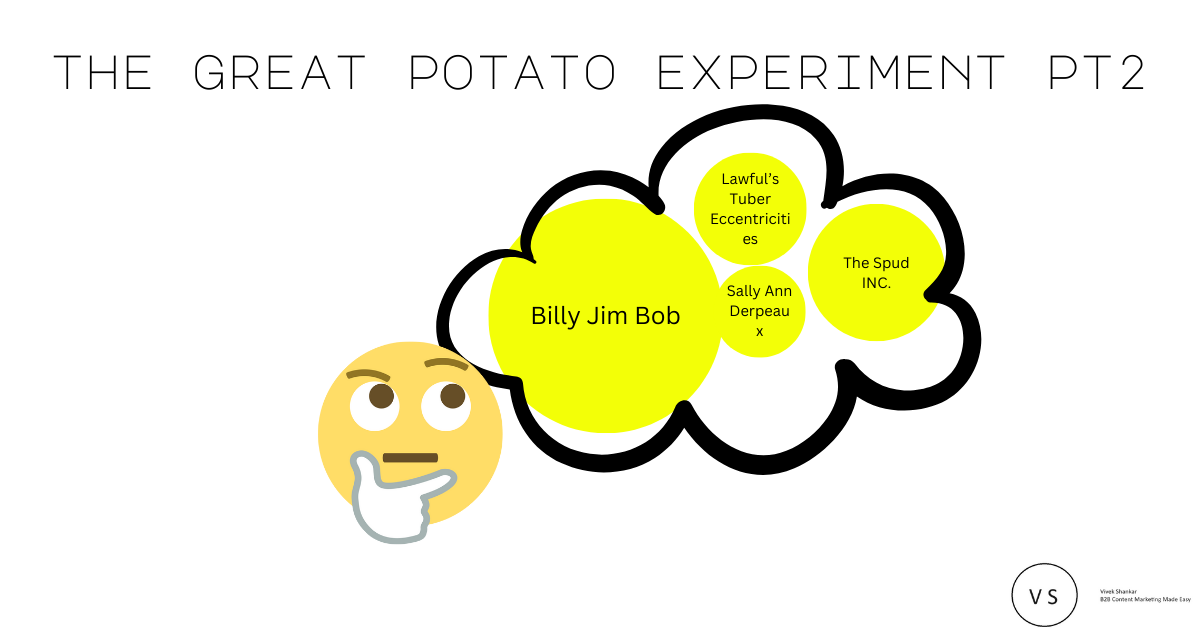
You face four vendors, all selling just potatoes and they're all selling them for the same price. Who do you buy from?
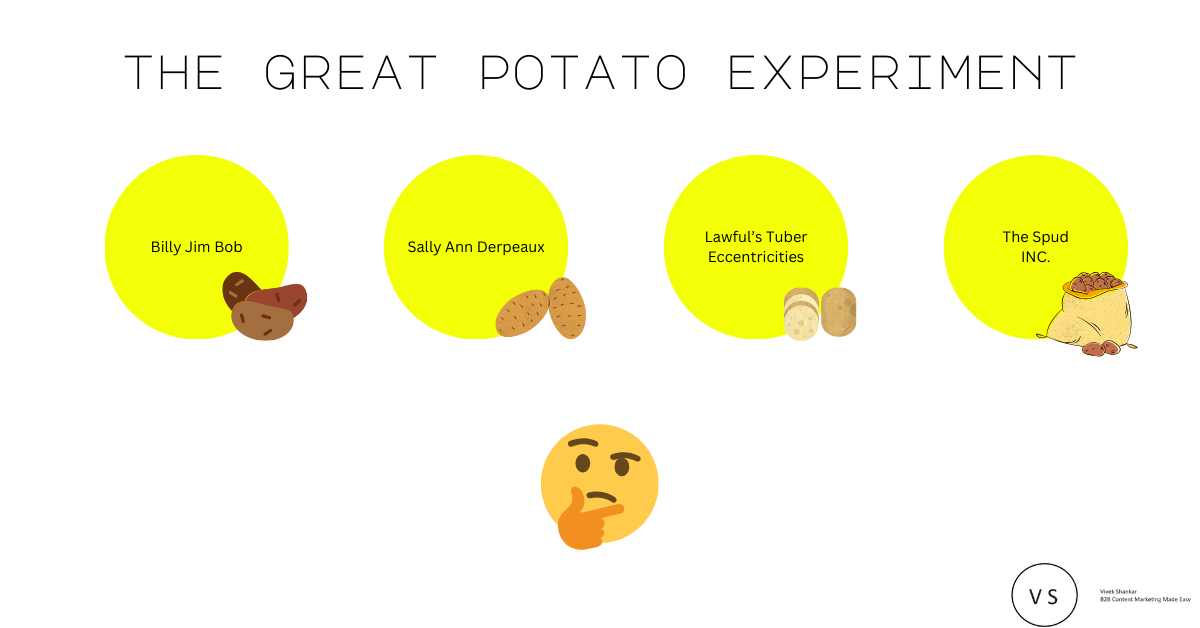
Simple. I'm more likely to go with a seller I'm familiar with. I may have bought potatoes from them before or briefly exchanged a few words with them.
My friend may have told me, "Billy Jim Bob is my go-to potato guy and the best I've ever seen. His taste attribution dashboards are transformational!"
And if I'm unfamiliar with potato sellers, I'll choose the biggest one out there.
In short, the seller that occupies pole position in my mind gets my money.
In our quest to solve pain points and create B2B content around them, we've forgotten a basic marketing principle: Brand recognition comes before almost everything else in a sale.
When products are undifferentiated, brand carries the sale.
With this epiphany in mind (I hear the traditional marketers guffawing in the corner), Company E's content strategy is clear: Establish affinity with its audience before producing any resource-intensive content pieces.
This means:
Investing in channels where it can gather feedback fast
Test different messaging to see what resonates
Test different formats
Borrow audiences as much as possible
Co-market with audience-adjacent companies
Learn the language. Especially humour
That doesn't sound like any legacy content strategy, does it? Where's the blog? Where's the social media "distribution" plan? Where's the buyer persona with the ICP's favourite ice cream flavour?
I'll admit, at mature firms, it takes a brave content marketer to pitch this strategy to Demand or whatever function they're reporting to. Early-stage companies have more freedom here—it's not like they have a choice.
Also, the average content marketing agency has no hope of executing such a plan since there are no productized outputs. Executing this plan seems tough.
But this playbook avoids content mediocrity and sameness when your product is undifferentiated. It emphasizes the customer first and pushes you to ask the right questions. It recognizes the emotion behind purchases and aligns you with them.
Most importantly, it turns your content into a brand awareness and revenue machine.
Now, my question to you is: Do you know what questions to ask to execute this strategy?
No posts
Comments
Nothing yet. Say the first thing.
Sign in to join the conversation.