
Hello 4D friends, I’m finally caught up after a swamped summer, and wanted to share some new thoughts with you.
I always say yes to the Kinference conference (formerly Brooklyn Beta); it’s a reunion of early “design Twitter” people that always yields dozens of great conversations and hugs. This year’s focus was AI, since founder Cameron Koczon says designers can’t sit this tech trend out.
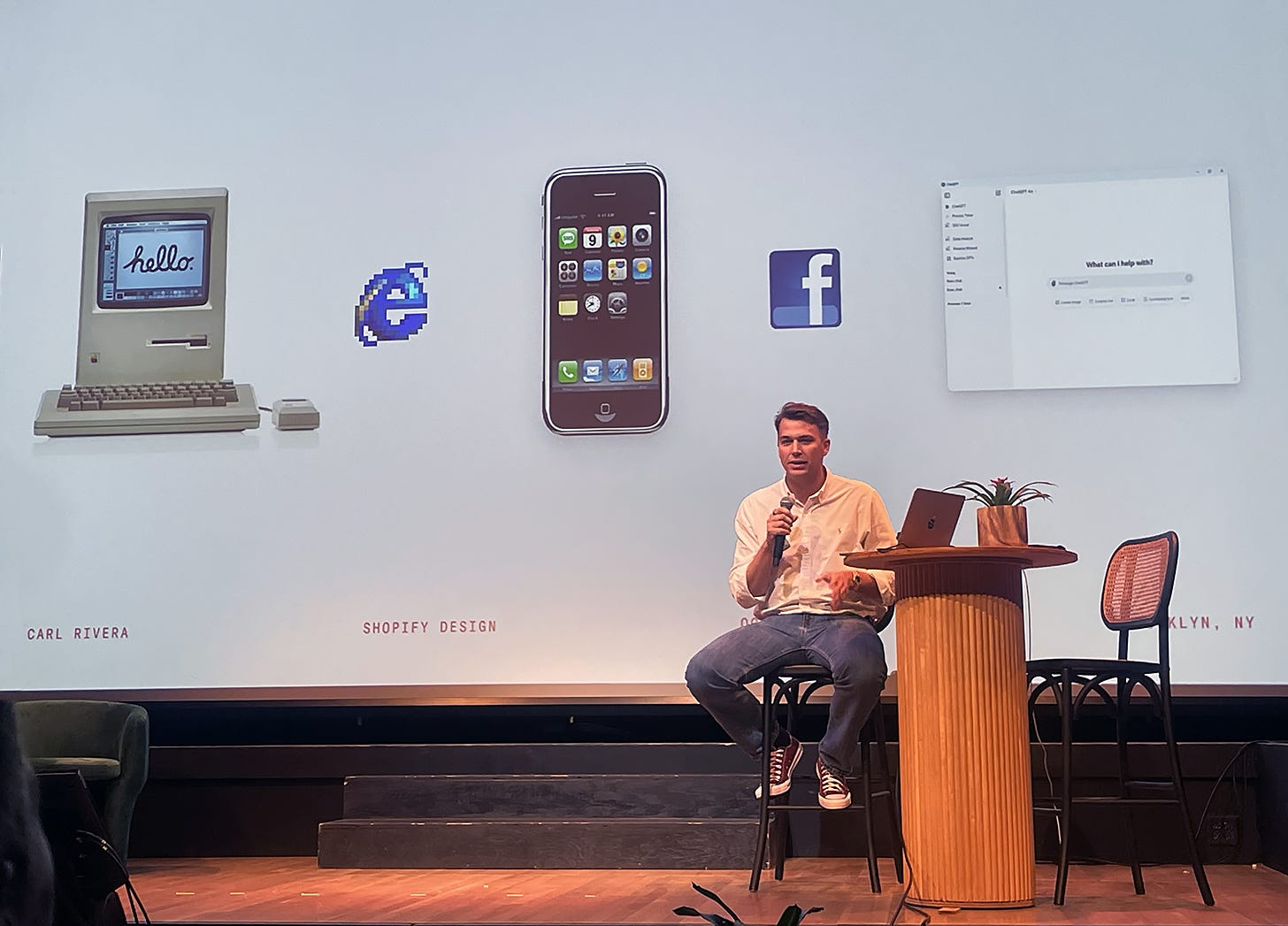
Kinference founder/MC Cameron Koczon thinks AI is a development on par with the iPhone in its impact on tech and culture. We could definitely decide to skip web3 and crypto, but we have to decide how we’re engaging with AI. What we do for the next 2-3 years will shape the rest of our careers (!) Go for “designer founder”, not just “founding designer.”
Designer Frank Chimero’s first talk in 8 years, “Beyond the Machine” (long read but well worth it) provided a counterpoint to Rick Rubin and the vibe coding culture with the idea of a spatial relationship to AI, illustrated by Brian Eno’s musical thinking “beside the machine” / Holly Herndon and Mat Dryhurst’s musical thinking “within the machine” / Spirited Away as an allegory for “beyond the machine.”
Designers Kelsey Aroian and Heather Phillips showed the emerging tropes for representing AI tech visually: sparkles, gradients, personas, AI-generated imagery, grids, and big data.
Designer Pablo Stanley illustrated his increasing reliance on ChatGPT, professionally and personally, noting how a white collar job crisis also creates an identity crisis. We’re outsourcing more of our brains to AI, and perhaps productizing loneliness. If it only cheerleads, how do we grow?
Shopify CDO Carl Rivera says that designers are the best-equipped people to lead the future. Teach your children that everything in the world is designed (poorly or powerfully). Aim for personal software (as niche as possible) or premium software (as polished as possible) — not the graveyard of average software in between.
Strategist Chappell Ellison had my attention with her four key questions — NOT “Can design save the world?”, but:
How should we reshape design education?
Where’s all the good design writing?
How do we rebuild the network?
Where are we all hanging out?
On the non-AI side:
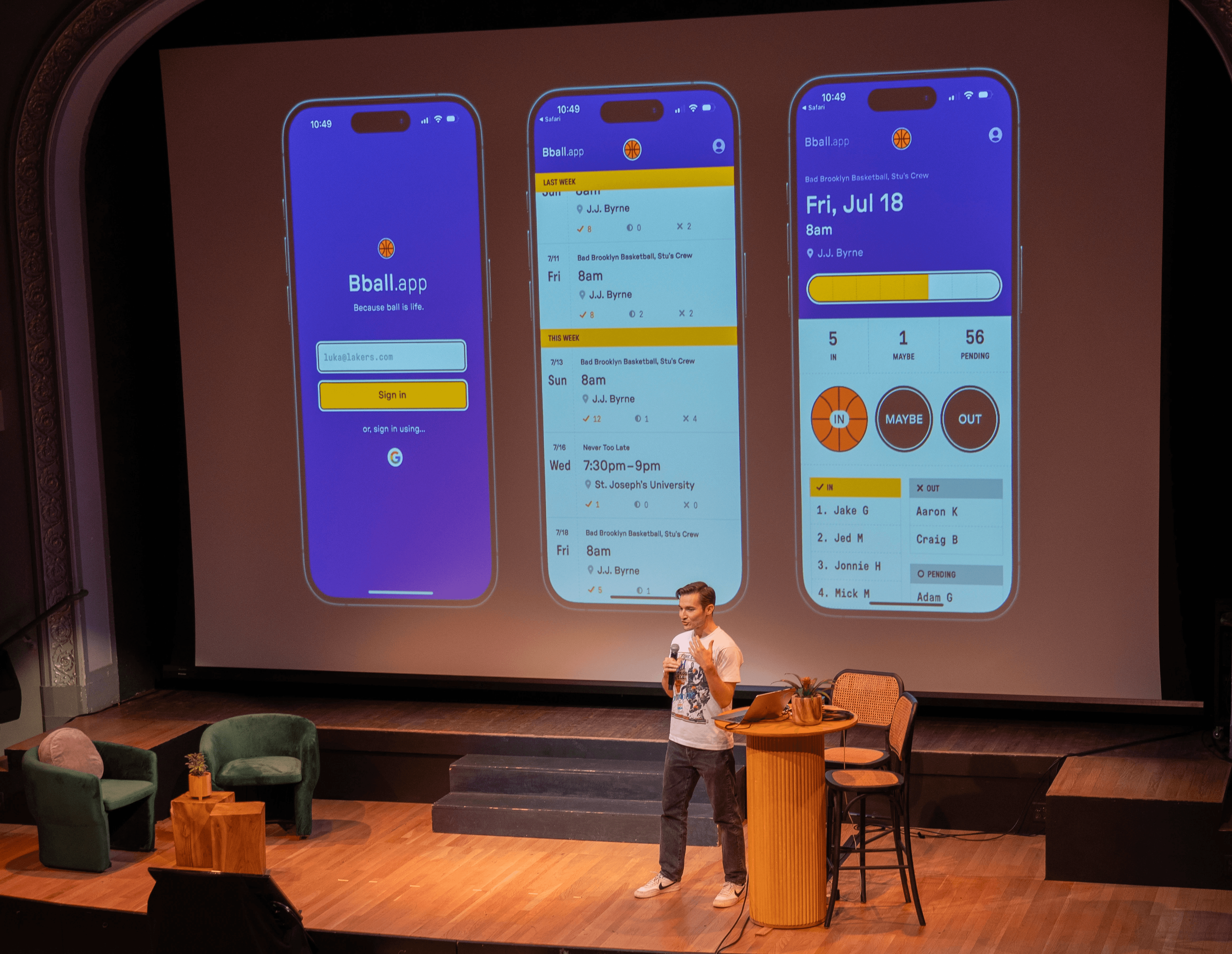
Jonnie Hallman quit his job when he scored the right domain name: ball.app
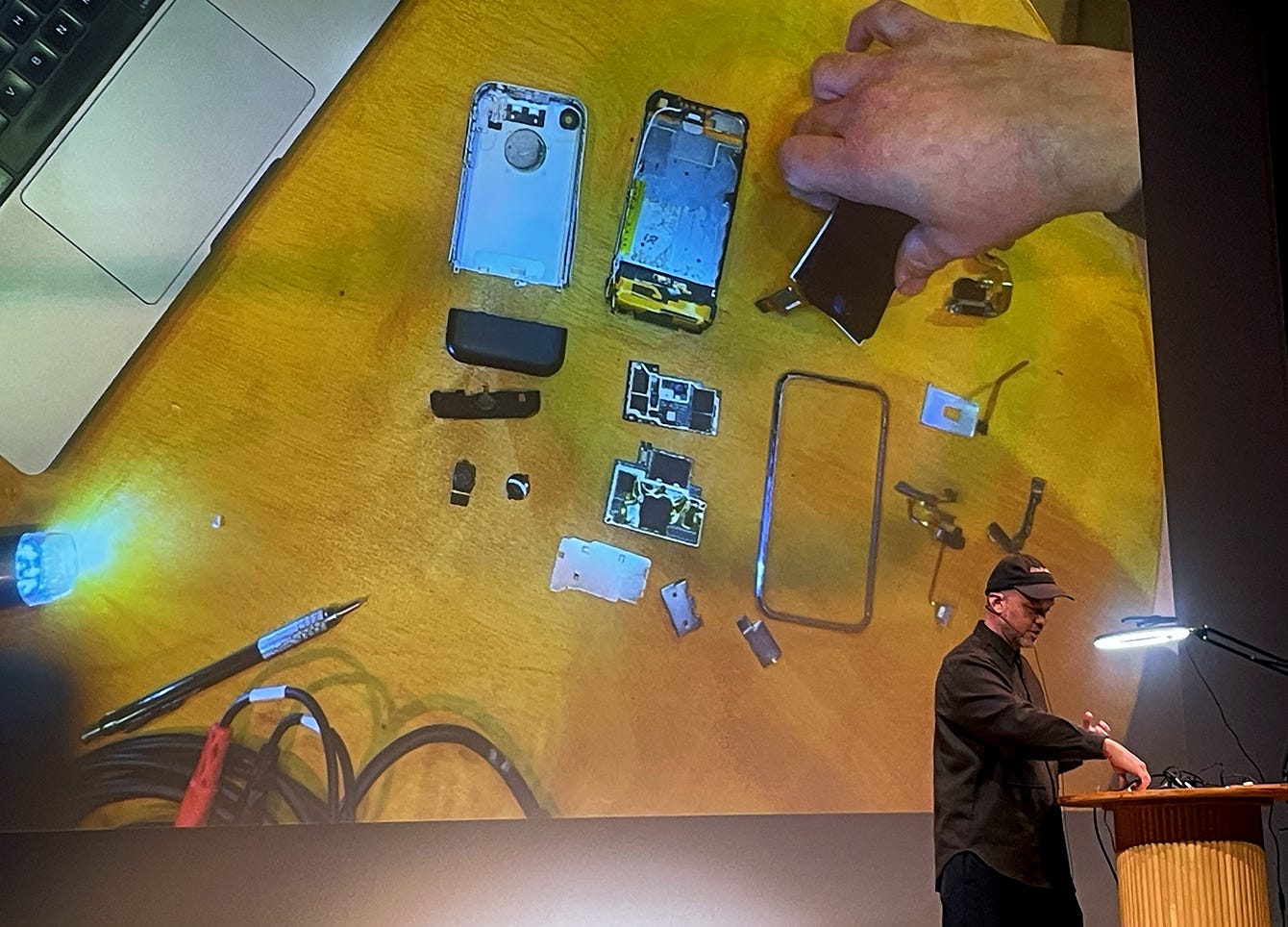
Tyler Mincey maintains the Teardown Library of old hardware in SF, and gave us an engineer’s look inside the iPhone 1 (which he helped ship)
The scale of VC investment in AI means they’re incentivized to hype it higher, so I take all AI press with a bucket of salt. AI is currently getting over half of all VC money, and the total was $252 billion in 2024 alone (estimates are over $1 trillion cumulatively). Investors need more of these AI companies to go big in order to recoup that. Many of the speakers at the conference were VCs, VC-funded, or VC-chasing, so the AI theme was expected, but they’re also closest to a lot of the action so I was overall glad to hear their stories.
I do agree AI is triggering a phase shift in tech (which is why I did my own qualitative research project to develop my POV on AI use last year). I need to update my POV doc to a v2, but everything is moving so fast! I still think AGI is a mirage, but a significant evolution of tech (adaptive interfaces, natural language agents, personalized everything) is increasingly concrete.
A significant omission at an AI-focused conference: any discussion of licensing models. We all know the LLMs are built on stolen content, it’s impossible to embrace them ethically unless we believe we’re in a proof-of-concept phase that does lead to a viable business model including content creators asap. I know there are models emerging, I’m not the best person to write about them but for example:
Frank did mention Public Diffusion, a model built entirely on public domain images (though it seems to have folded, unfortunately)
The issue I’m still chewing on: sure, GenAI is great for replacing collaborators if you don’t want pushback or delays or fees (or accuracy 😉). I’ve also heard teachers say their class Discords and Slacks are increasingly 🦗🦗🦗; students prefer to ask ChatGPT than feel stupid in front of classmates. AI tools create a world of unicorn creators and hyper-personalized learning. What are the second-order effects of dissolving so many human relationships?
And my biggest concern is the destruction of the information commons. Fake news was bad even before the GenAI boom. Sora is fooling even the deepfake detectors. Search results and social media feeds are polluted with bots and slop, and many individual contributors are retreating into dark forests of the internet. Are we creating a future without public facts, where clean data is privatized and commodified like water?
Rob Weychert had a critical take on the conference: “There were assertions that AI is not a replacement for a human while simultaneously marveling at how it allows you to bootstrap your startup with barely any headcount… A little compulsory hand-waving about unethically sourced training data. Maybe a sideways glance at the desecration of fact and the web being turned into a wasteland…”
Jan-Paul Koudstaal (event photographer) had a full outline of the speakers.
I also started teaching a new UX Essentials class in SVA’s Products of Design MFA program. What are the essentials these days? A mix of tech skills and conceptual skills and interpersonal skills… more on that soon!
Thanks for reading Think in 4D! This post is public so feel free to share it.
No posts
Comments
Nothing yet. Say the first thing.
Sign in to join the conversation.