
Walk through any school hallway and ask students what they want to be when they grow up. You will likely hear the same familiar answers that have echoed for generations. Doctor. Teacher. Nurse. Professional athlete. Influencer. These aspirations are not wrong. They are simply reflections of the careers students have actually been exposed to. What if the greatest challenge facing career education is not motivation but visibility?
That question sat at the center of a conversation with Britt Fennessy, Career Solutions Director at Edmentum, during ISTE 2026. Her perspective challenged a long held assumption in education that students naturally discover the right path if we simply provide enough academic opportunities. Instead, she argued that meaningful career readiness begins with exposure. As she put it, you cannot become what you cannot see.
Her own story illustrates the point. As a first generation college student, teaching was one of the few professions she truly understood because teachers were the professionals she interacted with every day. It was not until a college roommate mentioned becoming an occupational therapist that she realized entire industries had existed outside her awareness. The realization was simple but profound. Students cannot aspire toward careers they have never encountered.
Check out our interview with Edmentum’s CEO, Jaime Candee and the Co-Founder of Roadtrip Nation, Brian McAllister and their efforts towards transforming CTE programming here:
Thinkering Voices
Inspiration at Scale
·
Jul 16
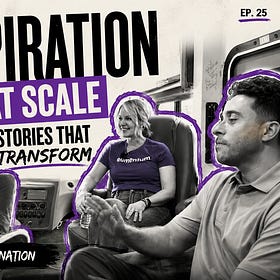
There are moments in education that feel bigger than partnerships, products, or programs. They feel like signals that something deeper is shifting beneath the surface of the system we have inherited. Sitting aboard the iconic Roadtrip Nation bus alongside Roadtrip Nation COO Brian McAllister and Edmentum CEO Jamie Candee was one of those moments.
This is why career exploration should not begin in high school after students have already made many of the decisions that shape their academic future. It should begin early and it should happen often. Exposure allows learners to discover possibilities while there is still time to shape their interests, build relevant skills, and make informed choices. Even discovering what they do not enjoy becomes valuable because every eliminated path brings greater clarity.
One of the most compelling ideas from the conversation was the belief that career should become the center of a learner’s educational journey rather than an afterthought. Instead of asking students to complete years of coursework before introducing career planning, education can begin by helping students understand themselves. Interests, strengths, learning preferences, and personal values become starting points for deeper exploration rather than static labels assigned by adults.
This represents a dramatic shift from the career counseling many adults remember. For years, career guidance often consisted of a brief conversation with an overwhelmed counselor who attempted to recommend professions based on a handful of personality questions. Those counselors were never the problem. They were simply asked to carry an impossible responsibility. The pace of change across industries has become too rapid for any individual to know every emerging pathway available to every student.
Technology offers an opportunity to rethink that model. By combining interest surveys, learning preferences, ongoing feedback, and authentic career stories, platforms can continually adapt recommendations as students grow. Rather than making a single career decision, learners engage in an evolving conversation with themselves. They discover careers they never knew existed while refining their understanding of what genuinely excites them.
The emphasis is no longer on telling students what they should become. Instead, it is about helping them understand who they are becoming.
Our wrap up of Deeper Learning Conference and how impressed we were with the in action CTE programs Ulster County showed us can be found here:
Perhaps the most refreshing aspect of the conversation was the willingness to challenge the outdated belief that college alone defines success. For decades education has often communicated a single narrative that equated achievement with earning a degree. Today’s world demands a broader definition. Success may include college, skilled trades, entrepreneurship, military service, technical certifications, creative industries, or careers that do not yet exist. The destination matters less than helping every learner find work that aligns with their talents and passions.
This philosophy also changes how schools think about data. Too often educational data exists simply to satisfy reporting requirements. When analyzed thoughtfully, however, student interests become powerful indicators for designing programs that truly serve communities. If nearly half of a district’s learners are showing interest in a particular industry, school leaders gain valuable insight into where pathways, partnerships, and resources should be expanded. Data becomes less about accountability and more about opportunity.
What stood out most throughout the discussion was the idea that education should empower rather than sort. For too long schools have measured students by how well they perform across every subject instead of helping them discover where they can contribute most meaningfully. Every learner does not need to excel at everything. Every learner deserves the opportunity to discover something they are uniquely passionate about.
Imagine a generation of students who graduate with more than a diploma. Imagine young people who understand their strengths, have explored dozens of careers, connected with professionals, reflected on their own interests, and can clearly articulate why they are pursuing their chosen path. Imagine reducing the number of students who arrive at college uncertain of why they are there or leave with degrees disconnected from their passions.
That vision begins with something remarkably simple. It begins with showing students what is possible.
Perhaps that is the future of career education. Not directing students toward predetermined destinations, but widening their horizons until they can confidently choose their own.
Because education was never meant to prepare students only for graduation. It was meant to prepare them for life. The more clearly students can see the possibilities before them, the more confidently they can build a future that is truly their own.
Want to learn more about our work? Think you have what it takes to join our fellowship and community of changemakers? Visit our website at www.thinkeringcollective.org
Comments
Nothing yet. Say the first thing.
Sign in to join the conversation.