
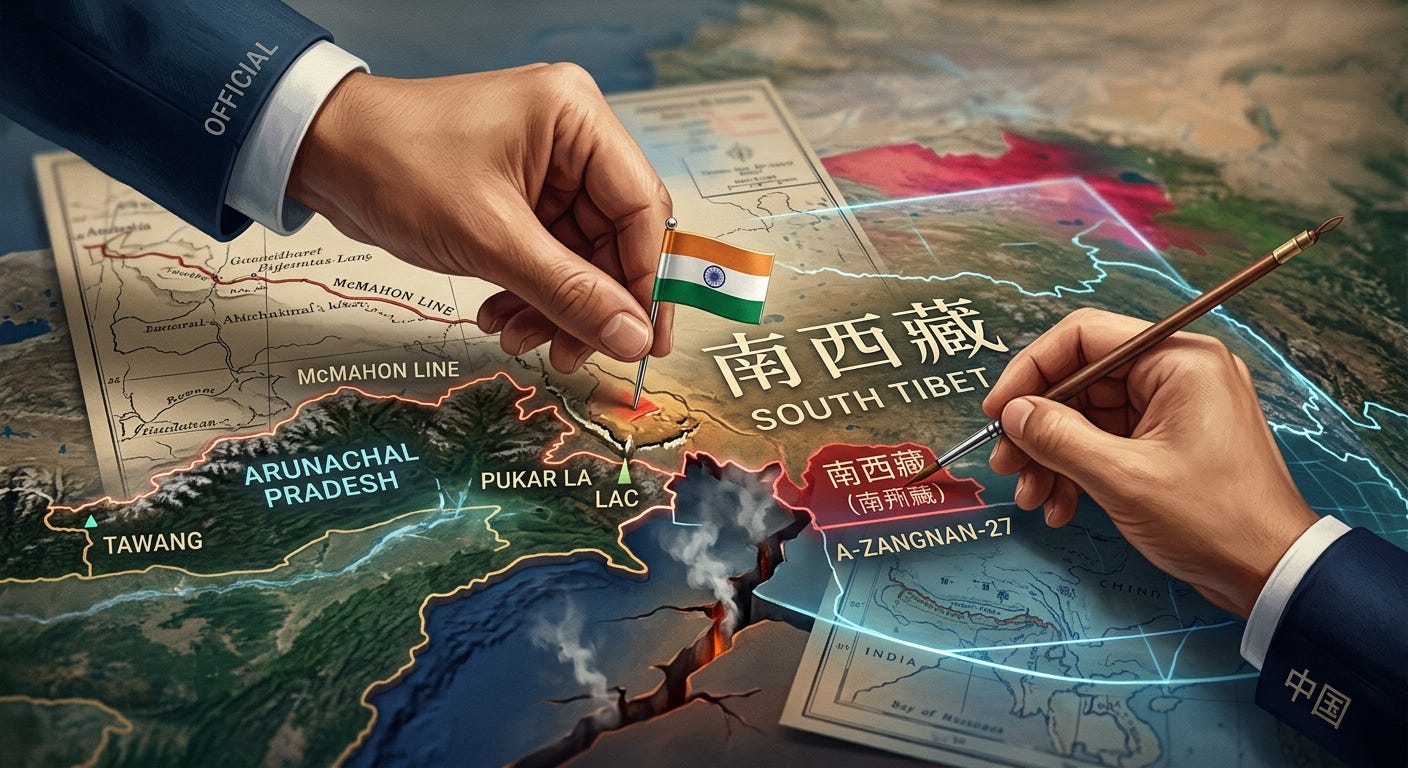
Few borders in Asia carry as much history, strategic weight and political sensitivity as the one India shares with China. Nowhere is that more evident than in Arunachal Pradesh, the eastern frontier that Beijing claims as “South Tibet” and New Delhi regar ds as an integral part of India.
The latest reports of a possible Chinese incursion near Pukar La have once again brought this difficult frontier into focus. Reports have alleged that Chinese troops crossed the Line of Actual Control (LAC) near Taksing. Arunachal Pradesh Chief Minister Pema Khandu, however, has denied reports of an ongoing incursion and said the matter would be verified with the Army and local organisations.
But whether this particular episode proves to be an incursion, a patrol face-off or a misreading of competing LAC perceptions, it comes at a consequential moment. India and China have spent the past two years trying to stabilise ties after the military crisis that began in Ladakh in 2020.
In October 2024, the two sides reached an agreement on patrolling arrangements in Depsang and Demchok, followed by disengagement and the resumption of coordinated patrolling. It was an important step towards repairing a relationship that had suffered its worst rupture in decades.
Yet the boundary remains unresolved, the LAC remains contested and distrust has not disappeared.
That is why New Delhi’s latest response is important. External Affairs Ministry spokesperson Randhir Jaiswal has reiterated that peace along the border are essential to the wider relationship, adding that the state of the border will reflect on the state of bilateral ties. The message is clear: India no longer sees the border as an isolated security problem that can be compartmentalised from the rest of the relationship.
The timing is also important because the dispute has moved beyond patrols and military positions. India has recently identified 27 places and geographical features in Arunachal Pradesh by their official Indian names. China objected, calling India’s move illegal and reiterating its claim over what it calls Zangnan, or South Tibet. India has rejected the Chinese position as an attempt to manufacture territorial claims and has repeatedly said that no renaming exercise can alter the status of Arunachal Pradesh.
To understand why Arunachal has become so central to India-China relations, one has to go back to the beginning of the modern boundary dispute.
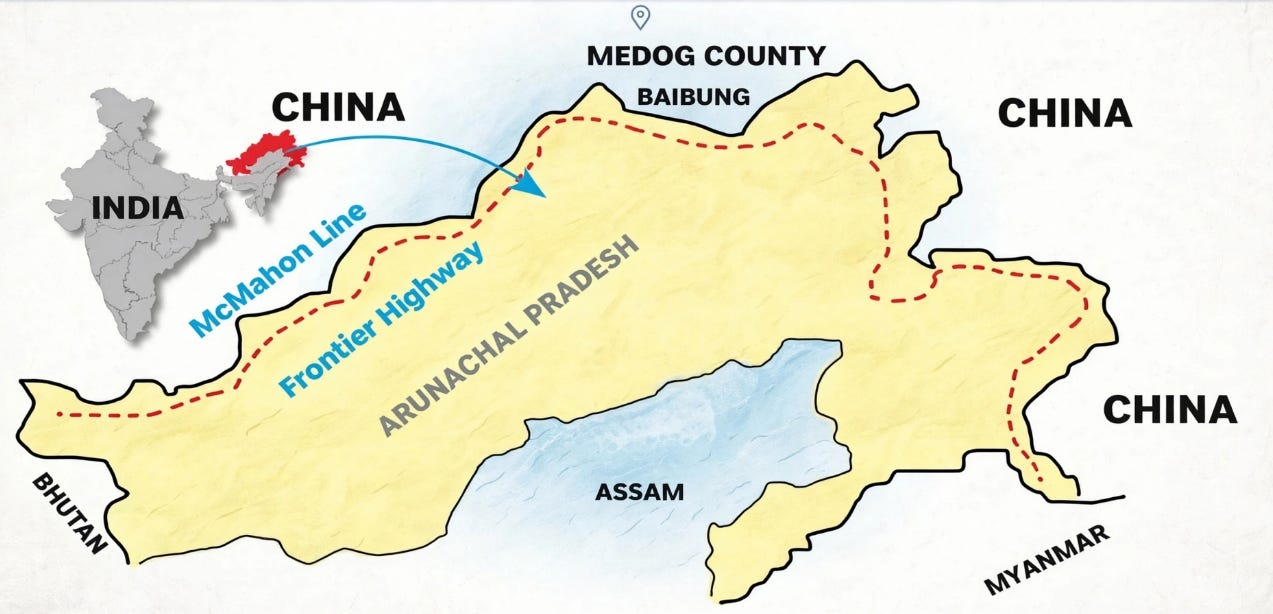
The roots of the conflict lie in the 1914 Simla Convention, where British India and Tibet negotiated a boundary that came to be known as the McMahon Line. The line runs through the eastern Himalayas and places present-day Arunachal Pradesh on the Indian side.
China did not accept the agreement, arguing that Tibet did not have the authority to conclude such an arrangement independently. India, inheriting the British Indian position after independence, has treated the McMahon Line as the legitimate boundary.
This is the fundamental disagreement. India sees the eastern boundary as an established frontier. China sees the McMahon Line as a colonial-era imposition and claims large parts of Arunachal Pradesh as southern Tibet. The dispute is rooted in competing interpretations of Tibet’s historical status and of the legal validity of the 1914 agreement.
For decades, however, the remoteness of the eastern Himalayas kept the dispute from becoming a constant military confrontation. The region was administered as the North-East Frontier Agency, or NEFA, rather than as a full-fledged state. That changed after the 1962 war.
The war remains the defining moment in India’s understanding of Arunachal. Chinese forces attacked across the disputed frontier in October 1962, overwhelmed Indian positions in the eastern sector and captured Tawang before advancing further into NEFA.
For India, the military defeat was devastating. But its longer-term consequence was equally important: Arunachal could no longer be treated as a distant frontier. New Delhi accelerated political integration, administration and infrastructure.
NEFA became the present day Indian state Arunachal Pradesh, meaning “Land of the Dawn-Lit Mountains’ in 1972. The Indian state increasingly understood that sovereignty in the Himalayas could not be secured by declaring a border from Delhi. It had to be demonstrated through roads, administration, civilian settlement and a permanent security presence.
The Chinese claim did not disappear. In 1975, four Assam Rifles personnel were killed at Tulung La; the last fatal India-China border incident until Galwan in 2020. A decade later, the Sumdorong Chu standoff brought the two sides close to war, with India launching Operation Falcon after Chinese troops established a presence in the area. Arunachal was soon tested again. In December 2022, Indian and Chinese troops clashed at Yangtse near Tawang after India said Chinese troops attempted to cross the LAC.
Arunachal is tied to China’s broader Tibet policy and its effort to control the narrative over Tibetan history and political identity. India’s position is equally firm: whatever Beijing’s interpretation of Tibet’s history, it cannot be used to question India’s sovereignty over Arunachal Pradesh.
The result is a dispute in which neither side is likely to abandon its basic position. Today, the two countries are fighting an infrastructure war. Roads, bridges, forward posts, airstrips, surveillance systems and border villages matter; so do maps and names. A road can alter military mobility, a permanent settlement can strengthen administrative presence. A new place name can establish a narrative. All these collectively alter the strategic balance.
The India-China relationship is larger than the border. The two countries are major Asian economies, important members of BRICS and influential actors in the Global South. These countries drive 44% of global economic growth as dominant manufacturing and technology hubs. Their rivalry affects regional security, trade, supply chains and the wider balance of power in Asia. A prolonged military confrontation between the world’s two most populous countries would have consequences well beyond the Himalayas.
As of now, Arunachal Pradesh will remain one of the hardest questions in India-China relations as neither country has yet found a way to live permanently with the other’s version of the map.
The author’s views are their own and do not necessarily reflect the blog’s.
📌 Subscribe to Think BRICS for weekly geopolitical video analysis beyond Western narratives. Follow also our new channels BRICS Business and Think BRICS Chronicles.
Comments
Nothing yet. Say the first thing.
Sign in to join the conversation.