
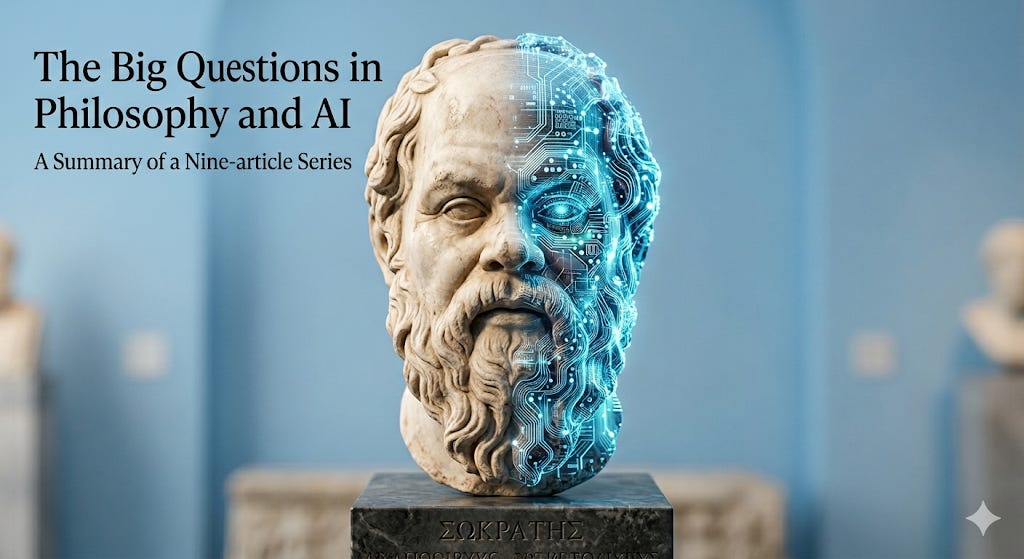
As someone who loves both philosophy and AI, I’m torn between getting my hands greasy building stuff and reflecting on bigger questions — some of which have been with us for thousands of years.
This is a summary of a project I started in January. Nine posts, each taking an area of philosophy and asking: what are the big questions AI raises within it?
These aren’t abstract exercises. Every one of these questions is landing on the desks of CEOs, policymakers, and technologists right now — most of whom have never taken a philosophy course. That’s the gap this series tries to close.
If you’re new here, start wherever your curiosity pulls you. If you’ve been following along, the final piece — meta-ethics — just dropped.
Is AI ending the scientific method — or fulfilling it?
What counts as explanation? Can a model that predicts everything but explains nothing still be called science?
What arguments can settle moral disputes about AI?
The ethics beneath the ethics. Before we can debate whether AI should do X, we need to ask: how do we settle moral questions?
Is AI playing Wittgenstein’s language games with us?
Meaning vs. mimicry. When a model produces perfect prose, does it understand — or is it the most sophisticated parrot in history?
But is it art?
What does aesthetics tell us about creativity, originality, and the role of intention in art — now that machines can paint, compose, and write?
Is AI fundamentally undemocratic? Should we care?
Power, consent, and governance. When a handful of companies shape the information diet of billions, what would Rawls, Mill, or Habermas say?
Are human minds special? Why?
Consciousness, intentionality, and the hard problem. If a machine behaves as if it’s conscious, does the distinction still matter?
AI is shaking the foundations of knowledge
How do we know what we know — and what happens when our most powerful knowledge-producing tool is also our least transparent one?
What are the two most important topics in metaphysics?
Free will and the nature of reality. AI forces both questions out of the seminar room and into the boardroom.
What separates humans from machines? Is that separateness an illusion?
From Heidegger to Haraway — the philosophical tradition that takes technology itself as the object of inquiry, not just its consequences.
This series is free and will stay free. If it made you think, the best thing you can do is share it with someone who’d wrestle with these questions too.
Paul Gibbons is the author of 9 books on leadership, change, and AI adoption — including the forthcoming Adopting AI. He advises organizations on AI adoption through his Adaptive Adoption framework.
Comments
Nothing yet. Say the first thing.
Sign in to join the conversation.