
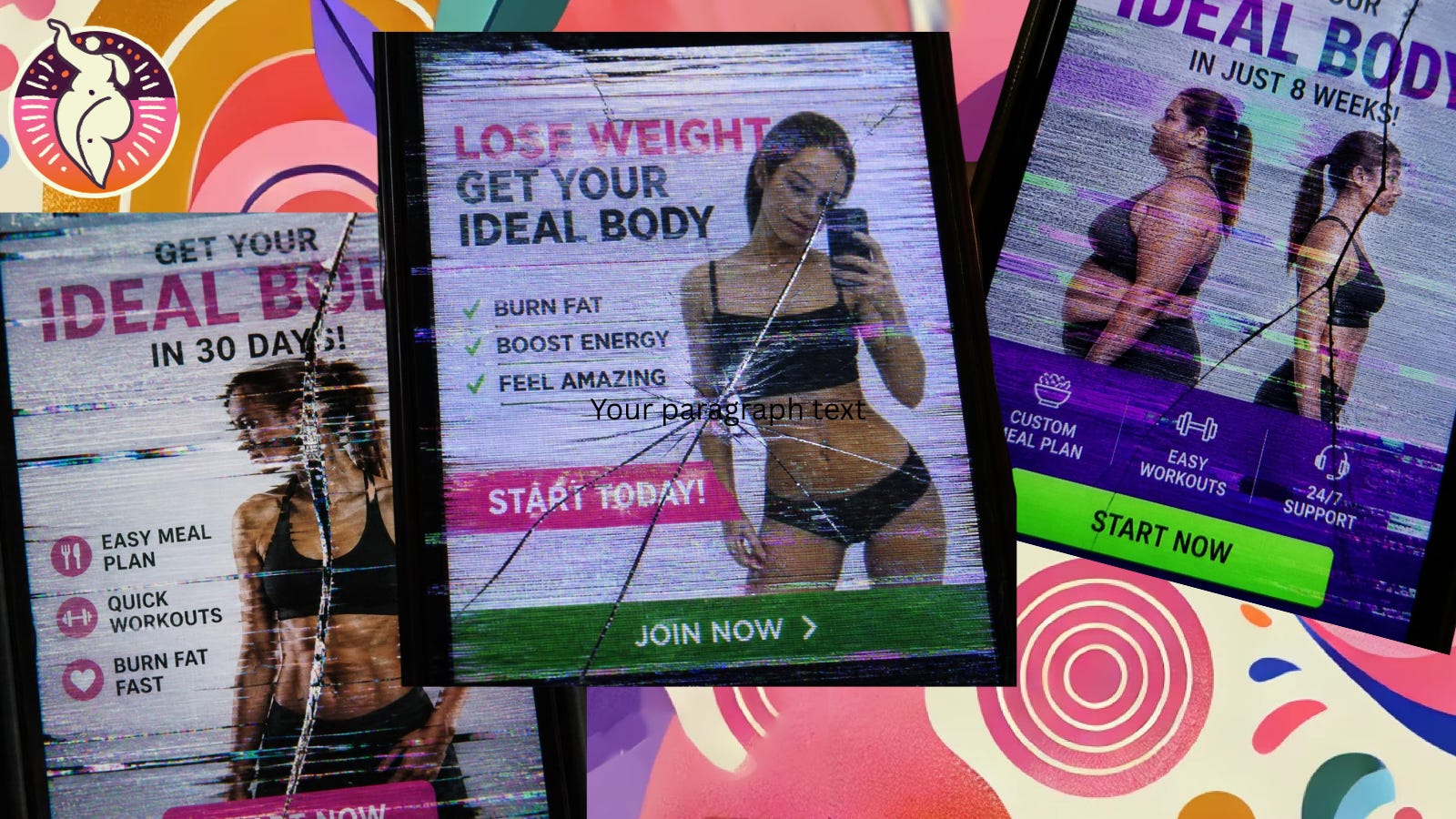
I clicked on an article the other day from one of my Substack subscribers and didn’t make it past the headline before a giant ad appeared trying to help me figure out how much I should walk at my age to lose forty-five pounds. Not because I had even googled for weight loss, or indicated any interest. Because I exist on the internet, in a fat body, and the algorithm has decided that my body is a problem that needs solving.
Weight loss advertising does not only target fat people, as far as I am aware. It targets anyone with a body, which is to say everyone, as a potential customer for the message that something about them needs to be corrected. Platforms identify you as fat and then hit you with a constant barrage of messaging insisting that of course you want pharmaceutical intervention . Of course you do. If there is one thing that capitalism teaches us at the end of the day, consent costs extra.
Weight loss ads are, of course, big business, but the scale and acceleration should be staggering. Drugmakers spent more than $1 billion on ads for weight loss and diabetes medicines in 2023 alone, up more than 50% from the prior year (CNBC, 2024). By 2025, GLP-1 drug advertising on national TV alone had exceeded $1.1 billion, nearly one-fifth of all pharmaceutical linear TV spending (EMARKETER, 2026). Twenty percent of all pharmacy ad spending was spent on GLP-1s.
Not for cancer. Not for heart disease. For weight loss. At their peak, Viagra and Cialis combined spent roughly $500 million a year on advertising. The only thing getting supersized these days is spending; weight loss drugs now spend more than double that, and, unlike your penis, they are not done growing. The cultural slot that boner pills used to occupy has been taken over by drugs that promise something more insidious than better sex. They promise a different body.
What makes weight loss messaging different from other forms of ubiquitous advertising is that it does not only sell a product. It sells a problem, and the problem is you. You do not need to have searched for ways to lose weight. You do not even need to be significantly fat. You just need to exist in a body that an algorithm has flagged as a conversion opportunity, because every weight loss ad carries the same implicit premise: your body is not acceptable, and it needs monitoring.
The threat of obesity mobilizes self-regulation and self-surveillance in individuals regardless of actual body size (Saguy, 2013). When shame activates, people move into one of four scripts described in the Compass of Shame (Nathanson, 1992): they withdraw, they avoid, they redirect the shame outward, or they turn it on themselves. Weight loss advertising is designed to trigger that fourth one.
Weight loss advertising triggers that shame across every body type. That shame can turn inward, becoming the self-surveillance and self-punishment that the diet industry calls a wellness journey. But it can also turn outward, becoming the judgment and body policing that we direct at other bodies to manage our own discomfort.
Because when your body is treated as something to be judged, you learn to judge it too. Psychologists call this objectification theory (Fredrickson & Roberts, 1997). Your brain doesn’t process these ads as sales pitches. It processes them as social comparisons, without you even noticing (Tiggemann & McGill, 2004). And the harm shows up in the clinical data: body surveillance, internalized weight bias, and body shame predict eating pathology severity (Martin-Wagar & Weigold, 2022).
So what does that even mean?
It means that every ad you see changes how you relate to your own body. You start watching yourself from the outside, monitoring how you look, treating your appearance as something to manage and control. You internalize the message that your body is wrong, and you carry that message into every room you walk into. Over time, that monitoring becomes a permanent state. It changes what you eat, how you move, whether you leave the house, how you feel about yourself when no one is looking.
And then your body responds to all of that. The shame triggers a physiological stress response that increases cortisol, which promotes appetite and fat storage, which produces more shame, which triggers more stress (Himmelstein et al., 2015). Rinse. Repeat.
Weight stigma is positively associated with obesity and diabetes risk, increased oxidative stress, and C-reactive protein levels, no matter how much you do or don’t weigh (Wu & Berry, 2017). The psychological and physiological damage compound each other, and they compound over time.
If weight loss ads are meant to produce shame, and that shame is meant to produce weight loss, why should we be upset about weight loss ads?
Tomiyama et al. (2018) documented that shame does not produce the weight loss the way we have been taught to believe, and it is instead associated with psychological distress, disordered eating, avoidance behaviors, and poorer health outcomes rather than sustained positive change. And the cruelest dimension is that the shame is internalized as personal failure.
Every ad is reaffirming that your body is wrong, and that it needs all of this extra surveillance and management and control. And PRODUCTS, of course. You internalize the message that the problem lives inside your own skin, and you detach yourself from your body. And when that happens, you stop trusting your body. You don’t trust your hunger, you don’t trust your signals.
Eating disorders researchers have argued that eating disorders are not just psychiatric conditions but culturally-induced diseases promoted partly by economic and social institutions that profit from the cult of thinness promoted by the mass media (Hesse-Biber et al., 2006). They have documented a lucrative market associated with eating disorders, and the advertising, weight-loss, diet-food, fitness, and cosmetic surgery industries are well aware of it.
A survey by the UK eating disorder charity Beat found that 96% of people with eating disorder experience found online weight loss ads harmful to their recovery (Beat, 2022). Not some people. Not many. Almost all.
And the people designing these campaigns know exactly what they are doing. Gak et al. (2022) describe targeted weight loss advertising as a form of slow violence: harm that is dispersed across time and space, that accumulates through repeated exposure rather than a single event, and that disproportionately affects those already marginalized. The ads do not need to be overtly cruel. They just need to be constant.
The violence is in the repetition.
So if weight loss advertising is so bad for people, why isn’t anyone doing anything to curtail them?
Platforms themselves have already written policies that should, by their own language, prohibit most weight loss advertising. The rules exist. They are just not enforced against the industry that most clearly violates them.
Meta prohibits advertisers from running ads that imply or attempt to generate negative self-perception in order to promote diet, weight loss, or other health-related products (Meta, 2024). Their policy explicitly bans ads that exploit insecurities to conform to certain beauty standards, reinforce negative or unhealthy body images, feature body-shaming, use distasteful messaging that could make people feel negatively about the way they look, or show side-by-side before-and-after comparisons for weight loss.
Under Meta’s own rules, a weight loss ad that makes you feel bad about your body should not exist on their platform. And yet.
TikTok’s advertising policies state that ad content and landing pages must not explicitly shame users about their bodies, suggest there is an ideal body type, or promote improved life circumstances or self-image as a result of changes in body appearance or weight (TikTok, 2026). They further ban content that suggests there is a right or perfect way to look, claims that looking a certain way will make individuals more desirable, successful, happy, or popular, or suggests that body appearance determines a person’s confidence, self-esteem, emotional wellbeing, desirability, popularity, or social standing.
Under TikTok’s own rules, an ad promising that weight loss will make you happier, more confident, or more successful should not exist on their platform. And yet.
Pinterest went further than any other platform. In July 2021, it became the first major platform to ban all weight loss advertising outright, prohibiting any weight loss language or imagery, any testimonials regarding weight loss or weight loss products, any language or imagery that idealizes or denigrates certain body types, and referencing Body Mass Index or similar indexes (Pinterest, 2021). The policy was developed with guidance from the National Eating Disorders Association, whose then-interim CEO called it a necessary step in prioritizing the mental health and well-being of Pinners, especially those impacted by diet culture, body shaming, and eating disorders.
Pinterest demonstrated that it is technically and operationally possible for a major platform to simply ban weight loss ads. They rejected over 4.2 million ads for body image policy violations in the second half of 2025 alone and removed 1.8 million organic pins for body shaming content (AuditSocials, 2026). The infrastructure to enforce such a ban exists. The precedent exists. The other platforms simply choose not to follow it.
The UK’s Advertising Standards Authority, working with the Medicines and Healthcare products Regulatory Agency, issued an enforcement notice in 2025 specifically targeting online advertising of weight loss drugs, reinforcing rules that require such products to be marketed responsibly and through appropriate channels (ASA, 2025).
Let us be explicit about this, because the disconnect between what platform policies say and what they permit is not a technical failure. It is a choice.
Meta bans ads that imply or attempt to generate negative self-perception to sell health products. Every weight loss ad implies that your current body is a problem to be fixed. That is the entire premise. Without the negative self-perception, there is no product to sell.
TikTok bans ads that suggest there is an ideal body type or claim that body appearance determines a person’s confidence, happiness, success, etc etc etc etc, you know the schpiel. Every weight loss ad, by definition, suggests that a different body type would produce a better life. The before-and-after format is not incidental to diet advertising. It is the core persuasive structure: this body was bad, this body is good, and the product is the bridge between them.
TikTok also bans content that promotes disordered eating and risky weight management behaviors. The diet industry’s foundational product is caloric restriction. The average diet involves severe calorie reduction that most nutritional science identifies as unsustainable and counterproductive. The UCLA meta-analysis found that at least one-third to two-thirds of people on diets regain more weight than they lost within four or five years (UCLA Newsroom, 2007). The annual probability of an obese woman achieving “normal weight” is 1 in 124 (Fildes et al., 2015).
If a product failed this consistently in any other industry, the FTC would call it deceptive. In the weight loss industry, it is called a business model.
Weight loss ads are, by their very nature, deceptive and toxic. They promise outcomes that decades of research say are largely impossible to sustain. They are damaging and constant. They produce shame, self-surveillance, and disordered eating in the people who see them, and that shame does not stay contained. The research is clear that this contributes to a larger epidemic of shame and body hatred that extends far beyond dieting. The ads are not a side effect of that epidemic. They are the engine.
The rules to stop weight loss ads already exist. Every major platform has written policies that should prohibit most weight loss advertising. Pinterest proved a platform can enforce them. The question is why we continue to treat the diet industry as an exception to rules that every other industry must follow , and whether the answer has anything to do with the seventy billion dollars it generates.
ASA. (2025, September). ASA partners with MHRA and GPhC to reinforce rules on the advertising of weight-loss drugs online. Advertising Standards Authority. https://www.asa.org.uk/news/asa-partners-with-mhra-and-gphc-to-reinforce-rules-on-the-advertising-of-weight-loss-drugs-online.html
AuditSocials. (2026, April 15). Pinterest ads 2026: Weight loss ban and wellness rules. https://www.auditsocials.com/blog/pinterest-ads-policy-2026-weight-loss-body-image-wellness-content-restrictions
Beat. (2022). Online advertising and eating disorders. Beat Eating Disorders. https://www.beateatingdisorders.org.uk/get-information-and-support/about-eating-disorders/research/online-advertising-and-eating-disorders/
Saguy, A. C. (2013). What’s wrong with fat? The war on obesity and its collateral damage. Oxford University Press.
CNBC. (2024, April 3). Weight loss, diabetes drug ad spending tops $1 billion. https://www.cnbc.com/2024/04/03/weight-loss-diabetes-drug-ad-spending-tops-1-billion.html
EMARKETER. (2026, May 7). Novo and Lilly face a GLP-1 pill marketing showdown. https://www.emarketer.com/content/weight-loss-drugmakers-top-sales-forecasts-pill-rivalry-intensifies
Federal Trade Commission. (2002). Weight loss advertising: An analysis of current trends. U.S. Federal Trade Commission. https://search.ftc.gov/sites/default/files/documents/reports/weight-loss-advertisingan-analysis-current-trends/weightloss_0.pdf
Fildes, A., Charlton, J., Rudisill, C., Littlejohn, C., Bilston, L. E., & Griffin, S. (2015). Probability of an obese person attaining normal weight: A meta-analysis. American Journal of Public Health, 105(9), e54-e56. https://doi.org/10.2105/AJPH.2015.302773
Fredrickson, B. L., & Roberts, T.-A. (1997). Objectification theory: Toward understanding women’s lived experiences and mental health risks. Psychology of Women Quarterly, 21, 173-206.
Gak, L., Olojo, S., & Salehi, N. (2022). The distressing ads that persist: Uncovering the harms of targeted weight-loss ads among users with histories of disordered eating. Proceedings of the ACM on Human-Computer Interaction, 6(CSCW2), Article 377. https://doi.org/10.1145/3555102
Hesse-Biber, S. N., Leavy, P., Quinn, C. E., & Zoino, J. (2006). The mass marketing of disordered eating and eating disorders: The social psychology of women, thinness and culture. Women’s Studies International Forum, 29, 208-224. https://doi.org/10.1016/j.wsif.2006.03.007
Himmelstein, M. S., Incollingo Belsky, A. C., & Tomiyama, A. J. (2015). The weight of stigma: Cortisol reactivity to manipulated weight stigma. Obesity, 23(2), 368-374. https://doi.org/10.1002/oby.20959
Martin-Wagar, C. A., & Weigold, I. K. (2022). Internalized stigma as a transdiagnostic factor for women with eating disorders. Eating Disorders: The Journal of Treatment & Prevention, 30(5), 495-510. https://doi.org/10.1080/10640266.2022.2095481
Meta. (2024, December 26). Health and wellness. Meta Transparency Center. https://transparency.meta.com/policies/ad-standards/restricted-goods-services/health-wellness/
Nathanson, D. L. (1992). Shame and pride: Affect, sex, and the birth of the self. W. W. Norton.
Pinterest. (2021, July 1). Pinterest embraces body acceptance with new ad policy. Pinterest Newsroom. https://newsroom-archive.pinterest.com/pinterest-embraces-body-acceptance-with-new-ad-policy
Pinterest. (2025, February). Advertising guidelines. Pinterest Policy. https://policy.pinterest.com/en/advertising-guidelines
Reuters. (2026, January 28). Novo’s Wegovy and Ozempic US advertising spend doubles rival Eli Lilly, data shows. https://www.reuters.com/business/media-telecom/novos-wegovy-ozempic-us-advertising-spend-doubles-rival-eli-lilly-data-shows-2026-01-28/
TikTok. (2026, June). Weight management and body image. TikTok Advertising Policies. https://ads.tiktok.com/help/article/tiktok-ads-policy-weight-management
Tiggemann, M., & McGill, B. (2004). The role of social comparison in the effect of magazine advertisements on women’s mood and body dissatisfaction. Journal of Social and Clinical Psychology, 23(1), 23-44.
Tomiyama, A. J., Carr, D., Granberg, E. M., Major, B., Robinson, E., Sutin, A. R., & Brewis, A. (2018). How and why weight stigma drives the obesity ‘epidemic’ and harms health. BMC Medicine, 16, 123. https://doi.org/10.1186/s12916-018-1116-5
UCLA Newsroom. (2007, April 3). Dieting does not work, UCLA researchers report. UCLA Newsroom. https://newsroom.ucla.edu/releases/Dieting-Does-Not-Work-UCLA-Researchers-7832
Wu, Y. K., & Berry, D. C. (2017). Impact of weight stigma on physiological and psychological health outcomes for overweight and obese adults: A systematic review. Journal of Advanced Nursing, 73(5), 1031-1044.
No posts
Comments
Nothing yet. Say the first thing.
Sign in to join the conversation.