
I used to pride myself as a fat woman for knowing how to dress my body. It probably helps that my fat distribution (thanks to my lipedema) is in very womanly places, in tandem with my being short, my figure is quite Hobbit-coded.
But the idea of “proportionizing “ as coined by drag queen Eureka O’Hara, or dressing with your resulting proportions in mind, has been the centerpiece of my inner fashion monologue ever since I started caring about clothing in my 20s. For me, as someone with big arms, a big ass, a small waist, and a short torso, it means always choose fit and flare silhouettes on the bottom, shirts with sleeves, and everything nipped in at the waist. I’m like a human land mermaid.
My trust in the concept of dressing “flatteringly” is starting to change though.
Because what is “flattering” actually short for? That it makes you look more aesthetically pleasing? Pleasing to whom? That it hides the things you are not supposed to have? A stomach? An ass? What we are really saying when we call something flattering is that it makes your body less visible, less objectionable, less of the thing it actually is.
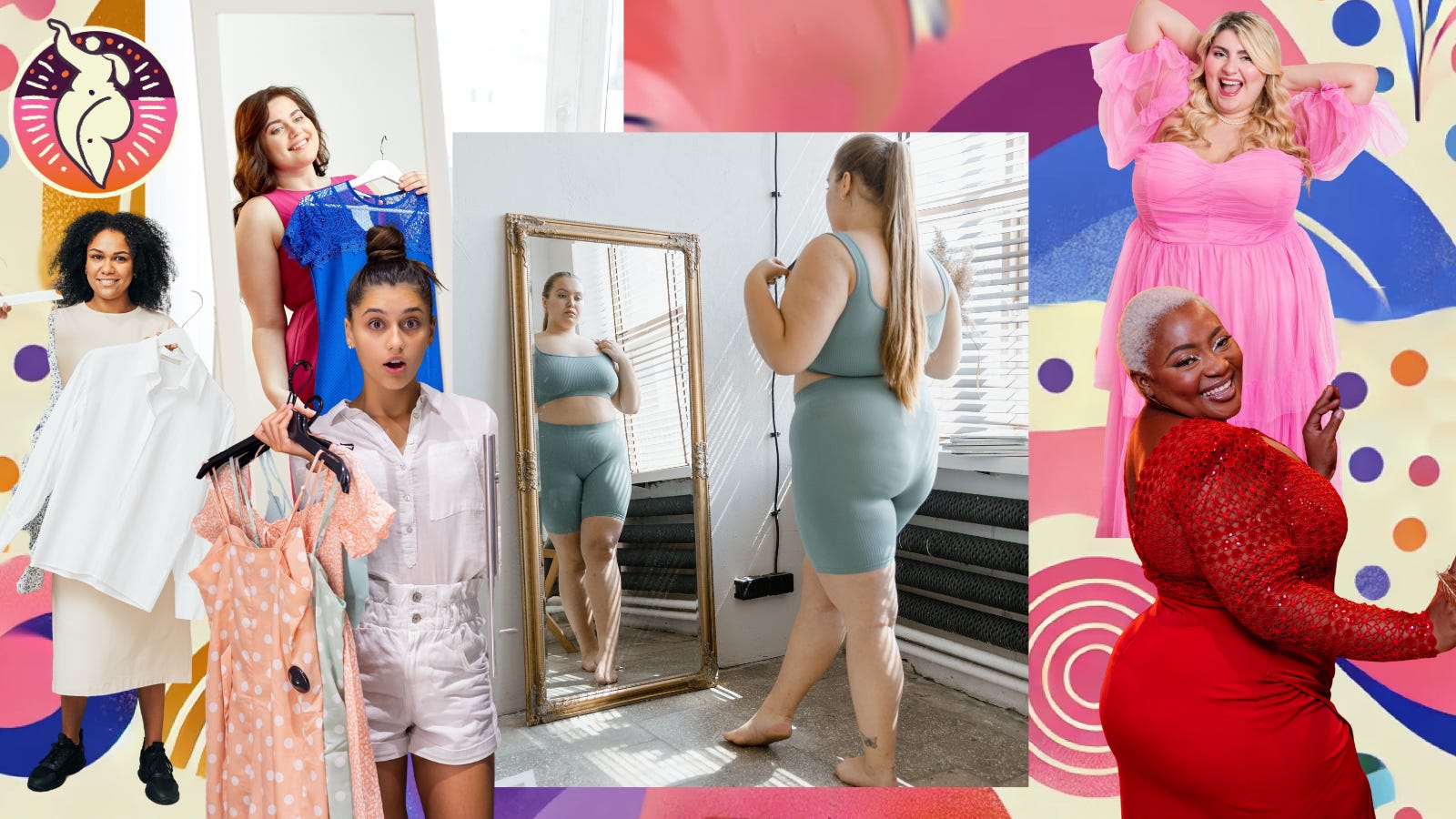
As a fat person, no dress is going to make me look NOT fat. Clothes aren’t going to make me a different size. And I don’t want my wardrobe to be a lifelong project dedicated to creating the optical illusion that I take up less space. That is what “flattering” actually asks you to sign up for. Not a compliment. A commitment to looking like someone else. It arrives in a changing room from a friend who means well, probably from your mother, from a sales associate who seems to be on your side. It never sounds like a rule. It sounds like kindness. But the unspoken deal is that your body is wrong as it is, and your job is to use clothing as one of the tools in your arsenal to fix the problem. And though it hides this, accentuates that, cinches here and drapes there, what it’s supposed to hide or showcase doesn’t seem to be a fixed aesthetic. We’re not really sure whose standard we’re following.
Research backs this up. A qualitative study found that clothing practices are an active part of how people manage body distress. Women reported using clothing strategically to hide “problem areas,” accentuate “assets,” and “flatter the figure.” These behaviors fluctuated depending on whether it was a “fat day” or a “thin day,” revealing that body evaluation and clothing choices are locked in a feedback loop (Grogan et al., 2013). The word “flattering” isn’t just describing a garment. It is activating a self-regulatory system where the body is constantly being assessed and corrected.
Who are we trying to look like, though?
The “flattering” standard maps almost perfectly onto a body that is young, thin, white, and able-bodied (Stice et al., 2001; Lewis, 2019; Becker et al., 2013; Foster & Pettinicchio, 2021). Fashion’s idea of what “works” was designed by and for that body, and then sold to everyone else as universal truth. When you’re told something isn’t flattering, what you are really being told is that you have deviated from the default. Not that the garment failed, but that you did. “Flattering” is a word that works overtime on fat bodies and aging bodies. Don’t show your arms. Don’t wear a bikini if you’re fat. Flashy clothes are only for the young. Cover your wrinkled legs. Hide your saggy tits. Smooth over the rolls.
Women have been assigned shapes that carry their own rankings. Apple-shaped, pear-shaped, hourglass, inverted triangle. Every one of these categories comes with an implicit verdict, and a corresponding codex of what flatters each one. Sometimes you want the pear. You never want the apple. Become a California Raisin. Spend your life trying to become a different fruit. Your brain becomes jelly.
Men don’t have shapes. Nobody is looking at a man and saying, “unfortunately he is rhombus-shaped.” Men just get to have bodies. We’re over here, fruits and shapes and trying to figure out which one is you, which one is right, and how you’re supposed to dress yourself to be the best fruitshape before you become fruit leather. You learn to see yourself from the outside before you ever feel yourself from the inside.
The subtext is always the same: some bodies are acceptable to look at, and some bodies need to be managed before they’re presented to the world. The rules about what is “flattering” are really rules about who is allowed to take up visible space without apology, and the rest of us are expected to do the work of disappearing on our own time.
“Flattering” occupies a weird space, linguistically. It never sounds like a command. It sounds like someone is looking out for you. “I’m just being honest.” “I just want you to look your best.” But the underlying message is always that you should not be seen too much. Do not let your body be the thing people notice. Use clothing to manage other people’s perceptions. Or in my case, never show off your tree trunk legs. Making it seem honest and earnest is how the surveillance stays invisible.
A 2026 paper by Zhu describes how this works: the watching doesn’t come from one authority. It comes from everywhere at once: your mother, your friends, social media, the woman next to you on the bus. Women learn to watch and correct their own bodies because everyone around them is doing the same watching. “Flattering” is one of the ways that watching gets passed around. It does not come from a uniformed authority, but instead comes from a friend in a changing room, which makes it harder to resist (Zhu, 2026).
You don’t even NEED a friend in the changing room now, since the clothes are all labeled to let you know just exactly how they’re going to fix you. “Tummy control.” “Body sculpting.” “Smoothing.” Every product label is another version of the same message: your body, unmodified, is not enough. The garment is not just shaping your body. It is shaping your idea of what your body is supposed to be.
Body image researchers are worried. Victoria Kleinsman, a self-esteem coach who works with women aged 13 to 60, described shapewear as an “IRL filter” for the body. She works with women who are crying on Zoom calls about what their bodies look like, wearing spandex shapewear and tights in boiling weather because they are afraid of what others will think about them due to their body size (Karmali, 2023).
And then there is the word itself. Shapewear. Your body already has a shape, and it’s probably a fruit. But the name tells you that what you have is not a GOOD shape yet. It is just a body, waiting to be shaped into something acceptable. The product doesn’t even try to hide what it thinks of you … it puts it in the name!
Objectification theory describes what happens next: women internalize the outside gaze and begin watching their own bodies the way someone else would, constantly monitoring how they look, treating their appearance as something to manage and optimize. Researchers call this self-objectification. It’s not vanity; it’s what happens when a culture treats your body as an object to be evaluated, and you absorb that evaluation as your own. Women who self-objectify invest more time and money in appearance maintenance and report fewer positive feelings toward their own bodies (Fredrickson & Roberts, 1997).
So when we talk about the word “flattering,” it’s not just about language. It’s about products. “Flattering” tells you your body is a problem. Shapewear sells you the solution. But the solution is temporary, and the insecurity it creates is not. You wear the shapewear, you get the compliment, the compliment reinforces the idea that the shapewear was necessary, and the cycle repeats. The garment comes off and you are back where you started, except now you’re hyper aware of how “wrong” you look without it. That knowledge does not go away.
But it doesn’t have to persist.
“Flattering” is externally focused by design. You are no longer dressing for yourself. You are dressing for someone else’s approval, someone else’s gaze, someone else’s idea of what your body is allowed to look like. But what actually draws people in has nothing to do with the garment’s corrective ability. People respond to confidence. They respond to ease, to humor, to the energy of someone who is comfortable taking up space. What’s flattering, it turns out, is a good mood and the absence of apology. The garment is not doing the work. The person wearing it is.
When I was pregnant, the stretchy lycra dresses that clung to my belly felt glorious. For years, those same dresses had hung loosely on me because I was terrified of fabric clinging to my midsection. But when I was pregnant with twins, everything clung to my midsection and I couldn’t do anything about it. The dress hadn’t changed. What changed was that I no longer felt like I needed to be ashamed. Pregnancy made my belly socially acceptable, and suddenly the same garment that would have felt like exposure felt like freedom, because no one could accuse me of it being unflattering.
That shift does not require a new wardrobe. It requires noticing, every time the word “flattering” shows up, what it is actually asking you to do. And then deciding whether that is a project you still want to participate in. Because the real question is not whether an outfit is flattering. The real question is: flattering to whom?
Becker, C. B., Diedrichs, P. C., Jankowski, G., & Werchan, C. A. (2013). I’m not just fat, I’m old: Has the study of body image overlooked “old talk”? Journal of Eating Disorders, 1(1), 6. https://doi.org/10.1186/2050-2974-1-6
Foster, J., & Pettinicchio, D. (2021). A model who looks like me: Communicating and consuming representations of disability. Journal of Consumer Culture. https://doi.org/10.1177/14695405211022074
Grogan, S., Gill, S., Brownbridge, K., Kilgariff, S., & Whalley, A. (2013). Dress fit and body image: A thematic analysis of women’s accounts during and after trying on dresses. Body Image, 10(4), 525-532.
Karmali, S. (2023, June 12). Shapewear is booming, and body image experts are worried: ‘It’s really dangerous.’ The Independent. https://www.independent.co.uk/life-style/fashion/shapewear-skims-control-pants-bodysuits-b2354685.html
Lewis, R. (2019). Modest body politics: The commercial and ideological intersect of fat, Black, and Muslim in the modest fashion market and media. Fashion Theory. https://doi.org/10.1080/1362704x.2019.1567063
Liu, Z. (2023). Research on the Use of Social Media to Grasp Consumers’ Psychology and Create Traffic: A Case Study of Brandy Melville. SHS Web of Conferences, 155, 02017. https://doi.org/10.1051/shsconf/202315502017
Patowary, U. (2024). Body Image and the Role of Women’s Innerwear in Shaping Perceptions. Research Journal of English Language and Literature, 12(4), 70–87.
Fredrickson, B. L., & Roberts, T. A. (1997). Objectification theory: Toward understanding women’s lived experiences and mental health risks. Psychology of Women Quarterly, 21(2), 173-206.
Shetty, K. J., & Kotian, S. (2023). A Systematic Review and Research Agenda of Body Image and Fashion Trends. International Journal of Case Studies in Business IT and Education. https://doi.org/10.47992/ijcsbe.2581.6942.0281
Stice, E., Spangler, D. L., & Agras, W. S. (2001). Exposure to media-portrayed thin-ideal images adversely affects vulnerable girls: A longitudinal experiment. Journal of Social and Clinical Psychology, 20(3), 270–288. https://doi.org/10.1521/jscp.20.3.270.22309
Zhu, X. (2026). The Double Erosion: Beauty Anxiety and Consumerism as Dual Mechanisms Undermining Women’s Bodily Autonomy. Lecture Notes in Education Psychology and Public Media. https://doi.org/10.54254/2753-7048/2025.nd34310
No posts
Comments
Nothing yet. Say the first thing.
Sign in to join the conversation.