
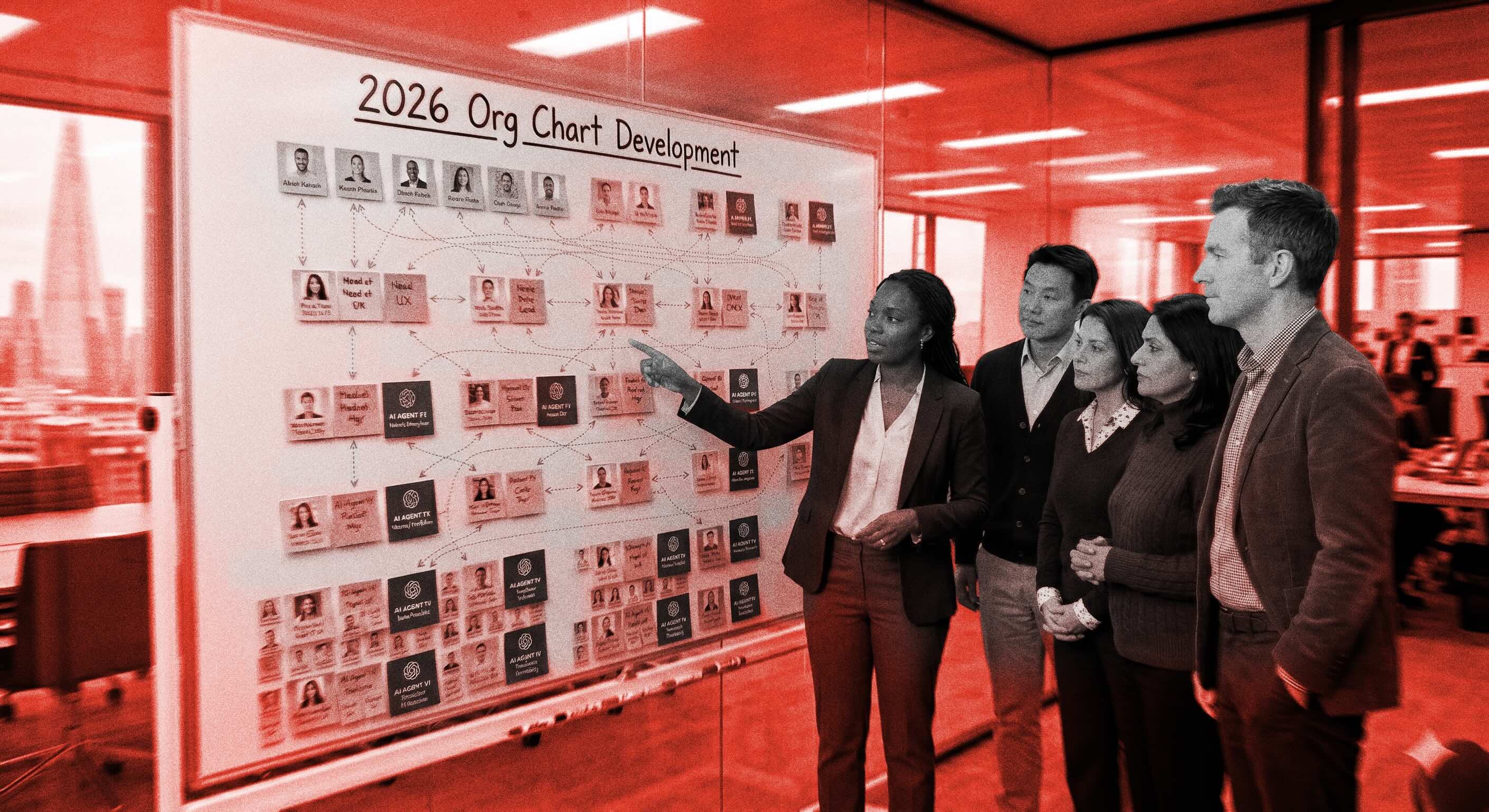
Many executives act as if AI productivity and objectivity are givens, agentic systems are enterprise-stable, and workforce cuts are the rational next step. Evidence shows developments in motion and advances are uneven: limited productivity gains, fragile agent situations, making layoffs pre-emptive. It’s a Work In Progress across the board. Ensure you are not outpacing critical steps and are addressing key underlying - e.g cultural - issues to reduce elevated business risks, especially if crucial governance is lagging.
“Technology is useful, but it is not enough” ― Satya Nadella, CEO, Microsoft.
Businesses are under pressure to move fast. Yours included. Shareholders want returns with evidence of ROI on AI investments. It is tempting to treat AI ‘adoption’ (e.g. measuring licensed users or ‘regular’ usage), faster coding, quick summaries, and slick presentations, combined with stalled hiring and planned layoffs, as ‘productive’ progress. They’re not.
Data reveal a less bullish reality:
~90% of firms cited no material impact from AI on employment or productivity over last 3 years, even as adoption expanded.
>2/3 actively use AI, but exec usage avg. only ~1.5 hrs/wk [NBER, 2026].
19% more time taken by experienced open-source developers using early-2025 frontier AI tools on realistic repository tasks [METR, 2025].
“Today, you don’t see AI in the employment data, productivity data, or inflation data.” – Torsten Slok, Chief Economist at Apollo, 2026.
Unaligned efforts, which don’t have compounding benefits, are not your priority, transformative steps. Strategic coordinated and coherent AI implementation is essential while we are navigating these transition phases: learning by doing, up-levelling to dynamic systems, iterating, refining, and moving from identifying, targeting, and testing new capabilities to dependable operating performance.
Is your company acting on anticipated gains more than realised ones?
Starting at the top, are you outpacing your company’s leadership capabilities? AI is an accelerant and integral component of organisations’ overdue digital transformations which mostly require significant shifts including decision rights, workflow design, training priorities, risk controls, cultural tenets, and metrics.
Gathering expertise across multiple divisions is needed to realise value from AI. Traditionally defined functional limits are misaligned with the dynamic needs of digitally transforming organisations. C-suite executives need to be working cross-functionally to ensure AI progress is aligned and advancing:
66% of C-suite leaders agree that it is very or extremely important for their firms to push beyong the boundaries of traditional organisational functions, but only 7% are making great progress doing so.
>50% of companies with global business service models now include finance, HR, IT, and procurement in shared services scope and 58% expect this footprint to increase over the next 3 years [Deloitte, 2026 Global Human Capital Trends].
Foster transformative thinking by identifying ‘grow the business’ compared to ‘run the business’ operations [Deloitte’s approach]. Or try a First Principles approach that is my preference [which Musk uses] - stepping back to figure out what would work best if you could start from scratch. Deloitte offers options for transforming corporate functions:
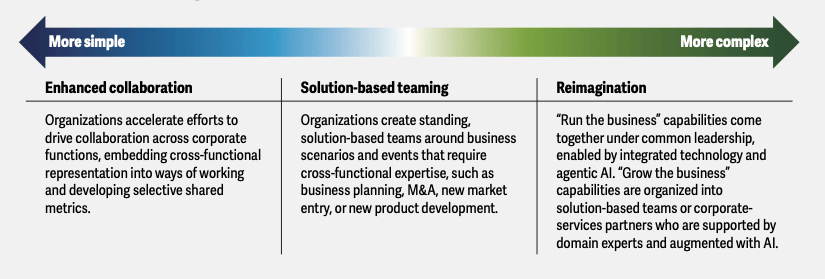
C-Suites are being reconfigured. Your firm has specific considerations based on your business, model, and executives’ expertise and experience with change, technology, people, risk and more. C-Suite executives are collaborating differently now to discover and test cross-functional combinations.
For the critical system-wide transformation to be effective, one dedicated C-Suite executive is likely necessary to enable coherent, coordinated, and continuing change [see previous newsletter Appoint a Chief Shift Officer].
What new C-Suite configuration makes sense at your company?
Next, can your company capture the value AI is capable of creating? It’s crucial to channel its power rather than creating chaos. Employees can misuse tools. They can also challenge incorrect AI responses. But AI agents increase risks substantially if they take unintended actions, exceed a permission boundary, or (unseen) compound flawed decisions at scale.
As agentic autonomy rises, the consequences of failure rise too. Governance and Responsible AI (RAI) don’t block progress, they enable business to scale.
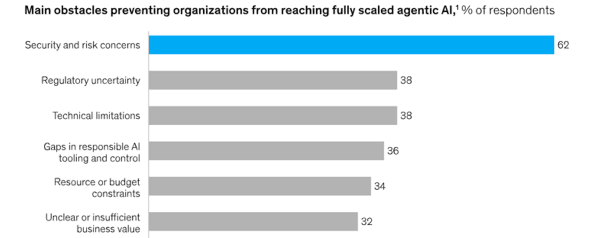
Evidence of widespread governance gaps shows:
Avg. RAI maturity rose from 2.0/5 to 2.3 last year, but only 1/3 of firms reach maturity 3 or more in strategy, governance, or agentic AI controls.
74% identify inaccuracy and 72% cite cybersecurity as high AI risks.
~60% cite knowledge and training gaps as the primary barrier to implementing RAI practices.
2.6/5 score for RAI maturity for organisations with explicit RAI ownership versus 1.8 for those without [McKinsey 2026 AI Trust Maturity Survey].
Active mitigation of risks lags behind awareness in nearly every risk category.
“In the age of agentic AI, organisations can no longer concern themselves only with AI systems saying the wrong thing; they must also contend with systems doing the wrong thing.” — McKinsey, State of AI Trust in 2026.
Agents’ Mistakes: Imperfections in the code or unclean data, inconsistent (human) directions, shifting environments, and longer series of steps are all factors contributing to agentic errors. Define boundaries and levels of agents’ decision-making responsibilities to mitigate risks as agentic use rises across business areas [see edition on Orchestrate Optimal Human-AI Operations].
AI’s “Emotions”: An emerging governance dimension relates to LLMs “functional emotions” as last week’s newsletter [Adapt for AI’s Emotional Logic] explored. These emotion concepts and persona effects shape outputs [Anthropic, April 2026]. Effects can compound: a confident-sounding response, a smoothed-over warning, a reward-hacking shortcut in “desperation” mode. Governance also covers how AI ‘reacts’ and ‘behaves’.
Improve governance to give your business a process framework for growth:
Agents need centralised deployment, shared libraries, testing, and continuous monitoring — not siloed pilots or unsupervised pockets.
In higher-risk cases, different providers’ agents can check each other’s work. Build in monitoring and human reviews mapped step-by-step.
Make RAI-based daily operational processes including risk tiering, automated red-teaming, deepfake detection, and clear documentation.
NOTE: 80% of an initiative’s value is derived from redesigning work. Technology delivers about 20% [PwC, 2026 AI Business Predictions].
Who owns governance in your company? Is ownership established and explicit?
If executives only see AI as a substitution play, employees know it and react. Job insecurity manifests daily as: hesitation to flag errors, reluctance to share knowledge with AI tools, slower adoption, quiet sabotage of metrics, and brain-drain of top talent. Job loss fears counter the productivity gains leaders want, evidenced by:
13% rise in workers’ regular AI use offset by a 18% drop in confidence in the technology’s utility [Manpower, 2026 Global Talent Barometer].
57% of leaders who have laid off people because of AI (~1/3) now question that decision.
700 reps are being rehired by a financial-tech company that claimed an AI chatbot could replace them. The firm plans to combine AI speed with human empathy [Deloitte, 2026 Global Human Capital Trends].
IBM’s CHRO has tripled their young hires, warning that displacing entry-level workers would create a dearth of middle managers and endanger the leadership pipeline [Fortune, Feb 2026].
Fear about training their AI replacement easily leads someone to under-document, under-share, and under-engage with AI tooling. Resistance shows up as missed deadlines, inattentive compliance, and erosion of discretionary effort vital for alignment and progress during turbulent times of change. An executive attitude of “do more with fewer people” is highly likely to result in a productivity tax paid in lower trust, engagement, and performance.
Is your company’s AI narrative causing people to stall and brace themselves?
Some leaders have announced reducing headcount ahead of proven workflow redesign or measurable enterprise returns. Aside from disengaging remaining employees, it is a risky order, especially when AI is not yet ready.
Nvidia’s Bryan Catanzaro, VP Applied Deep Learning Research said for his team “the cost of compute is far beyond the costs of the employees”.
Big Tech plans to spend $740 billion in AI capital expenditures, up 69% from 2025, while workers are less expensive [Fortune, April 2026].
Removing people who know your business’s key levers and factors, especially those close to the frontline - before they can redesign work, retrain teams, implement suitable governance and establish relevant monitoring - can disrupt the results AI is projected to be capable of.
Meanwhile, how are employees managing AI and orchestrating digital labour?
A high degree of AI oversight predicted 12% more mental fatigue.
More intensive AI oversight predicted 19% greater information overload.
Self-reported productivity plummeted when workers used four or more AI tools, “AI brain fry” results versus gains [BCG data in HBR, 2026].
Sustainable advantage comes from redesigning work so humans and AI create greater value collaborating effectively to benefit from together — not from assuming substitution is already justified.
“Most organisations (59%) are taking a tech-focused approach when it comes to AI. But those taking a tech-focused approach are 1.6x more likely to not realise returns on AI investments that exceed expectations compared to those that take a human-centric approach.” — Deloitte, 2026.
As of today, is using AI actually decreasing costs and creating more value?
Pace your AI progress so adoption, trust, training, governance, work redesign, and human readiness advance in consistent and coherent alignment.
Pacing AI progress means you:
Adapt the C-Suite for digitalising dynamic ecosystem demands.
Measure realised value, not assuming promised value.
Build governance that is operational, cross-functional, and agent-ready.
Recognise employees’ fears and manage human-AI transitions.
Redesign work before or alongside revised workforce planning.
Treat oversight, judgement, and verification as core capabilities.
The firms that scale AI successfully and transform need to decide when and where to accelerate, slow, and pause, and how much humans matter in the mix.
Check the evidence. Keep your judgment active.
Ask which AI gains in your work are measured versus assumed.
Separate first-draft speed from final-quality improvements.
Before accepting a recommendation, ask what might have missed, smoothed over, or prematurely resolved.
Redesign workflows. Manage human transitions.
Identify where AI introduces new verification, coordination, or exception-handling work for the team.
Track whether AI use is improving business outcomes, not just activity or perceived ‘adoption’.
Talk openly about how AI may be changing tasks, roles and careers to avoid silence breeding fear and potential sabotage.
Require explicit human review points for agentic tasks with financial, legal, customer, or reputational consequences.
Enable dynamics across discipline.
Encourage C-suite leaders to collaborate across technology, talent, risk, operations, legal, and business functions before scaling agents broadly.
Lead the narrative about people and AI.
Do not count headcount reduction as AI ROI unless workflow quality, resilience, and value creation are also improving.
Assign explicit ownership for AI trust, governance, and incident response mitigating future occurrences.
📹 The First Principles Method explained by Elon Musk (2014).
📘 The Coming Wave, Mustafa Suleyman.
🗞️ State of AI Trust in 2026: Shifting to the Agentic Era, McKinsey
🎶 Don’t Rush Me, Taylor Dayne.
As your AI initiatives progress, check for gaps between capabilities and costs, trust, and organisational readiness — as well as the human anxieties these gaps create. Recognise real advances versus assumptions. Pace your AI progress to ensure value, judgment, governance, and the people doing the integration work move forward together.
See you next week.
Sophie
Comments
Nothing yet. Say the first thing.
Sign in to join the conversation.