
“Where are you from?”
That question came from Sue, three barstools away from me, after I’d announced that New York City was not, in fact, on fire the night after the Knicks won Game 4 of the NBA Finals. We were sitting in a bar in my hometown, somewhere I hadn’t been in a couple of decades.
My answer, “I’m from here,” was technically accurate. But I’ve been thinking about that answer a lot recently. And as the US turns the ripe old age of 250 on Saturday, apparently a lot of us are thinking about where we come from and where we’re headed.
We’ll come back to my conversation with Sue, but first let’s go way back.
My family are all mutts.
On the Elliott side, my Uncle Bob traced paternal lineage back to the Elliot(t)s of Scotland: a clan of reivers that stole cattle from whichever side of England and Scotland was weaker at the time. I’d like to say I’m kidding, but there’s a fairly massive curse on the Elliott clan, administered by the Archbishop of Glasgow in 1525. A curse that goes on for pages, much of it sounding like Dr. Seuss went massively astray:
“I curse them going and I curse them riding; I curse them standing and I curse them sitting; I curse them eating and I curse them drinking…
….their arms, their legs, their hands, their feet, and every part of their body, from the top of their head to the soles of their feet, before and behind, within and without.”
It goes on, a lot, and has never been lifted despite multiple attempts (kudos to the team at Heavyweight).
But wait, good news: we’re probably not Elliotts after all. Uncle Bob’s sleuthing also turned up a bit of historical fiction: My great-great-grandfather William Washington Elliott was born in 1835, almost 13 months after his father William M. Elliott died. My dad’s mother was a Gleason: very, very Irish. We’re pretty sure.
Let’s track back the maternal side! Great idea, except that my mom was adopted. Her birth mother was of German heritage, the father unknown.
My 23andMe test from a decade ago came back looking pretty much like our beloved dog Yuki’s mail-in genetic test: I’m a mutt. My family is a lot of everything, mostly Irish, German, and some Eastern European.

Yuki, who was the greatest dog ever and 100% mutt.
So we’re a fine American family of traditional German, Irish, and Eastern European stock, always welcome in America. Right?
Not so fast, true-blue American of Irish and German heritage! I took a tour of the Tenement Museum in NYC with my Charter friends a few weeks back, looking at spaces and places occupied by multiple waves of German, Irish, Jewish, Italian, Black, Puerto Rican, and other immigrants and migrants in the 1800s through the mid-1900s.
Among the artifacts: the lovely poster below decrying the Irish and German as ne’er-do-wells, heavy drinkers, and election fraudsters.
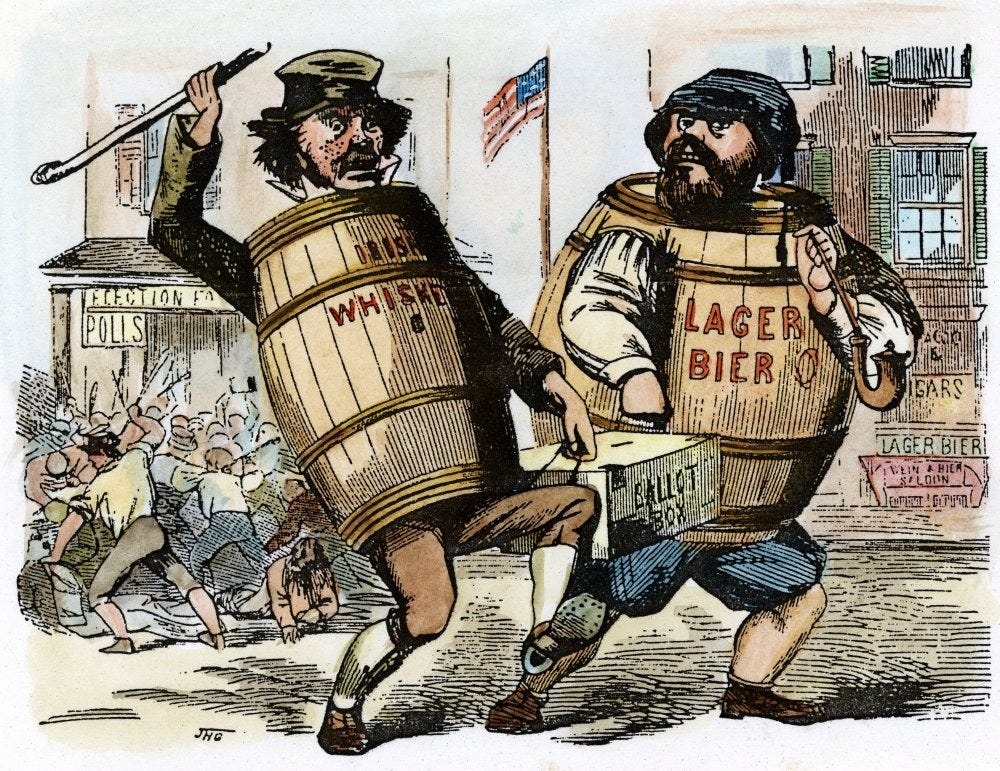
That poster is courtesy of the Know-Nothing Party, also known as the American Party, which counted more than 100 elected congressmen, eight governors, and a controlling share of half a dozen state legislatures in its semi-secretive ranks. They were nativists for those who were native at the moment: virulently anti-Catholic as well as anti-immigrant. Germans, Irish, and Italians were not among the wanted.
Time after time in our history, immigrants have been targeted and blamed for society’s ills and treated as the other.
If you feel like that’s happening now, you’re not alone. The good news is that as of last July, a record-high 79% of Americans said immigration is a good thing for the country, with the share wanting immigration reduced dropping from 55% in 2024 to 30%. Newer data points in the same direction: in Pew’s January survey of more than 8,500 adults, roughly two-thirds opposed suspending asylum applications and holding large numbers of immigrants in detention centers.
Immigrants, it turns out, contribute more than they take: paying into Social Security and Medicare far more than they extract, adding to jobs growth, and committing dramatically less crime than the rest of the population. Over the last 150 years, immigrants have never been incarcerated at a higher rate than people born in the United States.
This is a workforce and economic issue, too, and this week’s news drove that home. On Tuesday, the Supreme Court affirmed birthright citizenship. As Fortune’s Diane Brady reported, many business leaders see the ruling as a win: the Center for Migration Studies estimates that its beneficiaries will contribute $7.7 trillion to the U.S. economy over their lifetimes, and $438 billion between 2025 and 2029 alone.
Just like my ancestors did, back in the day.
Let’s get back to Sue. I went back to my hometown recently: a small town in the midwest where the coal mines are long gone, the farms are mostly corporate-owned, and the biggest employer is the nearby minimum-security prison.
I was sitting at the bar on Thursday night, having been in NYC on Wednesday night when the Knicks beat the Spurs for their third win. I share that bit of context because Sue, who was one of six patrons that night, loudly declared that “New York City was on fire last night; if the Knicks win tomorrow, that city will be gone.”
I hadn’t really said anything out loud other than ordering a beer, but decided that required a response. “No, it wasn’t. I was in NYC last night.” (Kevin Delaney, my editor in chief, says he’s proud of my growing ability to fact-check on my own, for once.) That’s when Sue asked where I was from, before diving back into what in the hell I was talking about.
What saved me that night was saying that I was an Elliott, and being able to name-check my Aunt Karen. Sue asked if Karen was my sister. Aunt Karen was thrilled to hear the sister bit, and it’s closer to true given we’re only eight years apart. Should you ever get into a jam in a small town in the midwest, I’d suggest saying Karen is your aunt. Get out of jail card.
Later, I wondered why I’d bothered piping up at all. Correcting Sue wasn’t going to change her media diet, and that wasn’t a conversation I wanted to have. I did it because I love NYC. “I was there last night; the energy was off the charts. People were shouting, honking, high-fiving. The vibes were awesome.”
Wasn’t there a fire near the stadium, and a shooting? “Sure: there’s 8 million people in NYC, something bad happens somewhere all the time. But that’s not the experience of being there.”
I love the experience of being in cities, and NYC is damn high on that list. I love San Francisco: that’s where my heart is. I’ve spent four decades now living in them. Cities are melting pots of people, food, music, and ideas, full of the highs and lows of America.
Cities are where the strivers land. Immigrants escaping persecution and chasing opportunity. Kids leaving small towns like mine, wanting more than the local options offered. I was one. People working hard, wanting a better life for themselves and, even more importantly, for their children. They chase that dream every bit as hard as anyone who was born, lived, and died in a town like mine.
That, to me, is the American Dream. Just like Sue’s hometown might be hers.
Sue and I didn’t solve immigration policy that night. We started three barstools apart, with her version of a burning New York, and ended with her asking after my Aunt Karen. A conversation that maybe helped turn “those people” into a guy whose aunt she knows.
The filter bubbles feeding Sue a New York in flames feed me caricatures of small-town America. The people in that bar weren’t those caricatures, either. The bubbles run the same play on all of us: keep us angry at each other from a distance, where the other side stays an abstraction. Up close, over a beer, abstractions have aunts.
It’s easier for me to pull up that barstool: I look like the rest of the crowd in that bar. I didn’t grow up understanding the experiences of people who looked different from me, but I knew the experience of feeling like an outsider. Over time I stumbled through enough conversations to see that people from different backgrounds, races, countries, and orientations had vastly different (and often far harder) experiences than mine. They also wanted the same things: security, purpose, opportunity, and a better future.
So this holiday weekend, close the social apps. Pull up a barstool, or a seat at the coffee counter. Talk with somebody whose version of America doesn’t match yours. Worst case, you fact-check a fire. Best case, you find out you know their aunt.
We sit at the start of the next 250 years. Getting the direction right will take a lot more conversations, and a lot fewer feeds. Maybe Sue will come to SF and I can show her around.
Back to the workplace next week.
Like what you’re reading? Please share!
Looking for something more insightful on the realities of small midwestern towns that have been challenged for decades? Pick up Beth Macy’s Paper Girl.
The New York Times has a beautiful, data-based exploration of “How a Nation of Immigrants Traces Its Roots.”
Want a ray of hope on bipartisan cooperation? Check out RAISE US, a consortium of private and public leaders focused on investing in workforce development.
Comments
Nothing yet. Say the first thing.
Sign in to join the conversation.