
Ravencoin got exploited on August 7. The Ravencoin project did not disclose the exploit until August 10, more than three days later, and only after mining pools 2Miners and RavenMiner had already begun mining an alternative chain to excise the invalid blocks. The specific flaw sat in the KAWPOW block header validation code. An nHeight field was not checked against the block’s actual position in the chain, which let an attacker manipulate the value to reach a validation path that skipped full proof-of-work verification entirely. Invalid blocks got accepted by vulnerable nodes starting at block height 4,487,776 at 15:44 UTC on August 7. The token dropped 19 percent on the disclosure. Upbit and Bitget suspended RVN deposits and withdrawals. Market cap collapsed to roughly $47 million. Ravencoin trades approximately 99 percent below its February 2021 all-time high of $0.2854, a network that once mattered enough for people to build asset tokenization infrastructure on top of it.
Arch Public has launched agentic, algorithmic trading tools for equities, ETFs, and commodities. Users can now access strategies for Nvidia, Google, gold, SPY, QQQ, and a growing list of other assets – all designed to complement existing portfolio positions and capitalize on market volatility.
Select strategies have produced returns ranging from 80% and 100% to more than 400% – with some exceeding 1,000%. These eye-popping results come from hands-off tools that require virtually no ongoing input from the user.
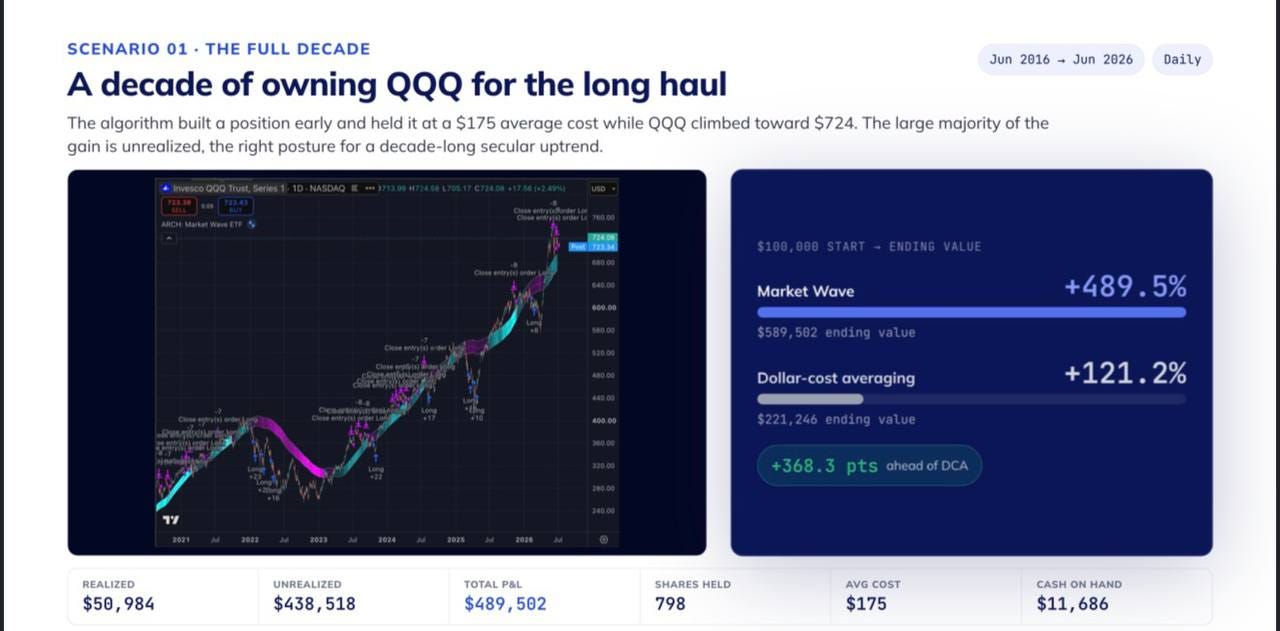
Explore the performance of strategies built around MSTR, GOOGL, NVDA, and GLD, then speak with the Arch Public team to learn how its automated tools could help you navigate volatility, generate cash flow, and build long-term positions.
CLICK HERE FOR MORE INFORMATION!
Harmony ONE got exploited yesterday. An independent on-chain investigator identified approximately four billion ONE tokens minted without authorization, representing roughly a 26 percent inflation of the approximately 15 billion existing supply. Harmony has not publicly confirmed the specific quantity of new tokens created, but its team acknowledged the exploit within hours, released an emergency validator patch, and paused the network bridge. Approximately 2.8 billion of the newly minted tokens got funneled to centralized exchanges within hours according to the same investigator’s analysis. One detail is worth pausing on. Harmony’s own totalSupply endpoint did not reflect the new mint while the tokens were being routed to exchanges, meaning the network’s own protocol reporting infrastructure did not accurately show the size of its own token supply. The team is now considering a full network rollback. ONE dropped as much as 40 percent on the news. Harmony was worth approximately $4 billion in January 2022. This is the third major security incident the project has suffered in four years, following the $100 million Horizon Bridge exploit attributed to North Korea’s Lazarus Group in 2022 and a 2023 bug in the staking system that inadvertently produced approximately 146.3 million additional ONE tokens. The current incident, if the researcher’s estimate holds, is roughly 27 times larger than the 2023 bug in terms of token quantity.
Two chains, two consensus-level exploits, both discovered within five days of each other, both on layer-one networks launched in 2018 and 2019 that were briefly meaningful, and both against projects whose original development momentum has visibly slowed. This is not a coincidence and it is not a run of bad luck. It is the shape of what is coming for the entire class of 2018 to 2020 alternative layer-one chains that are still technically alive but no longer economically vital enough to defend themselves.
Here is the mechanism, in plain terms.
When a chain’s market cap collapses, its security budget collapses with it. For proof-of-work chains like Ravencoin, security is a function of the hash rate defending the network, and hash rate follows the price of the underlying token. When Ravencoin was trading in the multi-cent range during its 2021 peak, miners had a strong incentive to point capacity at it. When it trades at $0.003 today, the economic case for pointing serious hash rate at Ravencoin collapses. Miners rotate to more profitable chains. The remaining hash rate concentrates in a handful of pools, which is exactly what happened here. Two mining pools, 2Miners and RavenMiner, now control a majority of Ravencoin’s hash rate. That is not decentralization in any meaningful sense. It is the last two operators keeping the lights on. When the security of the chain depends on two entities not colluding, and when both those entities are making a rational economic decision to keep supporting a chain with a $47 million market cap, you are one bad quarter away from those pools rotating to more profitable work and the chain going effectively dark.
For proof-of-stake chains like Harmony, the mechanism is different but the outcome is the same. Security depends on the value of tokens staked to validators, and on the professional discipline of the validator set. When the token price collapses from a $4 billion market cap peak, the economic penalty for a validator to misbehave collapses proportionally. The professional caliber of validators drops as staking rewards become less meaningful. Bug bounty programs shrink or disappear entirely. Independent security researchers who used to audit the code stop looking because there is no budget to pay them and no reputational reward for finding bugs in chains nobody uses. That last point is the important one. The reason a critical flaw in Harmony’s minting logic sat exploitable long enough to produce four billion unauthorized tokens is not that Harmony’s original team was incompetent. It is that nobody has been paid to look hard at that code in years, and the people who would have looked in 2021 are working on other projects now.
The development side of the equation matters too. Ravencoin was built by a small team of Bitcoin veterans in 2018 to enable asset tokenization on a proof-of-work chain. The original core developers moved on. Volunteer maintainers do their best but cannot match the professional security review that a chain like Bitcoin or Ethereum or Solana can afford. Harmony launched in 2019 with venture backing and a substantial team, but the 2022 bridge exploit and the subsequent collapse of the ONE token drove most of the original team elsewhere, leaving the network with a smaller and less resourced development effort operating under harder economic constraints. This is not unique to Ravencoin or Harmony. It describes the state of nearly every layer-one chain that launched in the 2018 to 2020 window and did not achieve permanent product-market fit. The chains still technically exist. The trading pairs are still listed on secondary exchanges. But the professional attention that kept them safe when they mattered has moved on to networks that still matter, and the code they left behind is being picked apart by exploiters who know that nobody serious is watching anymore.
There is a historical parallel worth naming. Ethereum Classic absorbed multiple 51 percent attacks in 2019 and 2020 that let attackers rewrite blocks and double-spend against exchanges. Ethereum Classic did not die. It kept operating in a diminished state, absorbed the reputational damage, and continues to exist today at a fraction of its 2018 relevance. That is the model for what Ravencoin and Harmony are likely to become. Not dead. Not delisted from every exchange. Just permanently smaller, permanently less trusted, permanently classified by serious market participants as chains where the security guarantees you thought you were paying for do not actually exist anymore. The 2018 to 2020 vintage of layer-one chains is going to spend the next several years being sorted into two categories. The survivors will be defined by having enough economic activity, enough active development, and enough professional security discipline to defend themselves. The rest will be sorted into the Ethereum Classic bucket by a series of exploits that keep coming, keep making the news, keep dropping the price further, and keep making the next exploit even more likely.
For investors, the practical implication is narrow but real. Any position in a layer-one chain outside the top handful is now carrying a security risk that is not fully reflected in the token price. That risk is a function of how far the market cap has fallen from peak, how concentrated the remaining validator or hash rate set has become, whether the original development team is still meaningfully engaged, and whether there is any active bug bounty program of consequence. If you own long-tail L1 tokens as investments rather than speculative rentals, those four questions are worth walking through for each position. And if the answer to two or more of them is unfavorable, you are holding the equivalent of a bond issued by a company that has stopped paying its accountants and its auditors while still telling you the balance sheet is fine.
The exploits will keep coming. The market cap decay creates its own vulnerability, which produces more exploits, which produce more market cap decay. Ravencoin and Harmony are not the end of this cycle. They are the middle of it.
I’ll see you tomorrow.

Coinbase establishes its tokenization hub in Abu Dhabi
Coinbase announced Tuesday that it has secured a Financial Services Permission from the Financial Services Regulatory Authority of Abu Dhabi Global Market, giving it regulatory clearance to establish an international tokenization hub in Abu Dhabi that can arrange investment deals and provide custody for tokenized securities. Tokenized securities registered and issued in ADGM will be fully backed by underlying shares under FSRA supervision, with eligible token holders receiving full shareholder rights including dividends and voting. The tokenized equities will initially be available only in eligible jurisdictions outside the United States.
MoneyGram Ramps Goes Multichain with Solana Launch
MoneyGram announced Tuesday that its Ramps stablecoin on-off ramp product is now live on Solana, giving Solana-based developers programmatic access to MoneyGram’s network of more than 60 million customers, nearly 500,000 retail locations, and cash withdrawal availability in more than 170 countries and territories through a single developer API. Rift is the first Solana wallet to integrate Ramps. The launch follows MoneyGram’s June 2026 decision to become an active Solana validator and its June 2026 launch of the MGUSD stablecoin on Stellar, extending the multi-chain infrastructure strategy the company first built on Stellar in 2022.
U.S. SEC sets meeting to propose Reg Crypto to support certain digital assets offerings
The Securities and Exchange Commission will hold its open meeting Friday August 14 at 10am Eastern to consider proposing new rules that would establish a tailored offering regime for certain investment contracts involving crypto assets under Chair Paul Atkins’s Regulation Crypto framework. The meeting proceeds against the backdrop of the September 15 CLARITY Act cloture vote and would represent the first formal SEC crypto rulemaking of Chair Atkins’s tenure. The three-member all-Republican Commission is expected to vote on whether to formally release the proposal for public comment.
Arch Public - It’s a hedge fund in your pocket. Built for retail traders, designed to outperform Wall Street. Try emotionless algorithmic trading at Arch Public today.
Promote your brand with The Wolf of All Streets. For sponsorship and partnership opportunities, contact info@thewolfofallstreets.io.
The Wolf Pack - My Telegram group where I share daily market updates, real-time observations, and ongoing discussions with the community. There’s a dedicated channel and group chat, and it’s completely free to join.
The Crypto Advisor - My weekly newsletter for registered investment advisors, combining macro trends, Wall Street insights, and crypto – all in one place..
X - I spend most of my time on X, contributing to CryptoTownHall every weekday morning, sharing random charts, and responding to as many of you as I can.
YouTube - Home of the Wolf Of All Streets Podcast and daily livestreams. Market updates, charts, and analysis!
The views and opinions expressed here are solely my own and should in no way be interpreted as financial advice. Every investment and trading move involves risk. You should conduct your own research when making a decision. I am not a financial advisor. Nothing contained in this e-mail constitutes or shall be construed as an offering of financial instruments or as investment advice or recommendations of an investment strategy or whether or not to "Buy," "Sell," or "Hold" an investment.
Thanks for reading The Wolf Den! Subscribe for free to receive new posts and support my work.
Comments
Nothing yet. Say the first thing.
Sign in to join the conversation.