
Bitcoin is approaching $80,000 as I write this, which is a pretty remarkable sentence considering where we were just a few days ago. Yesterday, I covered the mechanics behind the initial explosion in detail, so I’m not going to waste your time rehashing the Treasury announcement, the collapse in yields, or the massive short squeeze that followed. What matters now is that Bitcoin didn’t stop. The initial move could easily have been dismissed as a liquidation-driven anomaly, but price continued through $70,000, $72,000, $75,000 and beyond, while actual spot demand began showing up behind it. We’ve moved far enough, fast enough, that I think it’s worth revisiting a question I’ve been asking for months: was the Bitcoin bottom already in?
I’ve obviously had high conviction that the answer is yes, and not because I had some magical ability to predict that Bitcoin would suddenly rip nearly $20,000 higher in a matter of days. I didn’t. My argument was considerably less exciting, but probably more useful: enough things that have historically happened around major Bitcoin bottoms were happening again that eventually we had to stop dismissing them as coincidences. The market kept giving us evidence, even while price continued to look terrible and almost nobody wanted to believe it.
Weekly RSI was one of the first things that caught my attention. Bitcoin reached oversold conditions on the weekly RSI in March, an extraordinarily rare occurrence that has historically happened around major cycle bottoms. These readings don’t generally appear in the middle of healthy bull markets; they show up after enormous damage has already been done, when momentum has been crushed, sentiment is awful and sellers have spent months beating the hell out of anyone still willing to hold the asset. An oversold weekly RSI doesn’t magically identify the exact low, but historically it has told us that we are operating in the neighborhood where major lows tend to form.
Then came the divergences. Price continued looking terrible, but momentum increasingly refused to confirm the weakness, creating bullish divergences across multiple timeframes and even setting up the possibility of a massive one on the weekly chart. Anyone who has traded divergences knows that they are warnings, not timing mechanisms; they can persist for weeks or months while price continues doing things that make you question whether the indicator is broken. But combined with historically oversold conditions, they gave us another important piece of evidence that the character of the decline was beginning to change.
The same was true of the major moving averages. I’ve repeatedly discussed the 50-month and 200-week moving averages because Bitcoin has historically interacted with both around major cycle lows, and more recently my attention shifted to the daily 200-day moving average. Bitcoin had spent ages testing it. During previous Bitcoin bear markets, getting back above the 200-day and ultimately holding it has consistently been one of the clearest signs that the market is transitioning into something different. It doesn’t identify the exact bottom, and crossing a line on a chart certainly doesn’t guarantee that Bitcoin can never trade below it again, but the basic concept is pretty simple: bear markets tend to live around the 200-day moving average. Recoveries eventually stop doing that.
Bitcoin has now launched from its daily 50-day moving average and moved decisively through the 200-day. We are no longer sitting underneath resistance wondering whether it can eventually be reclaimed; price is attempting to leave that entire structure behind. The next technical piece I care most about is a meaningful higher high, because ultimately bear markets are defined by structure, not indicators. Lower highs and lower lows remain bearish until the market proves otherwise, and definitively taking out the major lower high that has defined this decline would make the argument that we are simply experiencing another bear-market rally considerably harder to defend.
But there’s another part of this move that I think is far more useful for most investors than another discussion about moving averages, RSI or divergences. Bitcoin has once again reminded everyone that identifying a potential bottom and actually buying one are two completely different things.
Think about the psychology of the past few months. When Bitcoin was getting destroyed and weekly RSI finally became oversold, nobody wanted it. When bullish divergences started appearing, nobody cared. When Bitcoin was sitting around major long-term support and sentiment was completely broken, the conversation wasn’t about accumulation; it was about how much lower we were going. ETF investors capitulated, retail disappeared, exchanges struggled, treasury companies that had been treated like perpetual Bitcoin-buying machines suddenly looked broken, and even Strategy went from the market’s most relentless buyer to a seller. These were exactly the kinds of conditions you would expect to see around a major bottom, and they were also exactly the conditions that made buying Bitcoin feel like an absolutely terrible idea.
Now Bitcoin is approaching $80,000 and suddenly everyone wants confirmation that the bottom is in.
Of course they do.
Markets charge you for certainty. You can buy when everything looks terrible and accept that you might be early, or you can wait until the market provides enough evidence to make you comfortable and accept that you’re probably going to pay considerably more. What you generally cannot do is receive maximum confirmation at the minimum price, because by definition the market has to move before the evidence becomes obvious. Bitcoin simply makes that tradeoff more brutal than most assets because it has a habit of compressing enormous amounts of return into incredibly short periods of time.
For all of the attention Bitcoin receives, it is actually incredibly boring most of the time. It can spend weeks or months chopping sideways, grinding lower, going nowhere and convincing everyone that something more interesting must be happening somewhere else. Then a handful of trading days can completely change the year. The exact statistics vary depending on the period you measure, but the phenomenon is remarkably consistent: a disproportionate amount of Bitcoin’s long-term performance has historically been concentrated in a very small number of its best days. In 2024, for example, Bitcoin’s ten best days produced roughly 52% in cumulative gains, while the other 355 days combined produced a negative return.
That statistic sounds almost absurd, but it perfectly illustrates why trying to time Bitcoin is so difficult. You can spend months feeling incredibly smart sitting in cash while Bitcoin does nothing, perhaps even selling at $65,000 because you’re convinced you’ll buy it back at $55,000. Then something nobody predicted happens, the market begins moving, leverage unwinds, real buyers arrive, and a few days later Bitcoin is flirting with $80,000. Your original decision may have been completely rational, but now you have an entirely new set of decisions to make. Do you chase it? Wait for $70,000? Refuse to buy because it has moved too far? What happens if the pullback stops at $74,000? What happens if the pullback you’re waiting for never comes?
One decision suddenly creates five more.
This is why I have always viewed Bitcoin primarily as something to accumulate rather than something most people should attempt to perfectly trade, and I say that as someone who has spent most of his adult life trading markets. There’s nothing wrong with managing risk, trading around a core position or reducing exposure when your thesis changes, but there’s a huge difference between doing that and believing you can repeatedly jump completely out of Bitcoin, avoid every drawdown and conveniently get back in before the handful of days that generate an enormous portion of the upside. Eventually, the market catches you standing outside.
Accumulation removes much of that problem. If you believe in Bitcoin over a sufficiently long timeframe, you accept that you will never buy every bottom, that some purchases will immediately go underwater, that bear markets will make you look stupid for months at a time, and that there will always be someone confidently explaining why you should have waited another 20%. You continue building a position when price and your personal circumstances allow, reassess the underlying thesis as new information arrives, and stop pretending that successful investing requires perfectly navigating every move in between.
That doesn’t mean “HODL” should become an excuse to stop thinking. If the fundamental Bitcoin thesis changes, reassess it. If your personal financial situation changes, adjust accordingly. If your position is so large that another 50% drawdown would meaningfully threaten your life, you have a risk-management problem regardless of how bullish you are. But price going down is not, by itself, a broken thesis, just as price going up is not suddenly proof that the thesis is correct.
That’s what makes the psychology of the past few days so interesting. Almost nothing about Bitcoin’s long-term investment case changed between $60,000 and $80,000, yet the willingness of investors to believe in that case has changed dramatically. At $60,000, everyone wanted more evidence. At nearly $80,000, the evidence is finally arriving, and the market is charging roughly $20,000 per Bitcoin for the privilege of seeing it.
I don’t know whether the absolute bottom is behind us, and neither does anyone else. Bitcoin could pull back violently from here, and after a move of this magnitude I would consider that completely normal. Previous transitions out of Bitcoin bear markets have included months of sideways action, painful retests and enough volatility to convince everyone multiple times that the recovery had failed. A bottom does not mean straight up, and I would actually prefer to see the market cool down and prove that these reclaimed levels can hold rather than immediately rebuild the same excessive leverage that was just wiped out.
What may have changed is the framework we should use to interpret those pullbacks. During a bear market, rallies are guilty until proven innocent. You respect the lower highs, assume strength can fail and wait for the market to demonstrate that the structure has actually changed. Once that structure begins to reverse, the calculation changes, and meaningful pullbacks increasingly become potential opportunities to accumulate rather than simply another chance to sell.
I think we’re getting very close to that point, if we aren’t there already. There is still confirmation I want to see, particularly a definitive break of the remaining bear-market structure and evidence that spot demand can persist after the insanity of this week subsides. But zoom out from the last few days and look at what has actually happened over the past several months: historically important oversold conditions, bullish divergences, tests of long-term support, complete sentiment destruction, capitulation across multiple corners of the industry, and now a forceful reclaim of technical levels that have historically mattered when Bitcoin transitions out of bear markets.
For months, the evidence suggested a bottom might be forming. This week, price finally started agreeing.
And if this really was the bottom, the most important lesson won’t be who managed to call the exact low. It will be the same lesson Bitcoin has taught investors repeatedly for more than a decade: most of the time, owning it is boring, uncomfortable and occasionally miserable, while a disproportionate amount of the reward arrives in a handful of violent moves that almost nobody predicts beforehand.
You don’t need to know exactly when those days are coming.
You need to make sure you’re still around when they do.
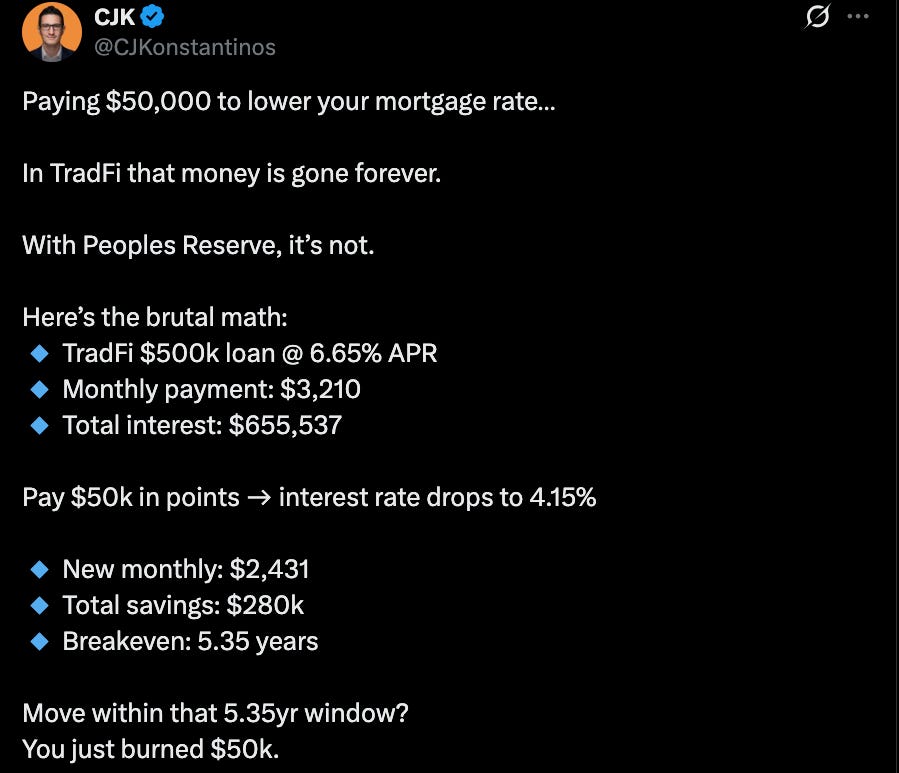
Peoples Reserve built the Bitcoin Powered Mortgage so you can buy real estate without selling a single sat: no liquidation risk, no taxable event, no giving up your upside. Staking is also live for $PRN, their loyalty token that works like tokenized mortgage points toward a lower borrowing rate, details on their site.
CJ Konstantinos details exactly how it works on his X account. Run your own numbers with the free calculator at

Kraken parent Payward explores becoming a ‘full bank’ outside the US
Kraken’s parent company is exploring becoming a full-service bank outside the U.S., potentially combining banking, trading and asset management under one roof. Kraken already operates a Wyoming-chartered SPDI, but executives are talking about something considerably broader, even floating mortgages as a potential future product.
The trend here is becoming impossible to miss. Crypto companies spent years desperately trying to maintain access to banks; now some of the biggest are trying to become banks themselves. Coinbase is helping customers finance home purchases with crypto, World Liberty Financial received conditional approval for a national trust bank, and Kraken wants to push further into traditional finance. The convergence is happening from both directions.
Things got spicy at the CFTC’s Innovation Advisory Committee meeting, where CME CEO Terry Duffy clashed with CFTC Chair Mike Selig and Kalshi COO Luana Lopes Lara over prediction markets and regulation. Duffy pointed out that CME has more people in its regulatory department than Kalshi has in its entire company, to which Lopes Lara responded, “Maybe you should learn a bit about efficiency then.” Duffy fired back, “Maybe you should learn about credible markets.”
Beyond the entertainment value, this is a sign of how quickly prediction markets have grown up. Kalshi and Polymarket are no longer cute crypto-adjacent experiments; they’re becoming legitimate competitors for trading volume, attention and eventually products traditionally controlled by massive derivatives exchanges. You know an industry has arrived when the incumbents start getting pissed off.
Ondo executive says tokenization is following the same path as early ETFs
Ondo Finance President Ian De Bode argues that tokenized securities are following essentially the same adoption curve as ETFs: initially dismissed as a niche financial product before gradually becoming embedded in mainstream portfolios. The important difference is that tokenization potentially expands beyond funds into stocks, bonds and other financial assets that can trade and settle onchain.
I like the ETF comparison because it strips away most of the crypto jargon. ETFs didn’t replace the assets underneath them; they created a dramatically easier wrapper for owning and trading them. Tokenization could ultimately do something similar for huge portions of traditional finance, except the upgrade isn’t simply packaging – it’s making assets programmable, globally transferable and potentially tradable around the clock.

Arch Public - It’s a hedge fund in your pocket. Built for retail traders, designed to outperform Wall Street. Try emotionless algorithmic trading at Arch Public today.
Promote your brand with The Wolf of All Streets. For sponsorship and partnership opportunities, contact info@thewolfofallstreets.io.
The Wolf Pack - My Telegram group where I share daily market updates, real-time observations, and ongoing discussions with the community. There’s a dedicated channel and group chat, and it’s completely free to join.
X - I spend most of my time on X, contributing to CryptoTownHall every weekday morning, sharing random charts, and responding to as many of you as I can.
YouTube - Home of the Wolf Of All Streets Podcast and daily livestreams. Market updates, charts, and analysis!
The views and opinions expressed here are solely my own and should in no way be interpreted as financial advice. Every investment and trading move involves risk. You should conduct your own research when making a decision. I am not a financial advisor. Nothing contained in this e-mail constitutes or shall be construed as an offering of financial instruments or as investment advice or recommendations of an investment strategy or whether or not to "Buy," "Sell," or "Hold" an investment.
Thanks for reading The Wolf Den! Subscribe for free to receive new posts and support my work.
Comments
Nothing yet. Say the first thing.
Sign in to join the conversation.