
As the Pentagon appears to be gearing up for a third wave of attacks against Iran and proxies in the region, energy prices remain greatly elevated compared to when the war began late-winter, forcing Americans and businesses, and populations around the world, to pay more at the pump, and global inventories continue to collapse with no end in sight.
But that doesn’t bother President Donald Trump.
At a recent rally in Long Island, New York, on August 14th, Trump stated:
“For you to pay a tiny little bit more for your gasoline, just remember you’re doing it so that a very evil country cannot have a [nuclear weapon]. So remember that when you have to pay a little bit more, you’re at $4. It’s OK.
“I’ll never apologize. I did the right thing… you just have to remember what we’re doing is a great service for the world.
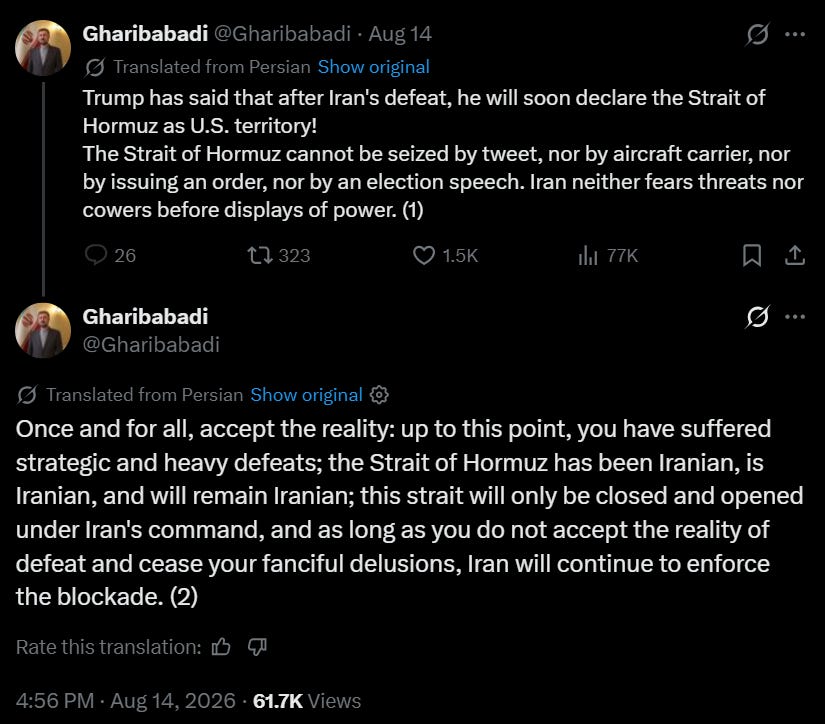
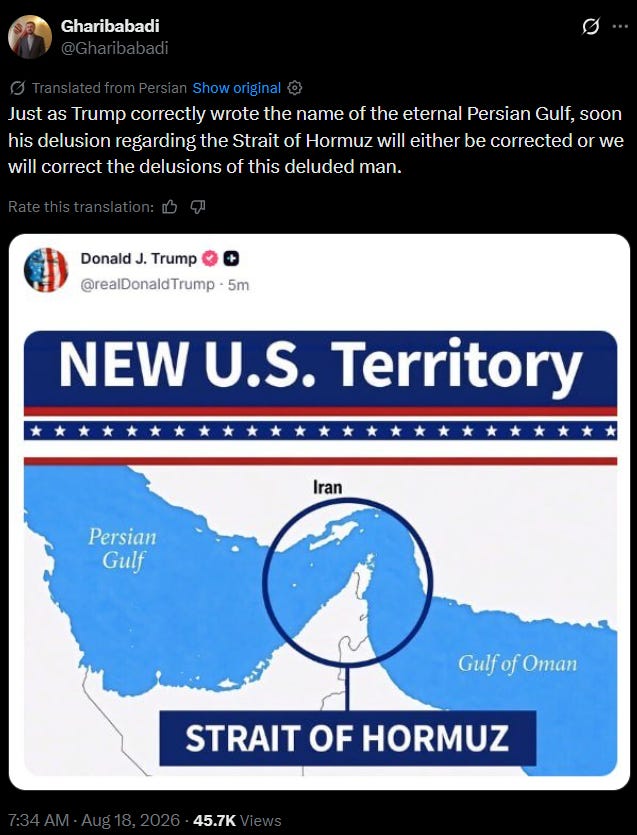
“After we finish defeating Iran ... pretty soon I’ll be declaring the Hormuz Strait a territory of the United States.”
In response, Iran’s Deputy Foreign Minister Kazem Gharibabadi posted on X: "This strait will be opened and closed only under Iran's command, and so long as you do not accept the reality of defeat and stop indulging in fantasies, Iran will continue to enforce the blockade."
MoneyWise added:
What was once envisioned by Trump administration officials to be a maximum six-week war against Iran is stretching into its sixth month, with no immediate end in sight. On August 17, Trump even threatened to bomb Oman if it “gets in the way” of locking in a peace deal with Iran. The U.S. and Iran have bitterly disputed the Strait of Hormuz’s future and whether a toll system will be implemented for safe passage.
Elevated gas prices are causing political headaches for the Trump administration, which has struggled to address the issue ahead of the November midterms, much like President Joe Biden did four years ago.
For many voters, gas prices serve as a visible indicator of inflation and shape overall perceptions of the economy. Those perceptions are largely negative, with 58% of Americans believing the U.S. economy is getting worse, according to a YouGov poll. Meanwhile, Americans are stuck with high gas prices for the foreseeable future.
“Americans today will spend $338 million more on gasoline than they did one year ago, or $2.35 billion more every week,” Patrick de Haan, head of petroleum analysis at Gas Buddy, said in an X post on August 15.
Howbeit gas prices are not as pressing as higher diesel prices.
Diesel runs the world; from ships, to jets, to trains, to trucks, to tractors, to generators, it all runs on diesel.
One week ago The WinePress warned of a growing diesel epidemic as prices continue to rise around the world, due to supply chain bottlenecks and rapidly dwindling reserves, with executives from several oil giants warning of impending shocks, along with countries such as Russia (which is the world’s second leading exporter of diesel) mulling its exports to ration its supply.
OilPrice.com said a week ago:
Meanwhile, in the U.S. itself, diesel inventories have slumped to the lowest for this time of the year in 30 years, Reuters noted in its report on record diesel prices. In other words, the U.S., the world’s biggest oil and fuel exporter, has limited space for boosting exports to fuel-hungry parts of the world further.
To make the picture even gloomier, the U.S. Energy Information Administration said earlier this week it expected some oil production in the Middle East to remain shut in well into 2027, maybe even until the end of the year. This suggests a prolonged supply squeeze both in crude oil and, as a consequence, in fuels. Such a trend might accelerate transport electrification, but then again, it might sap demand for EVs as well as higher fuel costs spread to every industry, including EVs.
Rationing in Russia continues despite the Kremlin initially trying to assure people that their energy markets were stable.
Russian-based outlet Meduza reported:
Gas stations in at least 12 Russian regions are once again reporting hours-long lines for fuel, according to a count by the news outlet 7×7. The regions include Krasnodar Krai, the Voronezh, Kaluga, Rostov, Ryazan, Tambov, Tula, Saratov, Smolensk, Penza, and Ulyanovsk regions, as well as Primorsky Krai.
Purchase limits have also returned. The Sochi city administration announced August 11 that gas stations in the region had imposed limits “due to logistical disruptions in fuel supply,” and it asked local residents and tourists to “refrain from using personal vehicles whenever possible” to ease the strain on gas stations.
In the Orenburg region, Governor Yevgeny Solntsev reported a “difficult situation with fuel.” Starting August 12, gas stations there capped purchases at 30 liters (about 8 gallons) of gasoline and 60 liters (about 16 gallons) of diesel and adopted an “odd-even” system: drivers with license plates ending in an even digit can fill up on even-numbered days, while everyone else fills up on odd-numbered days. Solntsev also promised to bring in police officers “to coordinate the situation at gas stations.”
Now diesel prices continue to rise.
On August 17th, the Barrel of Oil Equivalent (BOE) Report documented that “U.S. diesel crack, a key measure of refining profitability, hit an all-time high of $102.20 a barrel on Monday as global supply disruptions from the wars in Iran and Ukraine run into peak agricultural consumption season.”
BOE added:
The crack has hit new intraday record highs in five of the last six sessions, reflecting growing concerns about fuel availability as fresh attacks on Middle Eastern refineries added to existing supply disruptions.
The most immediate hit from surging diesel cracks is to farmers who need the fuel to power tractors, harvesters and other equipment, during the ongoing harvest season in the Northern Hemisphere and the planting season in the Southern Hemisphere.
Longer-term, it could hit most other sectors of the global economy as the fuel has wide-ranging uses from manufacturing to heavy transportation and power generation in parts of the world.
Shohruh Zukhritdinov, chief executive at oil trading firm NitrolOil, noted: “The U.S. is producing more diesel, not less, and yet the crack is still above $100. That tells you this is not a refinery incentive problem anymore – it is a refinery capacity and global replacement-barrel problem.”
Scott Shelton, energy specialist at TP ICAP, also added that the international diesel problem could get worse from here because of its export controls and sanctions. “The U.S.’s new policy could make it even harder for (China) to keep refinery run rates where they are and could make the diesel crisis worse,” Shelton said in a note to clients.
On top of this, OilPrice.com also pointed out this week that automation could also further erode diesel reserves. The news outlet wrote:
The rise of automation, AI, and electric trucks can fundamentally change the freight transportation industry in the United States, leading to a revolution in transport fuel demand. […] All these advances in freight transportation technologies suggest that U.S. fuel demand could fundamentally change in the coming years thanks to fuel savings and electrification.
In 2025, transportation accounted for about 29% of total U.S. energy consumption. Petroleum products accounted for about 89% of the total energy use of the U.S. transportation sector, according to data from the U.S. Energy Information Administration (EIA).
In 2025, the annual use of diesel, the backbone of the freight sector and a driver of any economy, in the transportation sector accounted for about 75% of total U.S. distillate consumption and about 14% of total U.S. petroleum consumption. On an energy content basis, diesel fuel accounted for about 22% of total energy consumption in the U.S. transportation sector and for about 6% of U.S. total primary energy consumption, per EIA data.
There are new reports suggesting that because the strategic oil reserve is being drained so rapidly that there are concerns that some of the caverns might collapse.
CNBC reported last week:
The caverns that hold the U.S. strategic oil reserve could get damaged by the rapid release of stockpiles in response to the Iran war, experts warned this week as inventories hit a four-decade low.
Damage to the caverns would make it more difficult to respond to future energy emergencies, the experts said. The oil in the Strategic Petroleum Reserve, or SPR, is stored at 60 salt caverns thousands of feet underground at four major sites along the Gulf Coast in Louisiana and Texas.
Both sides of the political aisle have voiced worries about the integrity of the salt caverns. Republican lawmakers raised those concerns when the Biden administration released a record 180 million barrels in response to Russia’s invasion of Ukraine in 2022. The SPR fell below 350 million barrels in 2023 under Biden. It was refilled to around 415 million barrels before the Iran war.
The Government Accountability Office said in a May report that “repeated partial drawdowns followed by refill can leach a single part of a cavern repeatedly, leading to undesirable shapes.”
The majority of the SPR’s caverns were found to be in “very good condition” after the 2022 drawdown, according to the GAO.
“However, every drawdown cycle expands cavern volume and reduces the spacing between caverns within the salt dome, which ultimately reduces their long-term viability,” it said.
Amos 4:1 Hear this word, ye kine of Bashan, that are in the mountain of Samaria, which oppress the poor, which crush the needy, which say to their masters, Bring, and let us drink.
Proverbs 28:16 The prince that wanteth understanding is also a great oppressor: but he that hateth covetousness shall prolong his days.
Of course Trump doesn’t care: he is enriching himself, his family, his buddies and executives, and his masters; but you? Let them eat cake!
Christian Westbrook UNSHADOWED (IAF) said in a recent note (emphasis his):
So Trump comes out and declares the strait is open again — completely made up, and who even believes him at this point? But “belief” is not the point. The headlines go out, and the high-frequency algorithmic trading pushes the oil prices back down. These markets have been completely manipulated by their statements:
1. Not just to make billions through insider trading
2. Not just to push people into confusion and learned helplessness
3. But to absolutely prevent any natural demand destruction ... meaning, usually if the world is running out of something, the price rises. That’s the most basic supply/demand concept. It’s been undermined by this cycle of nonsense announcements and manipulated markets — and this is GUARANTEEING that we are going into an absolutely worst-case “hard landing” scenario: the engineered energy crisis that will require fuel rationing and cause massive inflation across commodities, transportation, cost of living...everything.
The economy CANNOT survive what they have engineered here.
The upside is, a lot of people are about to feel a level of discomfort that will make them ask questions — and we’ll be able to wake up a lot of folks...
I believe he is absolutely correct. You can only jerry-rig the system for so long like he and his insider traders traitors are doing; quick gains before a monumental crash.
Proverbs 28:22 He that hasteth to be rich hath an evil eye, and considereth not that poverty shall come upon him.
Trump knows what he is doing, all these leaders know what they are doing. I am a broken record at this point, but once again, these “wars” are purely designed to bring the world to its knees. Russia-Ukraine and now the Iran war are just the next phases of the Great Reset, bringing in climate lockdowns similar to what we endured in 2020 (this time more systemic), transfer more wealth to the point, then strategically detonate that pyramid, and then usher in a new wave of dependency and oppression with a new system when the masses beg for bread.
There is no need to panic, we don’t panic here, but it would behoove you to at least add to your supplies, refill your tanks and have some extra on stand-by, because we are heading into a much deeper energy crisis.
Proverbs 22:3 A prudent man foreseeth the evil, and hideth himself: but the simple pass on, and are punished.
If you enjoyed this report and others like it, please consider sharing this post and supporting The WinePress down below!
Thanks for reading The WinePress News! This post is public so feel free to share it.
[7] Who goeth a warfare any time at his own charges? who planteth a vineyard, and eateth not of the fruit thereof? or who feedeth a flock, and eateth not of the milk of the flock? [8] Say I these things as a man? or saith not the law the same also? [9] For it is written in the law of Moses, Thou shalt not muzzle the mouth of the ox that treadeth out the corn. Doth God take care for oxen? [10] Or saith he it altogether for our sakes? For our sakes, no doubt, this is written: that he that ploweth should plow in hope; and that he that thresheth in hope should be partaker of his hope. (1 Corinthians 9:7-10).
The WinePress needs your support! If God has laid it on your heart to want to contribute, please prayerfully consider donating to this ministry. If you cannot gift a monetary donation, then please donate your fervent prayers to keep this ministry going! Thank you and may God bless you.
To support The WinePress, you can contribute by doing one or more of the following:
You may send cash, check or letters to this address:
Jacob M. Thompson
#119
12820 Adams Rd.
Granger, IN 46530
If you decide to send a check, please do not address it to “The WinePress.” Please address it to the name listed.
You can become a paid member on Substack.
You can also donate electronically by hitting the link below:
Comments
Nothing yet. Say the first thing.
Sign in to join the conversation.