
“The entire loop, not just orientation, is an ongoing many-sided implicit cross-referencing process of projection, empathy, correlation, and rejection.” — John Boyd, The Essence of Winning and Losing, 28 June 1995
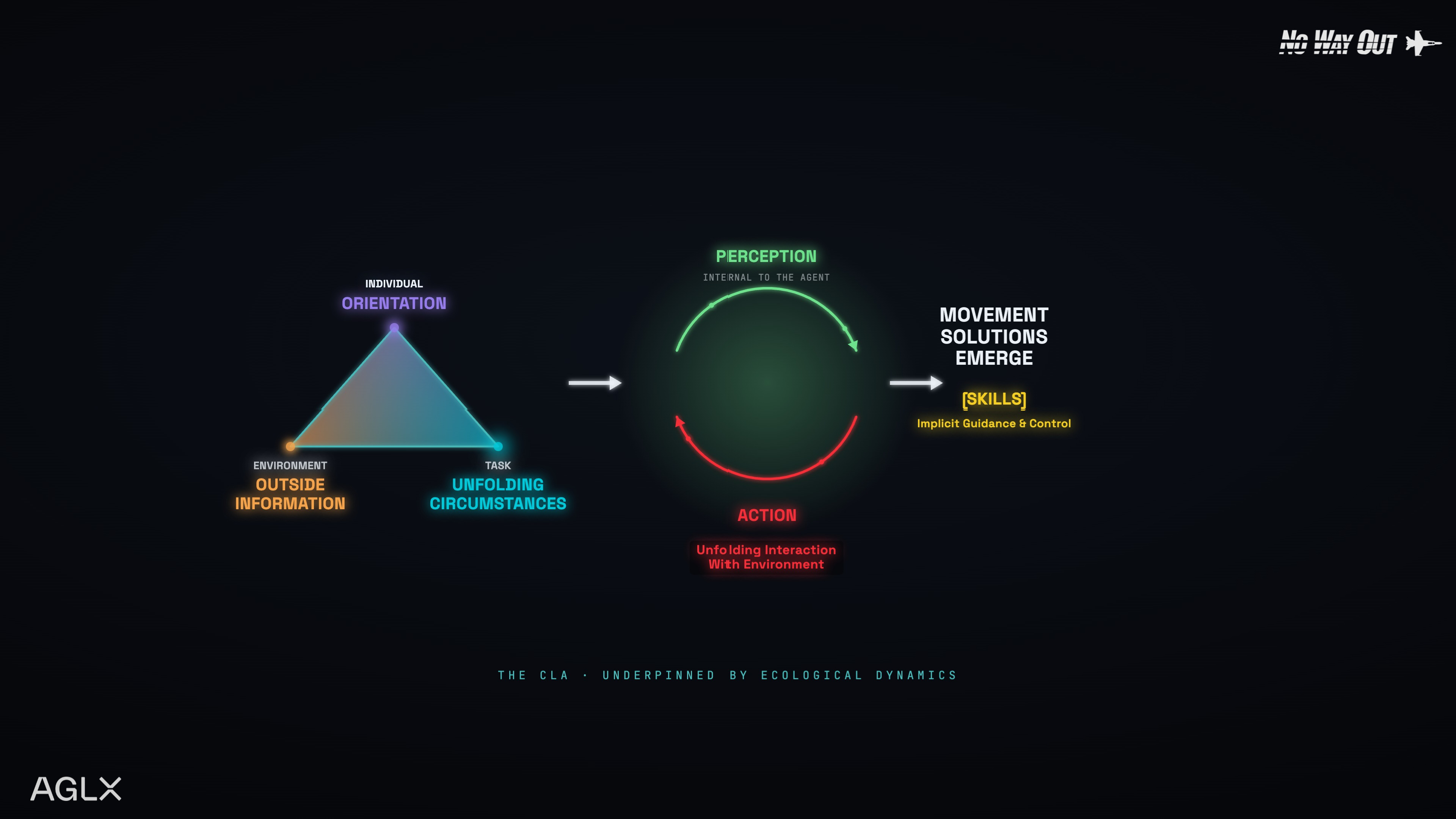
The thesis in one breath. The Constraints-Led Approach is not a coaching fad parked off to the side of decision science. Take the CLA informed by ecological dynamics, combine it with active inference and predictive processing, and you are looking at the same thing John Boyd drew. Not a metaphor for it. The CLA lives inside Boyd’s real OODA loop. It is one true way to see that loop, a single account of how an athlete perceives, orients, and acts inside a world that will not hold still. The loop is the larger container. The CLA is one accurate picture of what is happening within it.
You probably think these are three different things. Newell’s constraints. Boyd’s OODA. The brain’s predictive machinery. Watch them turn out to be one thing.
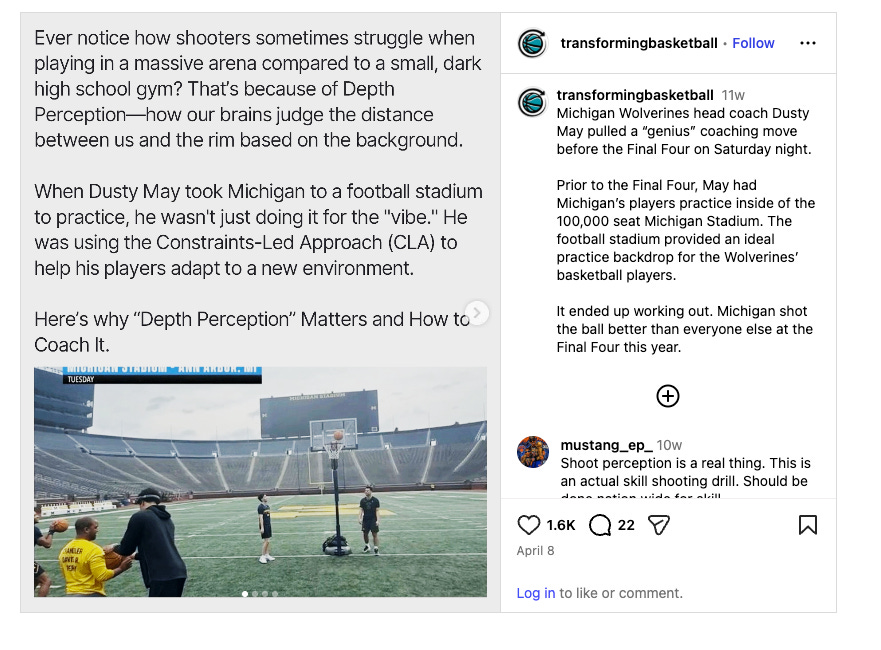
We are talking about elite sports organizations here, and something is shifting in them. The CLA is starting to reach coaches, and the best of them are using it to move past the dominant approach, the one built on centralized command and control and a belief in muscle memory. Now imagine what happens when that reaches the top. If front offices and the C-suite get the same update and buy in, a team can become genuinely elite, hiring the coaches and recruiting the players who fit a first-principles approach to performance. The leaders up there already talk about the OODA loop, name-dropped at cocktail parties and in annual reports. The trouble is, it usually shows up as a tidy four-box flowchart, misremembered as “make decisions faster than the other guy.”
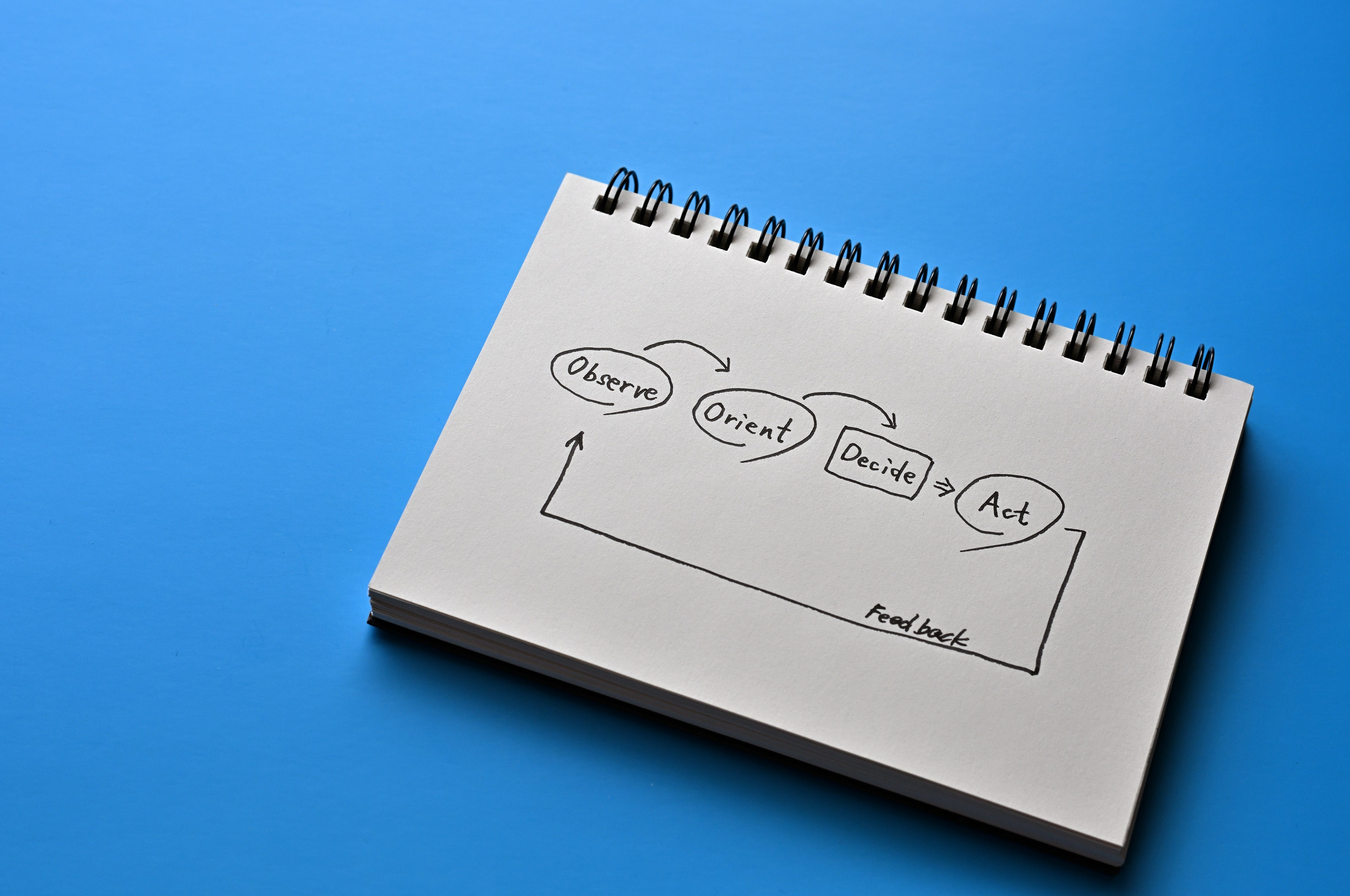
That flowchart is not the OODA loop. It is a cartoon of it. Presenting the loop as a four-step process is like describing a fractal as a simple shape. You get the outline and lose the complexity that unfolds at every scale.
A word on who discovered and sketched it. John Boyd was a fighter pilot who evolved into a polymath. In 1976 he wrote Destruction and Creation, and the title is the point: the paper is about destroying old, stale models of the world so you can create better ones. This matters more than it sounds. Without ongoing destruction and creation, our mental models go rigid, drift out of sync with reality, and we lose the ability to act on our own. Success comes from staying adaptable, from improving what Boyd called our capacity for independent action amid competition, uncertainty, and scarcity. That paper is the engine. Roughly nineteen years later, in his final brief, The Essence of Winning and Losing, dated 28 June 1995, he sketched the loop most people now recognize. He sketched it. He never formally published it. The sketch is influenced by cybernetics, complex adaptive systems, neuroscience, and psychology, along with the thinkers Boyd had spent decades reading: Gödel, Heisenberg, Popper, Polanyi, Darwin. At heart it is less a model of decision-making than an epistemological one. As Boyd put it, Orientation shapes the way we observe, the way we decide, and the way we act. Orientation is the main event, not a box you pass through.
Here is the part that should bother you. Athletes do not perform in tidy environments. They perform inside a volatile, uncertain, complex, and ambiguous world, full of novelty, the conditions we shorthand as VUCA. You cannot coach those features of the world away. There is no way out of them. You can only design for them. Boyd built a model for exactly that world. So did ecological dynamics. They used different words and never compared notes.
This piece, and the animation it rides with, is the comparison.
Karl Newell gave coaching its constraints model in 1986. Three categories shape every movement: the Individual, the Task, and the Environment. Rob Gray puts it as plainly as anyone: a constraint is something that takes away a solution you could otherwise use.
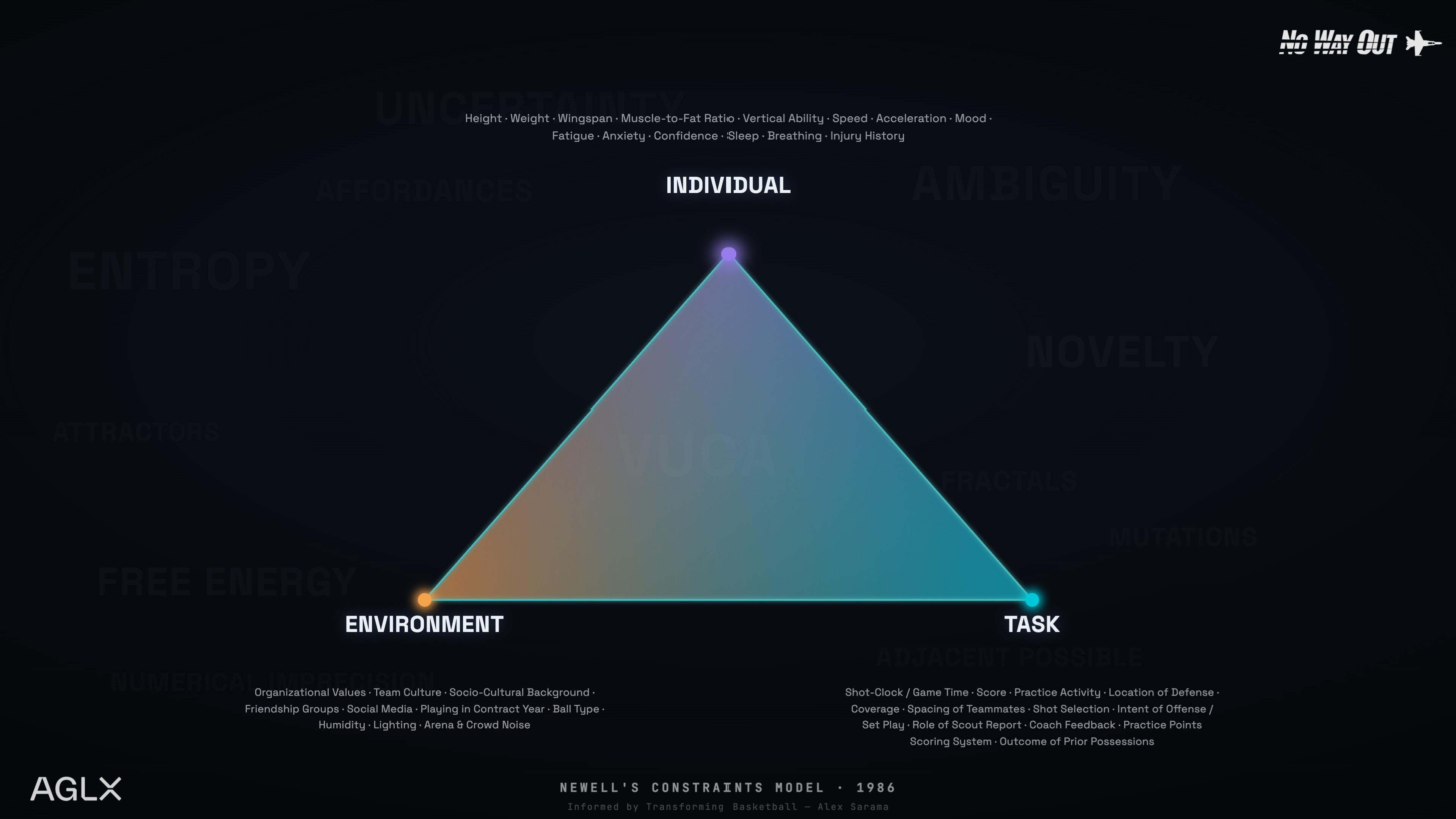
Use the canonical basketball example. The ten-foot rim is a task constraint. It removes the dunk as a scoring solution for most players. Drop it to six feet and the dunk comes back. Change the constraint, change the available solutions.
Individual constraints are what the athlete brings: height, weight, flexibility, fatigue, how they handle pressure. This is why we do not prescribe one perfect shooting technique. A solution that fits a six-foot guard does not fit a seven-foot center.
Task constraints are specific to the sport: the rules, the number of players, the equipment, the scoring system. A heavier ball, a shorter shot clock, a smaller court. These are the constraints a coach controls most directly.
Environmental constraints are the general ones that apply to anything: gravity, light, friction, surface, weather, crowd noise.
Credit where it is due. Alex Sarama’s Transforming Basketball does the hard work of putting these terms into the language of actual possessions, and Rob Gray’s research and podcast are the spine of the contemporary CLA conversation.
Now the move that unlocks the whole piece. Take Newell’s triangle and relabel the vertices in Boyd’s language. We have not drawn the OODA loop yet, so just hold onto these names. Soon you will find that Newell’s three constraints become specific, load-bearing parts of the loop:
Individual → Orientation. What the athlete brings is genetic heritage and previous experience, which is exactly what Boyd loads into Orientation.
Task → Unfolding Circumstances. The rules, the opponents, the shot clock, the live situation. These are the competing and collaborating loops you are reading in real time.
Environment → Outside Information. Gravity, light, surfaces, the dispositional properties of the world projected into the optic and acoustic arrays.
Same triangle. Different headings. Three constraints, three landing spots. You have already started drawing the OODA loop and you did not notice.
One honest caveat on that third arrow. Mapping the Environmental constraint cleanly onto Outside Information is a simplification, and I am making it on purpose to help people see the loop for what it is. In truth the environmental constraint travels with Unfolding Circumstances as much as with Outside Information. I will try to untangle that in section 6. For now, read Outside Information as your connection to the environment and keep moving.
Ecological dynamics builds everything on one engine: perception and action, coupled, continuous, inseparable. Strip an athlete down to the irreducible thing and you get perception-action. As Rob Gray says, it makes little sense to claim memories control actions when better information is sitting right there in the environment. Skill is a relationship between the player and the world, not a filing cabinet of recalled patterns.
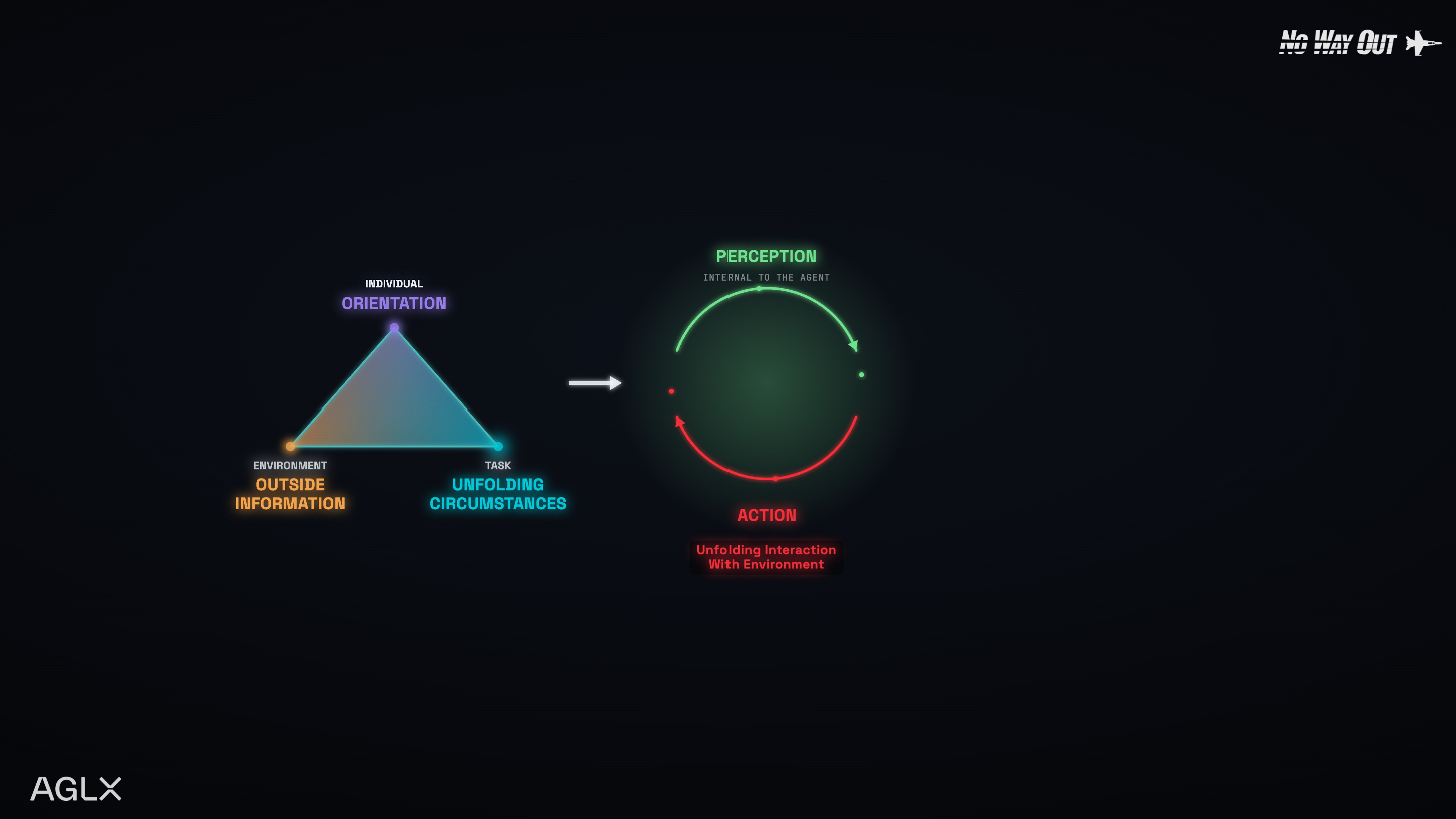
This is the engine. In the animation we set it apart on purpose, its own color, because everything else hangs off it.
And the engine runs on one central idea: the affordance. Gibson’s point was that we do not perceive raw physical properties and then compute what to do with them. We perceive what the environment offers us, directly, relative to our own body. A surface that is roughly flat, rigid, and large enough is not just a collection of measurements. It affords standing on, walking across, cutting off of. Turvey sharpened this by treating affordances as dispositions, real properties of the world that are there whether or not you are using them, the way salt is soluble before it ever meets water. The defender’s stance affords driving left. The closeout angle affords a shot. The gap affords a pass. Players perceive these directly through specifying information in the optic array and act on them. That is the Outside Information arrow feeding your loop, and it is the whole reason a coach designs the environment rather than narrating technique.
Comments
Nothing yet. Say the first thing.
Sign in to join the conversation.