
Last week I stood in three basketball gyms, and by Saturday night I could not stop chewing on what I had seen, because two of them were teaching kids to do what they were told and one of them was teaching kids to solve problems, and the one teaching kids to solve problems was not the one built on top of a leadership institution.
Let me put the two that matter side by side.
My daughters went to a PGC camp. I was there as a parent, which is the only reason I saw what I saw. On parents night the camp director, Rob Gardner, who also runs curriculum development for PGC, walked the room through their approach to shot selection, and about ninety seconds in I sat up, because I had heard this logic before. It was an iteration of what Alex Sarama put in Transforming Basketball. Nobody said the words. Nobody cited anybody. It was just the same underlying idea coming out of a different mouth.
Then I watched it on the floor and it was louder there. No lines. Nobody having an elbow adjusted. The coaches built a problem into the activity and stepped back, and the kids solved it over and over, and no two solutions came out identical because no two reps were identical.
They score it nine, seven, five. I told Rob he ought to run Fibonacci instead and go three, five, eight, which was a joke, and he was polite about it. But the numbers on a scoreboard are not rocket science. Somebody picked them, and every kid on the floor immediately starts hunting whatever pays most. Change the numbers, change the hunt. Nobody has to be told a thing.
If Fibonacci ever shows up in a PGC gym, that one is on me.
Then I saw the thing I have not stopped thinking about.
Somewhere in the middle of a session Rob spotted a problem on the defensive end. Now watch what he did not do. He did not blow a whistle and walk out on the floor and tell a fourteen-year-old to slide her feet. He pulled the coaches, explained the problem out loud, walked them through an example, and had every one of them reset the constraint on the defensive players.
The kids started responding faster almost immediately. Nobody had corrected a single one of them.
He did not push the marble (Note: I’m using the idea of a marble an in a bowl as a way to explain an attractor here. Much like I did during a recent Hedgeye Live event). He changed the bowl. And he did not hand his coaches a script either, he handed them the problem and let them each build their own version of the fix.
Afterward I got time with Rob and asked him straight, and he told me that over the last eighteen months or two years his thinking and PGC’s had been influenced by the constraints-led approach.
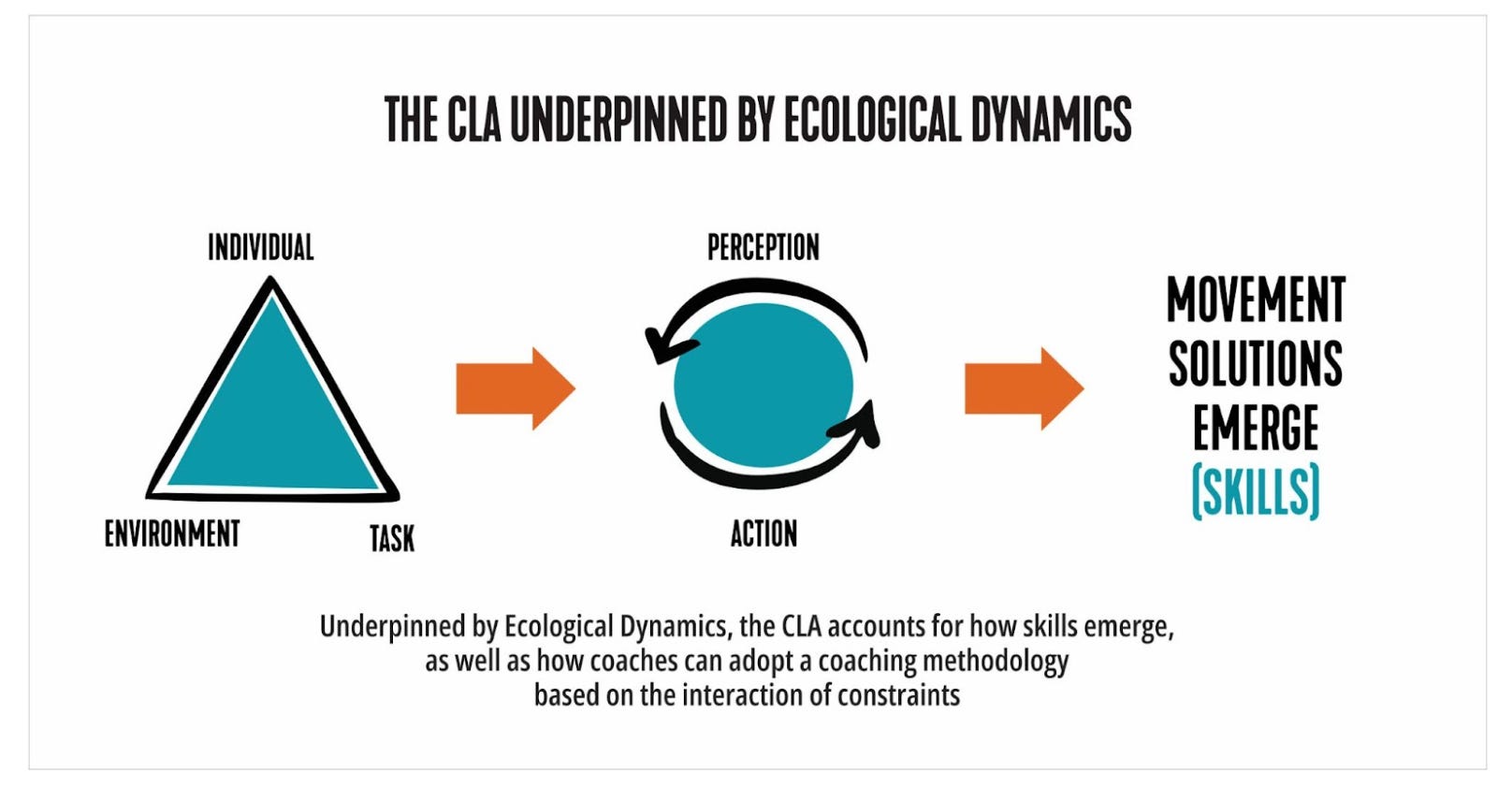
There were high school coaches in that gym too, sitting off to the side, not working the camp. They had come to watch Rob and take it back to their own programs, which is exactly what you want a coach to be doing, watching somebody else’s method closely enough to steal the good parts.
Then I did what I always do, which is ask my own kids about it in the car. Both of them lit up. They could tell me what they had been working on and why. Not the footwork. The problem. One of them said she got more out of those few days than out of a whole summer of AAU.
She is right, and it stung for a reason that has nothing to do with her.
I have spent a long time trying to get AAU coaches and high school coaches and athletic directors to sit down and look at this material. Not to hire me. To look at it.
I can usually get the meeting. What I cannot get past is one sentence, and it arrives in roughly the same shape every time, somewhere around minute twelve. I have been doing this twenty years. You do not even coach basketball.
Both halves of that are true, which is what makes it so hard to answer while you are sitting there. I do not coach basketball. And the person across the table has spent two decades in gyms, which is more floor time than I will ever have in my life.
Notice, though, who that sentence never comes from. It does not come from the coaches who drove out to sit in the corner of Rob’s PGC camp on their own time. In twenty years I have never once had a hard conversation with a coach who showed up somewhere to watch somebody else work, or with a coach who reads. The readers are the easiest conversations I have. They have usually already worked out half of this on their own, from a book that had nothing to do with basketball, and what they want from me is not persuasion. It is directions.
So hold onto that objection. We are coming back to it at the end, and the man who takes it apart is not me.
He led the Blue Angels.
Saturday I was at the Naval Academy for an elite camp, and I want to be careful here, because I did not go to Annapolis. I came into the Navy through Officer Candidate School. No ring, no claim on the place beyond the uniform and the twenty-some years of what it produced.
The staff ran the floor with lines and whistles and prescribed technique. Then a coach stood in front of a room of parents and explained that this place is built around leadership.
He was not wrong. That place is one of the finest leadership institutions this country has.
And I sat there doing arithmetic.
In uniform, in a classroom, on that campus, they teach Mission Command. Give people your intent, give them the boundaries, and then trust them to work out the how, because you cannot see what they can see from where they are standing.
Put the same person in a pinnie and a pair of Nikes and walk her into the gym, and she gets told where to stand, when to move, and what to do with her elbow.
Same institution. Same person. Two opposite theories of how a human being learns to make a decision, separated by a change of clothes.
The warmups told me the most.
At PGC the warmup was already the game. The problem was live from the first minute and the bodies came along for the ride. At the academy the warmup was a warmup. Lines, movement, technique, and then basketball started later, as a separate event.
I flew Tomcats, so this one lands close to home. There is no part of a fighter day where you loosen up on the flight line and then go fly. The brief prepares your mind. Everything your body needs happens airborne.
On the way out to the fight you pull a G-warm, a hard turn at altitude to wake up your tolerance and find out what kind of body you brought to work that morning. That is the warmup, and notice where it happens. In the jet. At speed. Inside the thing you are about to do for real.
The warmup is not what comes before the flight. The warmup is the first part of the flight.
You get ready to fly by flying.
There was a question and answer session with the head coach and I had a question loaded and I did not ask it. Not out of politeness. Because there is no version of a retired captain standing up in a gym full of parents to ask a working coach about ecological dynamics that does not end with me looking like I came to one-up the guy. That is not the play. You do not fix a system by embarrassing the person standing inside it.
So I went home and started pulling threads instead, and the threads went somewhere I did not expect.
Start in 1968, which has nothing to do with basketball, which is why it is worth your time.
The Navy had a problem over North Vietnam. In previous air wars American fighters had run kill ratios in the neighborhood of twelve to one. Over Vietnam that number collapsed. Dan Pedersen, who was handed the job of building the school, puts it at two to one when I asked him. Five years into a war, shooting down two of theirs for every one of ours, flying better airplanes.
The obvious explanation was hardware. The missiles were new, they were finicky, they missed. So the Chief of Naval Operations sent a captain named Frank Ault to go find out what was wrong with the missiles.
Ault came back and said the missiles were not the problem.
The problem was that crews had been taught procedures and had never once been made to solve a real problem against somebody actively trying to kill them. They knew the steps. They had never been in the fight.
So the Navy built a school where you fly against a thinking adversary who is allowed to beat you. First class convened 3 March 1969, and everybody now calls it TOPGUN, and after it existed the kill ratio went past twelve to one.
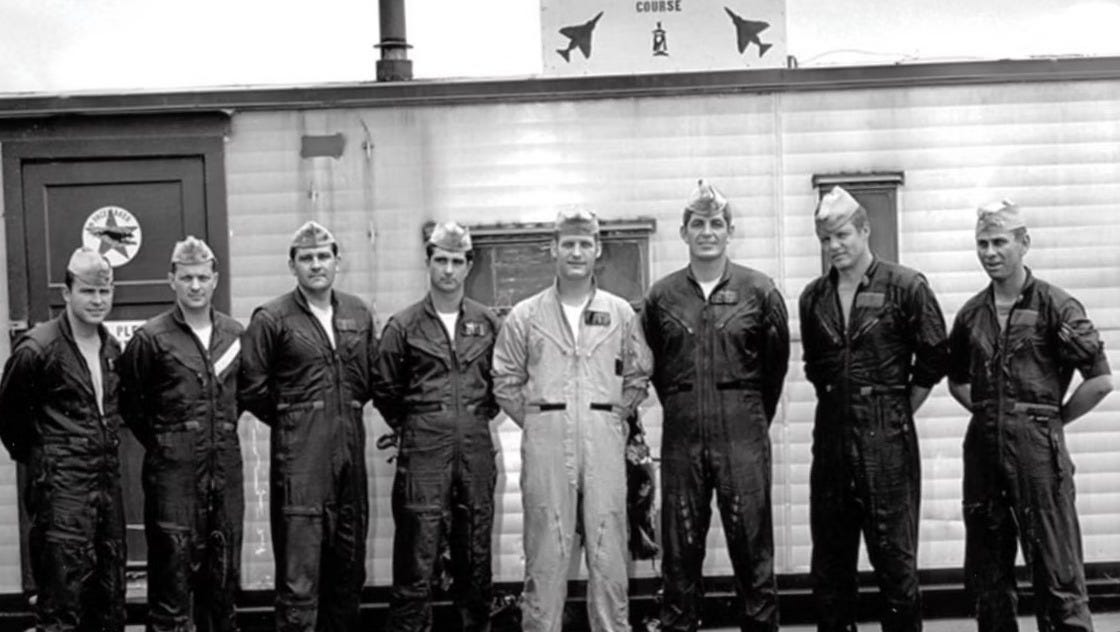
Sit with that for a second, because it is the rarest thing in this whole conversation. That is not a philosophy or a leadership theory or somebody’s book. That is a controlled experiment, run against a live opponent, measured, published, and paid for in aircrew. Change nothing about the airplanes. Change how you train. Triple the result.
And hold that date, 3 March 1969, because we are going to need it in about four minutes.
Here is where coaches bail out, and I do not blame them, because the version of this they have been sold is nonsense.
The version they get is: trust your players, empower them, let them play free. Then Tuesday arrives and there are twelve kids and two baskets and ninety minutes and no idea what to actually put on the floor, so out come the drills that have always come out, and everybody hopes the speech does the work somewhere in the gaps.
The speech never does the work.
Donald Vandergriff has spent a career on this. Retired Army officer, started as an enlisted Marine, wrote Adopting Mission Command, and he has been a guest on our show twice. He has read thousands of Prussian and German commander’s intents, actual orders, from the war of 1866 through the Second World War. And he says the standing attack on Mission Command is that it has no limits, no parameters, no boundaries.
He says that is flatly wrong. Those orders always named the limits. His phrasing on our show was that they said here are your limitations, I am giving you free will to achieve this, but I cannot give you everything.
Free will inside stated limits.
A coach knows exactly what that is even if nobody ever handed him the vocabulary. Three dribbles. Weak hand only. Score in eight seconds. Four on five. That is a limit, and inside it the kid still has to find the answer himself.
Vandergriff is just as hard on the opposite failure. He described a firm telling him, you are the Mission Command guy, go do Mission Command. His response was that this is not an intent, that is you handing me the leash and then hanging me with it.
Every coach who ever told a team to go out there and just play free has handed somebody that leash.
And here is the part that made me sit up, because I have heard this sentence before, from the other side of the world.
I had Rob Gray on our show, and Rob is one of the people who built the modern coaching version of this. Unprompted, he went out of his way to knock down the same misreading. He said people misinterpret the constraints-led approach as just let them play, do not say anything, do not do anything. He was emphatic that the coach still has a major role. You are still guiding. If a player is doing something that will not work, you step in. His phrase for it is guiding self-organization.
Two men who have never met, working in fields that do not cite each other, one reading Prussian battle orders and one watching layup lines, both spending their energy on the same correction.
It is not hands off. It is hands off the person and hands on the conditions.
The doctrine itself says the same thing in flatter language. The Army’s ADP 6-0 lists seven principles of Mission Command, and two of them are the whole ballgame. A mission order gives the why, the who, the what, the where, and the when, and deliberately withholds the how. And disciplined initiative, in the doctrine’s own words, is initiative exercised within the constraints of the commander’s intent.
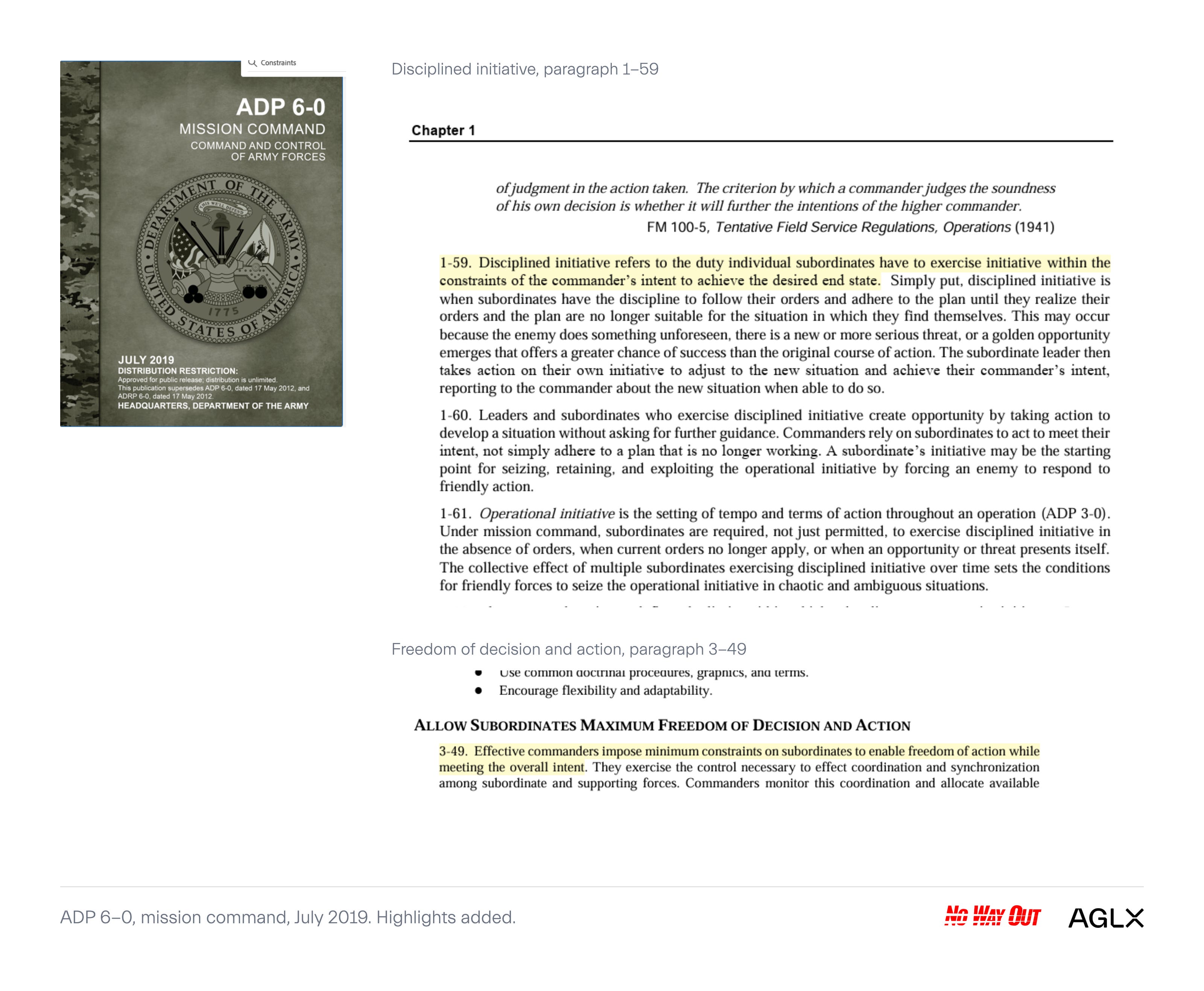
The Army put the word constraints in the definition. In a field manual. Sitting on a shelf four hundred yards from that basketball court.
But doctrine tells you what and almost never tells you how to train it, which is Vandergriff’s actual contribution. He says you cannot teach this through lecture and you cannot teach it through rote memorization. You teach it through problem solving games, then a rank-blind debrief where people are allowed to make mistakes as long as they do not make the same one twice. He calls the debrief successful when he does as little of the talking as possible.
He also turned up a German army training guidance document from the 1890s. One page. Army to divisions, and everything below that left to the divisions. No standardization. Outcomes. One division might teach loading a rifle differently than another, on purpose, because they valued freedom of action over uniformity.
One page. Now go look at the binder your program runs on.
And when I put this to Rob Gray, he described his own job in words Vandergriff could have used. Coach the outcomes, not the technique. Be aggressive on defense, create imbalances, create numbers. Those are outcomes. Not shoot with your elbow here and pass there when this happens.
An Army officer reading Prussian orders calls it outcomes-based training. A motor-learning researcher watching layup lines calls it coaching the outcomes. Neither has read the other.
Now the sports research, because this is where the coaches actually live.
The dominant model says a jump shot is a motor pattern you install through repetition. Square the shoulders, elbow in, feet at shoulder width, and grind it until the body cannot get it wrong. Build the arsenal in the driveway, then deploy it in the game.
Ecological dynamics says that model is describing something that does not exist.
Every shot in a live game is taken under a different arrangement of defender, teammate, fatigue, clock, and score, which means the shooter never gets to organize into the pre-planned position, because the world has already moved by the time he gets there. Sarama makes this point using Diana Taurasi, one of the greatest shooters who has ever lived, who says flatly that shooting is not technical and it is not reps, it is feel.
Feel is the word we reach for when we do not have a better one, and it turns out Boyd had the same problem. He borrowed a German one. Fingerspitzengefühl. Fingertip feel. German officers used it for the commander who reads a situation before he can tell you how he read it.
A general in 1940 and a shooting guard in 2020, both reaching for the fingertips, because neither language has a better word for it.
What Taurasi is describing is self-organization. Her body assembling a solution on the spot out of whatever the moment is offering.
Rob Gray goes at the same thing from the coaching side and finds the trap that catches everybody. Coaches do use small-sided games. They have for decades. But the games are identical every time, with the same constraints every time, which means the players stop discovering anything and start running a longer drill. And often the game gets bolted on at the end of a technical session, which quietly tells the players that the real work happened earlier and this part is where you demonstrate it.
The image I keep coming back to is a marble in a bowl. You do not push the marble. You shape the bowl, and the marble finds the bottom on its own, and it finds it from wherever it happened to start. Change the bowl and it finds a different bottom.
Shape the bowl. That is the whole job.
Look at what just happened.
A Navy captain investigating missile failures in 1968 concluded that the fix was to make crews solve real problems against a live opponent.
A retired Army officer reading century-old Prussian orders concluded that you set the outcome, name the limits, and let people find their own way to it.
A group of motor learning researchers watching jump shots concluded that skill is a solution assembled on the spot, not a pattern installed in advance.
Aviation, military doctrine, and sport science. Three literatures that do not cite each other. None of these people are in the same room, or the same field, or in most cases the same century.
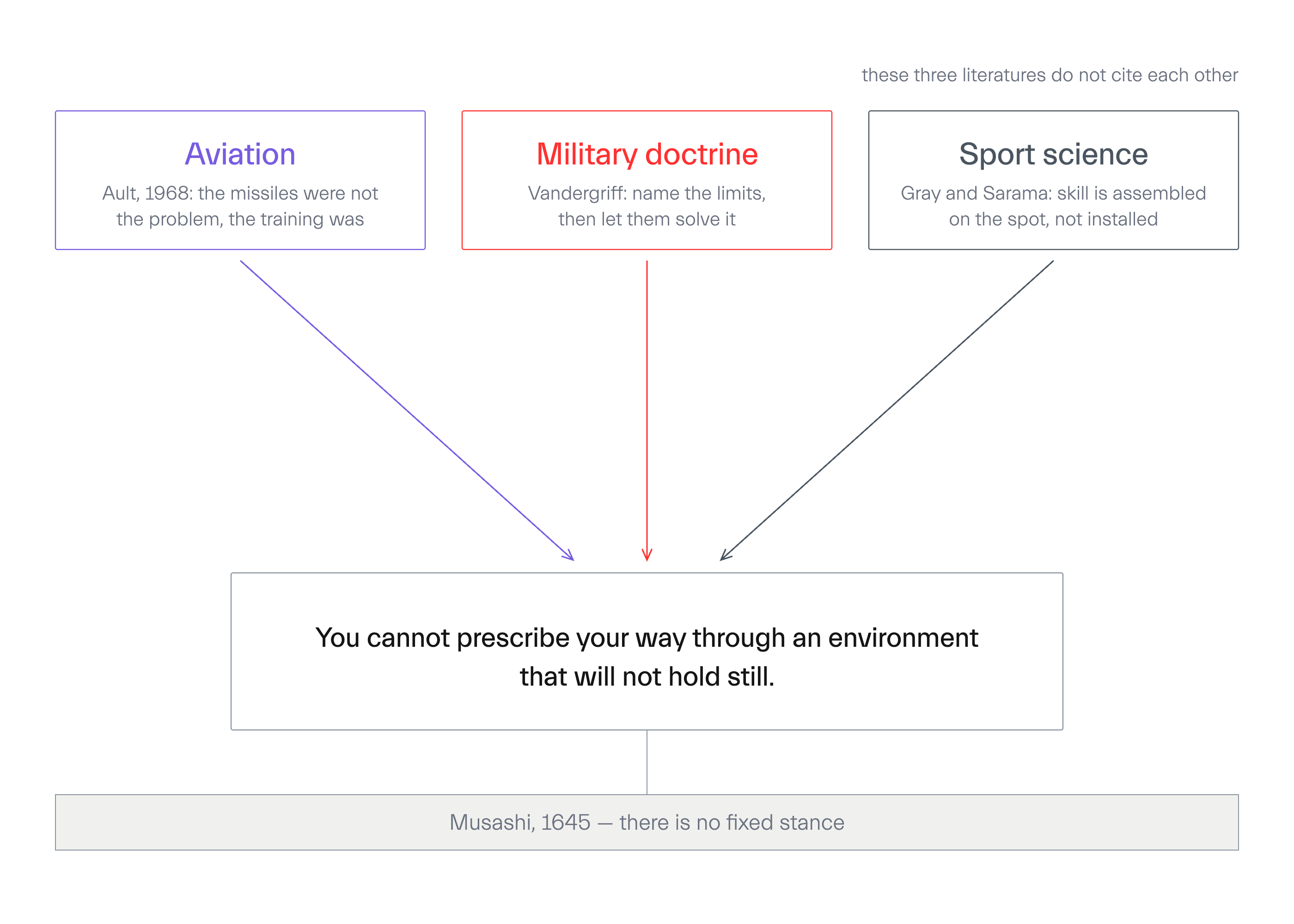
Same answer.
And it is older than all of them. Boyd’s source list for Patterns of Conflict runs to hundreds of entries, and sitting in it, in two different translations, is Miyamoto Musashi’s Book of Five Rings, written in 1645 by a swordsman who fought some sixty duels and never lost. Musashi’s central instruction is that there is no fixed stance and no correct guard to hold, because the situation will not sit still long enough for any position to stay correct. And he is blunt that none of it transfers by reading.
A technique manual arguing against technique, three hundred and eighty years ago, and Boyd owned it twice.
Boyd gives you the mechanism, and he gets closer to the coaching problem than any field manual does.
In 1989 he gave a briefing at the Marine Corps Command and Staff College at Quantico called Organic Design for Command and Control, and at the end he does something almost nobody does in public. He tells the room the title of his own briefing is wrong.
Command means to direct, order, compel. Control means to regulate or hold to a standard, and Boyd goes and digs up the root of it. Medieval Latin, contrarotulus. A counter roll. A checklist. Control, in its bones, is a checklist mentality.
So he throws both words out and retitles the briefing on the last slide. Appreciation and Leadership.
Then he defines the halves, and this is the part I want you to read twice.
Leadership must interact with the system in order to shape its character, and that shaping should be evident.
Appreciation must not interact and must not interfere. It must discern, not shape. And it should be invisible.
That is practice design. You shape the environment out loud, so everybody knows what problem they are solving. Then you watch, and you shut up, and your watching does not touch the thing you are watching.
The coach yelling corrections mid-possession has collapsed the two into one. He is trying to shape and discern at the same instant, and Boyd told a room of Marines in 1989 that the moment you do that, neither one works, because you cannot read the character of a thing you are altering while you look at it.
Go back to that PGC gym and you can watch this run clean. Rob discerns, invisibly, from the side. Then he shapes, evidently, by changing the constraint. Two separate acts, in that order, and the players never once had their solution taken away from them and handed back fixed.
And notice which direction the information moved. The problem was discovered in what the kids were producing on the floor and traveled up. The design change traveled back down. Both channels live, both doing their own job.
That is Boyd. That is Ohno. In a girls basketball camp, with nobody in the building using either name.
He also stopped in that briefing and asked whether there were any pilots present. Then he raised the argument every aviator knows. Close control tries to tell you exactly what to do and it screws it up. Broadcast control gives you the picture and gets out of the way. Just give me the information, I will do the job.
Now go stand on a sideline and tell me which one you are running.
One more thing from Boyd, because the fashionable version of him has it backwards and I had it backwards myself until recently.
People quote him as saying decentralize because it is kinder. What he actually did was diagnose, then prescribe. The diagnosis, at Quantico, is that command is top-down and control is top-down, which is his complaint, not his recommendation, and it is why he throws both words away. A system with two channels running down and none running up cannot see.
The prescription is in his working notes from June of 1989. He tracks where constraints and controls come from and agrees they arrive top-down. Then he asks how you change them, and answers bottom-up, pointing at our own Constitution, which has provisions for change built into it that come from below. He closes with a line I would hang in every gym in this country.
Our orientation should emphasize outside-in and bottom-up, otherwise we cannot easily cope with uncertainty and unpredictable change.
Now read that sentence again and swap the vocabulary, because it is the same claim the ecological people have been making since Gibson.
Outside-in means the information is out there, in the world, not assembled inside your head from a stored model. Perception and action are coupled to the environment, continuously, and what you perceive are affordances, which is just a fancy word for the things this particular place offers this particular body right now.
Walk down a staircase and notice you are not calculating riser heights. Your leg is not consulting a model of stairs. The step itself tells your leg what to do, and if the last one is a half inch shorter than the rest you find out the hard way, which is the whole point. The information was in the stair.
A defender closing hard is a stair. The gap between two bodies is a stair. A shooter’s feet are a stair.
Boyd said orientation should be outside-in. Gibson said perception is direct pickup from the environment. Two men, two fields, no contact, one sentence.
And he had a case he could not stop talking about, though somebody in a Q&A had to pull it out of him. In Conceptual Spiral he runs a roll call of names, and when he gets to Taiichi Ohno and Shigeo Shingo no hands go up, and it clearly irritates him. Later, asked about it, he describes Ohno looking at automobile production and deciding the arrow was pointed the wrong way. Instead of the earlier station pushing parts down to the later one, the later station pulls exactly what it needs, exactly when it needs it. Boyd says Ohno reversed the information flow from the bottom up, and calls it inverting the whole process. And here is the part I like. Ohno got the idea secondhand. He had never been in an American supermarket. He had men who had been to the States, and he sat them down and asked what you actually do in one, how you take the cart around and pick what you want off the shelf and settle up at the counter. Then he went and rebuilt a car company on it.
He did not walk into a real one until a business trip in 1956, years after the thing was already running on his floor.
Boyd’s own summary of it runs eight words. Instead of top-down, we got to go bottom-up.
On a basketball floor that gets uncomfortable fast. The coach sets constraints going down. What changes those constraints is what the players find going up. Run it one direction only and you are not operating a system, you are operating a factory pushing cars nobody ordered.
Now the contrast I cannot get out of my head.
Mike Krzyzewski entered West Point in the mid sixties, played point guard for Bob Knight, captained the team, graduated June 1969, and went on to win more games than anyone in the history of Division I men’s basketball. For fifty years he has credited West Point for how he leads. Take him at his word. I do.
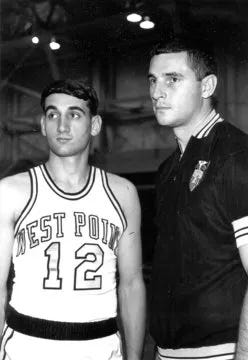
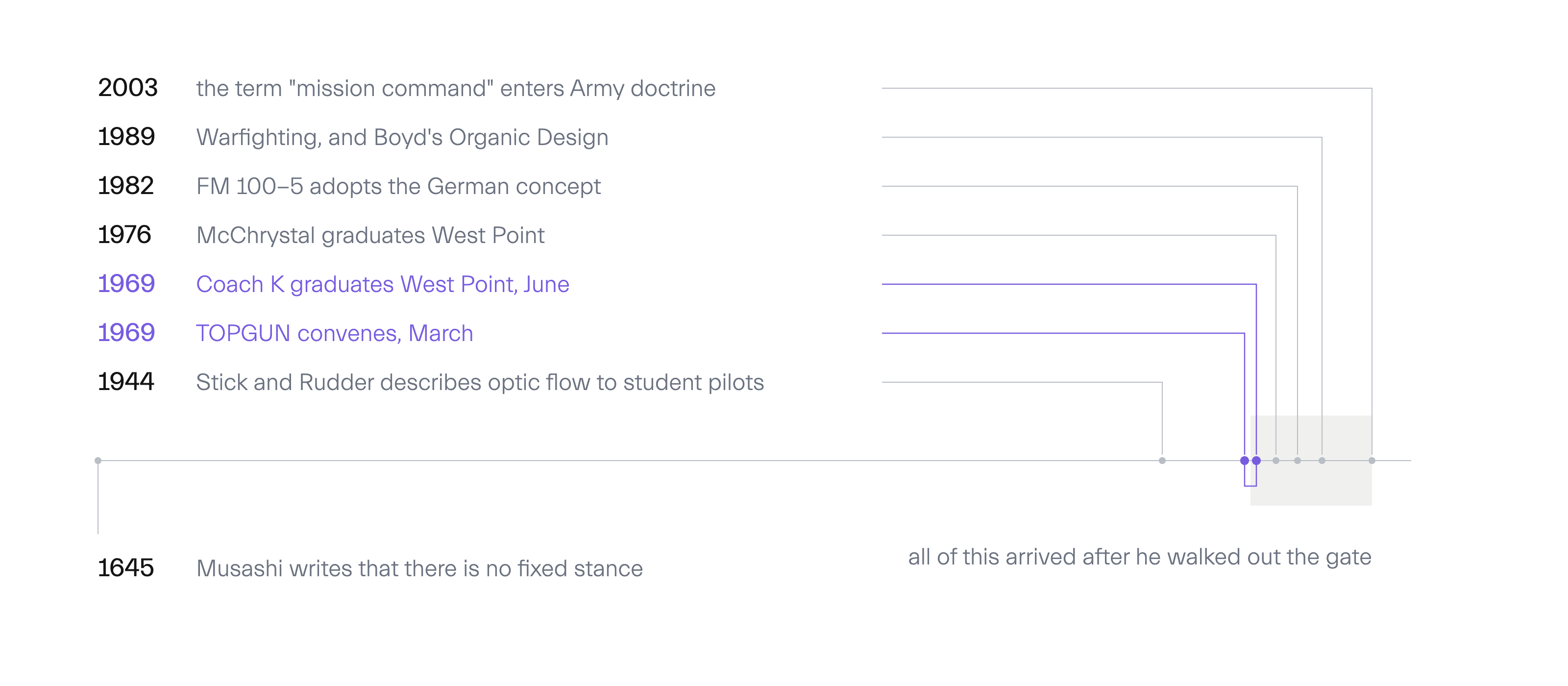
Now check the calendar. The Army did not formally adopt the Auftragstaktik material until FM 100-5 in 1982. The phrase Mission Command did not enter Army doctrine until 2003. Boyd gave Organic Design in 1989.
Coach K walked out the gate in June of 1969, which is three months after that first TOPGUN class convened, and every bit of the doctrine came after him.
So listen to how he describes his own coaching, and I did not get this from a magazine profile. I have never met the man. But a client of ours asked for leadership training this year and it turned out they had been through Coach K leadership clinics, so I went and did the work on his actual approach rather than the highlight reel.
He says he does not believe in rules, he believes in standards, because rules get imposed from outside and build a box that gets in the way of a player making a decision. He says he tears up the practice plan when the team that walked in is not the team he wrote the plan for. He asks players how they feel and what they think, because it multiplies the information he has. His teams broke their own huddles after timeouts and talked to each other instead of to him.
Standards instead of rules is intent instead of prescription. Rewriting practice for the team in front of you is designing for this athlete instead of the textbook one. Players running their own huddle is a self-organizing unit operating on shared intent while the leader keeps his mouth shut. Asking the guys what they see is appreciation running bottom-up, the channel Boyd said almost nobody builds.
He was doing it by feel, decades before anybody wrote the vocabulary, and he called it relationships.
I will be straight about the limits. His documented practice design was detailed plans, film study, structured teaching. That is not the constraints-led approach and I am not going to pretend otherwise. His leadership philosophy rhymes with this and his floor mostly did not. But that gap is the interesting fact, not the inconvenient one, because nobody had built him the bridge between the two.
Now put Stanley McChrystal next to him.
West Point, 1976. Also before 1982. But McChrystal did not stop learning at graduation. He kept going through professional military education on the way to flag rank, right through the years the Army was writing all of this down. So unlike Coach K, he got the doctrine. He got the language. He knew what Mission Command was supposed to be.
And it still did not tell him how to run the organization.
He took the Joint Special Operations Task Force in Iraq in 2003 and found a top-down, checklist outfit with overwhelming advantages in people and money and technology getting beaten by Al Qaeda in Iraq, which had none of those things and was a network. He had the same three options anybody in that seat has. Do the hard thing, do what everybody else does, or do the right thing. He did the right thing and built the method himself, under fire, because knowing the philosophy is not the same as having the method.
That is all Team of Teams is. Mission Command realized in place by a man with no other choice.
His contrast is the chess master against the gardener, and the reason he reached for chess is the part worth stealing. Chess is turn-based. Even played fast, it alternates. You move, then I move. His point is that the enemy in 2004 did not observe that courtesy. They moved several pieces at once and hit again before he had answered the first one, and they did it not because some headquarters was clever but because the people on the ground were reacting on their own authority.
You cannot play a turn-based game against an opponent who is not taking turns.
So the chess master has to give way to the gardener, who cannot actually grow the tomato and can only build the conditions where a tomato happens. Eyes on, hands off. The chapter right before that one is called Hands Off.
Now hold a drill up against that. A drill is turn-based. Everybody waits, everybody goes, the coach resets it. A game is not turn-based and never has been.
Two graduates of the same school, seven years apart. One got the culture without the method and found his way by feel over forty years. One got the doctrine and still had to build the method in a war.
Neither of them was handed the method. Which is the whole problem, and it is still the problem.
Here is the part that embarrassed me when I went back through the tape.
Vandergriff has been on our show twice, and both times he reached for a sports example without me prompting him, for a practical reason. People flinch at military versions of this, so if you can point at a non-military organization running Mission Command, they will actually listen.
The one he picked was Josh Heupel’s football program at Tennessee. Players allowed to fail. Players allowed to talk, doing their own interviews, which had not happened there in twenty years. Weekly meetings before big games where anyone on the staff can put a play on the table. A play against Kentucky where a receiver lined up behind a guard and came wide open, and in the postgame the player credited the assistant analyst who drew it up. Vandergriff’s read is that when people start crediting other people for their success, the trust is real.
And when he finished, I said this back to him, on the recording: so there are some constraints he puts on them that allow them to explore that space.
Constraints. Explore the space. About a football coach. Two years before I stood in a gym at Annapolis and finally saw what I had already said.
I cannot claim I discovered any of this last weekend. I had the pieces on tape. What I did not have was one week, three gyms, both versions side by side, with my own kids on the floor.
That is what changed. Not the thinking. The evidence.
The service academies teach this better than almost anybody. It runs through the leadership curriculum and the ethics instruction, and Mission Command is joint, so Annapolis does not get to sit it out. And the Marines did a lot more than sit through Boyd’s briefings.
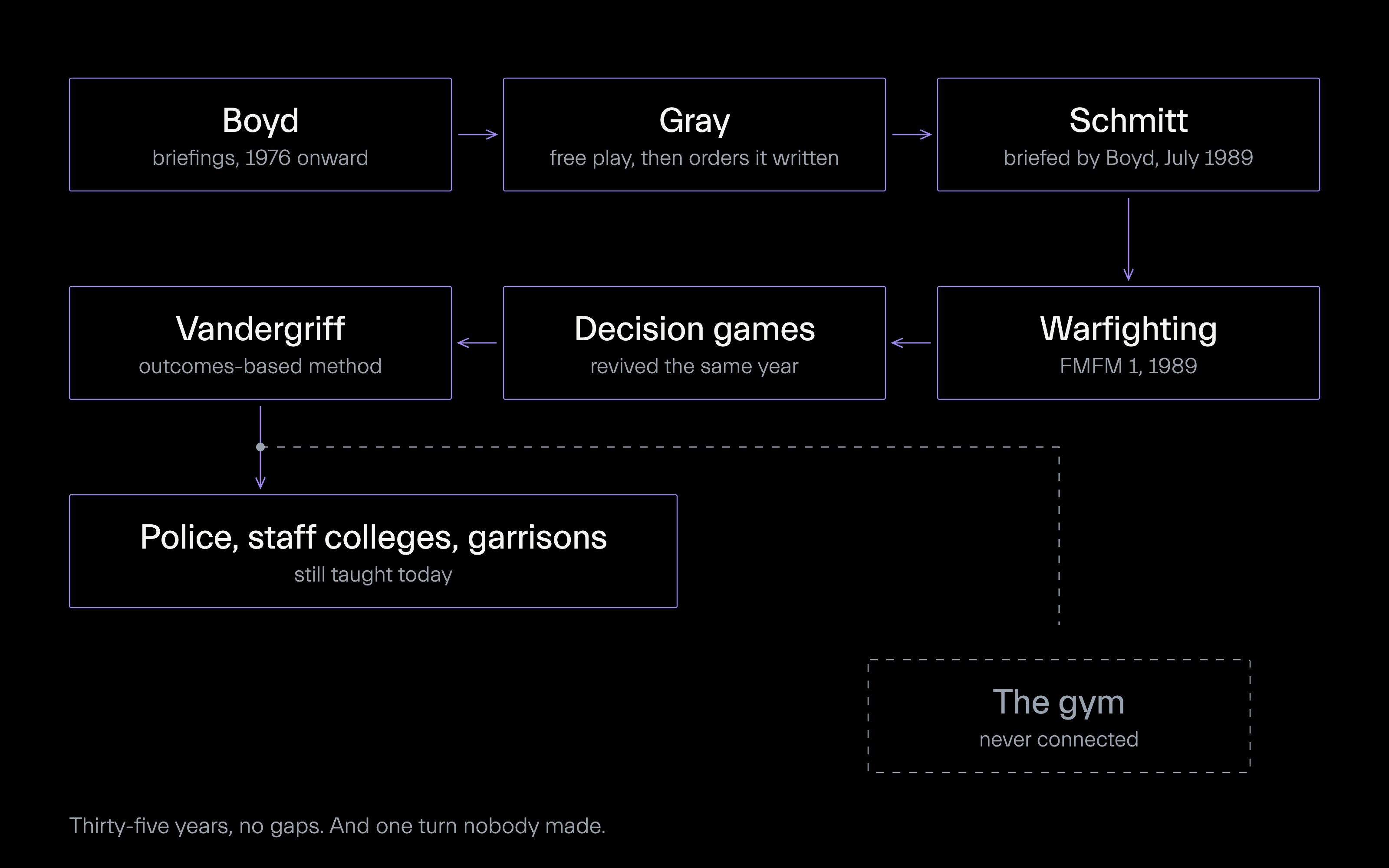
Al Gray had already been running force-on-force free-play exercises as a division commander. When he became Commandant he ordered the whole philosophy written down, and a young officer named John Schmitt wrote it. FMFM 1, Warfighting, published in 1989. A small book, deliberately short, meant to be read by every Marine regardless of rank, and it made maneuver warfare the official doctrine of the Corps. Schmitt wrote the 1997 successor too.
Boyd’s own notes log him briefing Schmitt in July of that same year.
And in that same 1989, Schmitt revived tactical decision games in the Marine Corps. Short, opposed, no-school-solution problems you hand somebody and make them defend their call out loud. That is the method Vandergriff still teaches today, and it is the same shape as everything else in this article. Set the problem, name the limits, let them solve it, debrief it without rank in the room.
So the chain is unbroken. Boyd to Gray to Schmitt, Schmitt to Warfighting and decision games, decision games to Vandergriff’s classroom and from there into police departments and staff colleges and a garrison at Fort Hood.
It runs thirty-five years without a gap.
It just never turned left into the gym.
Then those same midshipmen walk across the yard to practice and get coached in the opposite way.
The classroom says shape and discern. The gym says comply.
And the gym version has a name, which is worth saying out loud, because naming it stops this from being anybody’s personal failure. It is Taylorism. Frederick Taylor, scientific management, the one best way, the expert who studies the task and hands down the correct method to the worker who executes it. Break the job into parts, standardize each part, drill it, measure it. It built the assembly line and it built the modern basketball practice, and McChrystal spends a good chunk of Team of Teams explaining why it stopped working the moment the environment started moving faster than the plan.
That is what is running in most gyms. Didactic. Tayloristic. Top down. The coach holds the correct answer and distributes it.
Mission Command is the opposite instruction, and so is the constraints-led approach, and neither of them ever made it across the parking lot.
Let me be precise about what I actually saw, because precision is the entire point of this argument. I watched a camp, not a varsity practice. Camps are recruiting events built for evaluation in front of parents, not development across a season. I am not going to tell you the Navy women’s team practices that way, because I do not know that.
Here is what I do know. On one Saturday, the staff of an institution whose whole brand is leadership ran a floor on the opposite operating system, in front of the parents, on the same afternoon it was selling leadership to them.
And then there is the thing I cannot put down.
One of the assistant coaches on my daughters’ high school team is a naval officer. Still serving, still in uniform, coaching high school basketball on the side. She played for the current Naval Academy coach, and now she coaches, which is exactly how this is supposed to work. The standard travels inside a person.
So I asked her. She has never heard of the constraints-led approach. Never encountered it, never had it named, no idea it exists as a body of work.
She knows Mission Command cold. She learned it in uniform. She believes in it.
Look at what that means. Here is a young coach who was handed the philosophy and never handed the method. She knows a leader gives intent and boundaries and then trusts the people doing the work. Nobody ever showed her what that looks like at four o’clock on a Tuesday. So she does what anybody in that position does. She runs the drills she was run through and hopes the philosophy turns up somewhere.
That is not her failure. She is doing it right and the system gave her half a toolkit.
She is early in her coaching life, so it would be easy to file that under inexperience and move on.
Do not file it there. Because the same thing happened with a man who has more exposure to this than almost anyone alive.
Which brings me back to that Wall Street client, the one that had been through Coach K’s leadership clinics. The year after, they hired us to run their annual leadership off-site.
The thing we run for that is a Flow Learning Lab. It is the constraints-led approach pointed at teaming skills instead of jump shots. Not the technical work, the other stuff. Reading a room, speaking up when you are the junior person, handing off a task under load, briefing and debriefing. We build it with aviation teams, because aviation is where a lot of this was worked out and because a cockpit makes the stakes obvious to a room full of people who trade for a living.
One of the coaches I brought in was Ryan Bernacchi. Callsign Guido. Twenty-five years a naval aviator, four thousand hours in Hornets and Super Hornets. He was a TOPGUN instructor. He commanded a Super Hornet squadron. He was the Commanding Officer and Flight Leader of the Blue Angels, the number one jet, the one everybody else flies formation off of. His last assignment on active duty was Deputy Commandant for Leadership and Character Development at the United States Naval Academy.
He also coached lacrosse there.
Add those up. He taught at the school that built the method. He then led the most rehearsed, least forgiving team in aviation. He then owned leadership and character development for every midshipman at Annapolis. And he coached a varsity sport on that same campus.
If the connection between how we train aircrew and how we coach athletes were going to be obvious to anybody, it would be obvious to Guido.
And now go back and pick up that objection I asked you to hold. I have been doing this twenty years, you do not even coach basketball.
If reps were the thing that makes this visible, Guido would have seen it before anyone alive.
It came up before that engagement, and it came up by accident. The lacrosse coaching surfaced in conversation, and it happened to be the same day I had been on the phone with a buddy of mine who coaches lacrosse, about this exact material. So I brought it up.
Be precise about what he did and did not know, because the precision is the whole point.
He knew the practices. Small-sided games, opposed reps, the things Rob Gray has been arguing for. Any good coach arrives at some of that on his own, and Guido had.
What he did not know was that there is a science underneath it. That people have spent thirty years working out why it functions, what to call it, and how to design it on purpose. And that this same body of work is the missing method for the leadership doctrine he had spent his last tour teaching to midshipmen.
He had the practices in one hand and the doctrine in the other and nobody had ever told him they were the same object.
That is the finding, and it is the reason this article exists.
There is one more turn to this, and it is the part that keeps me up.
Gibson, the man behind all of it, did not build his theory watching sport. He worked aviation problems. The idea at the center of ecological dynamics, optic flow, came out of studying how a pilot lands an airplane. The whole world streaming outward around a fixed point, and that point is where you are going to touch down. Langewiesche was describing the same thing in Stick and Rudder in 1944, teaching people to fly.
So the science that coaches need was born in a cockpit.
And a TOPGUN instructor who led the Blue Angels had never heard of it.
This is not a story about coaches who are lazy or academies that do not care. The people at the center of it are as serious as they come. It is a story about a connection that is invisible from the inside, in every direction, at every level, even to the person who held all four jobs.
And once you accept that it is invisible, the young officer coaching my daughters stops being an anomaly and starts being the expected outcome. Right instinct, no vocabulary. An instinct you cannot name is an instinct you cannot teach to the next coach, cannot build a curriculum around, cannot defend in a staff meeting when somebody wants more drills.
It dies with the person who had it.
Walk back to TOPGUN and look at how the thing actually propagates, because this is the part everybody misses.
Students are hand-picked from fleet squadrons. About fifteen a class, three classes a year. Almost nobody goes. Then the graduate goes back to his squadron as the instructor.
The standard does not travel in a binder. It travels inside a person who has to be able to develop other people, and if he cannot, the standard dies at his ready room door.
I got to sit down with Dan Pedersen at his house, with a former instructor of mine along for it. Pedersen ran the original school in 1969 and hand-picked the first eight instructors, so if anybody gets to say what the place was for, it is him. And when the conversation turned to leadership he did not talk about airplanes at all. He talked about finding the middle-grade people who already have the knowledge and the courage to teach it, and then making them teach it.
He did the same thing later on a carrier with fifty-four hundred people aboard. He told his master chief he would back him a hundred percent, and then gave him one job. Organize the chiefs, have them lead, have them teach, have each of them mentor the best five or six who work for them.
That is not a tactics program. That is a leadership apprenticeship, and it is the same instruction whether you are running a fighter school or a ship.
Then there is the debrief, which is where the whole thing actually lives.
Pedersen described what it used to be before they fixed it. He called it who shot John. The biggest guy with the loudest mouth won the argument. So they built tools to reconstruct the fight graphically and hung the reconstruction on the wall, and after that you were not arguing with a commander, you were arguing with the picture.
And then he said the thing I have not been able to put down.
You never embarrass the student. Never. His instructors could beat anybody, and he said there were no points in that. What you do is challenge the guy, and then debrief him on the opportunities he had and did not use. Then take him back out and fly it again.
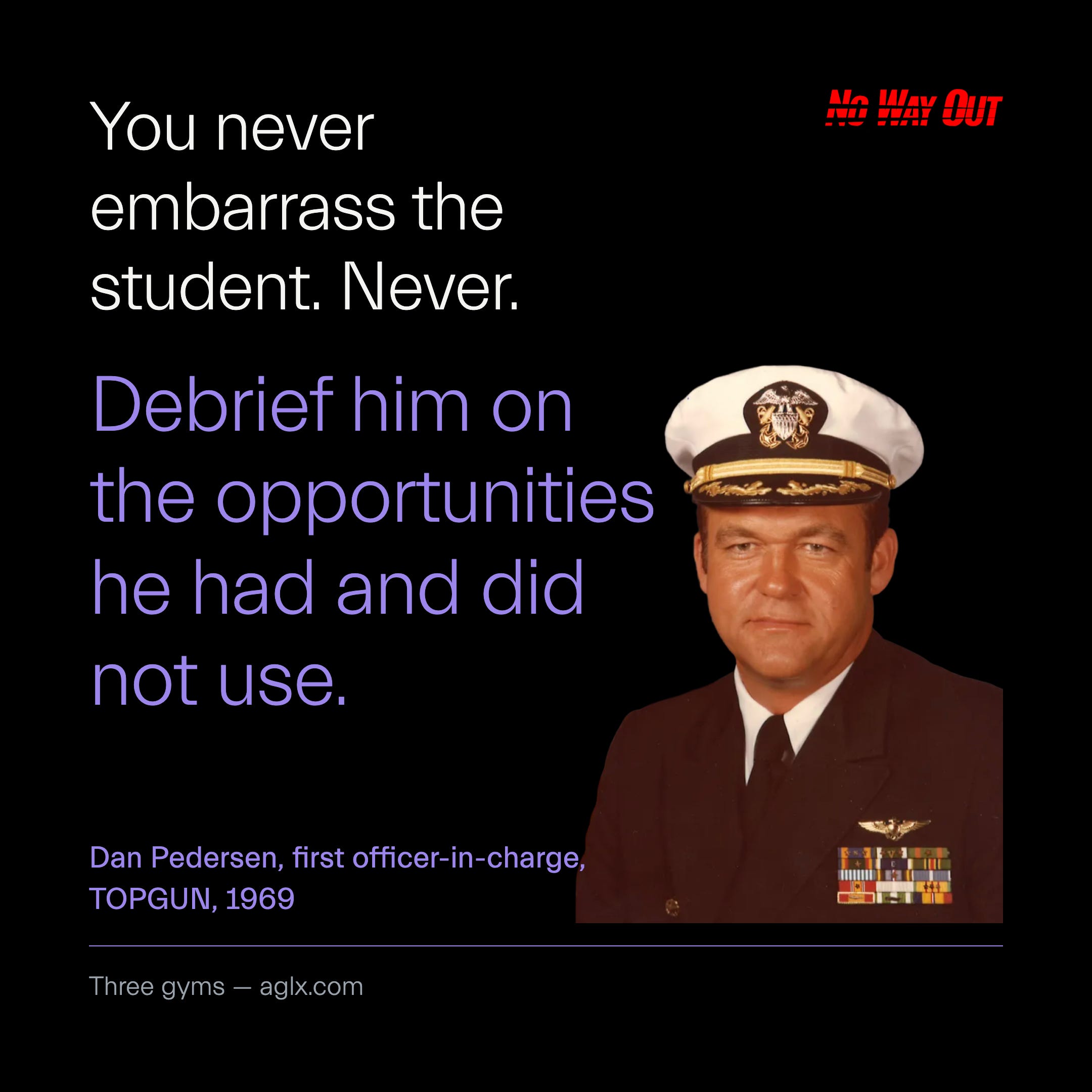
Read that a second time with a coach’s ears, because it is not what any of us were taught a correction is.
He is not debriefing what the kid did wrong. He is debriefing what the situation was offering that the kid never saw. The gap is not in the technique. The gap is in what he was able to perceive.
Gibson has a word for what the world offers you. Affordances. Pedersen built his debrief around them in 1969 and never needed the word.
Brief, free play, debrief. Intent, constraints, discernment. It is the same loop the constraints-led people are still fighting to get into basketball, and the Navy built it first, and built it because the alternative was getting people killed.
And there is one more thing, which is that the people on the coaching science side have been pointing at us this whole time.
Rob Gray told me that if there is any place this approach obviously belongs, it is the military and the police, because you cannot possibly script what you are going to walk into. He is right, and it is a little funny from where I am standing. The sport scientist points at the military as the obvious case. Meanwhile I am standing in a Navy gym watching lines and whistles.
Gray also handed me the question I would ask before any of mine. He says teams come to him and say we do not have good decision makers. And he asks them how much time in practice anybody actually makes a decision, or whether they only ever do what they were told beforehand.
That question does not need a framework, a citation, or a consultant. Any coach can answer it about their own Tuesday in about four seconds, and most of them will not like the answer.
So here is the only other question I would put in writing to an athletic department.
Does your practice design match your leadership doctrine?
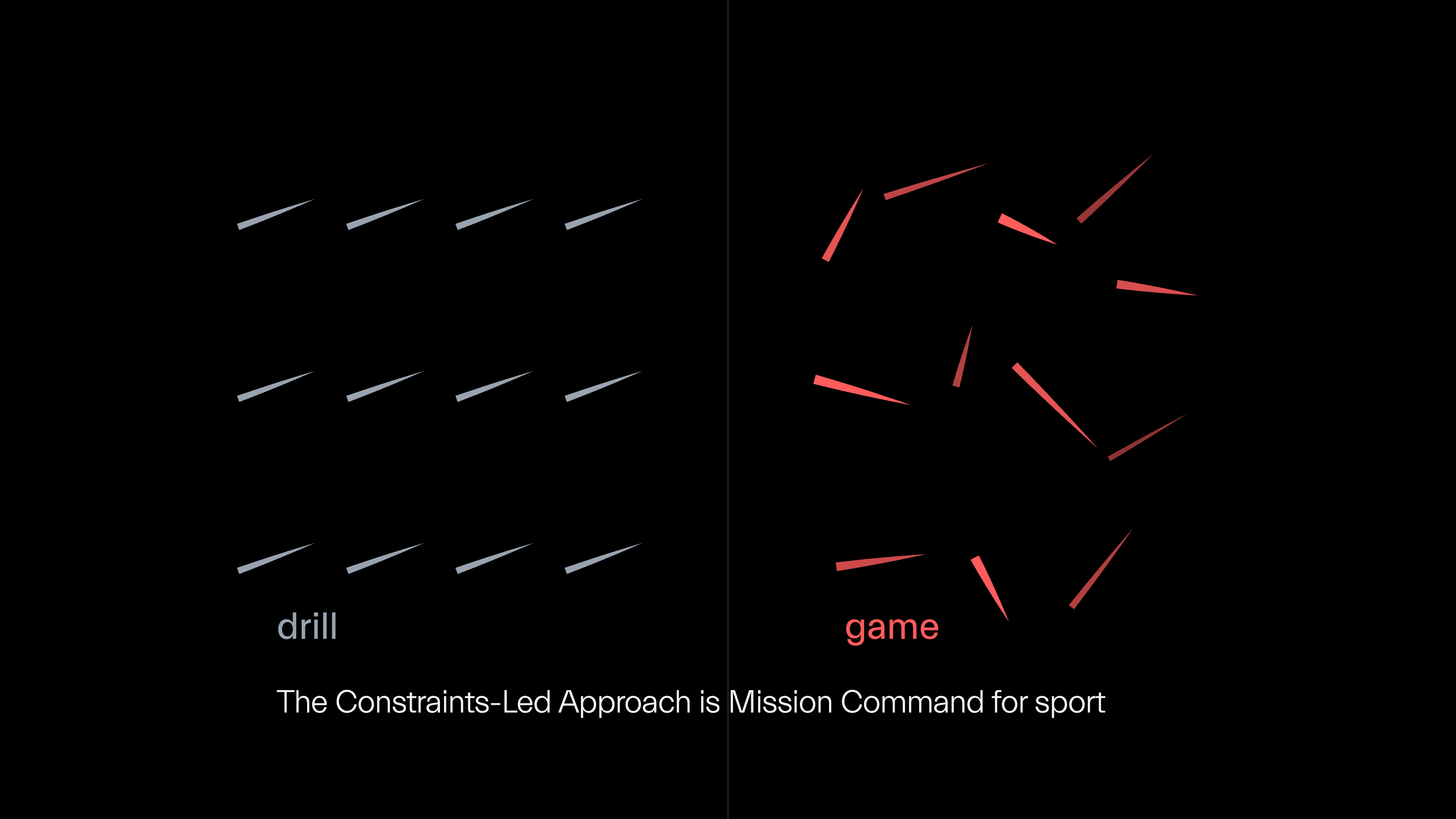
Not the speeches. Not the mission statement. Not the poster in the weight room. Your Tuesday afternoon. Because if a midshipman learns in a classroom that a leader gives intent and boundaries and then trusts the edge, and learns on the court that a leader gives step-by-step instruction and correction, one of those two lessons is going to win.
It will be the one that got a thousand reps.
The kids at that PGC camp could tell me what problem they were solving. Not the footwork. The problem. The assistant coach on their high school team came out of Annapolis knowing exactly what a leader is supposed to do, and nobody ever told her the Navy had already built the way to do it.
We got the first half right.
The gym is where we gave the second half away.
-Ponch
***Researched and drafted with AI, reported and verified by me. This is still a long, painful process.
Most of what follows came from conversations on No Way Out rather than from books.
What I watched at the Naval Academy was an elite camp, not a varsity practice. Camps are recruiting and evaluation events. I have kept the claim to what I actually saw.
Pedersen, D. No Way Out. The first officer-in-charge of the Navy Fighter Weapons School, on why the school was built, how instructors were selected, and what a debrief is for.
Bernacchi, R. Alignment, harmony, and the fuzz: Blue Angels leadership, debriefing, and the OODA loop. No Way Out, episode 160, 31 March 2026.
Vandergriff, D. No Way Out. Two conversations on Mission Command, commander’s intent, and how it has to be taught.
Gray, R. No Way Out. On constraint design, guiding self-organization, and what most coaches get wrong about the constraints-led approach.
Myszka, S. Why the NFL combine fails: OODA, constraints-led coaching, and the future of football cognition. No Way Out, 18 May 2026.
Friston, K. Karl Friston decodes the real OODA loop: active inference and what Boyd got right. No Way Out, 28 April 2026.
Boyd, J. R. A discourse on winning and losing (G. T. Hammond, Ed.). Air University Press. Contains Organic design for command and control, where Boyd retitles his own briefing Appreciation and leadership.
Boyd, J. R. Organic design for command and control. Presentation, Marine Corps Command and Staff College, Quantico, 25 April / 2 May / 3 May 1989. Transcript in Snowmobiles and grand ideals.
Boyd, J. R. The conceptual spiral. The Ohno and Shingo material is in the question period, not the briefing.
Boyd, J. R. Working notes, 7 June 1989. The source of “our orientation should emphasize outside-in and bottom-up.”
AGLX. John Boyd’s conceptual spiral: full transcript with slides. Foreword by Chet Richards, 2024.
Osinga, F. P. B. Science, strategy and war: the strategic theory of John Boyd. Routledge.
Musashi, M. The book of five rings, 1645. Two translations appear in Boyd’s own source list for Patterns of conflict: Victor Harris, 1974, and Nihon Services, 1982.
Headquarters, Department of the Army. ADP 6-0: Mission command: command and control of Army forces, 2019. The seven principles, and the two passages this article leans on, at 1-59 and 3-49.
Headquarters, Department of the Army. FM 100-5: Operations, 1982. The formal adoption of the German-derived concept, thirteen years after Coach K graduated.
U.S. Marine Corps. FMFM 1: Warfighting, 1989. Drafted by John Schmitt at the direction of General Alfred M. Gray. Superseded in 1997 by MCDP 1: Warfighting, also Schmitt.
Brown, I. A new conception of war: John Boyd, the U.S. Marines, and maneuver warfare. The book on how Boyd’s thinking became Marine Corps doctrine.
Vandergriff, D. E. Adopting mission command: developing leaders for a superior command culture. Naval Institute Press, 2019.
McChrystal, S., Collins, T., Silverman, D., and Fussell, C. Team of teams: new rules of engagement for a complex world. Portfolio/Penguin, 2015.
Taylor, F. W. The principles of scientific management, 1911. Worth reading once, so you can recognise it when you see it on a practice plan.
Renshaw, I., Davids, K., Newcombe, D., and Roberts, W. The constraints-led approach: principles for sports coaching and practice design. Routledge, 2019.
Sarama, A. Transforming basketball.
Gibson, J. J. The ecological approach to visual perception. Houghton Mifflin, 1979.
Langewiesche, W. Stick and rudder: an explanation of the art of flying, 1944. Where a lot of this starts, in a cockpit, describing what a pilot sees on the way down.
Newell, K. M. Constraints on the development of coordination. In M. G. Wade and H. T. A. Whiting, eds., Motor development in children: aspects of coordination and control. Martinus Nijhoff, 1986.
Ault, F. W. Report of the air-to-air missile system capability review. Naval Air Systems Command, 1969. The report that went looking for a hardware problem and found a training problem.
Pedersen, D. Topgun: an American story. The eight instructor-selection standards are in the foreword.
Elward, B. TOPGUN: the Navy Fighter Weapons School: fifty years of excellence.
Comments
Nothing yet. Say the first thing.
Sign in to join the conversation.