
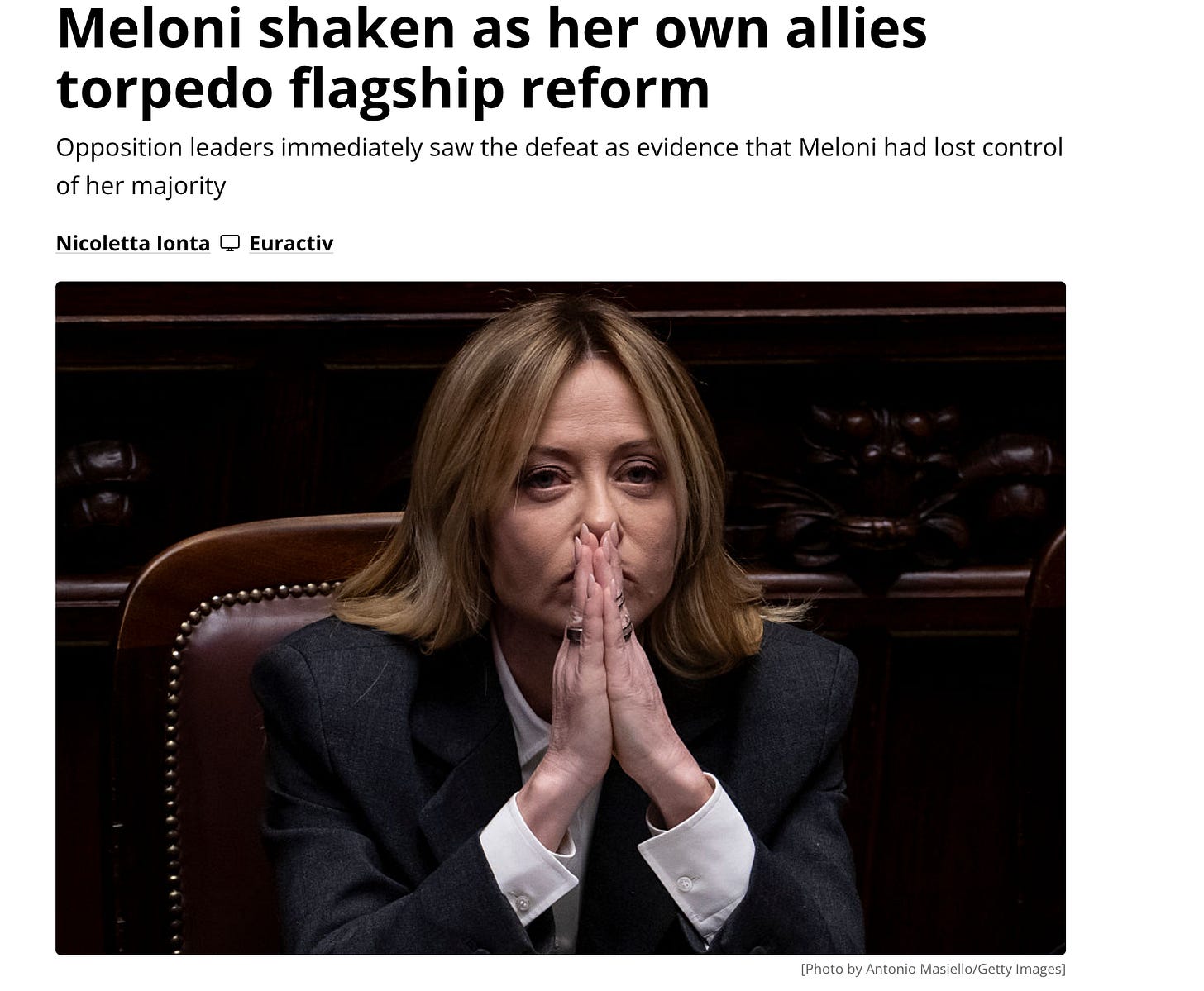
My top story this week concerns a parliamentary drama that played out in Italy’s Chamber of Deputies over three long days. At stake was the right-wing coalition’s controversial electoral reform, which proposes to maintain PR while introducing major ‘bonuses’ to leading candidates in order to guarantee ‘governing stability’. Initially, it looked like the bill was a dead duck: on Tuesday evening, a key amendment suffered a narrow, surprise defeat when more than 30 coalition lawmakers broke ranks under the cover of a secret ballot, voting alongside the opposition to defeat the government’s proposal 188 to 187. The rebellion was in-part fuelled by a controversial clause tucked into the text that would have abolished the current requirement of gender parity on candidate lists; a detail that alienated several female MPs. In a rapid turnaround that silenced the opposition’s brief celebrations, however, the government somehow rallied its numbers, and a few hours ago, the lower house pushed past the infighting and overwhelmingly approved the draft legislation. While the PD and M5S continue to denounce the reform as an attempt by Giorgia Meloni to rig the system in her favour ahead of the 2027 elections, the ruling coalition has secured its majority for the time being and the rebellion has, for now, vanished into thin air. The bill will next move to the Senate, where the text will face renewed scrutiny following the summer recess. For more details in the meantime, check out Nicoletta Ionta’s coverage over at Euractiv.
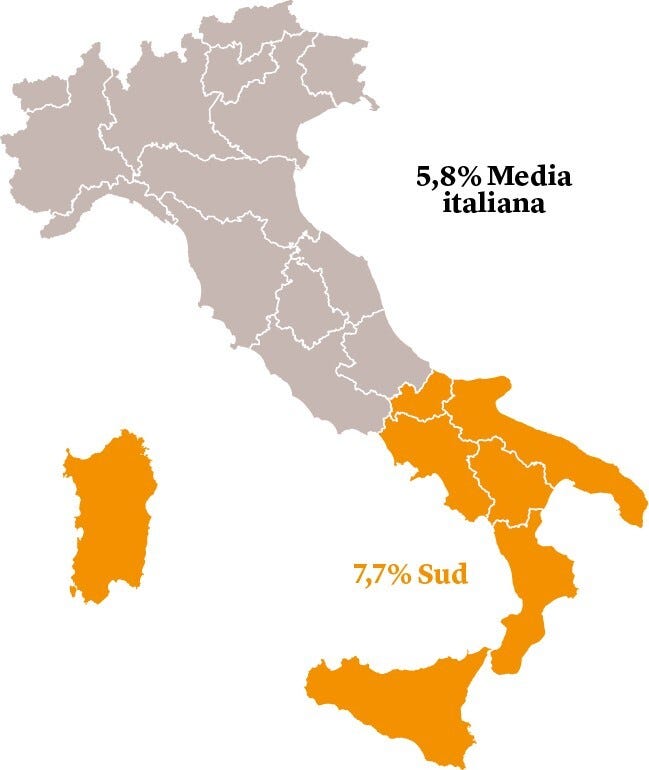
The Italian South is a land of competing caricatures. For romantics, it is a wild paradise of sun-baked baroque towns and crumbling stone villages. For cynics, it is a political hell crippled by underdevelopment, organized crime, and systemic corruption. Sometimes, though, data can help cut through such ossified stereotypes. New economic indicators reveal that, far from stagnating, the mezzogiorno is in fact growing at a faster rate than the industrial North! Between 2019 and 2024, GDP in the South increased by 7.7%, compared to 5.8% in the rest of Italy. At the heart of this unexpected surge is Naples, which has outpaced Milan in growth in recent years thanks to strategic public-private initiatives like the Apple Developer Academy, the Scampia medical complex, and a targeted influx of EU recovery funds. This momentum is mirrored in regional hubs like Bari and Catania, where engineering and tech investments are actively fuelling local economic recovery. Of course, all this should be taken with a pinch of salt. The historic divide has not vanished, and raw growth figures do not automatically translate into robust public services and equitable wages. Nevertheless, this is a key development that demonstrates a shift in the traditional chasm between North and South, and the possibility of a future for Campania and Puglia that isn’t entirely tied to seasonal tourism.
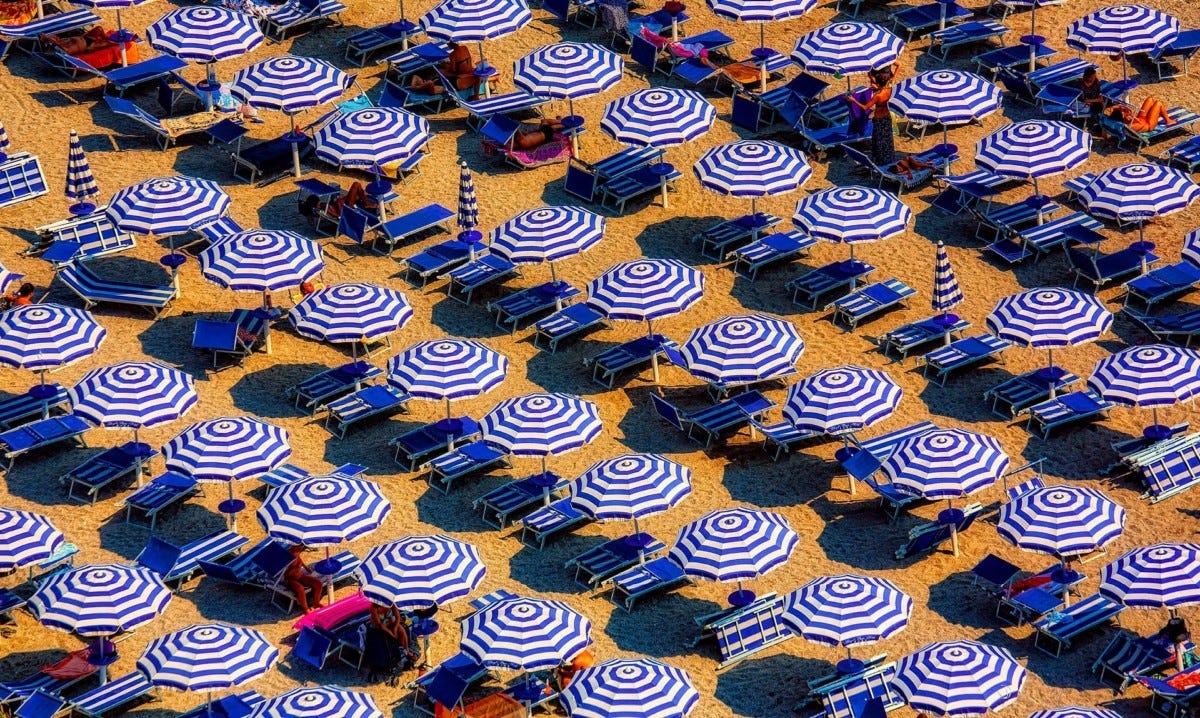
A couple of weeks ago, I spent some time in Rapallo on the Ligurian coastline for a brief beach break. It was my first time exploring this particular stretch of the region, and I was charmed indeed by the dramatic natural landscape and picturesque villages. What really caught my journalistic eye, however, was the absence of spiagge libere: free, public beaches. In Rapallo at least, nearly every accessible inch of shoreline was claimed by stabilimenti, private beach clubs, where fees to secure a sun lounger and an umbrella can amount to more than 60 euros per day. The class dynamics of this privatization are something I’ll be unpacking in a longer essay soon, but in the meantime, I wanted to highlight an interesting report on the same issue by Angela Giuffrida over at The Guardian that documents the deepening tension. Focusing on the so-called ‘panino police’ debacle, she interviews many Italians, most of whom are keen to offer their own criticisms of how corporate greed is de-democratizing the Italian summertime. If you’re heading to the coast this summer, then, check it out here.
While scrolling through my feeds this week, I came across a thought-provoking piece in Compact Magazine by the historian Mark Sedgwick, reviewing Andrea Scarabelli’s new biography, Julius Evola: An Adventurous Life. While Compact’s editorial line is usually not my cup of tea — I find it often ends up perpetuating the culture-war posturing it claims to deconstruct (?) — the subject of Evola is always worth dwelling on. Evola was a complex, highly dangerous author who cannot simply be dismissed as a conventional fascist; he was often critical of Mussolini, he was denied entry to the Fascist Party, and he maintained an anti-modern traditionalism that transcended orthodox political boxes. The real gravity of Evola’s legacy, though, lies in his esoteric philosophy and most of all his idiosyncratic interpretations of Buddhism and Hermeticism. In an era where neoliberal secularism feels increasingly exhausted, these mystical currents are finding a new resonance across the political spectrum, and this phenomenon surely warrants close, critical dissection. As Sedgwick astutely puts it: “Evola’s work matters because it is read, and should be read because it matters.” Read the full review here.

On a lighter note, the brilliant curators at My Analogue Journal on YouTube have just published a new guest vinyl set by the Italian DJ and producer Nicola Conte. What makes this particular mix so refreshing is its refusal to indulge in the typical bel paese nostalgia that characterises so much Italophilic enthusiasm on social media. Instead, Conte, whose career has bridged everything from bossa-nova-infused acid jazz to deep archival TV soundtracks, takes us on a cosmopolitan journey through 1970s Italian cosmic jazz. This was a fascinating era of musical cross-pollination, where Italian musicians were eagerly digesting and fusing sounds from Latin America and West Africa. The session, which features forgotten gems from the likes of the Gianni Basso Quartet and Mandrake Som Sombossa, is gorgeous and deeply atmospheric. Whether you are a dedicated crate-digger, then, or simply looking for a chill soundtrack for the late afternoon or golden hour, this has my full endorsement.
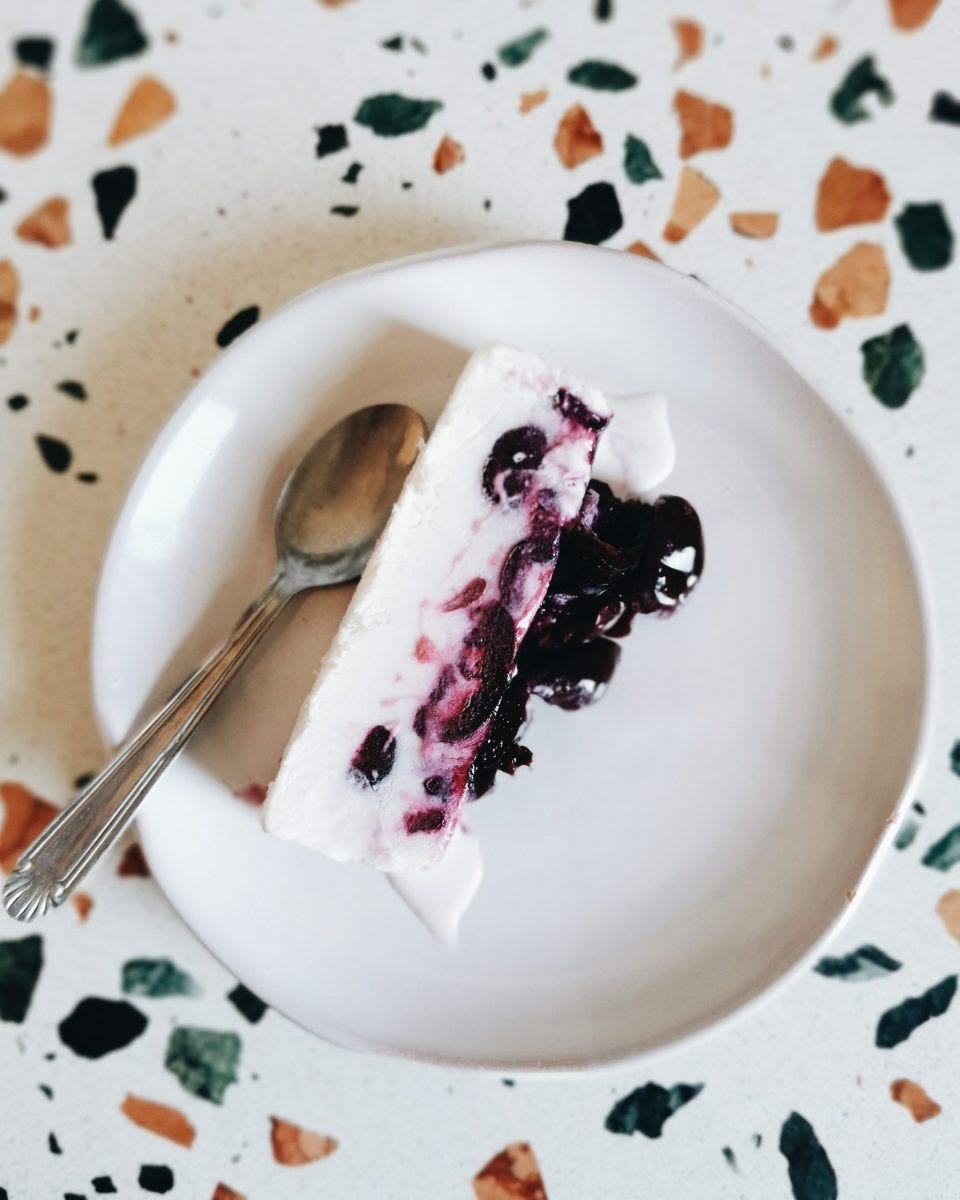
We have reached the very end of the cherry season here in Florence, and the last crates are sadly beginning to vanish from market stalls. While I’m of course enjoying the peaches, melons and nectarines that are so abundant right now, I always feel a twinge of melancholy when the cherries disappear. The silver lining? These late bloomers are fabulous: dark, jammy, and packed with that rich, almost savoury concentration of sugars that only the July heat can coax out. It’s the perfect moment, in other words, for a final blowout. This week, I’m turning to a recipe from Emiko Davies’s blog; a simple, four-ingredient cherry semifreddo. Unlike classic versions that require a meringue-like base, Davies’ recipe is comprised of just four ingredients: whipped cream, a touch of yogurt, sugar, and the fruit itself. It is quick to assemble, forgiving, and can sit in the freezer for a few days, no problem. For anyone else looking for a way to savour the last of the season’s cherries, then, check out the full recipe here.
I’m Jamie Mackay, a UK-born, Italy-based writer, working at the interfaces of journalism, criticism, poetry, fiction, philosophy, travelogue and cultural-history. I set up the Week in Italy a few years ago to cover ‘under the radar’ news. Since then this space has evolved to focus on politics, social issues, travel, books, music and film with particular attention to indie and underground culture that doesn’t get enough press. This is a labour of love, and journalism is my full time job, so if you like what you read please consider a paid subscription, buying my book, The Invention of Sicily, or simply help spread the word. Grazie!
Comments
Nothing yet. Say the first thing.
Sign in to join the conversation.