
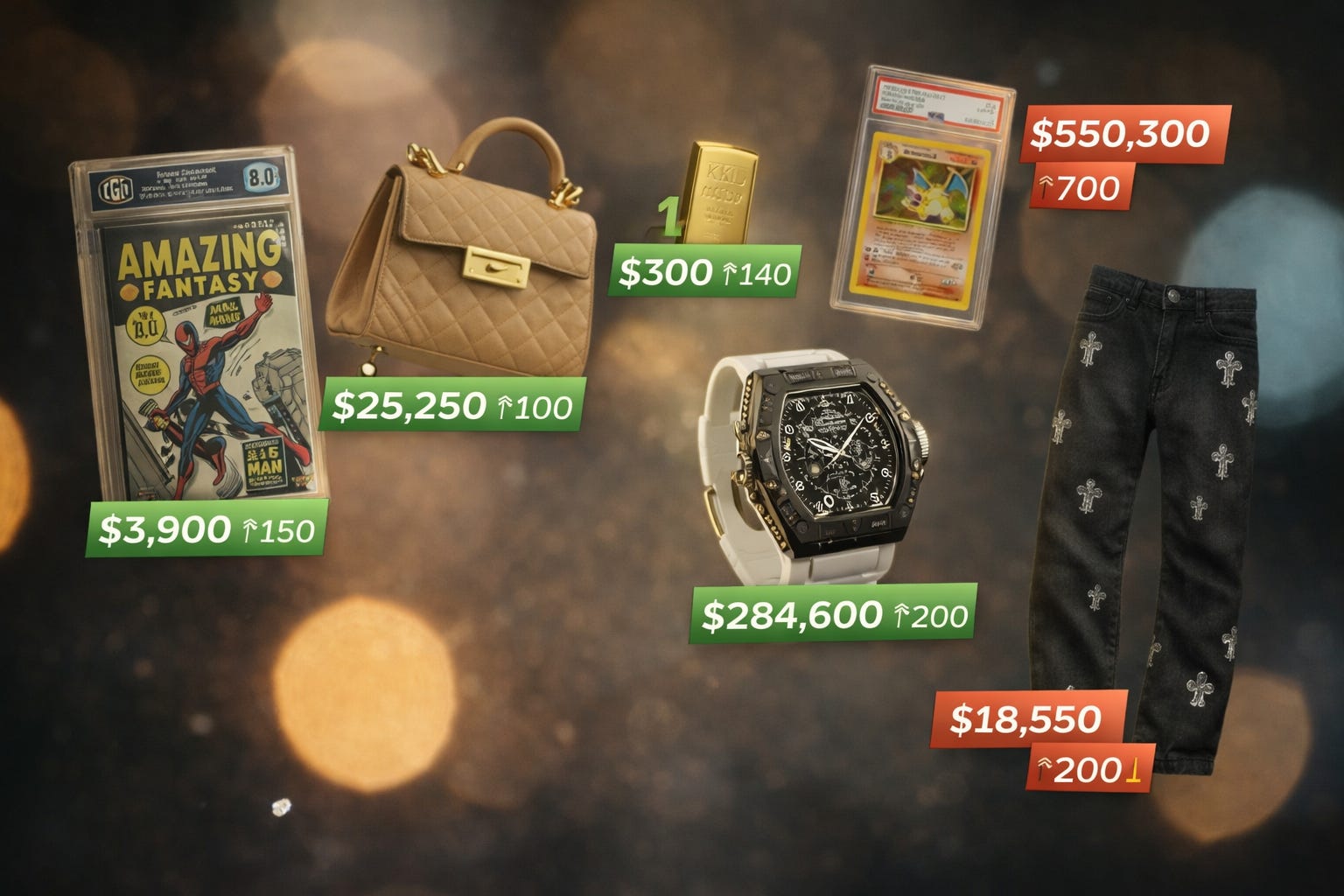
A friend of mine tried to sell an Omega Speedmaster last year on 47th in NYC. Bought it for £6,200. Wore it twice. Market value at the time, around £5,800. He tried everything. Best offer from a grey dealer? £3,400. A consignment shop said £3,800 but it would take 4-6 weeks and they’d charge 20% commission on top. He ended up on eBay. Sold it for £4,100, minus 12.9% in fees, minus shipping, minus insurance. Walked away with about £3,500.
On a watch the market said was worth nearly six grand.
That’s a 40% haircut and it happens every single day, across every category.
Cards, handbags, sneakers, watches, sealed product, wine, art. The thing changes. The spread doesn’t.
The global secondary market for physical goods is worth $400 billion. More than the GDP of most countries. And the infrastructure supporting it is eBay listings with blurry photos, Facebook groups where a guy named Dave says he’ll give you a good price, and Whatnot streams where you’re bidding against strangers at 2 AM hoping the card arrives graded correctly.
There is no Bloomberg terminal for Pokémon cards. No Kelley Blue Book for watches. No real-time pricing for sealed product or vintage handbags. No authentication layer. No vaulting.
A flea market with WiFi.
Every financial market has a spread. The gap between what buyers pay and what sellers receive. On the NYSE, fractions of a penny. On forex, measured in pips.
On physical goods with resale value? 40%.
If your brokerage skimmed 40% every time you sold a stock, you’d close the account and file a complaint. In secondary markets, people just accept it. They call it “the game.” Nobody questions it because nobody’s ever seen it work differently.
You can trade a derivative on the Japanese yen from your phone in 200 milliseconds. You can’t get a fair price on a Rolex Daytona or a sealed booster box without calling three people, checking four websites, and ultimately taking whatever someone offers you because there’s no transparent price and no liquid venue. The spread isn’t a market feature. It’s a symptom of missing infrastructure.
Something happened in the last five years that most people measured wrong.
A generation of 25-to-35-year-olds started pulling $80K to $200K from remote work, crypto, content creation, AI. Not trust fund kids. People with laptops and taste. They didn’t do what their parents did with money. They didn’t buy a house in the suburbs or max out a 401k.
They bought grails.
A PSA 10 Charizard. A sealed Base Set box. A Rolex Submariner they’ll never wear in the ocean. A Supreme brick, for God’s sake. A handbag that costs more than a used car, stored in a closet, appreciating faster than the S&P.
Housing is broken. Equities feel rigged. So people pour money into things they understand and care about. Honestly, if you zoom out, it might be the most rational allocation decision of the last decade. People buying what they know, holding what they love, watching it outperform their ISA & 401K.
But the infrastructure to price, trade, vault, and liquidate these assets? Doesn’t exist. You can check a stock price on 40 different apps in real time. You can’t check the fair market value of a Cartier Tank, a sealed Evolving Skies box, or a Birkin 25 without cross-referencing three websites, two Discord servers, and a guy on Reddit who “tracks this stuff.”
For ten years they told you to own less.
Throw it out.
Marie Kondo your life into a backpack.
One phone. One plate. One personality.
It lasted about a year.
Then sealed product prices tripled. Then watches became an asset class. Then people started putting Pokémon cards in bank vaults. A whole generation grew up being told stuff doesn’t matter, then realised that stuff, the right stuff, is the single best store of value they have access to.
Minimalism was a trauma response to 2008 dressed up as philosophy. The correction was always coming. Humans collect. We’ve done it since before we had language. Not a phase. Not consumerism. Something deeper. You see it in kids with stickers. You see it in billionaires with art. Same impulse, different price point.
The question was never “will people stop buying things?”
Here’s what most readers won’t know: the real customer in secondary markets isn’t the end buyer. It’s the dealer.
Dealers are market makers. The card vendor, the watch dealer, the vintage handbag reseller, the sneaker consignment shop. They buy at a % discount, authenticate, store, list, sell at retail. They set prices. They provide liquidity. They are the infrastructure, because nobody else built it for them.
I spoke to a mid-size card and sealed product dealer recently. Does about $120K per month in transactions. His setup: a spreadsheet for inventory, WhatsApp for customer comms, three different platform accounts he juggles simultaneously, and a pricing method that boils down to “I check eBay solds, TCGPlayer, and whatever I saw sell on Whatnot last week.” His authentication process? Fourteen years of experience and a UV light.
He’s running a six-figure monthly business with tools most people would find embarrassing for a side hustle. And he’s not unusual. He’s average.
These dealers lose 15-25% of potential margin to operational inefficiency alone, before platform fees even touch them. Give them real-time pricing and they price faster. Give them authentication infrastructure and they sell with confidence. Give them vaulting and they stop shipping every individual item. Give them an exchange and they access demand they could never reach from a single platform.
Fix the dealer, fix the market.
In 1985 you had to call a broker, who called a floor trader, who shouted at another floor trader, to buy a stock. Spreads were wide. Information was asymmetric. Settlement took five days. Then electronic exchanges happened. NASDAQ went digital. Spreads collapsed. Settlement went from T+5 to T+1. Real-time pricing became universal.
Physical secondary markets in 2026 are where equities were in 1985. Worse. At least in 1985 there was a regulated exchange. Cards, watches, bags, sealed product? There isn’t even a price everyone agrees on.
(So we’re building one.)
Real-time pricing across categories. Cards, watches, handbags, sealed product, sneakers. Fair market value sourced from actual transaction data. Real numbers, continuously updated, source and confidence level exposed. Look up any collectable or asset, know what it’s worth in 30 seconds. One place.
Instant liquidity. You have something valuable and you want cash. Get an instant offer based on real market data. Skip the listing, the waiting, the negotiating, the shipping, the praying.
Vaulting. Authenticated. Insured. Photographed. Sell it, trade it, use it as collateral without touching it. Ownership moves digitally. The physical item stays safe. Global.
An exchange. Order book. Bids and asks. Price discovery. The same mechanics that power every financial market on Earth, applied to physical goods with secondary value. From a PSA 10 Charizard to a Patek Philippe Nautilus.
Novel Auctions for the 1/1. Populations are important. If an item has a population of one and only one, it is unique. Many rare items are limited in number, or unique in a way that can’t be compared to others. They deserve to find true price discovery, where the seller gets the most for their item.
$400 billion in demand. Growing double digits. People are already pouring money into cards, watches, bags, sneakers, sealed product, art, wine. The demand isn’t the problem.
The 40% spread is a tax on missing infrastructure. Every point of that spread that gets compressed is value returned to the people who actually own things.
My friend with the Speedmaster? In a functioning market, he walks away with £6,000, not £3,500. That £1,500 difference didn’t go to anyone useful. It just evaporated into friction.
Multiply that by every watch, every card, every bag, every sealed box changing hands today. That’s the opportunity. That’s the waste.
The flea market gets its exchange.
See how we’re solving this: @altworths Launching soon
No posts
Comments
Nothing yet. Say the first thing.
Sign in to join the conversation.