
Last Veterans Day, I wrote about the extraordinary life of Peter Ortiz, a French Foreign Legionnaire, U.S. Marine, and OSS operative whose exploits during World War II seemed a lot more like fiction than history. Not long afterward, I was contacted by award-winning journalist Katie Sanders, who told me she and Nicholas Reynolds had written a new biography about Ortiz. Her interest was deeply personal, as her late grandfather was one of the Allied airmen Ortiz helped rescue from occupied France.
Recently, Katie was kind enough to send me an advance copy of their forthcoming book, Ortiz’s War: The Allies’ Secret Weapon Against the Nazis in France. I thought I already knew Peter Ortiz’s story. I quickly discovered how much I didn’t know.
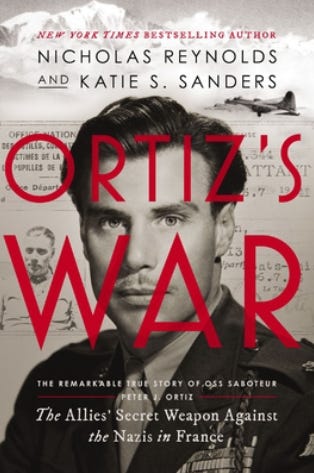
Ortiz’s War is meticulously researched history, but it doesn’t read like a conventional history book. It reads like an adventure novel and the most remarkable part is that it all actually happened.
One of the things I found most interesting was learning more about the world Ortiz came from. His father, Philippe Ortiz, was a sophisticated and well-connected figure in European publishing and an executive at Paris Vogue. Peter grew up in circumstances that could have led to a comfortable and privileged life. He lived in Grenoble, France, and could easily have followed his father into a fashionable European world.
Instead, as a young man, Ortiz walked away from that life and joined one of the toughest military organizations in the world, the French Foreign Legion. He thrived in the Legion, serving with distinction in North Africa in the 1930s. After his service commitment ended, Ortiz traveled to his mother’s home in La Jolla, California. He first worked at a dude ranch before joining a circus and eventually working a lion tamer in a circus. Those adventures in America didn’t last long.
When World War II began, Ortiz returned to the Legion in order to defend France. He was wounded, captured by the Germans, escaped captivity, and eventually made his way back to the United States. Once back in America, he could have remained safely out of the war. Instead, he enlisted in the Marine Corps.
The Marines quickly realized that their new enlisted man was hardly an ordinary recruit. Ortiz already possessed extensive combat experience and decorations for valor. He was commissioned as an officer and his unique abilities eventually brought him to the Office of Strategic Services (OSS), the wartime intelligence organization that preceded the CIA. This is where Ortiz’s War became even more difficult to put down.
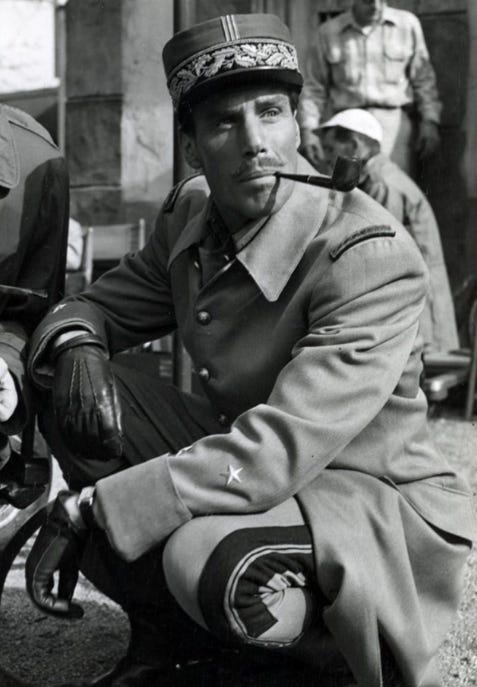
In 1944, Ortiz parachuted into Nazi-occupied France to work alongside the French Resistance. Yet one of the details from the book that I found most striking was Ortiz’s insistence on maintaining his identity as a United States Marine. Despite operating secretly behind enemy lines, Ortiz proudly wore his Marine Corps uniform during missions in occupied France.
One of my favorite episodes in the book concerns the formation of the team that accompanied Ortiz on his second mission into France. After returning to London from his previous mission, Ortiz was recuperating and receiving his first Navy Cross when he happened to encounter a group of fellow Marines.
They were Paramarines from Camp Lejeune, North Carolina, who had been sent to Britain to participate in OSS and special operations programs. The chance encounter ultimately helped shape Ortiz’s next team. Several of those Marines joined him for “Union II”, parachuting into occupied France in August 1944.
It is precisely this sort of detail that makes Ortiz’s War so enjoyable. Sanders and Reynolds show us the personalities and individual decisions behind those events. A chance encounter between Marines in wartime London ultimately helped assemble a team that would soon be operating together behind German lines in France.
Among the people Ortiz helped save during his service in occupied France were downed Allied airmen. One of them was Katie Sanders’s grandfather. To me, there is something remarkable about that fact. More than eighty years after a Marine operating behind enemy lines helped save a young airman’s life, that airman’s granddaughter has helped tell the Marine’s story.
Despite all of the adventure in Ortiz’s life, the book makes clear that he was more than an adventurer. He possessed an extraordinary sense of duty. That became very evident during the Union II mission. Ortiz and his team eventually found themselves surrounded by German forces near the village of Centron. Knowing that continued resistance would bring horrible reprisals against French civilians, Ortiz made the decision to surrender.
For a man who had spent much of his adult life fighting, surrender probably took more courage than pulling a trigger. Ortiz understood what capture by the Germans could mean for an Allied operative working behind enemy lines, but he was willing to risk his own life instead of endangering the villagers.
That episode captures something important about Peter Ortiz. Courage isn’t simply a willingness to face danger. It is a willingness to accept danger on behalf of someone else. Ortiz did that again and again.
What Sanders and Reynolds have accomplished with Ortiz’s War is more than a catalog of those adventures. They have taken a man whose résumé sounds almost mythical and made him human. Their research is detailed without weighing down the story, and both authors are extremely well suited to tell this story.
Sanders is an award-winning journalist whose family connection gives the project an unusually personal dimension. Reynolds is a former Marine and CIA officer who later served as historian of the CIA Museum. The result is both authoritative and very entertaining.
When I first discovered Peter Ortiz, I thought I had found a man who seemed to have lived a dozen lives in one. After reading Ortiz’s War, I think I underestimated him. More importantly, Sanders and Reynolds helped me better understand the man behind those adventures. Ortiz was certainly restless and daring, but when the moments came that demanded real courage, he repeatedly placed himself in danger for others. That is what separates the adventurer from the hero.
I highly recommend Ortiz’s War. Katie Sanders generously provided me with an advance copy, but I have no financial interest in recommending it. I simply think it is a fabulous book and well worth reading. It is one of the most enjoyable works of military history I’ve ever read.
Even if you don’t normally read military history, I think you’ll find this one difficult to put down. If you like stories about courage, espionage, adventure, the French Resistance, the Marine Corps, or simply extraordinary lives, Ortiz’s War belongs on your reading list.
Ortiz’s War: The Allies’ Secret Weapon Against the Nazis in France, by Nicholas Reynolds and Katie Sanders, will be released August 25, 2026.
When I finished it, I came away with essentially the same question I had when I first discovered Peter Ortiz: How have more Americans never heard of this man? Thanks to Sanders and Reynolds, I suspect that’s about to change.
Thanks for reading! This post is public so feel free to share it.
No posts
Comments
Nothing yet. Say the first thing.
Sign in to join the conversation.