
The Truce That Never Existed: How Saudi-Houthi Deterrence Was Mistaken for Peace
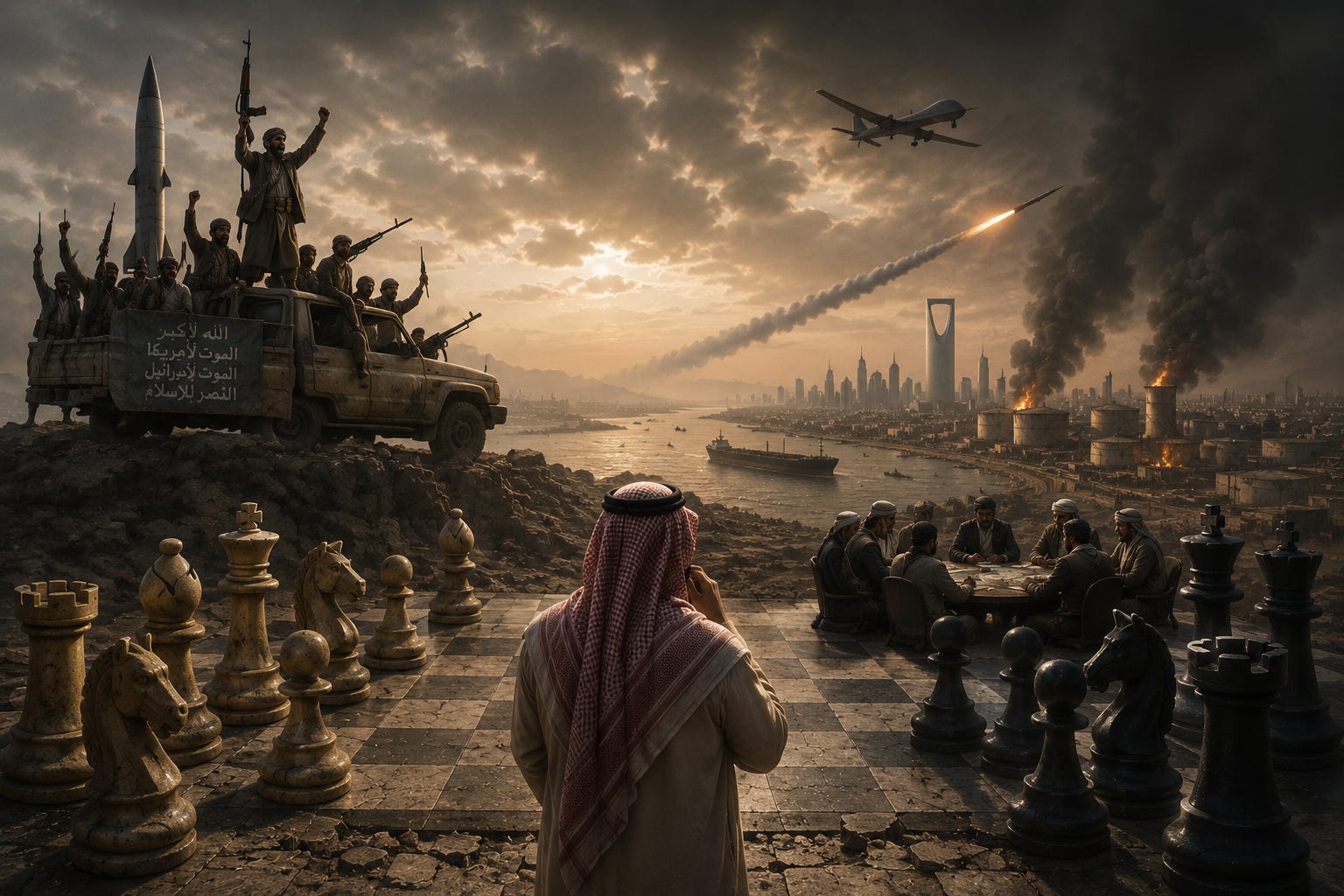
The renewed exchange of fire between Saudi Arabia and the Houthis has produced an instant obituary for a “two-year truce.” That description has been repeated so frequently that it now sounds like an established historical fact. The calendar tells a different story. The formal United Nations truce began on April 2, 2022, received two extensions, and expired on October 2, 2022. It lasted six months. The subsequent years formed an armed stand-down governed by private communication, Omani mediation, Saudi fear of renewed attacks, Houthi demands for money and recognition, Iranian regional calculations, and the shared expectation that missiles could return whenever diplomacy stopped delivering sufficient benefits.
The distinction matters because the word “truce” creates assumptions about written commitments, reciprocal obligations, agreed boundaries, monitoring procedures, and a common understanding of prohibited conduct. The Saudi-Houthi relationship possessed none of those features after October 2022. It rested on a narrower proposition: Riyadh would reduce direct military pressure and pursue an exit from Yemen, and the Houthis would largely refrain from striking Saudi territory while negotiations continued. Violence inside Yemen, economic attacks against the internationally recognized government, Houthi military expansion, maritime warfare, weapons development, political repression, and preparations for renewed regional confrontation all continued during the supposed calm.
The events of July 2026 have exposed the arrangement’s actual character. Strikes hit Sana’a International Airport amid a dispute over an Iranian aircraft carrying a Houthi delegation, and the Houthis responded with missiles and drones targeting Abha International Airport and southern Saudi Arabia. Houthi officials warned airlines about Saudi airspace and linked further restraint to the lifting of restrictions on Sana’a airport. The internationally recognized Yemeni government defended the airport operation as an assertion of sovereignty against unauthorized Iranian flights. Within hours, every unresolved issue returned at once: sovereignty, Iranian access, Houthi control of national infrastructure, Saudi security, the status of the blockade, and the movement’s ability to threaten civilian aviation and strategic facilities across the border.
Six months became four years through creative accounting
The original UN truce had a recognizable structure. It covered offensive military operations inside Yemen and across its borders. It provided for fuel shipments through Hudaydah, limited commercial flights from Sana’a, and discussions on reopening roads in Taiz and other governorates. The decline in large-scale hostilities brought real relief. Civilian casualties fell, flights resumed on a restricted basis, and fuel imports increased. Families divided by years of war gained limited opportunities to travel, receive medical treatment, and reconnect with relatives abroad.
Implementation remained partial. The roads around Taiz stayed largely closed. Armed forces retained their positions and strengthened some of them. Salary disputes remained unresolved. The parties never converted the temporary arrangement into a comprehensive ceasefire. When the Houthis pressed additional demands concerning payments to civil servants, military personnel, and security employees in the territories under their control, the extension process failed. The agreement expired on October 2, 2022, and the UN continued trying to preserve its practical benefits without a renewed mandate.
Media accounts gradually stretched the six-month document into an open-ended peace. Every additional month without a major Houthi strike on Riyadh or a renewed Saudi bombing campaign became part of the same imaginary truce. The starting date remained April 2022, even after the agreement governing that period had vanished. By 2023, some analysts described a year-long truce. By 2024, it had become a two-year truce. Later references expanded it to three or four years. The term acquired a rolling expiration date because no document defined the period after October 2022.
This chronological inflation also erased the difference between the UN process and the bilateral Saudi-Houthi channel. The UN truce formally involved Yemen’s warring parties and addressed nationwide issues. The subsequent talks increasingly revolved around Saudi Arabia’s security and its withdrawal from direct involvement. Oman facilitated private contacts focused on the border, cross-border attacks, airports, ports, salaries, reconstruction commitments, and the conditions under which Riyadh could remove itself from the Houthi target list. The Yemeni government frequently learned about major proposals after Saudi and Houthi negotiators had already shaped them.
The formal truce therefore ended after six months. The unofficial stand-down followed a separate timetable, with shifting terms, changing participants, and no ratified agreement. Combining the two periods creates the false impression of continuity. It also grants the later arrangement a diplomatic legitimacy that neither Riyadh nor the Houthis ever formally accepted.
Riyadh wanted an exit, and the Houthis priced it accordingly
Saudi Arabia entered Yemen in March 2015 expecting a relatively short campaign that would restore the internationally recognized government and roll back the Houthi takeover. The war developed into an expensive demonstration of the limits of conventional military superiority. Saudi aircraft destroyed military sites, infrastructure, government buildings, roads, bridges, warehouses, and communications facilities. The Houthis retained Sana’a, expanded their security apparatus, embedded themselves more deeply in northern institutions, and developed the ability to strike Saudi cities and strategic assets.
By 2022, Riyadh had powerful reasons to reduce its exposure. Years of civilian casualties had damaged the kingdom’s international reputation. The campaign generated sustained criticism in Washington and European capitals. The Saudi leadership had also placed Vision 2030 at the center of national policy, tying its domestic legitimacy to investment, tourism, logistics, entertainment, technology, industrial development, and vast construction projects. Houthi missiles and drones created a direct threat to that agenda.
The Houthis understood the pressure points with considerable precision. Previous attacks against airports, oil facilities, industrial sites, border cities, and energy infrastructure had shown that even limited strikes could create global headlines, affect insurance calculations, disrupt aviation, and raise questions about Saudi Arabia’s ability to protect flagship projects. Riyadh’s military could inflict immense damage on Yemen, and the Houthis could impose politically embarrassing and economically disruptive costs on the kingdom. This balance encouraged restraint without producing trust.
Saudi leaders began treating border security and protection of domestic infrastructure as the central measure of success. The restoration of a functional Yemeni state receded from immediate reach. The defeat or disarmament of the Houthis no longer appeared achievable at an acceptable price. Direct negotiations offered a route toward securing Saudi territory and transferring responsibility for the remaining war back to Yemeni actors.
The Houthis recognized that Saudi urgency increased their bargaining power. They demanded salary payments for employees in Houthi-controlled territory, expanded access through Hudaydah, more flights from Sana’a, reconstruction funds, the departure of foreign forces, and a political relationship with Riyadh that placed them on the level of a state authority. They also wanted control over the distribution of funds, which would strengthen their patronage system and deepen the dependence of the population on Houthi institutions.
The resulting talks resembled negotiations over the price of Saudi disengagement. Riyadh sought guarantees concerning missiles, drones, the border, and strategic infrastructure. The Houthis sought money, access, recognition, and freedom from external pressure. Yemen’s national political future remained unresolved because the immediate conversation concerned the interests of two armed powers, one trying to leave the battlefield and the other trying to convert military survival into permanent authority.
Yemen continued paying for Saudi-Houthi quiet
The reduction in attacks against Saudi Arabia never brought a comparable end to coercion inside Yemen. Only weeks after the formal truce expired, the Houthis launched drone and missile attacks against government-controlled oil terminals in Hadramawt and Shabwa. These operations halted exports and deprived the internationally recognized government of its principal source of revenue. Fighting also continued along front lines in Taiz, Lahj, Hudaydah, and other areas as opposing forces fortified positions and prepared for possible escalation.
The oil port attacks revealed the practical terms of the new arrangement. The Houthis could devastate the finances of their Yemeni opponents and preserve restraint toward Saudi Arabia. Riyadh could continue negotiations because its own territory remained relatively secure. The internationally recognized government lost revenue needed for electricity, salaries, basic services, currency support, and institutional survival. Saudi Arabia then faced greater pressure to provide financial assistance, giving Riyadh additional burdens and the Houthis additional leverage.
This was economic warfare conducted during the period widely described as peace. The Houthis attacked the government’s capacity to govern, then demanded that government oil revenue finance salaries in Houthi-controlled areas. Their position gave them multiple advantages. They could weaken the Presidential Leadership Council, fuel public anger in government-held territory, intensify dependence on Saudi aid, and present themselves as defenders of public-sector employees in the north. The demand for salaries carried humanitarian appeal and simultaneously advanced Houthi political control.
Armed incidents also continued near the Saudi border. In September 2023, a Houthi drone strike killed Bahraini soldiers serving with the Saudi-led coalition. The attack occurred during an active diplomatic phase and shortly after a Houthi delegation visited Riyadh. The parties contained the fallout because they wanted negotiations to survive. The absence of a major retaliatory campaign reflected political calculation. There was no joint investigative body, agreed attribution procedure, or enforcement mechanism capable of handling the incident under a recognized ceasefire framework.
The internal structure of Yemen remained deeply fragmented throughout this period. Houthi authorities ruled much of the north through an increasingly coercive security system. The Presidential Leadership Council presided over competing political interests, military formations, regional patrons, and local power centers. The Southern Transitional Council pursued its own project. Armed groups maintained separate chains of command. Rival monetary systems and currency values divided the economy. Roads and front lines divided families, markets, and supply routes.
Calling this environment a truce gave outside audiences an easy story: the bombing had stopped, diplomacy was advancing, and Yemen had entered a postwar phase. Yemeni civilians continued living under wartime political and economic conditions. The reduction in airstrikes removed one source of terror and death, providing meaningful relief. The state remained broken, the economy remained weaponized, and every major actor retained armed forces capable of restarting large-scale combat.
The Red Sea campaign revealed the narrow scope of the arrangement
The Houthi maritime campaign after October 2023 should have ended any serious description of the period as a comprehensive truce. The movement attacked commercial vessels, seized ships, launched missiles and drones across the Red Sea, threatened Bab el-Mandeb, fired toward Israel, and drew sustained American and British military action against targets in Yemen. The Houthis became a major regional military actor capable of disrupting global trade and influencing the strategic calculations of the United States, Israel, Iran, Egypt, Gulf states, shipping companies, and European governments.
Saudi Arabia worked carefully to avoid participation in the American and British campaign. Riyadh had no desire to reactivate direct war with the Houthis. Saudi officials understood that support for Western strikes could bring Houthi missiles back toward airports, oil facilities, ports, desalination plants, border communities, and the kingdom’s expanding Red Sea projects. The government’s caution preserved Saudi security for a time and allowed the Houthis to conduct a regional war from Yemeni territory without attacking the kingdom.
The supposed truce therefore covered one relationship and one class of targets: direct Saudi-Houthi strikes. It did not govern Houthi attacks on shipping, Israel, Yemeni oil infrastructure, government forces, or regional adversaries. It did not restrict weapons development, military recruitment, Iranian assistance, coastal deployments, missile storage, drone production, or maritime surveillance. It did not establish a nationwide political process accepted by Yemen’s principal constituencies.
The Houthis also gained strategic value from Saudi restraint. They could present themselves as a regional power confronting Israel and the United States while keeping open a negotiating channel with Riyadh. Their Red Sea campaign increased their popularity among some audiences, expanded their influence within Iran’s network, and demonstrated their ability to impose costs on international commerce. Their control over northern Yemen grew more entrenched as the outside world focused on maritime security.
A peace process capable of surviving such developments would have required explicit rules governing regional attacks launched from Yemeni territory. The Saudi-Houthi channel had no such provisions. Riyadh concentrated on protecting Saudi assets and preventing renewed bilateral war. The Houthis preserved freedom to operate beyond that narrow boundary. The arrangement’s durability depended on the movement’s willingness to separate its Saudi policy from its wider military agenda.
A coercive bargain sustained by permanent threats
The post-2022 calm functioned through mutual vulnerability. Saudi Arabia retained overwhelming airpower and the ability to strike Houthi infrastructure throughout northern Yemen. The Houthis retained missiles and drones capable of reaching sensitive Saudi targets. Both sides used the possibility of escalation to influence the other’s decisions. Every negotiation occurred in the shadow of potential attacks.
The Houthis repeatedly linked Saudi security to concessions involving airports, ports, salaries, revenue, military pressure, and diplomatic recognition. Their message remained consistent: Saudi Arabia could enjoy calm as long as Riyadh respected Houthi red lines and continued moving toward an acceptable agreement. Saudi officials conveyed their own warnings through Omani mediators, direct contacts, coalition statements, and military preparations. Restraint became a renewable transaction with no final settlement.
This arrangement also allowed both parties to avoid politically difficult admissions. Saudi Arabia could reduce its military role without publicly acknowledging that the campaign had failed to restore the Yemeni government to Sana’a. The Houthis could negotiate with the kingdom while maintaining a narrative of resistance and victory. Riyadh described diplomacy as an effort to support peace. The Houthis described Saudi concessions as proof that military pressure had forced the aggressor to retreat.
Omani mediation helped manage communication and prevent incidents from producing immediate escalation. Oman provided access, discretion, and working relationships with Saudi Arabia, Iran, and the Houthis. Mediation reduced the risk of miscalculation and kept proposals alive. It could not supply the missing political agreement, compel disarmament, reconcile Yemen’s competing authorities, or create an enforcement system from understandings that the parties preferred to keep informal.
The proposed roadmap came close to formalization in late 2023. It reportedly addressed salaries, exports, airports, ports, roads, ceasefire provisions, and a later Yemeni political process. The Houthi maritime campaign interrupted its progress, and discussions continued without producing a signed settlement. As of April 2026, renewed Saudi-Houthi contacts still revolved around a framework developed through direct bilateral consultations mediated by Oman, with major Yemeni actors warning that it had been shaped without adequate national participation.
A deal that remained unsigned for years could not serve as the legal basis for a truce that supposedly governed those same years. It served as evidence of unfinished bargaining.
Iran remained embedded in the equation
The Saudi-Iranian normalization agreement of March 2023 created a more favorable climate for Saudi-Houthi talks. Riyadh hoped that improved relations with Tehran would reduce regional pressure and limit Houthi attacks. Iran gained diplomatic access to Saudi Arabia and relief from a period of acute confrontation. The Houthis continued developing their own political and military agenda within a close relationship with Tehran.
Iranian support had already helped transform the Houthis from a powerful Yemeni insurgency into a regional missile, drone, and maritime force. Components, technical knowledge, training, political coordination, and strategic guidance expanded the movement’s capabilities. The Houthis retained meaningful autonomy in local decisions and derived enormous benefit from their place within Iran’s regional architecture.
The 2026 confrontation over the Iranian aircraft at Sana’a airport illustrates the unresolved problem. The Houthi authorities acted as though they possessed full sovereign authority to receive foreign flights, conduct relations with Tehran, and move delegations through infrastructure under their control. The internationally recognized government asserted its legal authority over Yemeni airspace and civil aviation. Saudi Arabia viewed direct Iranian access to Houthi-held territory through a security lens shaped by years of missile and drone attacks.
The clash emerged from the institutional vacuum that the supposed truce had left untouched. Yemen still had two governments claiming authority over the same airspace. The Houthis still possessed a military relationship with Iran. Saudi Arabia still considered that relationship a direct threat. Sana’a airport still carried humanitarian, political, military, and symbolic importance. A single flight activated every dormant dispute and returned missiles to the Saudi border.
The name concealed the danger
A truce requires identifiable parties, defined obligations, an agreed duration, verification arrangements, procedures for resolving incidents, and some expectation of accountability. The post-October 2022 Saudi-Houthi arrangement lacked each of these foundations. Its duration remained undefined. Its terms remained partly secret. Its territorial scope remained unclear. Its relationship to the Yemeni government remained disputed. Its enforcement depended on deterrent threats.
Calling it a two-year truce also minimizes the years of armed activity that continued around it. The Houthis attacked oil infrastructure, expanded their internal security state, developed weapons, fought Yemeni opponents, threatened regional targets, and launched a maritime campaign with global economic consequences. Saudi Arabia maintained military forces, financed allies, defended its border, and preserved the option of airstrikes. Both parties negotiated with weapons in hand.
The arrangement still produced important benefits. It reduced cross-border attacks, sharply curtailed Saudi airstrikes, spared civilian lives, enabled limited flights and fuel imports, and gave mediators space to work. Those gains belong in any fair assessment. They describe de-escalation under armed pressure, with progress tied to a temporary convergence of interests.
The formal truce lasted from April to October 2022. The following period was an extended Saudi-Houthi stand-down embedded in an active Yemeni war and an expanding regional conflict. Riyadh wanted border security, protection for Vision 2030, and an exit from a failed military campaign. The Houthis wanted money, access, recognition, and freedom to consolidate power. Oman kept the channels open. Iran remained connected to Houthi military growth. Yemen’s recognized government struggled to survive economically and politically while negotiations over its country increasingly occurred without its full participation.
The July 2026 escalation did not destroy two years of peace. It exposed four years of creative labeling. Saudi Arabia and the Houthis had postponed direct war through deterrence and bargaining. They had never resolved the causes of confrontation, defined the rules of restraint, or built institutions capable of managing the next crisis. Once the incentives changed, the missiles returned.
The Houthis Never Stopped Their Savagery in Yemen
Any account of the Saudi-Houthi “truce” that measures calm by the number of missiles crossing into Saudi territory erases what continued inside Yemen. The Houthis did not suspend the methods through which they seized and retained power. They deepened them. The reduction in Saudi airstrikes gave the movement greater freedom to consolidate its security apparatus, redirect resources toward internal control, intensify ideological indoctrination, expand military recruitment, and punish communities that resisted its authority. Northern Yemen moved further into an authoritarian wartime order in which political loyalty, religious conformity, access to employment, humanitarian assistance, freedom of movement, and personal safety increasingly depended on submission to Houthi institutions.
The movement had already developed a large network of intelligence services, prisons, prosecutors, courts, supervisors, neighborhood monitors, tribal intermediaries, and armed units by the time the formal UN truce began in April 2022. The quieter military environment allowed those bodies to operate with less external pressure. Security agencies continued arresting journalists, activists, lawyers, academics, aid workers, religious figures, political opponents, former government employees, and civilians accused of communicating with foreign organizations. Many detainees entered facilities outside ordinary judicial supervision, where families received little information about their whereabouts and no reliable indication of when they might be released. The accusation of espionage became a broad political weapon capable of criminalizing independent reporting, humanitarian data collection, criticism of corruption, contact with international institutions, and private expressions of hostility toward the movement.
Former detainees and human rights investigators have repeatedly described beatings, electric shocks, prolonged isolation, stress positions, threats against relatives, forced confessions, denial of medical care, and sexual abuse. Houthi officials have also used detention as a source of revenue and leverage. Families may face demands for money to learn where a relative is being held, arrange a visit, secure a transfer, obtain medical treatment, or negotiate release. This system turns imprisonment into a mechanism of punishment, intimidation, and extraction. A single arrest can impoverish an entire household while warning neighbors, colleagues, and relatives against political activity.
The judicial machinery gives many of these abuses a formal appearance. Houthi-controlled courts have issued death sentences against political opponents, journalists, religious minorities, and people accused of assisting foreign enemies. Proceedings involving national security charges frequently rely on confessions obtained in detention, secret evidence, politically appointed prosecutors, and judges operating within a system that offers little institutional independence. Defendants may receive limited access to counsel, face repeated delays, or discover that the judgment has already been determined by security officials. Public prosecutions allow the movement to portray repression as lawful defense of the state, even though the state it claims to defend emerged from an armed seizure of the capital and the destruction of Yemen’s constitutional order.
Executions and death sentences also serve a wider psychological purpose. The possibility that criticism, foreign contact, or political affiliation could lead to accusations of treason creates fear far beyond the individuals placed on trial. Every family watching a relative disappear into detention learns that procedural rights offer little protection. Every journalist sees the cost of investigating corruption or military activity. Every aid worker understands that ordinary professional communication can be reframed as espionage. Houthi authorities do not need to imprison the entire population when selective brutality produces widespread self-censorship.
The movement’s control over education has become equally important to its long-term project. Schools, universities, summer camps, mosques, cultural centers, and public offices provide channels for ideological mobilization. Textbooks and teaching materials increasingly present the Houthi leadership’s religious and political worldview as the natural foundation of Yemeni identity. Lessons glorify sacrifice, martyrdom, armed resistance, obedience to the movement’s leaders, hostility toward designated enemies, and the special religious status claimed by the Houthi ruling family. Teachers face pressure to attend ideological programs, supervise political activities, encourage participation in military-themed events, and incorporate movement narratives into ordinary instruction.
The educational campaign reaches well beyond formal curricula. Children attend summer programs filled with religious instruction, military symbolism, political slogans, weapons displays, and stories of battlefield heroism. Public ceremonies celebrate dead fighters and encourage young people to view enlistment as a sacred duty. Schools display images of Houthi leaders and commanders. Families receive visits from recruiters, local supervisors, tribal figures, and religious authorities who frame military service as a contribution to faith, honor, and national defense. The quieter front lines did not end child recruitment. They gave the movement time to institutionalize it.
Poverty strengthens the recruiters’ hand. Many families have lost salaries, savings, businesses, land, and access to public services after years of war. A household unable to buy food or medicine may find it difficult to resist a promise of money, social status, educational support, or assistance for the relatives of a fallen fighter. Children from poor families, displaced communities, tribal areas, and households already connected to Houthi military networks face especially intense pressure. Some join through indoctrination, some through economic desperation, and some because refusal could bring retaliation against their families.
The use of children also reshapes the social environment surrounding the war. A generation raised through militarized schooling, martyrdom culture, weapons training, and sectarian political instruction enters adulthood with fewer opportunities to imagine civilian life outside the movement’s control. Houthi leaders have invested in a durable social order that continually reproduces fighters, loyal administrators, informants, and ideological enforcers. This strategy extends the war beyond current battlefields and embeds it within families, schools, religious institutions, and local economies.
Women have faced a parallel expansion of control. Houthi authorities have imposed increasingly restrictive rules on travel, employment, public participation, and humanitarian work. Women may need a male guardian to travel between governorates, pass through checkpoints, or undertake professional assignments. Female aid workers and civil society activists have encountered surveillance, harassment, interrogation, detention, and accusations of immoral conduct or foreign collaboration. These restrictions obstruct humanitarian programs, reduce access to medical care, prevent women from supporting their families, and force many experienced professionals out of public life.
The repression of women reflects the movement’s broader effort to control social behavior through security power. Houthi authorities have used morality campaigns, neighborhood surveillance, religious instruction, and intimidation to regulate clothing, movement, work, education, public gatherings, and interaction between men and women. Security officials can turn ordinary personal choices into evidence of political unreliability. Women who challenge these restrictions risk punishment that often extends to their families, employers, and colleagues. The result is a climate in which social conformity becomes inseparable from political obedience.
Religious minorities have endured particularly severe persecution. The Baha’i community has faced arrests, forced displacement, property seizure, incitement, and accusations of serving foreign interests. Houthi rhetoric has portrayed religious difference as a security threat, allowing authorities to justify repression through a combination of sectarianism and conspiracy. Yemen’s remaining Jewish population has also faced pressure and displacement, accelerating the disappearance of a community with roots extending back centuries. These campaigns narrow Yemen’s religious and cultural space while reinforcing the Houthis’ claim that only their ideological interpretation deserves institutional protection.
Economic coercion has become another defining feature of Houthi governance. The movement collects customs duties, taxes, religious levies, licensing fees, checkpoint payments, commercial assessments, and mandatory contributions linked to military and political events. Businesses may receive demands to fund celebrations, commemorations, recruitment campaigns, propaganda activities, and support programs for fighters’ families. Merchants who resist can face closure, confiscation, detention, or accusations of disloyalty. Property belonging to political opponents, displaced families, minorities, and people associated with the former government has been seized or placed under the control of Houthi-appointed custodians.
These practices have created a wartime economy that enriches senior networks while much of the population remains dependent on humanitarian relief. Houthi authorities collect extensive revenue in the territories they control and continue blaming external enemies for unpaid salaries and collapsing services. The leadership uses the salary issue as a negotiating demand toward Saudi Arabia and the internationally recognized government while directing domestic revenue toward military institutions, security bodies, patronage networks, and ideological programs. Public employees bear the consequences through years of irregular or missing pay.
The attack on oil export facilities in government-held areas extended this economic warfare across the internal front lines. By targeting ports in Hadramawt and Shabwa, the Houthis deprived the internationally recognized government of revenue used for salaries, electricity, currency support, hospitals, infrastructure, and local administration. The movement then demanded access to public funds while continuing to weaken the authorities responsible for generating them. This strategy aggravated inflation, blackouts, unemployment, and institutional collapse throughout government-controlled territory, expanding the pressure on civilians who had no influence over the negotiations.
Humanitarian assistance has also become a field of political control. Houthi officials have interfered with beneficiary lists, restricted access to communities, pressured agencies to hire approved personnel, demanded control over data, and attempted to influence where aid is distributed. Local authorities can reward loyal communities and punish areas viewed as politically unreliable. Aid organizations often face a choice between accepting intrusive conditions and losing access to vulnerable populations.
The arrest of employees working for international and humanitarian organizations has made that pressure unmistakable. Houthi security bodies have accused Yemeni staff members of espionage, detained them without transparent evidence, and broadcast coerced confessions designed to support claims of foreign infiltration. These prosecutions create fear among aid workers and undermine the ability of agencies to collect accurate information, monitor distribution, investigate diversion, or communicate honestly with donors. The movement seeks continued access to international resources while resisting independent oversight of how those resources are managed.
Houthi control over information serves the same purpose. Journalists face arrest, threats, closure of media outlets, surveillance, and restrictions on reporting. Independent coverage of corruption, detention, military losses, recruitment, public discontent, economic hardship, or internal rivalry can attract immediate attention from the security services. The movement maintains a dense propaganda environment through television, radio, mosques, schools, public events, social media, and neighborhood mobilization. It portrays itself as the defender of Yemen, Palestine, Islam, and national sovereignty while treating domestic criticism as evidence of betrayal.
The quieter period also failed to end attacks against civilians in contested and government-held areas. Houthi forces continued using artillery, drones, missiles, snipers, mines, and road closures to pressure opposing communities. Taiz remained a powerful example of long-term collective punishment. Years of blocked roads forced civilians onto dangerous mountain routes, increased the price of food and fuel, restricted access to hospitals, separated families, obstructed trade, and turned ordinary journeys into exhausting and expensive ordeals. The partial reopening of some routes never erased the years of deliberate isolation.
Land mines have extended Houthi violence far beyond active combat. Mines and improvised explosive devices placed in roads, farms, homes, grazing areas, and routes used by displaced people continue killing and maiming civilians. Farmers cannot safely return to fields. Families attempting to rebuild encounter explosives near homes and wells. Children find unfamiliar objects that detonate when touched. Mine contamination preserves territorial control, delays reconstruction, frightens displaced communities away from returning, and guarantees that casualties will continue long after a front line becomes inactive.
Tribal communities have also faced a mixture of co-optation and punishment. The movement relies on tribal leaders for recruitment, dispute resolution, surveillance, fundraising, and local enforcement. Leaders who cooperate may receive access, positions, weapons, or economic privileges. Those who resist risk detention, property seizure, armed raids, political exclusion, or pressure against relatives. Houthi authorities have repeatedly demonstrated that local autonomy exists only within boundaries defined by the movement’s security interests.
This pressure reaches the families of Houthi fighters themselves. Public ceremonies glorify sacrifice and provide recognition to the relatives of the dead, while the movement continues demanding recruits from communities already devastated by years of war. Families may feel pride, fear, grief, economic need, and social obligation at the same time. The constant production of martyrs becomes a method of social organization, binding households to the movement through loss, benefits, honor, and expectations of continued service.
The diplomatic focus on Saudi-Houthi negotiations obscured much of this reality. International mediators concentrated on cross-border attacks, ports, airports, salaries, roads, oil exports, and the outline of a political roadmap. The Houthis gained the status of a negotiating authority while facing limited pressure over political prisoners, child recruitment, religious persecution, judicial abuse, aid diversion, repression of women, or the militarization of education. Each meeting with Saudi, Omani, UN, or foreign representatives strengthened the movement’s claim to political legitimacy.
Saudi Arabia’s priorities encouraged this narrow agenda. Riyadh wanted protection for its border, airports, oil facilities, ports, and economic projects. A negotiation focused on Houthi internal repression would have complicated the kingdom’s effort to disengage and created obligations Saudi leaders had little appetite to enforce. The Houthis understood that Riyadh needed a security arrangement more urgently than it needed political reform in Sana’a. They used that imbalance to seek money, access, and recognition while preserving the machinery through which they controlled the population.
The years of reduced Saudi-Houthi fire therefore gave the movement strategic breathing room inside Yemen. Houthi leaders strengthened intelligence services, expanded indoctrination, improved recruitment, deepened control over public institutions, extracted more revenue, and continued punishing dissent. Their relative restraint toward Saudi Arabia arose from the benefits of negotiation and the risks of provoking another large-scale campaign. Their violence against Yemenis remained central to the operation of Houthi power.
A truce that protects Saudi territory while leaving millions of Yemenis exposed to detention, extortion, ideological coercion, child recruitment, land mines, economic warfare, and political repression deserves a more accurate name. It was a pause in one channel of attack, arranged between actors pursuing their own security and political interests while Houthi brutality continued across the territory under their rule.
Operation Epic Fury Exposed the Extent of Iran’s Control Over the Houthis
Operation Epic Fury made the Iranian command structure in Yemen unusually visible because the war forced Tehran to activate political, diplomatic, logistical, and military channels that had operated more discreetly during the preceding years. Iran’s ambassador remained in Houthi-controlled Sana’a, Iranian aircraft resumed direct travel to the Yemeni capital, senior Houthi leaders flew to Tehran for Ali Khamenei’s funeral, and Iranian officials instructed the movement to prepare for the closure of Bab el-Mandeb if American attacks expanded against Iran’s power infrastructure. Reports that IRGC personnel inside Yemen would determine the timing of the maritime operation supplied the clearest indication of where authority over the most consequential Houthi military decisions ultimately rested.
Iran’s physical presence in Sana’a had survived the Saudi-Houthi stand-down, the negotiations mediated by Oman, Western strikes on Houthi positions, and Operation Epic Fury’s destruction of major parts of Tehran’s regional command network. Iranian ambassador Ali Mohammad Rezaei, whose name has also appeared in reporting as Ali Razaei, continued operating from the Houthi-controlled capital even though Yemen’s internationally recognized government had never accredited him. His public reappearance in July 2026 followed a long period of secrecy and included meetings with Houthi Deputy Foreign Minister Abdulwahid Abu Ras and other senior officials. Tehran had preserved a permanent political representative inside the governing structure created by the Houthis after their seizure of Sana’a, giving Iranian leaders a direct channel into the movement’s senior political, security, and military circles.
The ambassadorial title offered formal cover for a relationship with far broader responsibilities. An Iranian envoy living under Houthi protection could transmit instructions, arrange consultations, report on internal debates, coordinate messaging, evaluate Saudi and Yemeni government activity, and facilitate access for technical or intelligence personnel. He could also serve as a direct intermediary between the Houthi leadership and the IRGC during periods when secure communications became more difficult. Operation Epic Fury had killed senior Iranian officials, damaged command facilities, disrupted supply networks, and forced surviving personnel to reconstruct lines of authority under wartime pressure. A trusted representative already present in Sana’a acquired greater importance as Tehran tried to preserve one of the few elements of its regional network that retained extensive territory, functioning missile units, access to a major maritime corridor, and the ability to threaten American allies.
Regional reporting also connected Rezaei’s return to public view with an operations room established to manage the escalation from Yemen. Reports attributed a supervisory role to senior IRGC figure Abdul Reza Shahlai, long associated with Iranian activity in Yemen and support for the Houthis. The reported arrangement placed an Iranian diplomatic representative and a senior IRGC operative within the same command environment at a moment when the movement was escalating against Saudi Arabia and preparing for possible attacks around Bab el-Mandeb. The ambassadorial channel could manage political contact and public legitimacy, and the IRGC channel could manage targeting, communications, weapons allocation, and the timing of military activation.
The resumption of direct flights between Tehran and Sana’a created a second and far more visible connection. In early July, an Iranian Mahan Air aircraft landed at Sana’a International Airport, marking the first direct air link between the two capitals in nearly a decade. The flight reportedly carried more than 200 passengers. Houthi officials celebrated the arrival as the breaking of a blockade and announced their intention to continue the route. Yemen’s internationally recognized Presidential Leadership Council described the operation as a violation of Yemeni sovereignty because the Houthis had opened an international aviation corridor without authorization from the government legally responsible for the country’s airspace and civil aviation.
The choice of Mahan Air carried considerable security significance. The airline has a long history of association with the IRGC and the Quds Force, including the transportation of personnel, equipment, and resources supporting Iranian operations outside the country. A direct Mahan Air route into Houthi-controlled Sana’a could move diplomats, intelligence officers, technical advisers, missile and drone specialists, communications personnel, documents, money, electronic components, medical personnel, and political delegations. Many of the most valuable items required for advanced weapons systems are small enough to travel inside ordinary cargo or personal luggage, including guidance electronics, encrypted communications equipment, navigation components, sensors, processors, and specialized replacement parts.
Air access would also allow Houthi personnel to travel directly to Iran for training, consultation, medical treatment, weapons instruction, and strategic meetings. Maritime smuggling remains vulnerable to interdiction, weather, port surveillance, and the delays associated with circuitous routes through the Arabian Sea, Somalia, Oman, and the Gulf of Aden. An aviation corridor under Houthi control would reduce travel time, increase the security of senior delegations, and allow Tehran to maintain contact with Sana’a during an active regional war. The Houthis’ immediate determination to institutionalize the route showed that they regarded it as an essential political and strategic connection.
The first return flight to Tehran carried a delegation of senior Houthi officials to Ali Khamenei’s funeral. The delegation reportedly included members of the Supreme Political Council and senior representatives of the Houthi administration. They traveled aboard an Iranian aircraft from an airport controlled by the movement, joined official mourning ceremonies in Tehran, and appeared among foreign delegations paying tribute to the Iranian leader who had presided over the Houthis’ rise as a regional military force.
Their attendance conveyed allegiance, hierarchy, and membership in Iran’s regional order. Khamenei’s leadership had overseen the transfer of weapons knowledge, missile designs, drone technology, technical training, political support, and strategic guidance that allowed the Houthis to move from local insurgency to long-range warfare. Houthi leaders presented themselves at his funeral as representatives of an integral component of that project. Their physical presence beside Iranian officials and other members of Tehran’s network offered a public declaration that the movement’s identity, prestige, and regional mission remained tied to the Islamic Republic.
The funeral trip also created an opportunity for direct wartime consultation. Operation Epic Fury had placed Iran under severe military pressure and disrupted established chains of command. Senior Houthi officials arriving in Tehran could meet surviving political and military leaders, receive updated instructions, discuss weapons availability, assess the future of regional operations, and coordinate responses to American and Israeli attacks. Funeral diplomacy provided an ideal setting for such contacts because large delegations, private meetings, secure compounds, and military ceremonies could accommodate strategic discussions without requiring a separately announced summit.
The trip acquired further importance through the crisis surrounding the delegation’s return. The internationally recognized Yemeni government opposed another unauthorized Iranian flight into Sana’a. Saudi-backed forces struck the airport runway and sought to prevent the aircraft from landing, according to the accounts surrounding the escalation. The Houthis responded with missiles and drones directed toward Abha International Airport and other targets in southern Saudi Arabia, followed by warnings to airlines using Saudi airspace. The confrontation revived direct Saudi-Houthi attacks after years of relative restraint and demonstrated the value the movement placed on preserving the Tehran-Sana’a route.
The immediate dispute concerned an airport, an Iranian aircraft, and the movement of senior Houthi officials returning from Khamenei’s funeral. Its strategic meaning reached much further. Sana’a airport had become a direct Iranian access point into the Houthi capital. Interference with that route threatened the movement’s political relationship with Tehran, the movement of personnel, and the physical infrastructure supporting Iranian influence. The Houthis responded by targeting Saudi aviation, using deliberate symmetry to warn that restrictions on Sana’a airport would create insecurity for Saudi airports.
The episode also exposed the weakness of the assumptions supporting the supposed Saudi-Houthi truce. Riyadh had treated Houthi restraint as the product of bilateral negotiations, economic bargaining, Omani mediation, and the movement’s desire for salaries, port access, reconstruction commitments, and international recognition. Iran’s aviation link became the trigger for renewed attacks on Saudi territory. The Houthis placed the preservation of direct access to Tehran above the years of quiet they had negotiated with Riyadh, and their missile response served the interests of both the movement and its sponsor.
Iran’s instructions concerning Bab el-Mandeb revealed an even higher level of operational authority. In July 2026, Tehran reportedly told the Houthis to prepare to close the strait if the United States expanded its campaign to Iranian power plants and electricity infrastructure. The trigger concerned damage inflicted inside Iran. The proposed response involved missiles and drones launched from Yemen against vessels traveling through the Red Sea gateway. The economic consequences would fall on international shipping, Saudi exports, Egyptian canal revenue, European supply chains, Asian energy markets, and Yemen’s own import-dependent population.
Sources familiar with the preparations reported that the Houthis had already moved missiles and drones into positions capable of striking shipping near Bab el-Mandeb. The movement was awaiting orders. IRGC personnel inside Yemen would determine the precise moment when the closure operation began. That reported division of responsibility described direct command with unusual specificity: Tehran defined the condition for escalation, Houthi units prepared the weapons, Iranian personnel in Yemen retained authority over activation, and the economic target involved a global maritime route.
The reported order also explained why the Iranian ambassador, direct flights, funeral delegation, and military preparations belonged to the same sequence. Tehran was reinforcing its political presence in Sana’a, restoring physical travel between the capitals, consulting senior Houthi officials during Khamenei’s funeral, and preparing the movement to open a second maritime front if American attacks crossed an Iranian threshold. Each activity supported the others. Diplomatic representation maintained continuous contact. Aviation moved personnel and sensitive material. Funeral meetings enabled high-level coordination. IRGC officers supervised military readiness near the strait.
Bab el-Mandeb offered Iran a means of widening the economic consequences of Operation Epic Fury far beyond the Persian Gulf. Tehran had already used the Strait of Hormuz to pressure global energy markets and challenge American naval power. Houthi-controlled territory gave Iran access to the southern entrance of the Red Sea, creating the possibility of simultaneous disruption at two of the world’s most important maritime chokepoints. Iranian forces could pressure Hormuz through missiles, drones, mines, naval units, boarding operations, and attacks on tankers. Houthi forces could attack vessels approaching the Suez route, Saudi Red Sea ports, or the Gulf of Aden.
Coordinated disruption would stretch American and allied military resources across thousands of miles. Naval escorts, air-defense systems, surveillance aircraft, reconnaissance drones, missile interceptors, and strike platforms would have to cover the Persian Gulf and the Red Sea at the same time. Commercial carriers would face difficult choices about whether to transit dangerous waters, accept higher insurance premiums, or divert around the Cape of Good Hope. Saudi Arabia’s effort to redirect energy exports toward the Red Sea in response to instability around Hormuz would face another Iranian-controlled pressure point.
The Houthis’ own economic interests offered no rational reason to close Bab el-Mandeb in response to an American attack on Iranian electricity facilities. Yemen depends heavily on imported food, fuel, medicine, industrial goods, and humanitarian assistance. Maritime disruption would increase prices, delay deliveries, reduce port activity, and deepen the suffering of Yemeni civilians. Iran would gain strategic leverage over Washington and global markets. Houthi leaders would gain political prestige, Iranian support, and another opportunity to mobilize the population around a foreign confrontation.
This arrangement allows Tehran to export the costs of its retaliation. American or allied responses to Houthi maritime attacks would hit Yemen. Airstrikes would damage Yemeni infrastructure and produce Yemeni casualties. The Houthis would use the destruction for recruitment and propaganda. Iran could continue applying pressure from a greater distance, preserving more of its own forces and forcing Washington to divide its campaign across separate theaters.
Iranian influence also shapes the conservation and use of Houthi weapons. The movement possesses local assembly facilities and accumulated stockpiles, and its most advanced missiles, drones, anti-ship systems, guidance packages, engines, seekers, and electronic components depend on Iranian designs, procurement networks, technical assistance, and training. Operation Epic Fury damaged Iranian production facilities, transport links, command structures, and organizations responsible for supplying regional partners. Every sophisticated weapon in Houthi hands became more difficult to replace.
Tehran consequently had a strong incentive to regulate Houthi expenditure. A ballistic missile fired toward Israel could later be needed against a Saudi airport, an American vessel, or a tanker near Bab el-Mandeb. An advanced anti-ship weapon used for a symbolic attack could take months to replace during an intensive interdiction campaign. Iranian authorities controlling critical components and technical support gained substantial influence over when the Houthis launched, which systems they used, and how many remained in reserve for a larger regional crisis.
The Houthis’ delayed entry into Operation Epic Fury reflected these constraints. Their leaders immediately declared support for Iran, organized rallies, issued threats, and portrayed the American campaign as a war against the entire Iranian-led network. Their first major missile response came after a period of waiting, preparation, and Iranian reorganization. The movement conserved capabilities during the opening stage, when Tehran was assessing damage, reconstructing communications, identifying surviving personnel, and deciding how to distribute pressure across its remaining fronts.
Iranian intelligence support adds another element of control. Houthi attacks on maritime traffic require information about vessel ownership, routing, speed, registration, cargo, management, commercial affiliations, escorts, and defensive systems. Yemen’s local surveillance network cannot independently maintain a comprehensive picture of shipping across the Red Sea, Gulf of Aden, Arabian Sea, and western Indian Ocean. Iran can supply commercial tracking data, signals intelligence, naval surveillance, human reporting, and analytical support that allows Houthi crews to convert missiles and drones into a sustained maritime campaign.
The reported presence of IRGC personnel overseeing Bab el-Mandeb preparations gives this intelligence relationship an immediate operational function. Iranian officers can help identify targets, select launch windows, coordinate missile and drone attacks, monitor foreign naval movements, evaluate damage, and adjust subsequent operations. Their authority over the timing of the closure would give Tehran control over the point at which military preparations became a global economic crisis.
Iran’s influence over the Saudi front followed the same structure. The reduction in Houthi attacks against Saudi Arabia after 2022 coincided with Tehran’s own interest in reducing confrontation with Riyadh. The Saudi-Iranian normalization agreement of March 2023 gave Iran incentives to preserve diplomatic channels, weaken American efforts to organize a regional coalition, and allow the Houthis to consolidate their rule without provoking another major Saudi campaign. Houthi restraint supported that policy.
Operation Epic Fury transformed Tehran’s priorities. Iran faced direct attacks on its leadership, military infrastructure, ports, production facilities, transport routes, and power system. It needed additional means of threatening American allies, energy corridors, aviation, ports, and regional investment. The Houthi arsenal offered a ready-made source of pressure. Saudi Arabia’s airports, oil installations, Red Sea infrastructure, desalination facilities, and flagship economic projects remained vulnerable.
The Iranian ambassador’s presence in Sana’a ensured that Tehran could communicate those changing priorities directly. The air route provided movement between the capitals. The Houthi funeral delegation demonstrated political loyalty and enabled wartime consultation. The Bab el-Mandeb order established a specific Iranian trigger for Houthi escalation. The attacks on Saudi Arabia following the airport dispute showed how quickly that regional command relationship could override years of bilateral restraint.
Houthi officials continue to control domestic taxation, prisons, education, tribal appointments, recruitment, property confiscation, and internal political repression. Their regional warfare operates through an Iranian-built military system. Tehran provides critical capabilities, intelligence, strategic direction, supply networks, political backing, and access to a wider command structure. The movement’s local authority and Iran’s regional control function together, with the Houthis governing the territory and the IRGC shaping how that territory serves Iran’s war.
Operation Epic Fury exposed this arrangement because Tehran could no longer afford to keep it discreet. Iran needed its ambassador visible in Sana’a, its aircraft landing at the Houthi-controlled airport, its Yemeni allies present at Khamenei’s funeral, and its officers preparing a second maritime chokepoint for closure. The return of Houthi attacks against Saudi Arabia grew from the same activation. The supposed truce had endured during a period when Iran benefited from calm with Riyadh, and it began collapsing when Tehran required the Houthi front for a wider confrontation.
Riyadh’s Yemen Reckoning
Saudi Arabia now faces a serious reckoning over a Yemen policy built around bargaining with armed ideological movements whose goals consistently diverged from the restoration of a sovereign Yemeni state. Riyadh pursued direct negotiations with the Houthis in the hope that salaries, reconstruction commitments, access to ports and airports, diplomatic recognition, and reduced military pressure would secure lasting calm along the Saudi border. Saudi officials also relied heavily on al-Islah-linked political, tribal, administrative, and military networks in Marib, Taiz, and the internationally recognized government. The kingdom invested in two organizations with their own armed structures, ideological programs, foreign relationships, patronage systems, and ambitions for power. Yemen’s formal institutions became weaker, the anti-Houthi camp became more fragmented, and Iran retained the ability to reactivate Houthi pressure against Saudi Arabia whenever Tehran’s regional interests demanded it.
The latest escalation has exposed the failure of the assumptions that guided direct Saudi-Houthi diplomacy. Saudi officials treated the decline in cross-border attacks after 2022 as evidence that the movement had developed a durable interest in calm. They believed that economic incentives could deepen that interest and gradually separate Houthi decision-making from Iranian regional strategy. The reopening of Iranian access to Sana’a, the continued presence of Tehran’s ambassador, the movement of senior Houthi leaders to Ali Khamenei’s funeral, and Iran’s preparations to use the Houthis against Bab el-Mandeb showed that the movement remained firmly embedded in Tehran’s military system. Saudi negotiations gave the Houthis time, legitimacy, access, and the prospect of large financial transfers. Iran retained influence over the missiles, drones, intelligence networks, maritime capabilities, and strategic decisions that defined the threat to the kingdom.
The Houthis understood Saudi vulnerability and negotiated accordingly. Riyadh had powerful reasons to prevent renewed attacks against airports, oil installations, desalination facilities, ports, border communities, tourism developments, logistics corridors, and the high-profile projects associated with its economic transformation. Every vulnerable asset increased the price the movement could demand for temporary restraint. The Houthis sought salary payments in areas under their control, including institutions connected to their military and security apparatus. They demanded broader access through Hudaydah, unrestricted use of Sana’a airport, reconstruction financing, prisoner releases, and political recognition as the authority capable of negotiating Yemen’s future directly with Saudi Arabia.
These concessions would have strengthened the system that sustained Houthi coercion. Salary payments flowing through Houthi institutions would reinforce patronage, reward security personnel, and free other revenue for military expenditure. Reconstruction money would pass through contractors, officials, commercial networks, and local authorities answerable to the movement. Expanded airport access would facilitate travel by political delegations, intelligence personnel, technicians, advisers, and specialists connected to Iran. Looser port controls would increase revenue and make it easier to conceal sensitive components among civilian imports. The Houthis would gain resources and mobility while preserving their missiles, drones, prisons, indoctrination programs, intelligence services, and independent command structure.
Saudi negotiators also allowed the movement to redefine the war as a bilateral dispute between Sana’a and Riyadh. That framing elevated the Houthis from an armed organization that had seized the capital into a regional interlocutor negotiating as though it represented the Yemeni state. The internationally recognized government became a subordinate party expected to approve arrangements concerning national salaries, ports, airports, oil revenue, reconstruction, and political negotiations. Saudi Arabia had intervened to restore that government and later weakened it by negotiating around it.
The consequences extended throughout Yemen’s political system. Yemeni actors saw that armed pressure secured direct access to Riyadh. The Houthis received high-level negotiations because they possessed missiles capable of reaching Saudi cities. Southern forces expanded their influence through military organization and external backing. Tribal leaders, commanders, political parties, and local authorities developed separate relationships with Saudi institutions and officials. State ministries lost authority because foreign patronage delivered more money and protection than national law. Saudi policy encouraged every organized group to preserve its own forces and bargain independently.
Riyadh will continue talking to the Houthis because geography makes permanent silence impossible. The kingdom shares a long border with Yemen, and practical matters involving prisoners, border incidents, commercial movement, aviation, humanitarian access, and escalation control require channels of communication. Future contacts need to operate within a broader containment strategy. Saudi Arabia should condition economic concessions on verified restrictions affecting missiles, drones, foreign military personnel, weapons smuggling, port access, airport operations, maritime attacks, and the seizure of state revenue. The burden of proof should remain with the Houthis, whose record includes repeated use of negotiation to obtain relief, consolidate power, and prepare for the next confrontation.
Verification will require intrusive measures that the movement has resisted for years. Port inspections need access to cargo records, manifests, storage facilities, customs databases, and suspicious commercial networks. Airport arrangements require control over passenger lists, cargo screening, charter authorization, ground handling, and foreign airline access. Missile and drone restrictions require monitoring of production sites, storage areas, launch infrastructure, testing activity, component imports, and the movement of technical personnel. Iranian advisers and intelligence officers need to leave Yemen, and the Houthi authorities need to disclose the structures through which Tehran has provided guidance and support.
Saudi Arabia also needs to restore the Yemeni government’s role in negotiations concerning Yemeni sovereignty. Riyadh can maintain its own security channel with the Houthis, while decisions involving national resources, salaries, ports, airports, and political institutions should pass through a Yemeni framework. The Presidential Leadership Council requires greater coherence, regular presence inside Yemen, transparent decision-making, and stronger control over revenue and appointments. A government that depends entirely on Saudi financing and resides largely outside the country will remain vulnerable to pressure from every armed organization with local power.
The review of Saudi policy also needs to address al-Islah. The party and its associated networks have played a significant role in resisting Houthi advances, particularly in Marib and Taiz. Islah-linked commanders, tribal leaders, politicians, administrators, businessmen, charities, religious figures, and local institutions provide organizational capacity that the recognized government often lacks. Saudi officials turned to these networks because they could mobilize fighters, maintain local alliances, administer territory, and communicate with communities that distrusted distant government institutions.
Reliance on al-Islah produced its own political and institutional costs. The party developed through decades of Islamist organizing, tribal alliances, business interests, religious institutions, military relationships, and participation in Yemen’s former governing order. Its influence reaches into mosques, schools, charities, local administrations, armed units, and commercial networks. Saudi support helped preserve these structures during the war and gave party-linked figures access to public institutions, security appointments, and military resources.
The arrangement allowed partisan networks to operate alongside the state and sometimes through it. Military units nominally belonging to the government often answered to commanders with personal, tribal, or party loyalties. Public appointments reflected political bargaining. Financial flows passed through overlapping civilian and military channels. Local rivals accused Islah-linked officials of monopolizing resources, suppressing competitors, and treating government institutions as extensions of the party’s organizational interests. These grievances weakened public confidence in the internationally recognized authorities and gave the Houthis material for propaganda.
Al-Islah’s connection to the Muslim Brotherhood tradition has intensified distrust among southern movements, secular Yemenis, the United Arab Emirates, and local communities that experienced the party’s rule as exclusionary. Saudi Arabia’s regional policy toward Brotherhood-linked organizations has frequently treated them as security threats. Yemen became an exception because Islah remained useful against the Houthis and possessed networks that Riyadh could activate quickly. This selective approach allowed immediate military needs to override the longer-term consequences of empowering another ideologically organized movement with independent political and armed influence.
Saudi concern about southern separatism increased the value of al-Islah as a counterweight. The party supports Yemeni unity and has strong reasons to resist the expansion of the Southern Transitional Council. Riyadh could use Islah-linked forces and political figures to prevent southern actors from dominating territory, energy resources, ports, and government institutions. This balancing strategy placed Saudi Arabia inside Yemen’s internal struggle over unity, independence, federalism, northern influence, southern grievances, and control of state revenue.
Expanding Islah’s role would deepen mistrust among southern constituencies and strengthen the STC’s claim that Saudi Arabia plans to rebuild a northern-dominated political order. Non-Islah actors in Taiz and Marib would fear exclusion from administration and security institutions. Regional patrons could resume competition through local forces. The Houthis would exploit fear of the Muslim Brotherhood to court communities hostile to Islah and present their own authoritarian rule as protection against Islamist party control.
Saudi Arabia should treat al-Islah as one political organization among many. Party membership should provide no automatic entitlement to military command, public revenue, government appointments, or foreign funding. Islah-affiliated officials should participate through transparent institutions, audited budgets, civilian oversight, and the same legal standards applied to every Yemeni actor. Armed units receiving Saudi salaries, weapons, equipment, or training should answer to a unified national command and submit to independent inspection.
Commanders who maintain ghost soldiers, divert weapons, obstruct audits, run illegal detention facilities, interfere with civilian government, or use public forces to advance party interests should lose funding and command authority. Politicians who direct public contracts toward favored commercial networks should face investigation. Officials who exploit religious institutions for coercive mobilization should lose access to state resources. Saudi financial support should flow through identifiable accounts, verified payrolls, and institutions capable of producing records open to review.
A wholesale purge of al-Islah would damage defenses in areas where its networks remain deeply embedded. Marib and Taiz cannot be reorganized through a sudden decree issued from Riyadh. Tribal relationships, local defense structures, political loyalties, commercial interests, and administrative networks have developed over decades. Removing every Islah-associated figure would fracture anti-Houthi forces, create security vacuums, empower opportunistic commanders, and drive affected networks toward new foreign patrons. Saudi Arabia needs gradual integration, individual vetting, financial transparency, and common institutional standards.
The same requirements should govern every Saudi-backed Yemeni organization. Southern forces, tribal formations, former regime networks, Salafist units, local commanders, technocrats, and political parties should face common rules concerning weapons, financing, detention, recruitment, taxation, appointments, and administration. Saudi policy has repeatedly created exemptions for favored clients and then tried to balance them against one another. This approach preserved fragmentation because every group benefited from maintaining independent leverage.
The kingdom should stop financing Yemen through a web of personal relationships and overlapping patronage channels. Saudi officials, military officers, diplomats, intelligence personnel, development programs, and political intermediaries have often cultivated separate networks of Yemeni clients. Those clients compete for access, funding, travel, protection, and appointments. Their survival depends on presenting themselves as indispensable to Saudi interests. Yemen’s weakness becomes an asset for brokers who profit from managing the relationship.
A comprehensive inquiry should examine how this policy developed and why it survived repeated evidence of failure. The review should reconstruct the advice given to senior Saudi leadership, the Foreign Ministry, the Defense Ministry, intelligence services, the Saudi ambassador’s office, and the agencies responsible for reconstruction, economic support, and military assistance. Investigators should determine who argued that the Houthis could be detached from Iran, who predicted that economic incentives would produce lasting restraint, and who minimized the significance of Iranian personnel, weapons networks, direct flights, maritime planning, and Houthi participation in Tehran’s regional command system.
The inquiry should also investigate the assumptions behind Saudi reliance on al-Islah. Officials should explain why party-linked armed and administrative networks received support without full integration into national institutions. They should account for the effects on southern trust, government cohesion, local political competition, military command, and relations with other regional partners. The review should identify cases in which immediate convenience repeatedly displaced the stated goal of building a functioning Yemeni state.
Intelligence handling deserves particular scrutiny. Analysts may have warned that the Houthis viewed negotiations as a means of consolidating power and that Tehran retained influence over regional escalation. Others may have documented Iranian advisers, missile components, intelligence support, smuggling routes, and command relationships. The inquiry should establish whether senior officials received these assessments, whether diplomatic priorities caused uncomfortable findings to be softened, and whether dissenting judgments were excluded from decision-making.
Financial auditing should reach every major Saudi expenditure connected to Yemen. Billions of dollars have supported government budgets, salaries, military forces, fuel, electricity, humanitarian relief, local authorities, development projects, contractors, and political intermediaries. Auditors should examine duplicate payrolls, ghost employees, inflated contracts, exchange-rate manipulation, diverted equipment, unauthorized payments, and assets acquired by officials or brokers involved in the Yemen portfolio. Fraud, bribery, embezzlement, and deliberate falsification should lead to asset recovery and prosecution.
Policy failure requires consequences proportionate to the conduct involved. Officials who made defensible judgments under uncertainty may need reassignment or removal from the Yemen portfolio because their assessments proved dangerously wrong. Those who concealed intelligence, suppressed dissenting analysis, misrepresented Houthi commitments, protected corrupt intermediaries, or promoted arrangements that benefited private networks should face dismissal and loss of access to future national security positions. Evidence of corruption, abuse of authority, or deliberate deception should trigger criminal investigation.
The advisers and intermediaries who promoted the strategy also need to account for the claims they made. Anyone who argued that payments and recognition would separate the Houthis from Iran should explain the evidence supporting that judgment. Anyone who described the post-2022 calm as a durable political transformation should account for the movement’s maritime campaign, Iranian diplomatic presence in Sana’a, direct flights to Tehran, Houthi attendance at Khamenei’s funeral, and reported Iranian direction over preparations to close Bab el-Mandeb. Anyone who presented al-Islah as a straightforward state-building partner should explain why party-linked networks retained independent military, political, religious, and commercial influence.
Saudi institutions need mechanisms that preserve dissenting analysis and prevent preferred diplomatic policies from determining the conclusions of intelligence assessments. Decision-makers should receive competing judgments, confidence levels, evidence gaps, and clear descriptions of the risks attached to each policy. Officials responsible for negotiations should not control the evaluation of whether those negotiations are succeeding. Financial agencies should not depend on political intermediaries to verify the use of funds distributed through their networks.
The most likely Saudi response will combine renewed military pressure with continued private communication. Riyadh has strong reasons to avoid another open-ended air campaign while the Houthis retain the ability to threaten oil infrastructure, airports, ports, and investment projects. The kingdom may strengthen air defenses, intensify intelligence collection, expand weapons interdiction, support government forces near strategic front lines, and retain Omani channels for crisis management. These measures will achieve little without a deeper correction in the political assumptions guiding Saudi policy.
Saudi Arabia needs to stop searching for one Yemeni organization capable of managing the country on its behalf. The Houthis cannot deliver a stable national order while preserving an Iranian-supported missile force and coercive government. Al-Islah cannot rebuild legitimate institutions while maintaining partisan control over military, religious, and administrative networks. Southern organizations cannot secure national acceptance through territorial expansion and foreign patronage. The Presidential Leadership Council cannot establish authority while operating as a collection of externally financed leaders with separate armed constituencies.
A viable Saudi policy should concentrate on institutions capable of outlasting individual clients: an audited national payroll, a unified military command, protected oil exports, functioning courts, transparent customs administration, locally credible government, independent financial oversight, and a political process capable of addressing southern grievances, northern representation, tribal authority, resource distribution, and the future structure of the Yemeni state. Riyadh possesses enormous leverage over actors dependent on its money. That leverage should enforce common standards instead of rewarding separate patronage relationships.
The return of Houthi missiles has forced Saudi Arabia to confront the cost of years spent financing calm without establishing security. The kingdom strengthened a negotiating process that gave the Houthis time and resources while their Iranian relationship deepened. It relied on al-Islah-linked networks whose independent influence contributed to the fragmentation of the anti-Houthi camp. The officials, advisers, brokers, and beneficiaries who promoted these policies should face a documented, evidence-based accounting of the claims they made, the warnings they ignored, the money they distributed, and the interests they served.
No posts
Comments
Nothing yet. Say the first thing.
Sign in to join the conversation.