
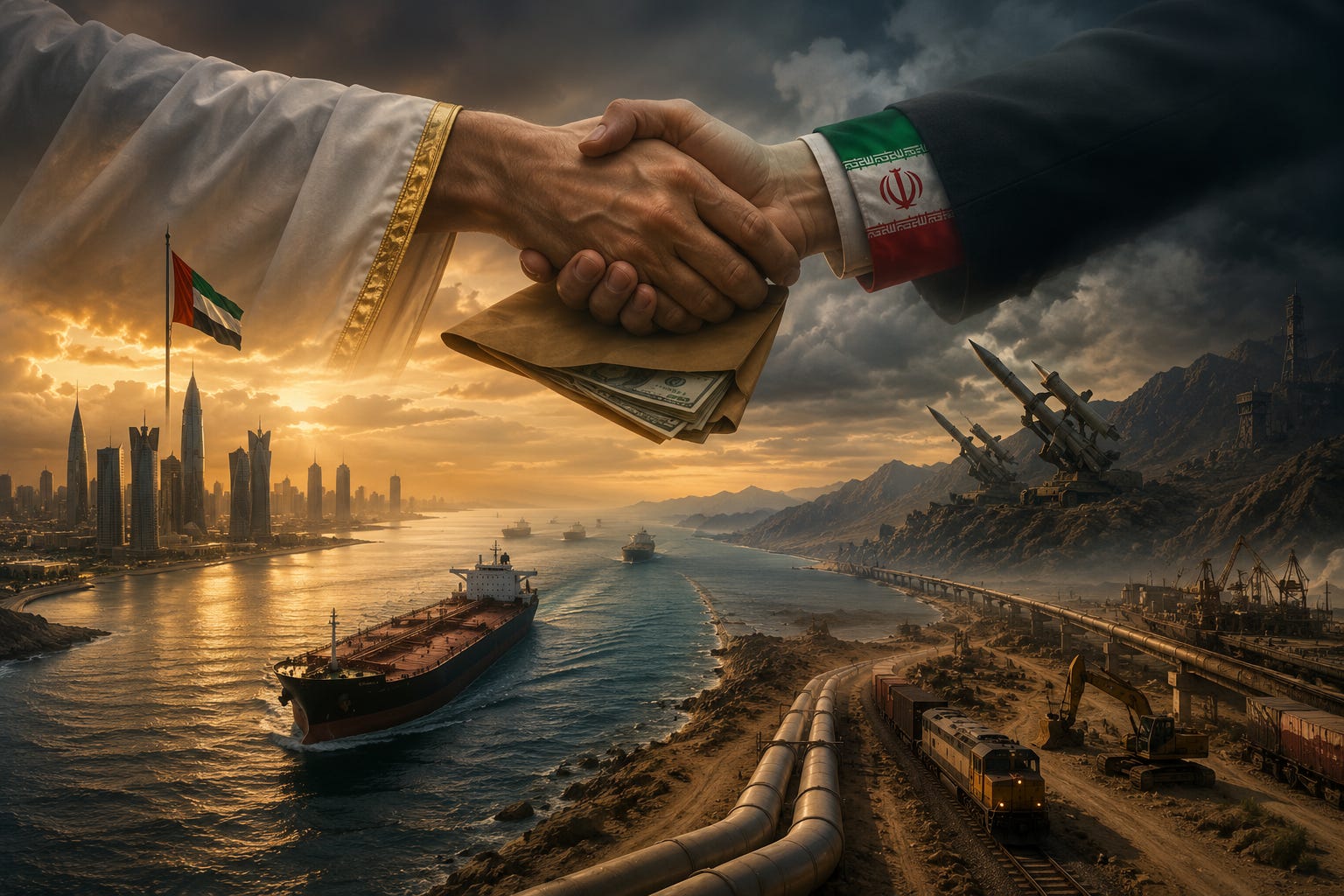
The Price of Passage
The Gulf states’ willingness to consider arrangements that resemble a “bribes-for-peace” scheme with Iran reflects a strategic calculation shaped by geography, financial exposure, infrastructure timelines, and the limits of military protection in the Strait of Hormuz. Governments across the Gulf are investing heavily in railways, pipelines, ports, industrial zones, overland corridors, and logistics networks that could eventually reduce their dependence on the strait, yet those projects remain incomplete, unevenly connected, and incapable of carrying the full volume of energy exports and commercial traffic that currently moves through Hormuz. Their immediate prosperity therefore remains tied to a maritime passage that Iran can threaten through naval harassment, missile deployments, drones, mines, sabotage, proxy operations, and carefully calibrated attacks designed to raise the cost of transit without requiring a permanent closure. Gulf rulers understand that infrastructure diversification will take many years to mature, and they are consequently prepared to purchase a measure of Iranian restraint during the period in which their economies remain acutely exposed.
This arrangement rests on the recognition that the Strait of Hormuz has become a political tollgate whose operation depends partly on the behavior of the state most capable of disrupting it. Iran does not require complete control over the waterway to extract concessions from its neighbors, because intermittent attacks, threats, seizures, and military demonstrations can raise insurance costs, delay shipping, unsettle investors, and undermine confidence in the Gulf as a dependable commercial center. A temporary surge in maritime risk can affect energy prices, freight contracts, port schedules, industrial planning, and government revenues long before any physical interruption reaches the scale of a formal blockade. The Gulf states are therefore responding to an environment in which commercial confidence can be damaged through limited coercion, and payments to Tehran, whether direct, indirect, financial, diplomatic, or commercial, become part of the cost of maintaining access to the global economy.
The term “bribe” captures the coercive character of the arrangement because Iran is effectively demanding compensation for refraining from actions that it has created the capacity to undertake. Such compensation may take the form of cash transfers, investment channels, access to regional markets, energy deals, sanctions relief mechanisms, humanitarian carve-outs, informal trade, diplomatic recognition, or reduced pressure on Iranian networks operating across the region. Gulf governments can present these measures as de-escalation, regional dialogue, economic engagement, or confidence building, though the underlying transaction remains closely tied to Tehran’s ability to impose losses. Iran’s leverage derives from the possibility of disorder, and every concession that follows a threat reinforces the perception that disruption can be converted into financial and political gain.
For the Gulf states, the attraction of this arrangement lies in its capacity to reduce immediate risk at a time when their development models depend on uninterrupted commercial movement. Saudi Arabia, the United Arab Emirates, Qatar, Kuwait, Bahrain, and Oman are pursuing expansive economic programs built around tourism, aviation, finance, logistics, manufacturing, data centers, renewable energy, petrochemicals, and foreign investment. These sectors rely on predictability, dependable shipping schedules, affordable insurance, and confidence among multinational companies that regional tensions will remain manageable. A prolonged crisis in Hormuz would threaten far more than crude oil exports, because it would also weaken the broader image of the Gulf as a stable platform for global commerce, investment, and long-term economic planning. Paying Iran to reduce the likelihood of disruption can therefore appear financially rational when measured against the enormous losses that even a short period of instability could produce.
The willingness to pay also reflects the limits of external security guarantees. The United States retains substantial military power in the region, including naval forces, air bases, missile defense systems, intelligence capabilities, and partnerships with Gulf militaries, yet these assets cannot guarantee that every commercial vessel will remain safe under every condition. Iran’s maritime strategy has been designed around this limitation, using small craft, drones, shore-based missiles, mines, cyber operations, proxy groups, and deniable attacks to create uncertainty without presenting a single target that can be eliminated through conventional military action. Gulf governments have watched repeated episodes in which American deployments increased after attacks had already occurred, and they have learned that deterrence often arrives in the form of punishment after disruption rather than complete prevention before it. This experience encourages regional leaders to supplement military protection with political arrangements that reduce Iran’s incentive to initiate a crisis.
Gulf states also face the problem of escalation control, because any major confrontation with Iran could expose their own cities, oil facilities, ports, desalination plants, airports, power stations, and industrial zones to retaliation. The physical concentration of critical infrastructure makes the region especially vulnerable to missile and drone attacks, and the economic consequences of damage can extend far beyond the immediate repair costs. A strike on a refinery or export terminal can interrupt production, raise insurance premiums, discourage investors, and force governments to divert funds from development programs toward emergency security measures. Iran’s leadership understands that Gulf modernization has produced valuable and visible targets, and the threat to those assets strengthens Tehran’s bargaining position whenever regional tensions increase.
This vulnerability helps explain why Gulf governments may continue paying for passage even as they borrow heavily to construct alternative corridors. The debt incurred for railways, ports, pipelines, and industrial zones finances a long-term effort to change the geography of trade, whereas payments to Iran address the immediate exposure created by the current geography. These expenditures operate on different timelines and serve different functions within the same strategic framework. Corridor investment builds future autonomy, and accommodation with Tehran protects the revenue required to complete those investments. A serious disruption in Hormuz could reduce export income, delay construction, increase borrowing costs, and weaken the fiscal position of governments already funding large-scale development programs. Maintaining calm in the strait therefore supports the very projects intended to reduce dependence on it.
The alternative corridor strategy remains expensive because geography cannot be replaced through announcements or memoranda of understanding. New routes require rail connections across multiple jurisdictions, compatible customs systems, secure border crossings, port capacity, storage facilities, pipelines, electricity networks, financing agreements, and political coordination among states with different priorities. The India-Middle East-Europe Corridor, expanded transport routes through Iraq, Saudi links to the Red Sea, Emirati pipeline capacity toward Fujairah, and potential Mediterranean connections all face substantial technical and political obstacles. Construction costs are only one part of the burden, because governments must also fund security, maintenance, digital systems, insurance frameworks, and commercial incentives strong enough to attract shippers away from established maritime routes.
Many of these projects also depend on regional stability beyond the Gulf itself. Corridors crossing Iraq, Jordan, Syria, Israel, Türkiye, or the Red Sea remain exposed to conflict, political disputes, militia activity, terrorism, sanctions, and changes in diplomatic relations. A route designed to bypass Hormuz may still pass through another vulnerable zone, creating a transfer of risk from one geography to another. Gulf governments are therefore financing a network of partial alternatives whose combined capacity may gradually reduce dependence on the strait without eliminating the need for it. Hormuz will remain commercially central for years because it offers a direct connection between Gulf energy producers and Asian markets, and the cost of replacing that route at scale remains extraordinarily high.
Debt becomes part of this calculation because Gulf states are attempting to build strategic autonomy before the next major crisis closes the financial window available for doing so. Large infrastructure projects require substantial borrowing, particularly when governments are simultaneously funding defense procurement, social programs, industrial subsidies, tourism projects, renewable energy, and urban development. Saudi Arabia’s transformation agenda, Oman’s logistics ambitions, Qatar’s gas expansion, Kuwait’s infrastructure plans, and the UAE’s global investment strategy all demand sustained capital expenditure. The pressure to finance multiple priorities can increase sovereign debt, reduce fiscal flexibility, and create a stronger need for stable export revenues. Every escalation with Iran threatens those revenues and raises the cost of borrowing, which makes temporary accommodation more attractive to governments managing ambitious development plans under tightening financial conditions.
Iran benefits from this dynamic because Gulf debt and infrastructure commitments increase the value of stability. A government carrying major financial obligations has stronger incentives to avoid shocks that could weaken revenue, delay projects, or reduce investor confidence. Tehran can exploit this sensitivity by calibrating threats around moments when Gulf states are launching bonds, attracting foreign investment, hosting major events, or announcing new development initiatives. The greater the scale of Gulf economic ambition, the more costly instability becomes, and the more valuable Iranian restraint appears. This creates a form of coercive interdependence in which Gulf modernization generates both strategic strength and new forms of vulnerability.
The Gulf states may also view payments to Iran as a means of managing uncertainty surrounding American policy. Regional leaders have experienced changes in Washington’s priorities, fluctuations in military deployments, disagreements over sanctions, and periodic pressure to assume more responsibility for their own defense. They have also observed that American officials can demand tougher regional positions toward Tehran without offering guarantees that the United States will absorb the costs of retaliation. A Gulf government facing attacks on ports, refineries, or shipping lanes cannot base its entire security strategy on the expectation that Washington will respond quickly, consistently, and in a manner that protects local economic interests. Direct arrangements with Iran provide an additional instrument of risk management that can be adjusted according to regional conditions.
Oman and Qatar can play especially important roles in facilitating these arrangements because both states maintain channels with Tehran and possess experience in mediation, financial transfers, prisoner exchanges, and quiet diplomacy. Their involvement allows larger Gulf states to communicate with Iran without publicly acknowledging the full extent of the transaction. Commercial agreements, humanitarian mechanisms, and regional dialogue can serve as vehicles for delivering benefits linked to maritime restraint, creating a system in which payments are dispersed across several relationships and described in language that avoids the appearance of tribute. This diplomatic structure offers Iran economic and political rewards, while Gulf governments preserve public claims of sovereignty and strategic independence.
Saudi Arabia and the UAE have additional reasons to participate because both are seeking to position themselves as global logistics and investment centers. Their economic models depend on the belief that they can remain commercially functional during regional crises, and repeated disruption in Hormuz would weaken that claim. Saudi Arabia’s Red Sea infrastructure and east-west pipeline provide some protection, while the UAE’s Fujairah facilities offer a partial outlet beyond the strait, though neither state possesses enough alternative capacity to remove the broader regional consequences of a major closure. Their ports, airlines, financial centers, and industrial networks would still suffer from higher insurance costs, supply delays, and reduced investor confidence. Paying Iran for restraint can therefore support their international branding as stable commercial hubs during a period of continued strategic exposure.
Iran’s approach also draws strength from the fragmented interests of the Gulf states. Each government has a different level of dependence on Hormuz, a different relationship with Tehran, and a different capacity to reroute exports. Oman shares the strait with Iran and benefits from mediation, Qatar depends heavily on maritime gas exports, Kuwait has limited alternatives, Bahrain faces direct political and security pressures, the UAE possesses partial bypass capacity, and Saudi Arabia has greater access to the Red Sea. These differences make a unified Gulf response difficult to sustain, because the price each state is willing to pay for calm varies according to its exposure. Tehran can negotiate bilaterally, offer selective assurances, and cultivate separate channels that weaken collective bargaining.
The arrangement also carries domestic political advantages for Gulf rulers because quiet payments may attract less public attention than military confrontation, infrastructure damage, or interrupted economic growth. Leaders can frame engagement as responsible diplomacy, regional stabilization, or protection of national development, while the financial costs remain buried within broader trade, investment, or aid packages. The public may never see a clearly defined payment tied to shipping access, because the bargain can be distributed through several commercial and diplomatic mechanisms. This opacity allows governments to manage the political embarrassment associated with paying an adversary and gives Iran room to claim economic gains without openly admitting that it has traded restraint for compensation.
The danger lies in the durability of the incentive structure created by these payments. Once Iran learns that threats to Hormuz produce concessions, the pressure to repeat the cycle grows stronger. Tehran can raise the level of risk whenever it seeks new financial relief, diplomatic recognition, or regional influence, then reduce tensions after obtaining sufficient benefits. Gulf governments may view each payment as a temporary measure, though the cumulative effect can establish an informal system of tribute in which commercial access becomes contingent on recurring accommodation. Alternative corridors may eventually weaken this leverage, yet their construction period gives Iran years in which to refine and monetize its coercive position.
The Gulf states accept this risk because their leaders are balancing immediate survival, fiscal obligations, and long-term transformation. A principled refusal to pay could trigger a confrontation that damages the revenues needed to build alternative routes, and a military campaign aimed at eliminating Iran’s maritime capabilities could expose the entire region to retaliation. Accommodation offers a way to protect current income, preserve investor confidence, and maintain the construction schedules of projects designed to create future resilience. The payments therefore function as part of the financing structure of diversification, because they help preserve the stability on which borrowing, construction, and commercial expansion depend.
The resulting policy amounts to a race between Iranian coercion and Gulf infrastructure development. Tehran is attempting to extract maximum value from its geographic leverage before alternative routes reduce its influence, and the Gulf states are trying to preserve enough stability to complete those routes without suffering a devastating interruption. Each side understands that the current arrangement has a limited horizon, though the duration of that horizon remains uncertain because corridor projects face delays, cost overruns, political disputes, and security risks. Iran’s strongest position exists during the transitional period, when Gulf governments have already committed vast sums to diversification and still depend heavily on Hormuz for the revenue needed to finance it.
The “bribes-for-peace” model therefore reflects a regional order in which geography, debt, and coercion have become tightly connected. Gulf governments are paying to keep the maritime system functioning while they construct a more flexible commercial network, and Iran is using its capacity for disruption to capture a share of the wealth generated by that system. The arrangement may protect shipping for limited periods and reduce the likelihood of immediate escalation, though it also rewards Tehran for maintaining the very capabilities that make payment necessary. Until the alternative corridors become operational at meaningful scale, the Gulf states will remain trapped in a costly bargain in which they finance future independence with one hand and purchase present access with the other.
Diplomacy Under an Emptying Magazine
The system of purchased restraint emerging around the Strait of Hormuz also helps explain the Trump administration’s renewed interest in diplomacy, because Washington now faces the same tension confronting the Gulf states on a much larger military scale: it seeks to impose enough pressure to compel Iran to reopen the waterway and limit its regional attacks, while preserving the weapons, alliances, political support, and economic stability required to sustain that pressure over time. The Gulf governments are paying to protect commerce while financing alternative corridors, and the United States is searching for a negotiated pause while attempting to preserve the appearance of inexhaustible military dominance. In both cases, the immediate requirement is time, though Washington’s need for it has become politically dangerous because the administration spent months presenting force as the instrument that would eliminate the need for compromise.
The administration’s announcement that it was considering renewed diplomacy followed an intensive bombing campaign that damaged Iranian military infrastructure, imposed substantial economic costs, and demonstrated the reach of American air power without producing the political capitulation that President Donald Trump had repeatedly suggested would follow overwhelming pressure. Iran retained control over the principal strategic problem at the center of the confrontation, continued threatening commercial navigation through Hormuz, maintained enough missiles and drones to attack American positions and regional partners, and preserved a governing structure capable of absorbing punishment while distributing the costs of war across neighboring states and the international economy. Under those conditions, diplomacy became less an expression of confidence in negotiations than an acknowledgement that the existing military campaign had reached a point of declining strategic returns, where additional strikes could destroy more targets while leaving the essential sources of Iranian leverage intact.
Trump’s interest in returning to negotiations also reflects the difference between demonstrating military superiority and converting that superiority into a stable political outcome. The United States can strike Iranian missile sites, radar stations, naval facilities, command centers, ammunition depots, nuclear infrastructure, and coastal positions, though each successful operation consumes expensive weapons and creates pressure for further attacks whenever Iran restores damaged capabilities or shifts operations into civilian, underground, mobile, or proxy-based networks. Iran’s leaders have structured their defense around endurance, dispersion, and retaliation because they understand that they cannot match American firepower directly, and they therefore seek to ensure that every round of American escalation creates additional obligations for Washington across a widening theater. The administration entered the conflict expecting concentrated force to produce a rapid concession, while Tehran responded by multiplying the number of locations, partners, bases, shipping routes, and civilian economies exposed to retaliation.
The resulting burden extends beyond the number of bombs available for offensive strikes, because the most serious pressure concerns the air-defense interceptors needed to protect American troops, Gulf cities, Israeli territory, ports, oil facilities, airports, and maritime infrastructure from Iranian missiles and drones. Offensive munitions can be rationed by reducing the number of targets or changing the tempo of operations, while defensive shortages create a more immediate political problem because commanders may have to decide which incoming threats receive priority and which assets remain exposed. Reports that the United States had expended a significant share of several critical munitions, including air-defense interceptors and long-range precision weapons, therefore carried enough credibility to influence Iranian calculations even when the precise inventory figures remained classified, disputed, or incomplete. Public reporting indicated that concerns over declining stocks formed part of the debate surrounding Trump’s decision to pause a planned escalation and create room for diplomacy.
The central question is not whether every leaked estimate is accurate, because military stockpile assessments depend on classified inventories, production schedules, weapons already allocated to other theaters, maintenance requirements, training reserves, deployment patterns, and the minimum quantities commanders consider necessary for future contingencies. A country may possess thousands of weapons on paper while having far fewer immediately available in the theater, compatible with the relevant launch platforms, cleared for operational use, or considered expendable without weakening preparations for a conflict elsewhere. Reports that the United States is “running out” can therefore exaggerate the immediacy of depletion while still capturing a genuine problem involving production capacity, replacement speed, theater allocation, and the competing requirements of Europe, the Indo-Pacific, Israel, and the Middle East.
American munitions production was never designed for an open-ended regional conflict requiring repeated offensive strikes alongside continuous defense against large numbers of comparatively inexpensive drones and missiles. The cost imbalance alone creates a long-term vulnerability, because Iran and its partners can launch systems costing a fraction of the interceptors used to destroy them, forcing the United States and its allies to spend heavily in order to preserve the lives, infrastructure, and political confidence attached to every defended target. Even a successful interception campaign can therefore deepen strategic exhaustion when the adversary retains enough launch capacity to continue imposing unfavorable exchanges. Iran does not need every projectile to penetrate American defenses, since the sustained requirement to detect, track, intercept, replenish, deploy, and protect can produce financial and operational pressure regardless of the immediate casualty count.
The leaks about diminishing stocks are therefore plausible in their broad direction even when their most dramatic formulations remain impossible to verify publicly. The United States has not exhausted its arsenal, and it retains the industrial, technological, and financial capacity to expand production over time, though wartime demand operates on a faster schedule than procurement reform, factory construction, workforce expansion, component acquisition, and multiyear contracting. Weapons cannot be produced instantly through presidential rhetoric or emergency appropriations, especially when supply chains depend on specialized materials, electronics, propulsion systems, skilled labor, testing facilities, and a limited number of manufacturers. A prolonged conflict can consequently expose the gap between the enormous total power of the United States and the smaller quantity of particular weapons available at the place and time they are needed.
Trump’s handling of these reports has weakened his own negotiating position because he has allowed the public discussion of shortages to persist without establishing a coherent account of American capacity, strategic priorities, or willingness to sustain the conflict. His assertions that the United States possesses overwhelming or virtually unlimited military resources have appeared alongside reports that senior officials advised a pause because of declining air-defense stocks and concern over the cost of a further escalation. The resulting ambiguity may reassure domestic audiences that the military remains powerful, though it also tells Tehran that operational constraints are influencing presidential decisions. Diplomacy conducted under those conditions begins with an avoidable disadvantage, because Iranian negotiators can reasonably conclude that Washington’s urgency arises from pressure on its own resources rather than a sudden Iranian willingness to compromise.
A president seeking maximum leverage would ordinarily attempt to conceal operational limits, create uncertainty about his tolerance for continued escalation, and persuade the adversary that delay will worsen its position. The Trump administration has allowed the opposite impression to circulate, with public accounts depicting a president weighing negotiations while military officials warn about the sustainability of continued strikes and the erosion of defensive reserves. Every day that these reports remain unanswered allows Iran to interpret the diplomatic opening as evidence that its strategy of endurance is working. Tehran can then demand greater concessions, delay talks, intensify pressure on shipping, or launch additional attacks in the expectation that Washington has stronger incentives to stop the war than Iran has to accept American terms.
The persistence of the leaks may result from ordinary bureaucratic conflict, because different parts of the administration and military establishment have distinct reasons to publicize the strain on American inventories. Pentagon officials may seek to prevent an escalation they consider strategically unsustainable, secure larger appropriations, accelerate procurement, protect reserves intended for China or Russia, or shift responsibility for operational limitations toward civilian decision-makers. Political officials may use the same information to prepare the public for a diplomatic turn, while members of Congress, defense contractors, allied governments, and military commanders may emphasize shortages for their own institutional purposes. The cumulative effect can produce a stream of disclosures without any single coordinated source or presidential authorization.
The possibility that Trump himself authorized, encouraged, or tolerated the leaks deserves serious consideration because they provide him with a politically useful explanation for returning to negotiations after presenting military victory as attainable. Trump’s political style places enormous value on personal dominance, visible success, and the ability to describe any reversal as a choice made from strength. A straightforward admission that the bombing campaign failed to compel Iran would undermine the image he cultivated, while an argument that responsible leadership requires preserving critical munitions allows him to change course without acknowledging that Tehran resisted American pressure. The shortages can be presented as a technical obstacle created by previous administrations, defense manufacturers, Pentagon planning failures, allied dependence, or the global burden carried by the United States, leaving Trump free to claim that he would have continued striking under better inherited conditions.
Such a leak strategy would also permit Trump to approach negotiations as the leader protecting America’s military readiness rather than the leader retreating from an unfinished war. He could argue that he has already demonstrated overwhelming force, destroyed major Iranian targets, and created an opportunity for a settlement, while avoiding the greater mistake of spending weapons needed for other threats. This narrative would appeal to parts of his political coalition that support military strength and oppose prolonged foreign wars, allowing him to combine aggressive rhetoric with a negotiated pause. It would also shift public discussion away from the limited political results of the strikes and toward the condition of the arsenal, where responsibility can be distributed across Congress, the Pentagon, industrial capacity, and decades of procurement policy.
The same approach carries severe strategic costs because an excuse designed for domestic consumption becomes intelligence for the adversary. Iran listens to American political narratives for evidence of operational pressure, leadership division, electoral sensitivity, and thresholds for escalation, and it has decades of experience distinguishing public threats from the constraints shaping actual policy. A story explaining why Trump needs diplomacy can simultaneously explain to Tehran why it should refuse diplomacy on American terms. Once Iranian leaders believe that the president requires a pause to preserve weapons, limit casualties, protect oil markets, calm Gulf partners, or avoid a politically damaging expansion, they gain every incentive to increase the price of agreement.
Trump may have assumed that the scale of American strikes had already established enough fear to overcome any appearance of constraint, though that assumption reflects a persistent misunderstanding of Iranian decision-making. Tehran does not evaluate American pressure solely through the amount of damage inflicted during a single phase of the conflict, because its leaders also measure the enemy’s willingness to continue, the resilience of domestic institutions, the availability of regional retaliation, the political cohesion of the opposing coalition, and the economic sensitivity of global markets. A heavily damaged Iran can still believe it is gaining leverage when the United States pauses first, opens diplomatic channels, discusses weapons shortages publicly, and signals concern about sustaining the operation.
Iran’s surprise ballistic missile attack on American forces in Jordan exposed the consequences of that misreading. The attack occurred after Trump paused strikes to create space for renewed diplomacy, and United States Central Command described it as an attempted surprise operation by the Islamic Revolutionary Guard Corps. American defenses reportedly intercepted the missiles, preventing casualties, though the political significance of the attack rested in Tehran’s decision to launch it during the diplomatic opening rather than in the physical results alone.
The attack demonstrated that Iran interpreted the pause as an opportunity to improve its position rather than as a concession requiring reciprocal restraint. Tehran could test American defenses, undermine Trump’s claim that his pressure had compelled caution, reassure its own supporters that it retained offensive capability, and send a warning to regional governments considering cooperation with Washington. By striking a United States base while diplomatic discussions were being revived, Iran also imposed a choice on Trump between retaliation that could destroy the opening he had just announced and restraint that could reinforce the impression of American hesitation.
This was not irrational behavior arising from an Iranian rejection of diplomacy as such, because coercive escalation has long formed part of Tehran’s negotiating method. Iranian leaders frequently combine talks with military pressure, proxy attacks, maritime harassment, nuclear advances, detentions, and threats against regional infrastructure because they view negotiations as another arena in which leverage is accumulated and exchanged. A pause by the opposing side creates space for Iran to establish new facts, demonstrate remaining capabilities, and raise the cost of failure. The Trump administration appears to have treated diplomacy as a temporary suspension of coercion, while Iran treated the diplomatic period as part of the coercive campaign.
The surprise attack also revealed the limits of transactional assumptions embedded in the administration’s approach. Trump often treats negotiations as a process in which sufficient pressure brings both parties toward a deal that can be advertised as mutually beneficial, yet Iran’s leadership is pursuing regime survival, regional authority, ideological legitimacy, deterrence, sanctions relief, and freedom of action across several interconnected theaters. Its decisions are not governed entirely by economic incentives or by a calculation of material losses. Iranian officials may accept enormous damage when they believe endurance will fracture the opposing coalition, raise global energy costs, exhaust American resources, or demonstrate that military pressure cannot dictate the terms of regional order.
Washington’s repeated expectation that Iran will respond to restraint with restraint therefore rests on a weak understanding of the adversary’s strategic culture. Iranian leaders often read unilateral pauses, limited retaliation, public concern over escalation, and urgent diplomatic outreach as evidence that pressure is producing results. They may accept negotiations after such signals, though they will enter them seeking payment for reducing threats they have already intensified. This is the same coercive model operating in Hormuz, where Tehran creates insecurity and then demands economic or political compensation for restoring a portion of the stability it disrupted.
The attack on the base in Jordan further suggests that Iran understood the value of targeting Trump’s personal credibility. The president had presented the bombing campaign as proof that Iran could be subdued through decisive force, and he had subsequently promoted renewed diplomacy as a choice available because American power had created favorable conditions. A surprise attack during the pause damaged both propositions by showing that Iran remained capable of striking American forces and willing to do so when Washington expected talks. Tehran thereby challenged the administration’s account of deterrence, turning the diplomatic opening into evidence that American pressure had not produced Iranian submission.
The episode also raises questions about whether American intelligence understood Iranian intentions and whether political leaders were prepared to act on the warnings available to them. A surprise attack does not always indicate a complete intelligence failure, because commanders may detect preparations without knowing the precise target or timing, while political leaders may possess warnings that remain too ambiguous to justify preventive action. The administration’s public emphasis on negotiations may nonetheless have encouraged a climate in which evidence of imminent escalation received less weight than the desire to preserve diplomatic momentum. Governments seeking a deal often become vulnerable to interpreting adversary behavior through the agreement they hope to reach, especially when domestic and military pressures make the alternative increasingly costly.
Trump’s response will determine whether the attack becomes a temporary challenge or a deeper collapse of American leverage. A large retaliatory campaign could accelerate munitions consumption, widen the conflict, expose additional bases, and eliminate the diplomatic route the administration had begun constructing. A limited response could preserve negotiations while encouraging Iran to believe that attacks below a certain casualty threshold remain manageable. A return to talks without meaningful retaliation would allow Tehran to claim that military pressure forced Washington back to the table, increasing Iranian demands over Hormuz, sanctions, regional deployments, and the future of its missile and nuclear programs.
The administration has therefore entered diplomacy under conditions partly created by its own messaging. Reports of munitions pressure may be accurate, exaggerated, selectively framed, or politically authorized, though their strategic effect remains the same because they tell Iran that time may be working against the United States. Trump may have allowed the leaks to provide a face-saving explanation for negotiations, yet the explanation also weakened the threat that negotiations were supposed to carry. Iran’s surprise attack showed that Tehran understood this vulnerability and intended to exploit it before Washington could transform the pause into a political success.
The broader lesson concerns the relationship between force, diplomacy, and knowledge of the adversary. Military superiority creates negotiating leverage only when the opposing leadership believes that further resistance will produce steadily worsening consequences and that the state applying pressure possesses the resources, political unity, and determination to continue. Public disclosures about declining inventories, visible disagreement within the administration, sudden pauses after intensive operations, and urgent discussion of renewed talks weaken that belief, especially when the adversary has organized its strategy around endurance. Trump sought to move from bombing to diplomacy without appearing to retreat, and the narrative of munitions scarcity may have offered him a domestic bridge between those positions, while Iran used the same bridge as evidence that another attack could raise the price of peace.
The failure was therefore larger than a single intelligence lapse or an unsuccessful attempt to intercept diplomatic momentum. It reflected an American approach that repeatedly measured Iran by the damage it had suffered rather than by the leverage it believed it retained. Tehran entered the pause with damaged infrastructure, heavy losses, economic pressure, and continuing exposure to American power, while it also possessed missiles, drones, regional networks, control over the rhythm of maritime disruption, and a growing conviction that Washington needed negotiations. The surprise attack on American forces expressed that conviction with unmistakable clarity, revealing that diplomacy announced under visible operational pressure can invite escalation when the adversary views negotiations as an extension of war rather than a departure from it.
The Fractured Shield
Iran’s surprise attack on American bases during Washington’s renewed diplomatic opening exposed more than the weaknesses of the Trump administration’s coercive strategy, because it also forced Arab governments to reconsider whether the regional security arrangements built around American protection still offer a reliable foundation for collective action. The attack demonstrated that Tehran remains willing to exploit diplomatic pauses, operational constraints, and political divisions, while the uneven American response reinforced the perception that each Arab state may face a different level of exposure and a different degree of protection depending on its strategic value to Washington. The resulting uncertainty has accelerated a process already visible across the region, as Qatar deepens its dependence on Iran, the United Arab Emirates restores commercial balance despite severed diplomatic relations, Saudi Arabia pursues selective engagement to protect economic interests extending far beyond its modest trade with Tehran, and Jordan continues to absorb military and political risks without receiving security commitments proportionate to its role. These policies reflect a widening strategic dissonance in which Arab governments increasingly approach Iran, the United States, and one another through national calculations that no longer fit comfortably within the institutional language of the Gulf Cooperation Council, the Arab League, or the Organization of Islamic Cooperation.
The dissonance begins with the unequal geography of exposure, because the Arab states do not confront Iran from the same position and cannot be expected to define security through identical priorities. Qatar shares the world’s largest gas field with Iran and depends on the uninterrupted operation of infrastructure whose security cannot be separated from relations with Tehran. Oman shares the Strait of Hormuz and has built a diplomatic role around mediation, commercial access, and political communication with the Islamic Republic. Bahrain faces direct concerns involving Iranian influence, sectarian mobilization, and proximity to Iranian military power, while Kuwait lacks the strategic depth and alternative export routes available to larger states. The UAE possesses significant financial and logistical capacity, along with the Fujairah outlet beyond Hormuz, though its ports, aviation sector, re-export economy, and position as a global commercial center remain highly sensitive to regional instability. Saudi Arabia has greater territorial depth and Red Sea access, yet its oil facilities, industrial zones, investment projects, and expanding tourism economy remain vulnerable to missile, drone, and maritime pressure.
These differences shape the value each government assigns to engagement, confrontation, neutrality, and external protection. A policy that appears prudent in Doha may seem dangerously permissive in Manama, while a security arrangement acceptable to Riyadh may offer little reassurance to Amman. Calls for a unified Arab posture often assume that shared language, religion, institutions, and concerns about Iranian influence can override the distinct economic structures and geographic vulnerabilities of more than twenty states. Those common features support consultation and occasional coordination, though they cannot erase the reality that each government faces a different combination of threats, revenue sources, domestic pressures, alliance commitments, and strategic opportunities.
Qatar’s growing dependence on Iran provides the clearest example of how national interests can pull an Arab state toward a relationship that appears inconsistent with a broader Gulf security agenda. The shared North Field-South Pars gas reservoir binds the two countries through geology, infrastructure, production decisions, and long-term energy planning. Doha’s position as a leading liquefied natural gas exporter depends on the stability of maritime routes and the avoidance of conflict that could damage offshore facilities or interrupt tanker traffic. Iran therefore occupies a position in Qatar’s security environment that cannot be reduced to ideological rivalry or competition for regional influence, because Tehran is also a neighboring state with the capacity to affect the physical foundation of Qatar’s national wealth.
This dependence extends into airspace, transportation, food security, diplomacy, and political mediation. During the previous Gulf crisis, Iran opened routes and supplied goods that helped Qatar resist pressure from its Arab neighbors, creating a durable memory within the Qatari leadership that regional institutions can become instruments of coercion while Tehran can become a source of strategic relief. Doha has little incentive to place its economic survival entirely in the hands of a collective Gulf framework that once failed to protect it from isolation imposed by fellow members. Its willingness to deepen ties with Iran therefore reflects a broader conclusion that diversified dependence may offer greater security than exclusive reliance on Arab solidarity.
Qatar’s approach also supports its ambition to remain an indispensable mediator between actors that do not communicate directly. Its relations with the United States, Iran, Hamas, the Taliban, Türkiye, European governments, and multiple regional movements allow Doha to convert political access into diplomatic relevance. Greater dependence on Iran carries risks, including exposure to Iranian pressure and suspicion among Arab partners, though it also strengthens Qatar’s position as a channel through which Washington and Tehran can exchange messages during periods of crisis. Doha gains influence from the very fragmentation that weakens collective Arab policy, because every broken relationship creates demand for an intermediary capable of maintaining contact with all sides.
The UAE is pursuing a different version of strategic accommodation through the restoration of balanced trade and commercial functionality despite the diplomatic rupture with the Islamic Republic. Emirati leaders understand Iran as a military threat, a regional competitor, a source of maritime insecurity, and an unavoidable commercial neighbor. Dubai’s historic role as a hub for Iranian trade, finance, re-export activity, transportation, and business networks created ties that survived repeated political crises. Abu Dhabi’s security concerns encouraged a harder line toward Tehran, while Dubai’s commercial interests favored managed access and predictable economic relations. The national policy that emerged from these competing pressures seeks enough distance to preserve security partnerships and enough commercial flexibility to protect the UAE’s position as the region’s principal trading platform.
The return to more balanced trade reflects the UAE’s wider economic strategy, which depends on maintaining connections across rival political blocs rather than aligning its commercial system entirely with any single camp. The Emirates trade with China, invest in Africa, cooperate with India, maintain security relations with the United States, expand ties with Russia, build partnerships with Israel, and preserve channels with Iran. This approach allows Abu Dhabi and Dubai to position the country as a junction through which capital, goods, technology, and political influence can move even when relations among larger powers deteriorate. Iran fits into this model as a market, a source of commercial activity, a security concern, and a neighboring state whose exclusion would impose costs on Emirati trade without eliminating Iranian influence.
The UAE’s policy also reflects skepticism about the durability of confrontation as a regional organizing principle. Repeated cycles of pressure have damaged Iranian capabilities without removing the Islamic Republic or ending its ability to threaten shipping, activate partner groups, and strike regional infrastructure. Emirati decision-makers have consequently placed greater emphasis on reducing direct exposure, strengthening defense systems, expanding intelligence capabilities, and preserving economic channels that can support de-escalation. Their willingness to trade with Iran does not amount to confidence in Tehran’s intentions, because it arises from a judgment that economic interdependence can provide communication, influence, and limited restraint during periods when military deterrence remains uncertain.
Saudi Arabia’s selective engagement with Iran reflects a broader and more ambitious calculation, because the kingdom’s direct trade with the Islamic Republic remains limited while the economic interests endangered by confrontation span Asia, Europe, Africa, the Red Sea, and the global investment system. Riyadh is financing an extensive national transformation that requires foreign capital, imported technology, stable energy markets, growing tourism, major construction projects, and confidence that Saudi territory can support long-term commercial commitments. A sustained conflict with Iran would threaten these priorities through missile attacks, higher insurance costs, disrupted shipping, delayed investment, and renewed doubts about the kingdom’s ability to protect its infrastructure.
Selective engagement allows Saudi leaders to manage Iranian risk without granting Tehran privileged access to the Saudi economy. Riyadh can maintain diplomatic channels, coordinate on limited regional matters, reduce hostile rhetoric, and pursue understandings intended to protect shipping and critical infrastructure, while keeping most commercial ties constrained and preserving its security relationship with Washington. The low level of bilateral trade makes engagement easier to calibrate because Saudi Arabia can offer political recognition, diplomatic access, or regional dialogue without creating the deep economic dependence visible in Qatar’s relationship with Iran or the broad commercial networks connecting Iran to the UAE.
The kingdom’s principal objective is the protection of economic interests located elsewhere. Saudi relations with China, India, Europe, the United States, and other Asian markets depend on stable oil exports, reliable sea lanes, predictable investment conditions, and a regional environment that does not repeatedly interrupt development planning. Engagement with Iran therefore serves as a means of securing Saudi Arabia’s wider global relationships. Riyadh may offer Tehran enough access and recognition to reduce the risk of attacks, while ensuring that the principal gains from stability flow into Saudi projects, foreign partnerships, and long-term economic diversification.
This policy also reflects a more restrained assessment of the value of regional leadership. Saudi Arabia has historically carried the expectation that it should organize Arab and Islamic responses to major crises, finance weaker partners, defend collective positions, and absorb political costs on behalf of institutions whose members frequently pursue conflicting policies. The expansion of Vision 2030 has increased the opportunity cost of this role, because resources devoted to open-ended regional competition can no longer be separated from domestic transformation. Riyadh’s selective engagement signals a willingness to prioritize Saudi economic security over the maintenance of a unified front whose members may not share the kingdom’s risks or contribute proportionately to its defense.
Jordan occupies the most difficult position in this fragmented landscape because it continues to perform functions essential to Western and regional security while receiving limited protection from the consequences. The kingdom hosts American forces, supports intelligence cooperation, protects borders, assists operations involving Syria and Iraq, intercepts threats moving through its airspace, and serves as a geographic buffer between Israel, the Gulf, Syria, and Iraq. These responsibilities expose Jordan to Iranian missiles, drones, proxy networks, smuggling operations, domestic political pressure, and retaliatory attacks, while its modest economy and dependence on external assistance leave it with fewer resources for independent defense.
The Iranian surprise attack on an American base in Jordan illustrated the imbalance between the kingdom’s strategic contribution and the security guarantees it receives. Jordanian territory became a platform and a target within a confrontation shaped largely by decisions made in Washington, Tehran, and other regional capitals. The United States retains a substantial military presence and provides important assistance, though the absence of a clear and automatic commitment to defend Jordan against every form of Iranian retaliation leaves Amman exposed to risks created by the American role itself. Jordan must cooperate closely enough with Washington to secure aid and protection, while avoiding the appearance that it has become an unrestricted staging ground for attacks on neighboring states.
Jordan’s experience weakens the appeal of collective security arrangements that distribute obligations more readily than protection. The kingdom has participated in Arab initiatives, supported Gulf partners, maintained peace with Israel, assisted Western counterterrorism campaigns, and absorbed refugee flows from multiple conflicts. Its strategic loyalty has not produced the level of economic integration, military assistance, debt relief, or political backing necessary to transform its vulnerability. As wealthier Arab states invest in sovereign capabilities and bilateral relationships, Jordan remains dependent on external commitments that can shift according to American priorities, Israeli calculations, and Gulf financial decisions.
The differences among Qatar, the UAE, Saudi Arabia, and Jordan therefore reflect more than diplomatic preference, because they reveal an Arab regional system divided by wealth, geography, state capacity, historical experience, and access to powerful external partners. A unified posture toward Iran would require these governments to agree on the nature of the threat, the acceptable level of economic engagement, the conditions for military retaliation, the allocation of defense costs, and the treatment of states that maintain closer relations with Tehran. Previous crises have shown how difficult such agreement would be, particularly when members of the same institutions have used blockades, media campaigns, proxy competition, economic pressure, and political isolation against one another.
The GCC possesses the strongest institutional foundation for coordination, though its record demonstrates the limits of turning a council of sovereign monarchies into a collective defense organization. Joint commands, military exercises, intelligence exchanges, and integrated air-defense proposals have created useful channels, while national procurement decisions, divergent foreign policies, and concerns about Saudi dominance have prevented deeper integration. Qatar’s experience during the blockade reinforced its determination to preserve autonomous relationships, Oman has consistently resisted policies that could compromise its mediation role, Kuwait favors caution and consensus, the UAE pursues flexible global partnerships, and Bahrain remains more dependent on Saudi and American security support.
The Arab League faces even greater obstacles because its members include states with incompatible governments, alliances, economic systems, and threat perceptions. Some depend on Gulf financial support, others maintain close relations with Iran, several are preoccupied with civil conflict or state reconstruction, and many lack the military capacity to contribute meaningfully to collective defense. League declarations can establish a diplomatic position, though they rarely create the operational commitments necessary to protect shipping lanes, intercept missiles, defend infrastructure, or impose coordinated costs on an aggressor. The organization’s breadth provides political legitimacy while limiting strategic cohesion.
The OIC offers an even wider forum whose membership includes Iran, Türkiye, Pakistan, and numerous states with interests extending far beyond Arab security. Its value lies in diplomatic consultation, religious legitimacy, humanitarian coordination, and political messaging, while its composition makes it unsuitable as the foundation for an Arab strategy toward Tehran. Any attempt to transform the OIC into a security bloc would be constrained by the presence of the very powers whose competing ambitions have contributed to regional fragmentation.
A fully unified Arab security posture is therefore unlikely to emerge, though the absence of complete unity does not require every state to operate in isolation. The more realistic model involves overlapping groups organized around specific threats, geographic zones, economic projects, and military capabilities. Maritime security in the Red Sea could bring together Saudi Arabia, Egypt, Jordan, selected African states, and outside naval powers. Air and missile defense could connect Gulf states with Jordan, Israel, the United States, and European partners through intelligence and early-warning systems. Energy security could involve Qatar, Oman, the UAE, India, Japan, South Korea, and major European importers. Corridor protection could generate separate arrangements linking Saudi Arabia, the UAE, Jordan, Iraq, Türkiye, India, and Mediterranean states.
Such coalitions would exist outside the traditional boundaries of the GCC, Arab League, and OIC because contemporary threats no longer follow institutional geography. Iranian missiles cross Arab borders, drones move through Iraqi and Syrian airspace, maritime attacks affect Asian and European importers, cyber operations target globally connected infrastructure, and logistics corridors link Gulf ports to states across several regions. Security partnerships organized around actual capabilities and shared exposure may provide greater value than broad political organizations whose members lack common operational priorities.
The expansion of ties beyond traditional Arab and Islamic frameworks also reflects the growing agency of middle powers. India offers markets, technology, naval reach, and infrastructure investment, while Türkiye provides military industry, regional access, and political influence. Pakistan contributes strategic depth, military expertise, and a potential deterrent role, though its relations with Iran and internal economic constraints complicate any permanent alignment. European states can support maritime security, intelligence, investment, and defense production, while Asian energy consumers have a direct interest in protecting Gulf exports. Israel possesses advanced missile defense, intelligence, cyber capabilities, and operational experience, even as the political cost of overt cooperation remains high across much of the Arab world.
Arab governments are already constructing relationships across these lines because reliance on a single patron has become increasingly risky. The United States remains the most powerful external security provider, though its commitments vary according to the country involved, the administration in office, the availability of forces, and the competing demands of other theaters. China offers trade, infrastructure, and diplomatic access to Iran without a comparable willingness to provide military protection. Russia can supply weapons and political support while maintaining close ties with Tehran. Türkiye, Pakistan, India, France, the United Kingdom, and other powers can contribute selected capabilities, though none can replace the American military role across the entire region.
A strategy of diversified partnerships allows Arab states to distribute dependence and increase their freedom of action. Qatar can rely on the United States for military protection, Iran for geographic accommodation, Türkiye for political support, and Europe and Asia for energy markets. The UAE can maintain American defense ties, Chinese commercial relations, Indian strategic cooperation, Israeli technological links, and Iranian trade channels. Saudi Arabia can combine American weapons, Chinese investment, Pakistani military cooperation, European technology, and selective dialogue with Tehran. Jordan can seek deeper Gulf, European, Israeli, and Asian partnerships to reduce the vulnerability created by its heavy reliance on Washington.
This approach also carries risks because a proliferation of bilateral and small-group alliances can intensify competition, create incompatible obligations, and allow external powers to exploit Arab divisions. Iran can negotiate separately with each state, offering restraint to one while pressuring another. China can use investment to discourage positions that threaten its energy interests, while the United States may condition security support on restrictions involving Chinese technology. Türkiye, Israel, Pakistan, and India can draw Arab governments into rival strategic networks. The resulting order may provide flexibility while increasing the complexity of every regional crisis.
The central requirement is therefore not symbolic unity, because Arab governments need mechanisms that allow differentiated policies without turning every divergence into institutional paralysis. A state may maintain trade with Iran while participating in maritime intelligence sharing, engage Tehran diplomatically while supporting joint missile defense, or rely on Iranian airspace while opposing Iranian proxy activity elsewhere. Coordination built around defined interests can accommodate these variations more effectively than demands for a single political line that governments will evade whenever national interests require it.
A realistic Arab security architecture would begin with transparency about capabilities, vulnerabilities, and commitments. Governments would identify which states are prepared to defend specific sea lanes, share radar data, intercept missiles, protect infrastructure, finance weaker partners, and respond to attacks on bases located outside their own territory. Jordan’s role would require particular attention because any regional system that uses the kingdom as a military buffer without providing reliable defense and economic support will reproduce the imbalance exposed by the Iranian attack. Smaller states would also need assurance that cooperation will not become a vehicle for domination by larger neighbors.
The future regional order will therefore be built through variable partnerships rather than a single unified bloc. The GCC, Arab League, and OIC will continue to provide diplomatic legitimacy, consultation, and political cover, while the most consequential security arrangements will increasingly connect states according to geography, technology, trade routes, and immediate exposure. This development does not represent the abandonment of Arab cooperation, because it reflects an effort to move cooperation toward areas where governments possess enough common interest to act.
The choice facing Arab states is not confined to collective unity or unrestricted national improvisation, because both extremes would leave serious vulnerabilities. A rigid unified posture would collapse under the weight of divergent interests, while complete fragmentation would allow Iran and outside powers to negotiate with each state from a position of greater strength. The more sustainable approach combines national flexibility with functional coalitions, allowing governments to choose distinct relationships while preserving common defenses against threats that no state can manage alone.
Qatar’s dependence on Iran, the UAE’s commercial balancing, Saudi Arabia’s selective engagement, and Jordan’s underprotected strategic role reveal the shape of this emerging order. Each government is responding rationally to its own position, though the accumulation of rational national choices can produce a region that remains collectively vulnerable. The challenge lies in building enough coordination to prevent Iran from converting every difference into leverage, while allowing Arab states to pursue the diverse partnerships required by their economies and geography. Their future security will depend less on declarations of unity than on whether they can construct overlapping alliances strong enough to function during a crisis, flexible enough to accommodate divergent relationships, and credible enough to ensure that no state becomes the expendable frontier of a strategy designed elsewhere.
The Mirage of a New Security Order
The gradual fragmentation of Arab security policy raises a broader question that extends beyond relations with Iran or the immediate consequences of the Strait of Hormuz crisis, because every state now attempting to hedge between competing powers must confront the reality that none of the available external partners is prepared, or perhaps even capable, of assuming the stabilizing role that the United States occupied for decades after the Gulf War. Washington’s credibility has weakened under the weight of inconsistent commitments, shifting political priorities, and growing resource constraints. China has emerged as the Gulf’s principal economic partner while showing little appetite for assuming the military responsibilities required to secure the region. Emerging minilateral arrangements among regional powers remain constrained by historical rivalries, conflicting ambitions, and limited trust. The result is a strategic environment in which governments possess more diplomatic options than at any previous point in the modern history of the Middle East, while simultaneously finding that none of those options provides a sufficiently comprehensive foundation upon which to construct a durable regional order.
The central dilemma facing regional policymakers is that the old security architecture has eroded faster than a replacement can emerge. For decades, Gulf governments built their foreign and defense policies around a relatively straightforward assumption that the United States would guarantee freedom of navigation, deter major interstate aggression, defend critical energy infrastructure, maintain overwhelming military superiority, and intervene decisively whenever regional stability faced an existential threat. Washington did not always fulfill these expectations, and disagreements repeatedly emerged over Iraq, Syria, Yemen, Iran, and the Arab Spring, though the underlying premise remained largely intact because no other external power possessed the capability or willingness to replace the United States.
That assumption no longer commands the same confidence. Successive American administrations have demonstrated increasing reluctance to commit unlimited military resources to prolonged Middle Eastern conflicts, while simultaneously directing greater attention toward strategic competition with China in the Indo-Pacific and continued commitments in Europe. Regional governments have watched Washington withdraw from Afghanistan, reduce its military footprint in parts of the Gulf, debate the sustainability of munitions stockpiles during confrontations with Iran, and repeatedly signal that regional partners should assume greater responsibility for their own security. The issue extends beyond the specific decisions of any one administration because it reflects a broader structural shift in American strategic priorities, defense planning, and domestic political attitudes toward military intervention.
The perception of unreliability has become almost as consequential as actual policy. Strategic partnerships depend not only on military capabilities but also on confidence that those capabilities will be employed under circumstances that matter to allies. A defense guarantee loses much of its deterrent value when regional governments begin questioning whether political leaders in Washington will judge a particular crisis sufficiently important to justify escalation. This uncertainty encourages states to diversify their partnerships regardless of whether the United States ultimately remains militarily dominant, because dependence on a single patron becomes increasingly difficult to justify when future political decisions cannot be predicted with confidence.
China has become the principal beneficiary of this reassessment in economic terms without translating that influence into a comparable military role. Beijing has steadily expanded its position as the Gulf’s largest trading partner, a major investor in infrastructure, energy, telecommunications, manufacturing, artificial intelligence, logistics, and digital connectivity. Chinese companies have become deeply embedded in ambitious national development programs across Saudi Arabia, the United Arab Emirates, Qatar, Oman, and other regional economies. The Belt and Road Initiative, industrial partnerships, technology transfers, and long-term energy contracts have created dense commercial relationships that neither Washington nor regional governments can ignore.
These expanding economic ties have led many analysts to predict that China will eventually assume broader security responsibilities in the Middle East, following the historical pattern through which commercial interests gradually generate military commitments. Such expectations underestimate both China’s strategic preferences and the political foundations of its global expansion. Beijing seeks stable markets, secure energy supplies, reliable transportation corridors, and access to investment opportunities, though it has consistently demonstrated a preference for obtaining those objectives without becoming the principal guarantor of regional security.
Chinese policymakers understand that military intervention would fundamentally alter Beijing’s relationship with the Middle East. Military alliances require political commitments, defense treaties, forward deployments, intelligence sharing, crisis management, and the willingness to incur substantial financial and political costs on behalf of partners whose interests may diverge from China’s own priorities. Every intervention creates winners and losers, every security guarantee generates expectations, and every military presence exposes personnel and assets to retaliation. Beijing has carefully avoided assuming those obligations because they would undermine one of the principal advantages underpinning its regional strategy: the ability to maintain productive relationships simultaneously with Iran, Saudi Arabia, the UAE, Israel, Egypt, Türkiye, and numerous other states whose interests frequently collide.
China’s diplomatic approach relies upon preserving strategic flexibility rather than choosing sides in regional disputes. The Chinese government can facilitate dialogue, encourage de-escalation, sponsor economic cooperation, and support infrastructure development precisely because it avoids becoming identified as the military protector of one regional bloc against another. The successful mediation of the Saudi-Iran rapprochement strengthened Beijing’s diplomatic profile, though it did not indicate a willingness to defend that agreement through military means or guarantee its long-term survival. China seeks influence through economic indispensability rather than expeditionary military power, allowing regional governments to benefit from Chinese investment without expecting Beijing to intercept missiles, patrol shipping lanes, or respond militarily when crises erupt.
The distinction between economic influence and military responsibility becomes particularly important during periods of confrontation. A conflict that disrupts Gulf energy exports threatens Chinese economic interests more directly than those of almost any other major power, yet Beijing continues to favor diplomatic engagement, commercial adjustment, and political mediation over direct military involvement. This restraint reflects a calculation that intervention would expose China to the same cycle of regional entanglement that has consumed American attention for decades while distracting Beijing from its primary strategic priorities in East Asia and the Western Pacific.
Regional governments increasingly recognize this limitation. Chinese investment can finance ports, industrial zones, artificial intelligence projects, renewable energy infrastructure, logistics corridors, and advanced manufacturing facilities, though it cannot replace American naval patrols in the Strait of Hormuz or provide immediate military responses to attacks on Gulf energy infrastructure. Beijing offers prosperity without comprehensive protection, leaving Arab governments with an economic partner that cannot substitute for a security guarantor.
The search for alternative security arrangements has consequently shifted toward minilateral partnerships involving smaller groups of states with overlapping interests. These flexible coalitions promise greater responsiveness than broad regional organizations while avoiding complete dependence on outside powers. Security cooperation among Egypt, Türkiye, Saudi Arabia, the UAE, Jordan, Iraq, Pakistan, and selected Mediterranean or Red Sea partners has become increasingly attractive because such arrangements appear more adaptable than traditional multilateral institutions whose members often disagree on fundamental strategic questions.
The appeal of minilateralism rests upon the assumption that smaller groups can coordinate more efficiently around shared interests, though this assumption encounters substantial political obstacles once specific security responsibilities enter the discussion. Egypt and Türkiye illustrate both the potential and the limitations of this model. Relations between Cairo and Ankara have improved considerably following years of confrontation over the Muslim Brotherhood, Libya, Eastern Mediterranean energy competition, and competing regional ambitions. Diplomatic normalization has reopened channels of communication, expanded economic exchanges, and reduced tensions that once appeared deeply entrenched.
Improved relations, however, should not be mistaken for strategic trust. Egypt continues to view Türkiye as an ambitious regional power whose ideological preferences, military activism, and growing influence across North Africa, the Horn of Africa, Syria, and the Eastern Mediterranean could eventually conflict with Egyptian interests. Ankara likewise recognizes Egypt as the indispensable Arab power controlling the Suez Canal, possessing one of the region’s largest armed forces, and maintaining relationships with Gulf monarchies, Israel, and European partners that do not always align with Turkish objectives. Cooperation has become possible because confrontation proved costly, though mutual confidence remains limited by unresolved questions concerning long-term regional leadership.
The same pattern appears elsewhere across the Middle East. Saudi Arabia and Türkiye cooperate on selected issues while competing for influence across the broader Islamic world. The UAE and Türkiye have dramatically expanded commercial relations despite continuing differences over political Islam and regional interventions. Egypt and Qatar have repaired diplomatic ties without fully resolving the legacy of previous disputes. Saudi Arabia and Qatar have reconciled institutionally while maintaining distinct foreign policy priorities. Jordan cooperates extensively with Gulf monarchies while pursuing its own security requirements along the Syrian and Iraqi borders. Each bilateral improvement reduces friction without eliminating the strategic calculations that originally produced mistrust.
This accumulation of unresolved differences constrains the effectiveness of emerging security partnerships. Military alliances require states to share intelligence, coordinate procurement, integrate command structures, establish common threat assessments, and develop confidence that partners will accept significant risks during moments of crisis. Historical experience across the Middle East offers relatively few examples of sustained cooperation at that level. Governments frequently exchange intelligence on immediate threats, conduct joint exercises, and coordinate limited operations, though they remain reluctant to surrender meaningful strategic autonomy or depend extensively upon partners whose future political decisions remain uncertain.
The problem extends beyond political relationships because regional military capabilities themselves remain highly uneven. Some states possess advanced air forces but limited naval capacity. Others maintain large ground forces while lacking sophisticated intelligence or missile defense systems. Wealthier Gulf monarchies rely heavily upon imported equipment, foreign contractors, and external logistical support, while countries such as Egypt and Türkiye possess larger indigenous defense industries but confront financial constraints limiting modernization. These asymmetries complicate the construction of integrated security architectures because governments contribute different capabilities while expecting comparable influence over strategic decisions.
The financial dimension further limits ambitious security projects. Defense integration requires sustained investment in interoperable communications, joint training, maintenance systems, logistics, intelligence infrastructure, and command institutions. Governments simultaneously financing economic diversification, large-scale infrastructure projects, debt servicing, social spending, and technological modernization often hesitate to commit additional resources toward collective military structures whose political durability remains uncertain. National defense budgets therefore continue prioritizing sovereign capabilities over genuinely integrated regional systems.
These structural limitations produce increasingly narrow hedging strategies. During the previous decade, regional governments could diversify their foreign relations while assuming that American military predominance would continue providing an overarching security framework within which economic experimentation remained relatively low risk. Contemporary hedging occurs under far more restrictive conditions because every additional partnership potentially complicates relations with another major power.
Saudi Arabia provides an instructive example. Riyadh seeks Chinese investment while preserving access to American military technology. It expands relations with India without weakening energy exports to East Asia. It restores diplomatic engagement with Iran while maintaining deterrence against Iranian regional activities. It deepens cooperation with Pakistan while preserving strategic dialogue with Türkiye. It explores artificial intelligence partnerships with multiple countries while attempting to avoid becoming trapped within technological competition between Washington and Beijing. Every one of these initiatives broadens Saudi Arabia’s diplomatic flexibility while simultaneously creating new constraints that limit future freedom of action.
The United Arab Emirates faces similar challenges. Abu Dhabi has built an international strategy around commercial openness and diversified partnerships extending across nearly every major geopolitical bloc. This approach generates remarkable economic resilience, though it also requires increasingly careful management as competition among great powers intensifies. Cooperation with China invites American scrutiny of advanced technology transfers. Continued commercial engagement with Iran raises questions among Western partners. Expanded defense cooperation with Israel generates political sensitivities elsewhere in the region. Each successful partnership increases the diplomatic complexity of maintaining all the others simultaneously.
The narrowing space for hedging reflects the growing interconnectedness of economic, technological, military, and political competition. States can no longer compartmentalize these relationships as easily as during previous decades because decisions involving telecommunications, semiconductor production, artificial intelligence, satellite infrastructure, critical minerals, cyber security, ports, energy exports, financial systems, and defense procurement increasingly influence one another. A commercial agreement may carry military implications, while an infrastructure investment may reshape intelligence relationships or affect access to advanced technology. Governments therefore discover that diversification itself has become more difficult as strategic competition spreads across multiple sectors simultaneously.
This evolution suggests that the future regional security order will remain considerably more fragmented than many policymakers anticipated following the recent wave of diplomatic normalization across the Middle East. Reconciliation among former rivals has reduced immediate tensions without creating the deep institutional trust necessary for comprehensive collective defense. External powers continue pursuing fundamentally different objectives, with the United States reducing its appetite for open-ended commitments, China avoiding military entanglement, Russia facing substantial constraints elsewhere, and European governments possessing limited independent capacity to shape regional security.
The consequence is neither complete strategic collapse nor the emergence of a coherent replacement architecture. Instead, the region appears headed toward an increasingly fluid landscape composed of overlapping bilateral relationships, temporary issue-based coalitions, limited security arrangements, and selective economic partnerships that expand or contract according to the particular crisis at hand. Such a system offers considerable flexibility, though it provides relatively little predictability. Governments retain multiple diplomatic channels while possessing few guarantees that any partner will remain committed once the costs of intervention begin rising.
The most likely outcome is therefore not the emergence of a new Middle Eastern security paradigm comparable to the American-led order that dominated previous decades, because no regional or external actor possesses the combination of military capacity, political legitimacy, economic resources, and strategic willingness necessary to construct such an architecture. The future instead resembles an increasingly decentralized system in which governments continuously recalibrate limited partnerships according to changing threats, commercial opportunities, technological dependencies, and domestic political considerations.
This environment leaves hedging possible, though within increasingly narrow boundaries. States will continue cultivating multiple relationships, diversifying economic partnerships, purchasing military equipment from different suppliers, participating in selective diplomatic initiatives, and avoiding rigid alignment wherever feasible. The scope for such maneuvering will steadily diminish as great power competition intensifies and regional crises force governments to reveal their priorities through concrete decisions rather than carefully balanced rhetoric. Strategic autonomy will remain an aspiration pursued through constant adjustment rather than a stable condition secured through institutional design.
The emerging regional order therefore offers fewer certainties than either the American-dominated system that preceded it or the multipolar vision often presented by its critics. Arab governments are entering an era in which they possess greater freedom to choose partners while simultaneously finding that none of those partnerships provides sufficient confidence to replace the guarantees they once expected from Washington. The search for security will continue through overlapping arrangements, selective cooperation, and carefully calibrated diplomacy, though these efforts are unlikely to produce a comprehensive architecture capable of eliminating the underlying uncertainty that now defines the strategic landscape of the Middle East.
No posts
Comments
Nothing yet. Say the first thing.
Sign in to join the conversation.