
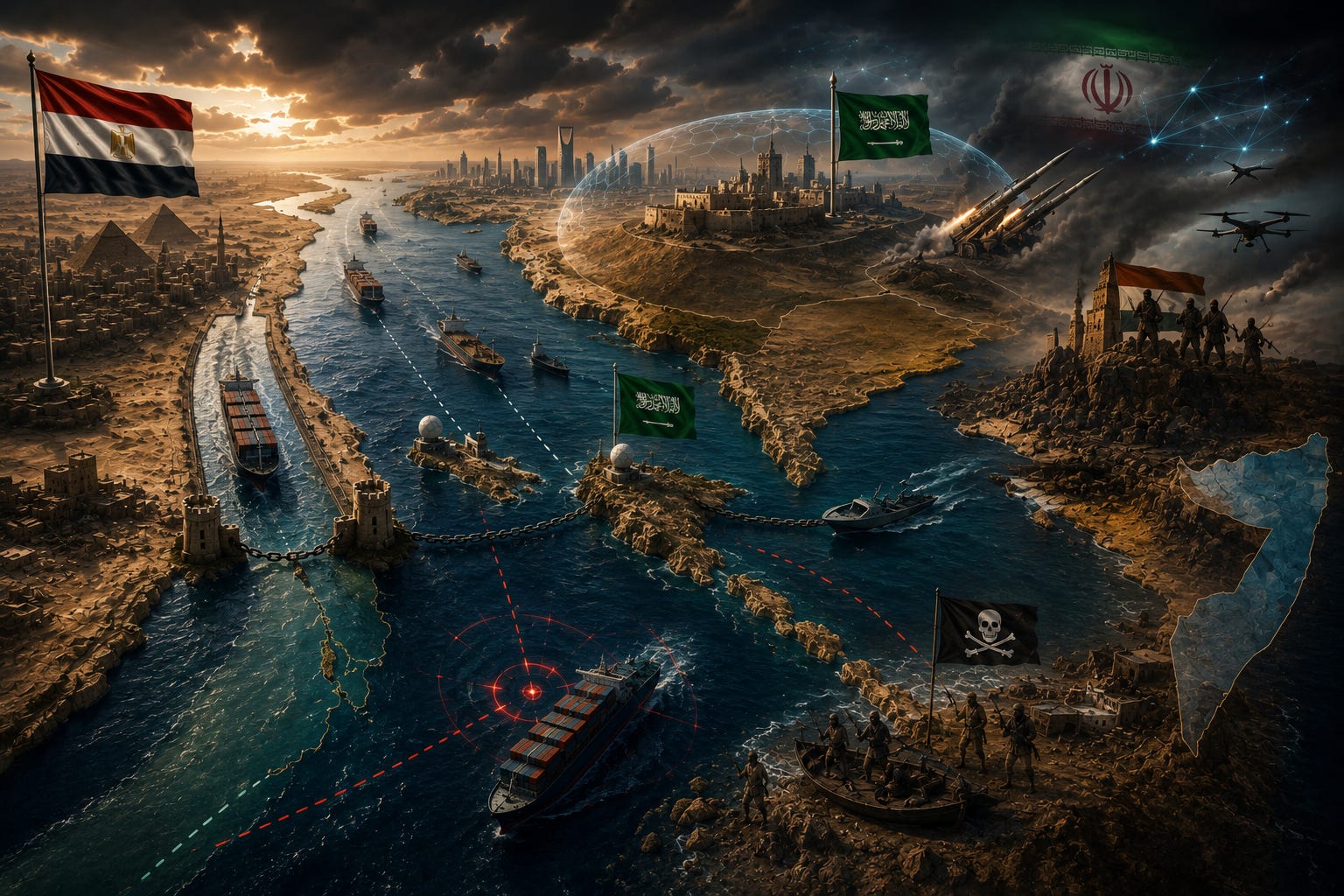
Egypt at the Door: Why Cairo Is Still Outside the Mecca Defense Pact
Egypt has spent much of 2026 behaving like a member of an emerging Saudi-Turkish-Pakistani security architecture without becoming a formal member of its most consequential institution. Cairo participated in the four-country consultations that preceded the Mecca Joint Defence Agreement, coordinated with Riyadh, Ankara, and Islamabad during the Iran crisis, expanded bilateral military cooperation with Pakistan and Turkey, and publicly supported institutionalizing the quadrilateral relationship. Yet when Saudi Arabia, Turkey, and Pakistan signed the Mecca agreement on August 7, Egypt was absent. Within days, Turkish Foreign Minister Hakan Fidan publicly identified Egypt as a possible future member, while competing reports emerged over whether Cairo had hesitated or Riyadh had objected to Egyptian accession. The resulting picture is considerably more complicated than a simple Egyptian rejection or Saudi veto.
Middle East Eye has now reported, citing unnamed sources, that Saudi Arabia opposed Egyptian participation despite Turkish efforts to bring Cairo into the agreement. The report has inevitably revived the old argument that President Abdel Fattah el-Sisi’s uncompromising hostility toward the Muslim Brotherhood remains an obstacle to Egyptian integration with a security architecture in which Turkey plays a major role. That explanation has some historical foundation. It is also insufficient to explain the current Saudi calculus. Riyadh itself has spent years rebuilding relations with Ankara, and the Saudi leadership has little interest in allowing disputes over the Brotherhood to determine the Kingdom’s security policy while Saudi territory, infrastructure, shipping routes, and regional influence face far more immediate threats. The more important question is what Egypt’s inclusion would do to the internal structure of the pact, who would define its strategic priorities, and how much freedom Saudi Arabia would retain after admitting the largest Arab military into an organization whose institutional identity has barely been established.
Egypt’s ambiguous position begins with the fact that the Mecca pact did not emerge suddenly in August. Saudi Arabia and Pakistan already possessed an unusually close defense relationship, strengthened by Pakistani military deployments, training relationships, and the September 2025 Strategic Mutual Defence Agreement. Turkey’s entry transformed that bilateral arrangement into something much more ambitious. Ankara contributes a large, experienced military, an expanding defense-industrial complex, considerable drone and missile capabilities, naval power, operational experience across several theaters, and NATO interoperability. Saudi Arabia contributes money, geographic centrality, political weight, infrastructure, and the strongest incentive to create an additional deterrent structure. Pakistan contributes a large military establishment, long experience working with Saudi forces, strategic depth, missile capabilities, and the unavoidable significance of being a nuclear-armed state.
Egypt would fundamentally change that equation. With Cairo inside, the pact would contain the four most consequential Sunni-majority military and political centers stretching from North Africa through the eastern Mediterranean and Arabian Peninsula into South Asia. Egypt would bring control of the Suez Canal, proximity to the Bab al-Mandab through the Red Sea, a large standing military, extensive air and naval assets, influence in Libya and Sudan, access to the eastern Mediterranean, and a political claim to leadership in the Arab world that neither Turkey nor Pakistan possesses. Its accession would therefore be qualitatively different from adding another friendly state. It would alter the center of gravity of the organization.
That helps explain why Saudi hesitation, if the Middle East Eye reporting is accurate, could have very little to do with Sisi’s hostility toward the Muslim Brotherhood. Saudi Arabia has its own long and complicated history with the Brotherhood and has designated the organization a terrorist group. Riyadh and Cairo have frequently differed over Turkey, Qatar, Syria, Libya, Gaza, and the appropriate treatment of political Islam, yet the idea that the current Saudi leadership would exclude Egypt primarily because Sisi is too hostile to the Brotherhood produces an awkward explanation of Saudi policy. Mohammed bin Salman has pursued reconciliation with Turkey because Saudi strategic requirements changed. Those requirements do not require Riyadh to adopt Ankara’s political preferences, much less the ideological sympathies associated with segments of Turkey’s ruling establishment.
The Brotherhood question is more relevant to Turkey-Egypt relations, and even there its importance has declined. Ankara and Cairo spent years on opposite sides of one of the most acrimonious political disputes in the region after Sisi removed Mohamed Morsi in 2013. Turkey became a center for Egyptian Brotherhood figures and opposition media, while Sisi’s government treated Turkish support for the Brotherhood as interference in Egypt’s internal security. Their competition subsequently expanded into Libya and the eastern Mediterranean. Since their rapprochement, both governments have demonstrated that strategic interests can override much of that history. Turkey curtailed the activities of some Egyptian opposition media operating from its territory, diplomatic relations were restored, presidential visits resumed, and military and economic contacts expanded. The same Sisi government supposedly rendered incompatible with the emerging pact by its anti-Brotherhood position was already participating in the four-country mechanism with Turkey, Saudi Arabia, and Pakistan before the Mecca agreement was signed.
The chronology is therefore important. In March, the foreign ministers of the four countries met in Riyadh. Additional consultations followed, including meetings in Antalya, Islamabad, and Cairo. On June 21, Sisi received the Saudi, Turkish, and Pakistani foreign ministers and explicitly called for strengthening the institutional character of the quadrilateral mechanism. Egypt was not standing outside a Saudi-Turkish-Pakistani project trying to gain admission. Cairo was already part of the diplomatic architecture from which the defense pact subsequently emerged. Its disappearance from the final three-party treaty demands an explanation based on what changed when consultation began turning into a binding mutual-defense commitment.
The most plausible answer begins with Saudi control. Riyadh has compelling reasons to ensure that the Mecca pact develops initially around a manageable core whose members bring complementary capabilities without immediately creating competing Arab leadership centers. Pakistan presents almost no challenge to Saudi leadership within an Arab security structure. Islamabad wants Saudi investment, energy cooperation, diplomatic support, and a strengthened strategic relationship. Its principal military concerns remain centered on South Asia. Turkey is far more powerful politically and militarily, yet Ankara’s non-Arab identity limits its ability to compete directly with Riyadh for leadership of the Arab state system. Saudi Arabia can therefore accommodate considerable Turkish influence while retaining a distinct claim to Arab leadership.
Egypt is different. Cairo has historically regarded Arab security as an arena in which Egypt possesses an inherent leadership role derived from geography, military size, population, history, and control of the Suez Canal. Even after decades of economic weakness reduced Egypt’s regional influence, no Egyptian government can comfortably accept permanent junior status in a major Arab defense structure. Bringing Egypt into the Mecca pact at its creation could consequently produce immediate questions about command, headquarters, strategic planning, force contributions, Red Sea responsibilities, and political leadership. Saudi Arabia may prefer to establish the institution, its secretariat, procedures, funding arrangements, and strategic priorities before admitting a member capable of demanding substantial influence over all of them.
There is also a significant difference in threat perception. Saudi Arabia currently has an urgent requirement for external military support because its security perimeter has become increasingly exposed. Iranian missile and drone capabilities, the Houthis, instability in Iraq, threats to Red Sea shipping, and uncertainty over the durability of U.S. protection have pushed Riyadh toward overlapping security arrangements. Pakistan and Turkey can provide capabilities that address portions of this problem without sharing every Saudi priority.
Egypt views the regional map through another set of vulnerabilities. Cairo is concerned with Gaza and Sinai, Libya, Sudan, the Red Sea, Ethiopia and the Nile, Mediterranean security, economic disruption through the Suez Canal, and the possibility that regional wars could produce new refugee and displacement pressures. Egypt supported Gulf security during the Iran conflict, including the provision of air-defense assistance, while remaining reluctant to become trapped in an open-ended confrontation. That reluctance illustrates precisely why Cairo may be uncomfortable with an Article 5-style commitment whose future interpretation remains uncertain.
For Egypt, the question is not simply whether it wants Saudi Arabia, Turkey, and Pakistan as security partners. It already has substantial relationships with all three. The question is whether Cairo wants an attack on any of them to generate a treaty obligation that could draw Egypt into conflicts originating in the Gulf, Yemen, Syria, or even South Asia. Pakistan’s confrontation with India alone creates obvious complications. Turkey has its own disputes and military commitments extending from Syria to the eastern Mediterranean. Saudi Arabia faces recurring threats from the Houthis and potentially Iran-linked actors. Egypt would have to calculate whether the deterrent value gained from membership compensates for the possibility of acquiring security obligations far beyond its immediate priorities.
The same calculation works in reverse. Saudi Arabia may question what Egypt would actually promise when the agreement is tested. Cairo’s behavior during recent crises suggests that it will assist Gulf partners when Egyptian interests and regional stability require it, while carefully controlling the scale and political meaning of that assistance. Riyadh is trying to create deterrence through the expectation that aggression against Saudi Arabia could activate Turkish and Pakistani support. Adding a powerful member with numerous reservations could strengthen the pact on paper while making its collective-defense clause more politically conditional.
Another source of Saudi caution may be Egypt’s relationship with the UAE. Riyadh and Abu Dhabi have developed increasingly serious differences over Yemen, Sudan, regional ports and trade routes, political influence, and competing approaches to the future balance of power in the Arab world. Egypt maintains important ties with the UAE, including substantial financial, investment, political, and military relationships. Cairo also shares some Emirati concerns about Islamist political movements. A Saudi-led defense architecture formed amid growing Saudi-Emirati competition would inevitably raise questions about how Egyptian membership affected that rivalry.
Riyadh may have little appetite for importing those questions into the pact before its basic institutions exist. Egypt would resist being forced to choose between Saudi Arabia and the UAE, particularly when both relationships serve important Egyptian interests. Saudi Arabia would have reason to wonder whether Egyptian participation could give Abu Dhabi an indirect window into an organization from which the UAE is currently absent. None of this requires an explicit Saudi accusation of Egyptian disloyalty. Institutional designers routinely begin with the partners whose commitments and strategic expectations are easiest to reconcile, then expand once procedures and boundaries have been established.
Turkey has reasons to prefer the opposite approach. Ankara benefits enormously from Egyptian accession because it would turn the Mecca agreement from a striking trilateral pact into the nucleus of a genuinely transregional security system. Turkey has spent years repairing relations with Egypt, Saudi Arabia, and other Arab governments partly because its earlier regional posture generated costly isolation. Bringing Sisi’s Egypt into a Turkish-supported defense structure would demonstrate that Ankara has moved beyond the ideological battles of the post-Arab Spring period. It would also give Turkey access to a security network spanning the eastern Mediterranean, Red Sea, Gulf, and Arabian Sea.
This explains why Turkish officials can enthusiastically discuss Egyptian accession while Saudi Arabia may prefer to delay it. Ankara gains geopolitical validation from enlargement. Riyadh bears much of the institutional cost of enlargement because the secretariat is located in Saudi Arabia and the Kingdom is trying to establish itself as the political center of the arrangement. The disagreement, assuming the reports of a Saudi objection are accurate, may therefore reflect different visions for the pact’s development rather than disagreement over whether Egypt is a friendly state.
Egypt itself has reasons to preserve ambiguity. Remaining associated with the four-country consultation mechanism allows Cairo to participate in regional diplomacy and security coordination without accepting every obligation contained in the Mecca agreement. It can conduct exercises with Pakistan, expand defense cooperation with Turkey, coordinate Red Sea policy with Saudi Arabia, provide military assistance to Gulf states when necessary, and retain diplomatic freedom toward Iran, India, the UAE, and the United States. Formal accession can always occur later if the pact develops into an effective institution and Cairo secures satisfactory terms.
This also means Egypt is neither fully “in” nor simply “out.” It is outside the treaty and inside the political ecosystem that produced it. That distinction may persist for some time. The R4 consultative framework involving Egypt, Saudi Arabia, Turkey, and Pakistan can continue alongside the narrower three-member mutual-defense organization. Such an arrangement could even prove useful. The trilateral pact can develop military procedures and deterrence commitments among its founding members while the quadrilateral forum handles broader political coordination, mediation, regional crises, and eventual discussions over enlargement.
The unresolved issue will be what kind of institution the Mecca agreement becomes. If it remains primarily a political deterrent statement supported by exercises, intelligence sharing, arms cooperation, and defense-industrial projects, Egyptian accession becomes easier. If it develops integrated military planning, predefined contingency obligations, permanent command mechanisms, or expectations of automatic operational support, Cairo will demand far greater clarity before joining. Saudi Arabia will simultaneously become more selective about admitting states capable of changing the organization’s strategic direction.
For that reason, reducing Egypt’s absence to Sisi’s anti-Muslim Brotherhood position risks mistaking an old ideological dispute for the current strategic argument. The Brotherhood remains part of the history shaping Egyptian-Turkish relations and continues to influence Egyptian perceptions of Turkey and Qatar. It cannot adequately explain why Egypt participated in months of quadrilateral consultations, why Sisi himself advocated institutionalizing that framework, why Turkey now openly supports Egyptian membership, or why Egypt has continued expanding military cooperation with the states involved.
The sharper explanation is that Egypt is too important to be an uncomplicated addition. Its military weight, Arab identity, Red Sea position, relationship with the UAE, distinct threat priorities, ties to India, concern about open-ended military commitments, and expectation of an influential institutional role would all change the Mecca pact. Saudi Arabia may want that eventually. It has strong reasons to decide first what it wants the organization to become.
Egypt therefore remains at the door because both Cairo and Riyadh have reasons to postpone the final decision. Sisi can obtain many of the benefits of cooperation without immediately accepting a collective-defense obligation. Mohammed bin Salman can consolidate a Saudi-centered institution before negotiating the terms under which another major Arab power enters it. Erdogan can continue campaigning for Egyptian accession because enlargement advances Turkey’s vision of a broader regional security system. Pakistan can work comfortably with either configuration.
The result is an unusual security architecture in which the fourth country may already be politically embedded before becoming legally attached. Egypt’s eventual accession remains plausible, perhaps even likely if the pact survives its first tests and develops credible military mechanisms. The timing and terms will reveal far more than whether Cairo has joined another defense agreement. They will show whether the Mecca pact is becoming a flexible network of regional powers, a Saudi-centered collective-defense organization, a Turkish-supported transregional security bloc, or some combination of all three. Egypt’s current absence is therefore one of the best indicators of the unresolved struggle over what this new alliance is actually supposed to be.
Egypt and the Pact’s Missing Military Weight
Whether Egypt eventually joins the emerging Saudi-Turkish-Pakistani defense structure has consequences that extend beyond the membership count because Cairo exposes the central weakness of the entire project: the distance between the enormous aggregate military resources of the participating states and their demonstrated willingness to employ those resources collectively. Adding Egypt would give the arrangement impressive numbers, geography, access to two seas, control of the Suez Canal, another large air force and navy, and considerably greater Arab political weight. None of those additions automatically creates an effective collective-defense organization. Egypt’s recent record in the Red Sea is particularly instructive because Cairo has suffered enormous economic damage from Houthi disruption of shipping while doing remarkably little militarily to suppress the source of that disruption. Saudi Arabia, meanwhile, has just discovered that a treaty describing an attack on one member as an attack on all does not necessarily produce a meaningful allied response when missiles and drones actually begin hitting Saudi targets.
This is why Egypt’s absence simultaneously weakens the Mecca agreement and saves its founders from immediately confronting another uncomfortable question about what membership means. Egypt is the Arab state with perhaps the clearest direct economic interest in restoring secure commercial navigation through the Red Sea. Houthi attacks and the resulting diversion of commercial vessels around the Cape of Good Hope have severely damaged Suez Canal revenues, depriving Egypt of badly needed foreign currency and increasing pressure on an already fragile economy. Cairo possesses a large navy, operates major naval facilities on both the Mediterranean and Red Sea coasts, controls the northern entrance to the Red Sea through Suez, and has spent heavily on naval modernization. Yet Egypt has shown little appetite for using those capabilities against the Houthis. Its military posture has concentrated on protecting Egyptian territory, maintaining maritime awareness, and avoiding direct entry into the Yemen conflict.
That record should temper expectations about what Egyptian membership would contribute to Saudi security. Egypt has ample military assets. Its willingness to deploy them against non-state actors capable of retaliating against Egyptian territory, shipping, ports, or economic infrastructure has been considerably more limited. Cairo has watched a threat inflict substantial economic losses on Egypt without translating those losses into a sustained offensive military campaign. There are understandable reasons for this restraint. Egypt remembers its disastrous intervention in Yemen during the 1960s, wants no new Yemen war, faces serious security concerns in Libya, Sudan, Gaza, Sinai, and the Nile basin, and cannot easily absorb another expensive military commitment. Those constraints would follow Egypt into any defense pact.
At the same time, the inability or unwillingness of Egypt to confront the Houthis has revealed why its exclusion is significant. Red Sea security is precisely one of the areas where a four-country arrangement should theoretically have advantages over the current trilateral. Saudi Arabia controls much of the eastern Red Sea coastline. Egypt controls Suez and possesses major facilities along the western side. Turkey brings sophisticated defense-industrial capabilities, drones, naval platforms, electronic warfare systems, and experience conducting expeditionary operations. Pakistan brings a substantial navy, missile capabilities, manpower, and extensive experience working with Saudi forces. A serious quadrilateral could divide responsibilities, establish permanent maritime surveillance, integrate intelligence, coordinate air and missile defense, escort commercial shipping, protect ports and energy infrastructure, and create predetermined responses to attacks originating from Yemen.
The absence of Egypt leaves a geographical hole in any such design. A regional maritime-security structure concerned with the Red Sea but lacking the country that controls the Suez Canal is inherently incomplete. Egypt’s inclusion would connect the eastern Mediterranean directly to the Red Sea component of the pact and give the organization a continuous strategic geography extending from Suez through the Arabian Peninsula toward the Arabian Sea. It would also make it easier to frame Red Sea security as a regional responsibility rather than a predominantly Saudi concern. For Riyadh, that could be useful because Saudi Arabia has been trying to avoid another unilateral military campaign in Yemen after years of costly and politically damaging intervention.
The larger problem is that there is little evidence so far that the trilateral itself possesses the operational machinery required to exploit even the capabilities its existing members already have. The Mecca Joint Defence Agreement contains powerful language about collective deterrence, and Turkish officials have compared its mutual-defense provision to NATO’s Article 5. Such comparisons create expectations that the agreement has not yet earned. NATO’s deterrent power does not come from the wording of Article 5 alone. It rests on decades of integrated command structures, joint planning, common procedures, exercises, intelligence mechanisms, logistics, prepositioning, interoperability, political consultation, and the demonstrated expectation that an attack can trigger military action.
The Mecca agreement was signed before comparable mechanisms had been constructed. That makes it closer, at this stage, to a political declaration backed by potentially formidable states than to an operational military alliance. Saudi Arabia clearly wants to communicate that it is no longer dependent on a single external security patron and that attacks on the Kingdom could acquire consequences extending beyond the Saudi military. Turkey benefits from presenting itself as a central security actor across the Middle East. Pakistan gains strategic and economic value from formalizing its already extensive defense relationship with Saudi Arabia. All three obtain political advantages from the announcement itself.
The Houthis have now forced them to confront the difference between announcing deterrence and producing it. Only days after the Mecca agreement was signed, the Houthis attacked Saudi Aramco’s Jazan refinery and subsequently continued targeting Saudi interests. Saudi Arabia’s new allies did not produce the kind of visible collective military response that an Article 5 analogy would lead outsiders to expect. Turkey did not launch strikes against Houthi missile infrastructure. Pakistan did not deploy forces to conduct retaliatory operations. There was no obvious activation of a trilateral military command, coordinated strike package, joint ultimatum backed by predetermined consequences, or rapid collective operation demonstrating that an attack on Saudi Arabia had literally become an attack on all three states.
The failure is important because deterrence depends heavily on what happens after a threat tests a declared commitment. The Houthis had every incentive to test the new agreement quickly. They could determine whether the language represented a genuine change in Saudi Arabia’s defensive position at relatively low cost, particularly if Riyadh and its new partners remained reluctant to escalate. Their attacks therefore functioned as an involuntary experiment in the credibility of the pact. The initial result was not encouraging. Saudi Arabia acquired new treaty language without acquiring an immediately visible automatic response mechanism.
This does not make the agreement meaningless. It identifies where its present value actually resides. The most consequential component may have little to do with conventional military cooperation and much more to do with Pakistan’s nuclear status. Saudi Arabia has spent decades under the U.S. security umbrella while maintaining an unusually close defense relationship with Islamabad. Formalizing a mutual-defense relationship with the only nuclear-armed Muslim state inevitably creates strategic ambiguity about whether Pakistan’s deterrent ultimately extends to Saudi Arabia. Pakistani officials do not need to publish a detailed nuclear doctrine covering the Kingdom for adversaries to incorporate that possibility into their calculations.
The Mecca agreement strengthens that ambiguity by adding Turkey to the arrangement and explicitly defining an attack on one party as an attack on the others. The resulting deterrent question becomes much more serious than whether Pakistani aircraft or troops would arrive after another Houthi strike. An adversary contemplating a war that threatened the Saudi state itself has to consider whether escalation could eventually engage Pakistan’s strategic capabilities. That uncertainty may be the pact’s most important security contribution. It operates at the upper end of the escalation spectrum, where threats become existential, while offering considerably less evidence of effectiveness against the persistent lower-level attacks that Saudi Arabia actually encounters most frequently.
That distinction explains the paradox exposed by the Houthi attacks. A Pakistani nuclear umbrella could potentially discourage an adversary from attempting to destroy or conquer Saudi Arabia. It cannot readily deter a Houthi drone launched at a refinery unless Pakistan convinces the Houthis and their Iranian supporters that such an attack could initiate a chain of escalation carrying unacceptable consequences. Nuclear weapons are poorly suited to answering harassment, maritime disruption, militia attacks, inexpensive drones, and calibrated missile strikes. Saudi Arabia’s most persistent threats live precisely in that space below existential war. Riyadh therefore needs conventional deterrence, integrated air defense, intelligence, counter-drone capabilities, maritime control, and credible retaliatory options at least as much as it needs strategic nuclear ambiguity.
Egypt would contribute most strongly to that conventional level if Cairo were willing to assume the required obligations. Its geography is particularly valuable. Its military could strengthen Red Sea surveillance, naval patrols, air-defense coordination, logistics, basing, and control of the northern maritime approaches. Egypt also has relationships with states across Africa and the Arab world that could help broaden the political legitimacy of a Saudi-centered maritime-security architecture. A four-country structure involving Egypt would look less like an improvised Saudi insurance policy and more like the foundation of an indigenous regional security organization.
Egyptian membership could also increase the pact’s credibility in the Arab world. Pakistan and Turkey are powerful states, yet neither is Arab. A Saudi-led arrangement with Ankara and Islamabad can easily be interpreted as Riyadh importing external military weight because existing Arab security structures have failed. Adding Egypt would allow Saudi Arabia to claim that the two principal Arab military powers are anchoring a broader system with Turkish and Pakistani support. The political symbolism would be considerable, particularly as GCC cohesion has weakened and Saudi-UAE disagreements have become more visible.
Yet Egypt’s inclusion could just as easily magnify the credibility problem if Cairo joined without changing its behavior. A four-member pact in which Egypt continues avoiding operations against the Houthis, Turkey carefully selects which attacks justify involvement, Pakistan avoids actions that could jeopardize its other strategic relationships, and Saudi Arabia remains reluctant to retaliate decisively would accumulate military assets without accumulating deterrence. An alliance containing millions of military personnel, advanced aircraft, warships, missiles, drones, and potentially a nuclear umbrella can still fail to deter relatively inexpensive attacks if every government retains a different threshold for action.
This is why the first Houthi test deserves more attention than ceremonial declarations surrounding the agreement. The attacks demonstrate that the principal challenge is political commitment rather than aggregate military capacity. Saudi Arabia, Turkey, and Pakistan already possess more than enough conventional power to impose severe costs on the Houthis if they jointly decide to do so. Their limited response cannot be explained by lack of aircraft, missiles, drones, ships, or manpower. It reflects calculations about escalation, Iran, Yemen, domestic priorities, international reaction, and the costs of becoming involved in another war.
Adding Egypt does not solve that problem. Cairo brings another government with its own extensive list of reservations. Egypt would be especially wary of transforming a Saudi defense commitment into an obligation to participate in another Yemen campaign. It would also seek clarity about whether the agreement covers attacks involving Iran, Israel, Pakistani disputes with India, Turkish confrontations in Syria, and conflicts involving non-state proxies. The more expansive the collective-defense principle becomes, the more difficult it will be to obtain automatic Egyptian participation.
The irony is that Egypt may currently contribute almost as much to the emerging architecture from outside the treaty as it would as a cautious member. Cairo can coordinate intelligence, participate in exercises, provide air-defense assistance, facilitate maritime cooperation, conduct bilateral training, and support Saudi Arabia diplomatically without accepting an obligation to respond to every attack against every treaty member. Riyadh can call upon Egyptian cooperation when their interests align while avoiding the political embarrassment of discovering that another formal ally interprets collective defense differently when a crisis occurs.
For regional security, therefore, the more urgent question is whether the Mecca pact can develop credible mechanisms before it expands. If Saudi Arabia, Turkey, and Pakistan establish a standing military committee, common threat assessments, integrated air and missile-defense coordination, intelligence fusion, maritime patrol arrangements, contingency plans, logistics protocols, and clearly defined thresholds for collective action, Egyptian membership could substantially strengthen the system. Cairo would be joining an institution whose obligations and benefits could be evaluated concretely.
If those mechanisms do not emerge, Egyptian accession would primarily enlarge the photograph. The alliance would gain another major military, another president at summits, another set of exercises and communiqués, and another impressive aggregate figure for troops and equipment while retaining the same uncertainty about who actually fights when somebody attacks a member. The Houthis have already demonstrated how quickly adversaries can exploit that uncertainty.
The Pakistani nuclear connection consequently remains the element most capable of altering strategic calculations immediately. It creates ambiguity at the highest level of escalation even while the conventional architecture remains immature. Egypt’s participation could theoretically extend that ambiguity to Cairo as well, raising extraordinary questions about whether a Pakistani strategic guarantee would ultimately encompass Egyptian security. That alone could affect calculations involving major interstate war. It would still offer Egypt little assistance against the forms of coercion it currently faces most often, including disruption of Suez traffic, instability around Sudan and Libya, pressure surrounding Gaza, and threats to Red Sea commerce.
Egypt’s presence would therefore make the emerging quadrilateral geographically coherent, politically heavier, and militarily more impressive. Its absence leaves the Red Sea architecture conspicuously incomplete and reinforces the impression that the Mecca agreement remains primarily a Saudi effort to manufacture additional deterrence during a period of extraordinary insecurity. The first Houthi attacks have already shown that declarations of collective defense do not automatically generate collective military action. Until Turkey and Pakistan demonstrate what they are actually prepared to do when Saudi territory is attacked, adding Egypt would expand the pact’s potential more than its proven capability.
That may ultimately be the most revealing reason to watch Cairo from the outside. Egypt does not need to rush into an organization whose founders themselves have yet to establish the operational meaning of membership. Saudi Arabia needs to demonstrate that the pact can deter something below the threshold of existential war. Turkey needs to show how far its military commitments extend beyond diplomatic solidarity. Pakistan needs to clarify, at least through behavior, what its guarantee means when Saudi infrastructure comes under repeated attack. Once those questions acquire credible answers, Egypt’s decision will carry far greater strategic significance. Until then, the missing Egyptian seat is only one part of a larger uncertainty surrounding an alliance whose military potential is enormous, whose nuclear implications are potentially historic, and whose first encounter with the type of attack it was supposedly created to deter has already exposed how much of the architecture still exists on paper.
The Hormuz Capitulation
By August 2026, the question surrounding the Strait of Hormuz is no longer whether Iran might eventually acquire enough leverage to charge ships for passage or impose political conditions on navigation. Iran has already done it. For months, the IRGC has operated what shipping brokers have described as a “Tehran toll booth,” directing vessels through routes close to the Iranian coast, determining which ships can pass, coordinating individual transits, and extracting payments that have reportedly reached roughly $2 million for large tankers. Some payments have been made in cryptocurrency and others through Chinese financial channels, giving Tehran additional means of circumventing sanctions. Dozens of foreign vessels have reportedly paid for passage, while ships associated with governments Iran considers hostile have faced exclusion or greater difficulty obtaining clearance. What began during the war as coercive interference with an international waterway has therefore already developed into a functioning system of selective access, payment, and Iranian gatekeeping.
The more recent negotiations involving Iran, Oman, the Gulf states, and the United States concern the terms under which this accomplished fact will be regularized, constrained, or partially legitimized. Iran has sought billions of dollars in economic benefits from reopening the strait more fully and has promoted arrangements under which it would receive revenue for security, safety, environmental, or other maritime services. Tehran has estimated that a broader system of charges could generate as much as $40 billion annually for participating states. The Omani proposals have attempted to soften the arrangement by dividing responsibility for traffic, including an inbound lane under Iranian oversight and an outbound lane associated with Oman, while formally excluding compulsory Iranian tolls. Even that formulation has contemplated voluntary contributions for services, and Iran has continued pressing for considerably greater authority. The argument is therefore taking place after Iran has demonstrated that it can impose a payment regime by force and after commercial shipping has already adapted to Iranian control.
That is what makes the Gulf response so extraordinary. Saudi Arabia, the UAE, Qatar, Kuwait, Bahrain, and Oman are not confronting an abstract Iranian proposal that they can accept or reject before it changes conditions at sea. They are confronting a new condition that Tehran created unilaterally, through military pressure and the credible threat of further attacks, and they have spent months trying to negotiate their way into a tolerable version of it. Shipping through Hormuz has collapsed from prewar levels of roughly 130 vessels a day to a tiny fraction of normal traffic during periods of heightened tension. Even when the United States has announced that it controls the strait or created alternative protected routes closer to Oman, commercial vessels have frequently remained reluctant to use them. Some have continued relying on Iranian-controlled passages because shipowners and insurers judge Iranian permission to be more immediately relevant to physical survival than declarations of control by outside powers.
For Gulf governments that have spent hundreds of billions of dollars on defense, the implications are severe. Their principal maritime artery has effectively become subject to the discretionary power of the state they have spent decades identifying as one of their principal security threats. Saudi Arabia has now added Turkey and Pakistan to a new mutual-defense arrangement. The UAE has developed substantial military capabilities and invested heavily in power projection. Bahrain hosts the U.S. Fifth Fleet. Qatar hosts one of the largest concentrations of U.S. military infrastructure in the region. Oman sits directly across the strait from Iran and has extensive security relationships with Western powers. Yet Iran has managed to establish a system under which commercial actors negotiate with the IRGC over passage, sometimes pay Tehran for access, and organize their behavior around the assumption that Iran possesses the ability to decide who can safely transit the waterway.
The rapid acceptance of this reality becomes easier to understand when the economic exposure of the Gulf monarchies is considered alongside Iran’s ability to tolerate prolonged disorder. Saudi Arabia’s current economic strategy depends on investment, tourism, construction, logistics, financial development, new industries, and the credibility of Vision 2030. The UAE depends even more heavily on aviation, ports, finance, real estate, international commerce, tourism, and its reputation as a safe commercial platform. Qatar’s LNG exports remain dependent on maritime access through Hormuz. The infrastructure supporting these economies is highly concentrated and exceptionally difficult to protect completely. Oil-processing facilities, LNG terminals, desalination plants, airports, refineries, ports, power infrastructure, pipelines, and major urban developments offer Iran and its partners a large menu of economically consequential targets.
During a sustained confrontation, Tehran does not need to destroy Gulf militaries to impose costs that Gulf governments consider intolerable. It can attack or threaten fixed infrastructure, increase insurance rates, interrupt tanker traffic, frighten investors, complicate aviation, create uncertainty around energy exports, and periodically demonstrate that expensive missile-defense systems cannot guarantee complete protection. Even an interception rate that would be considered militarily successful can become economically inadequate if the small percentage of missiles or drones that penetrate defenses strike refineries, desalination plants, LNG infrastructure, or ports. The economic threshold for damage is considerably lower than the military threshold for defeat.
Iran’s governing system has spent decades absorbing conditions that Gulf governments are organized to prevent. Sanctions, inflation, currency collapse, infrastructure deterioration, unemployment, capital flight, and declining living standards have repeatedly been subordinated to the regime’s military and ideological priorities. The Iranian leadership has demonstrated an exceptional willingness to transfer the economic costs of confrontation onto its population. Saudi Arabia, the UAE, Qatar, and the smaller Gulf monarchies have developed political economies in which prosperity, modernization, predictability, and insulation from regional chaos are central to state legitimacy. Tehran can therefore impose pressure against economic systems that have far more to lose from prolonged uncertainty than Iran’s governing elite does.
Months of successful Iranian coercion have now reinforced that asymmetry. Once shipping companies began negotiating payments, arranging passage with the IRGC, and treating Iranian approval as a commercial necessity, the barrier to normalization became lower. A tanker operator deciding whether to pay a toll is not conducting a grand-strategic debate about freedom of navigation. It is calculating the cost of a delayed cargo, war-risk insurance, charter obligations, crew safety, and the possibility that a ship worth tens or hundreds of millions of dollars could be damaged. If paying Iran is cheaper than waiting indefinitely or risking an attack, the commercial decision is straightforward. Repeated across dozens and eventually hundreds of vessels, those individual decisions create a new maritime reality long before diplomats formally recognize it.
The Gulf governments are now adapting to a system that commercial behavior has already helped institutionalize. Oman has tried to negotiate a structured arrangement. Qatar has supported diplomatic efforts and has incentives to restore LNG traffic rapidly. Saudi Arabia and the UAE have invested heavily in alternative export infrastructure, storage, pipelines, and ports that reduce their exposure to Hormuz. None of these policies has reversed Iranian control. They manage its consequences. Even alternative routes have their own vulnerabilities, particularly when Iranian partners such as the Houthis can threaten Saudi infrastructure and Red Sea shipping.
Saudi Arabia consequently finds itself facing pressure at both ends of the Arabian Peninsula. Iran has established effective gatekeeping power over Hormuz, while the Houthis retain the ability to attack Saudi territory and disrupt maritime activity around the Red Sea and Bab al-Mandab. The Kingdom’s response has been an extraordinary expansion of security relationships, including the new agreement with Turkey and Pakistan, continued reliance on U.S. capabilities, investment in domestic defense production, alternative transport corridors, and diplomacy with Iran. Yet the proliferation of security arrangements has not prevented the two most strategically important maritime approaches to Saudi Arabia from becoming vulnerable to Iranian or Iran-aligned coercion.
This is particularly damaging to claims that a fundamentally more assertive regional security architecture has emerged. The Saudi-Turkish-Pakistani agreement combines three states with enormous aggregate military power. Pakistan brings a large military and nuclear weapons. Turkey contributes a capable navy, sophisticated drones, missiles, electronic warfare, operational experience, and a rapidly expanding defense industry. Saudi Arabia contributes money, advanced Western weapons, strategic geography, and the political incentive to create a new deterrent system. On paper, the combination looks formidable. At Hormuz, however, Iran has already established a toll system and selective passage regime, while Saudi Arabia and its neighbors are negotiating around the resulting reality.
Pakistan’s nuclear connection remains potentially important at the uppermost end of escalation. An Iranian leadership contemplating an existential attack on Saudi Arabia would have to consider the possibility that Pakistan’s strategic guarantee could eventually become relevant. That uncertainty can strengthen Saudi deterrence against catastrophic interstate war. The Iranian strategy at Hormuz demonstrates why such a guarantee addresses only a portion of Saudi Arabia’s actual security problem. Tehran can collect money from tankers, manipulate passage, threaten individual vessels, support proxy attacks, strike infrastructure selectively, and periodically close or restrict navigation without approaching the threshold at which a Pakistani nuclear response becomes credible.
Years of Iranian military development have concentrated precisely on exploiting this space. Missiles, drones, mines, fast boats, coastal systems, proxy militias, sabotage capabilities, cyber operations, and deniable attacks give Tehran numerous ways to impose economic pain while controlling the scale of escalation. Every Gulf government then has to decide whether a particular incident is serious enough to justify a larger war. Iran only needs enough restraint to keep the answer uncertain. Its success at Hormuz indicates that this approach has survived even after a much larger regional conflict and substantial damage to Iranian military capabilities.
The behavior of Arab states also reveals how little collective willingness exists to accept the costs required to reverse the situation. Restoring unrestricted navigation against Iranian resistance would require sustained military operations rather than another declaration. Iranian coastal missile positions, drones, mines, naval assets, IRGC facilities, surveillance systems, and command infrastructure would have to be suppressed whenever they threatened shipping. Tehran could retaliate against Gulf energy infrastructure and ports. Proxy forces could expand attacks elsewhere. Insurance rates could remain elevated for months. Energy exports could suffer further interruptions. Gulf governments would have to accept substantial economic damage while waiting for military pressure to alter Iranian behavior.
Their conduct indicates that they have judged this price to be too high. That judgment explains why accommodation has occurred so quickly. Governments dependent upon predictable commerce have chosen to restore as much predictability as possible rather than fight indefinitely over the principle that Iran should possess no gatekeeping authority. The calculation can be economically rational for each individual government while producing a disastrous collective outcome. Every state that seeks a separate accommodation reduces the incentive for the others to resist. Iran gains additional leverage because it can offer preferential treatment to friendly states and punish governments that participate in efforts to challenge its control.
The tiered nature of Iranian access makes this particularly effective. Iranian vessels can move under favorable conditions. Ships associated with friendly countries can negotiate passage and payments. Vessels connected to hostile governments can be delayed, restricted, or excluded. Tehran therefore possesses a mechanism capable of converting maritime control into diplomatic leverage. China, Pakistan, and other states can receive more favorable treatment, while the United States and Israel face greater restrictions. The strait becomes an instrument for rewarding political relationships and imposing costs on adversaries.
Once the Gulf states accept that arrangement as the operating environment, Iran acquires leverage extending far beyond the revenue collected from individual ships. Negotiations over sanctions, frozen Iranian assets, Iranian oil exports, U.S. military deployments, regional proxy forces, and future ceasefires can all become connected to maritime access. Tehran can reopen Hormuz partially when negotiations advance and restrict it when pressure increases. Commercial shipping becomes a pressure gauge attached to every major regional negotiation.
The economic component makes the precedent even more troubling. Tehran has floated proposals that could generate tens of billions of dollars annually from maritime services associated with reopening and managing the strait. Such revenue would arrive when Iran needs resources to rebuild damaged military infrastructure, replenish missiles and drones, repair air defenses, support the IRGC, and stabilize government finances after months of conflict. Even if revenues were formally designated for maritime safety or environmental services, money entering the Iranian state system would free resources for other purposes. Gulf governments could therefore end up participating in an arrangement that helps finance Iran’s recovery from the same confrontation through which Tehran established its coercive control.
The emerging accommodation also changes the meaning of Gulf investment in bypass infrastructure. Saudi pipelines to the Red Sea, UAE export capacity through Fujairah, Omani ports facing the Arabian Sea, rail projects, storage facilities, and proposed regional corridors are valuable resilience measures. Their accelerating importance reflects the assumption that Hormuz cannot reliably be restored to its previous status. The regional response is increasingly focused on reducing dependence on the strait rather than denying Iran the ability to dominate it.
Egypt’s experience with the Red Sea reinforces the same pattern. Houthi attacks have inflicted enormous losses on Suez Canal revenues, yet Cairo has shown little willingness to undertake sustained military operations against the Houthis. Saudi Arabia has suffered renewed Houthi attacks despite its new defense agreement. Iran controls access through one strategic chokepoint while an Iran-aligned movement can disrupt another, and the major Arab states affected by both threats have increasingly concentrated on economic adaptation, diplomacy, defensive measures, and alternative routes.
For Tehran, the lesson is enormously favorable. The regime has demonstrated that geographical leverage combined with a high tolerance for economic pain can compensate for substantial conventional weaknesses. It does not need to match Saudi defense spending, Turkish industrial capacity, Pakistani manpower, or U.S. naval power platform for platform. It needs to make the use of those capabilities sufficiently expensive that the governments possessing them prefer negotiation. Hormuz has shown that this threshold can be reached.
The supposed regional shift toward strategic autonomy therefore requires a much harsher assessment. Arab states have certainly diversified their diplomatic and military relationships. Saudi Arabia is building connections with Turkey and Pakistan while maintaining ties with Washington and cultivating China. The UAE has pursued its own network of partnerships. Qatar and Oman have positioned themselves as mediators. Defense procurement is becoming more diversified, and regional governments are investing in domestic military industries. These developments provide additional options. They have not yet produced a willingness or capability to prevent Iran from imposing a new commercial order in the region’s most important waterway.
What has emerged instead is a model of strategic risk management built around accepting certain forms of coercion while reducing their economic consequences. Gulf states are constructing bypass routes, negotiating shipping arrangements, purchasing additional air defenses, diversifying partners, maintaining dialogue with Tehran, and seeking external guarantees against catastrophic escalation. The objective increasingly appears to be keeping Iranian pressure within tolerable limits rather than eliminating Tehran’s capacity to impose it.
For Iran, this is close to an ideal strategic outcome. Tehran can remain conventionally weaker than the combined states surrounding it while exercising disproportionate influence over their economic decisions. The IRGC does not need permanent uncontested naval supremacy in Hormuz. It needs shipping companies to believe that crossing without Iranian approval is dangerous. Once that belief becomes embedded in insurance models, charter contracts, corporate risk assessments, and government planning, coercive control acquires a degree of permanence independent of the number of Iranian warships physically present.
The most damaging precedent may ultimately be psychological. Before the war, the idea that Iran could openly charge foreign tankers for passage through Hormuz and have major shipping companies negotiate with the IRGC would have represented an extraordinary breakdown of the maritime order. Months later, the discussion has moved to what Iran should charge, which services might justify payments, how traffic lanes should be divided with Oman, what economic benefits Tehran should receive, and which political conditions should accompany reopening. The extraordinary has already begun to become administrative.
That transformation tells us far more about the current balance of power than another defense summit. Saudi Arabia can sign an Article 5-style agreement with Turkey and Pakistan, seek an eventual Pakistani strategic umbrella, expand its own military industry, and purchase additional Western weapons. The UAE can build sophisticated armed forces and bypass infrastructure. Egypt can possess one of the largest militaries in the region. The United States can maintain fleets and bases across the Gulf. Yet Iran has already demonstrated that it can make commercial actors pay for passage through an international chokepoint and induce neighboring governments to negotiate around that fact.
The Arab states have therefore accepted much more than an inconvenient temporary disruption. Through months of adaptation, negotiation, alternative routing, and limited resistance, they have begun accommodating an Iranian-created maritime order in which Tehran exercises a gatekeeping role that it did not possess before the war. Whether the final diplomatic agreement formally recognizes Iranian tolls is almost secondary to what has already occurred. The IRGC has collected payments. Ships have sought Iranian permission. Traffic has followed Iranian-controlled routes. Gulf economies have adjusted. Diplomats are negotiating from a baseline created by Iranian coercion.
Any assessment of the new regional security architecture has to begin there. The central development is not that Iran may someday monetize Hormuz. It already has. The consequential question is why states possessing vastly greater aggregate wealth, advanced weapons, powerful external allies, new defense pacts, and supposedly expanding strategic autonomy have accepted the resulting reality with such remarkable speed. Their answer, expressed through behavior rather than declarations, is that the economic and military cost of reversing Iranian control appears greater than the cost of living with it. That calculation has given Tehran something far more valuable than the millions collected from individual tankers. It has established the expectation that Iran can create a new regional reality through coercion and then negotiate over the price everyone else will pay to live inside it.
If Suez Is Next
Saudi Arabia’s response to the effective loss of reliable access through Hormuz has increasingly depended on moving energy westward, particularly through Red Sea infrastructure and onward through Egypt. That escape route is already coming under pressure. Saudi tankers using the Red Sea have begun switching off tracking systems to reduce their exposure after the Houthis declared a maritime embargo on Saudi Arabia in July and attacked Saudi-linked shipping and infrastructure. More Saudi crude is consequently moving north toward the Suez Canal and through Egypt’s SUMED pipeline, including unusually heavy loadings from Sidi Kerir. The strategic concentration is becoming obvious: traffic diverted away from one Iranian-controlled chokepoint is being pushed toward another maritime system that the Houthis are increasingly capable of threatening.
For Egypt, the danger extends well beyond another decline in Suez Canal receipts. The canal is one of the central strategic assets upon which Egypt’s international importance rests, linking the Mediterranean to the Red Sea while providing Cairo with revenue, political influence, leverage over global commerce, and a permanent role in international maritime security. If commercial operators begin treating the entire Red Sea-Suez route as a high-risk corridor, Egypt would lose far more than transit fees. Its economic crisis would worsen, its attractiveness as a logistics and manufacturing hub would suffer, foreign-currency shortages would become more difficult to manage, and Cairo would discover that an armed movement hundreds of miles to the south had acquired a continuing veto over the commercial value of one of Egypt’s most important national assets.
The immediate threat does not require the Houthis to reach the canal itself. They only have to make the approaches to Suez sufficiently dangerous that shipping companies decline to use it. The August 11 attack on the Egyptian-owned Tihamah in the Bab al-Mandab, which killed crew members and Yemeni rescuers, demonstrates how directly Egyptian commercial interests can already be exposed. The Houthis can damage the economics of Suez from Yemen because the canal depends upon the entire route connecting it to the Indian Ocean. A container ship leaving Asia for Europe cannot benefit from a perfectly secure Suez Canal if it has to traverse a lethal maritime corridor before reaching it.
The emerging security problem becomes considerably more serious when developments on the Somali side of the Gulf of Aden are included. Cooperation between the Houthis and Al-Shabaab is no longer merely hypothetical. UN investigators have documented a developing relationship involving weapons transfers, training, technical expertise, logistics, and discussions concerning maritime attacks. Earlier UN reporting described meetings in which Al-Shabaab sought advanced weapons and training from Houthi representatives and was expected in return to increase piracy in the Gulf of Aden and off Somalia, disrupting commercial traffic and generating ransom revenue. Subsequent investigations documented continued arms flows from Yemen into Somalia and described growing Houthi-Al-Shabaab cooperation as a regional security threat.
Ideological compatibility is not required to make such cooperation effective. Al-Shabaab is affiliated with al-Qaeda, while the Houthis belong to an entirely different ideological and sectarian universe and operate within Iran’s regional network. Their interests can nevertheless converge around weapons trafficking, revenue generation, attacks on common adversaries, intelligence exchange, technical assistance, and disruption of maritime commerce. Criminal networks require even less ideological justification. Somali pirates, smugglers, arms traffickers, corrupt port officials, local militias, and terrorist organizations can cooperate transactionally whenever doing so produces money, weapons, intelligence, or freedom of movement.
A maritime ecosystem built from those relationships would present a qualitatively more complicated challenge than the Houthi threat alone. The Houthis possess missiles, drones, surveillance capabilities, experience identifying commercial targets, access to Iranian technology and expertise, and territory overlooking the Bab al-Mandab. Somali pirates possess local knowledge of a vast coastline, small-boat experience, boarding capabilities, ransom networks, and familiarity with operating among ordinary fishing and commercial traffic. Al-Shabaab brings territorial access, organized armed networks, smuggling relationships, intelligence capabilities, terrorist infrastructure, and the ability to provide protection or logistical support on the Somali side. Iran does not need to place all these actors under a centralized command for their combined activity to become strategically useful.
Such a network could stretch the threat environment across a maritime area far larger than any single Houthi missile engagement zone. Missile and drone attacks could push commercial vessels farther from Yemen only for piracy risks to increase closer to Somalia. Ships seeking routes believed to be safer from one threat could become more exposed to another. Armed groups could share information about ship movements, cargoes, ownership, security procedures, and vulnerabilities. Smuggling routes used to transfer weapons from Yemen into Somalia could operate in the opposite direction for personnel, money, intelligence, or captured equipment. Even intermittent coordination would force shipping companies to assess the Gulf of Aden and southern Red Sea as one interconnected threat environment.
Commercial shipping is particularly vulnerable to this type of distributed pressure because attackers do not need anything resembling maritime supremacy. A handful of successful attacks can transform insurance calculations across an entire region. Shipping companies respond to probability multiplied by potential loss, and the potential loss associated with a modern container vessel, LNG carrier, tanker, cargo, crew, environmental disaster, or lengthy salvage operation is enormous. Repeated incidents can therefore divert thousands of ships even when the overwhelming majority would have completed their voyages safely.
The Houthis have already demonstrated this principle. Their maritime campaign never required them to sink every vessel approaching the Bab al-Mandab. They needed enough successful attacks and enough uncertainty about future targeting to convince major shipping lines that sailing around Africa was commercially preferable. A broader Houthi-Somali threat network would extend the same method geographically. Piracy adds another variable because vessels face the possibility of hijacking and ransom alongside missile and drone attack. The commercial calculation becomes progressively more unfavorable as different threats accumulate.
Suez would consequently be strangled from the south rather than attacked at Port Said or Ismailia. The canal itself could remain under complete Egyptian military control, its banks could remain secure, and every vessel entering from the Mediterranean could be protected. Revenue would still collapse if vessels originating in Asia, the Gulf, or East Africa concluded that reaching the southern entrance was too dangerous. Egypt would be defending a secure canal connected to an insecure sea.
That possibility has acquired additional significance because Hormuz is already compromised. Ordinarily, disruption of one chokepoint encourages rerouting through another. Saudi Arabia can move more crude through its East-West pipeline to Yanbu when Hormuz becomes unreliable. Cargoes can then move through the Red Sea and Suez, while SUMED provides another mechanism for transferring oil toward the Mediterranean. These alternatives reduce dependence on Iran’s control of Hormuz only as long as the western route remains usable. Houthi pressure therefore attacks the principal geographic hedge Saudi Arabia has against Iranian control of its eastern maritime exit.
The combination creates something approaching strategic encirclement of Arabian Peninsula energy exports. Iran exercises coercive leverage over Hormuz. The Houthis can threaten the Bab al-Mandab and Saudi Red Sea facilities. Additional networks operating from Somalia could expand insecurity eastward across the Gulf of Aden. Saudi Arabia may possess pipelines that bypass Hormuz, yet those pipelines terminate on a Red Sea coastline increasingly exposed to Houthi attacks. Moving oil from one coast to the other simply transfers the vulnerability if both maritime exits can be threatened by interconnected actors.
Egypt then becomes inseparable from Saudi security whether or not Cairo joins the Mecca defense agreement. The entire rationale for Saudi westward diversification depends upon Egyptian-controlled infrastructure and maritime geography. Suez, SUMED, Egyptian Red Sea ports, Mediterranean terminals, and the security of Egyptian waters form part of the alternative architecture through which Saudi Arabia can reduce dependence on Hormuz. If Egypt remains militarily passive while Houthi operations progressively undermine that architecture, Saudi Arabia’s most important bypass loses much of its strategic value.
This makes Cairo’s previous restraint toward the Houthis increasingly difficult to sustain. Egypt could tolerate declining Suez revenues for a period while assuming that the crisis would eventually subside. A durable expansion of Houthi reach, especially when accompanied by cooperation with Somali armed organizations, changes the calculation because the threat becomes structural. Cairo would have to contemplate the possibility that the commercial viability of Suez now depends upon security conditions across the Bab al-Mandab, Gulf of Aden, Yemeni coast, and parts of the Somali littoral.
The Egyptian military has spent enormous sums acquiring naval capabilities that should theoretically give Cairo a major role in precisely this environment. Egypt operates substantial surface combatants, submarines, amphibious vessels, helicopters, aircraft, and naval facilities on the Red Sea and Mediterranean. It has strategic access to both ends of the Suez Canal and maintains close military relationships with Saudi Arabia, the UAE, the United States, France, and increasingly Turkey. Its weakness has been less a shortage of military hardware than an unwillingness to assume the risks of a sustained campaign far from the immediate Egyptian coastline.
That restraint becomes harder to reconcile with Egyptian national interests if the threat continues moving northward economically even when it does not move northward physically. Every successful Houthi attack that persuades another shipping company to avoid the Red Sea effectively reaches Suez. Every increase in war-risk insurance reaches Suez. Every Somali pirate attack that encourages another diversion around the Cape reaches Suez. Every Houthi weapon transferred to an organization capable of attacking shipping from the African side increases the risk surrounding Suez. Geography no longer allows Cairo to define defense of the canal as defense of the canal zone.
The possibility of cooperation with Somali pirates creates an especially difficult enforcement problem because piracy is decentralized by nature. There is no requirement for the Houthis to establish a formal alliance with a recognizable pirate organization. Maritime criminality can be subcontracted. Intelligence about vulnerable vessels can be sold. Weapons can be exchanged for ransom proceeds. Pirates can target particular nationalities or cargoes in return for payment. Houthi-connected facilitators can provide drones, communications equipment, GPS data, explosives, or surveillance information. Local criminal groups can provide boats, crews, safe houses, coastal access, and knowledge of shipping patterns.
Al-Shabaab could provide another level of organization. UN investigators have already warned that Houthi-Al-Shabaab cooperation includes weapons smuggling and technical training and reflects more than simple commercial exchange. Reports of discussions about increasing piracy are particularly significant because they indicate an understanding of maritime disruption as a strategic tool. A terrorist organization does not need to transform itself into a conventional navy to influence international shipping. It can enable pirates, tax smugglers, provide intelligence, facilitate weapons transfers, offer sanctuary, or conduct occasional spectacular attacks designed to magnify the overall perception of insecurity.
Iran would benefit from such developments even without directing every operation. A fragmented maritime threat environment provides Tehran with deniability while increasing pressure on Saudi Arabia, Egypt, Israel, the UAE, Western navies, and international commerce. The Houthis could retain their own political agenda while transferring expertise and weapons. Al-Shabaab could pursue revenue and regional influence. Pirates could pursue ransom. Smugglers could profit from moving weapons and people. Their motivations would differ while their combined activity produced the same strategic result: commercial access between the Indian Ocean and Suez would become increasingly expensive, dangerous, and politically contingent.
The problem for conventional militaries is that destroying such an ecosystem is considerably more difficult than defeating a fleet. Naval forces can escort merchant vessels, intercept suspicious boats, patrol transit corridors, strike known missile launch sites, and conduct surveillance. They cannot easily police thousands of miles of coastline, distinguish every fishing vessel from a pirate reconnaissance platform, prevent every weapons transfer, eliminate every mobile drone team, and protect every merchant ship simultaneously. Persistent security would require intelligence networks, coastal partnerships, counterterrorism operations, maritime interdiction, port security, economic measures against criminal networks, and cooperation with governments on both sides of the Gulf of Aden.
That requirement immediately raises the question of who would provide the necessary security architecture. Egypt has an overwhelming economic interest. Saudi Arabia has an overwhelming strategic interest. Turkey possesses considerable naval capabilities and influence in Somalia. The UAE has developed an extensive network of commercial and security relationships around the Horn of Africa and Gulf of Aden. Pakistan possesses a large navy and experience operating in multinational maritime-security missions. The United States and European states have long maintained counterpiracy capabilities in the region. In aggregate, the resources are formidable. Their political coordination remains far less impressive.
The emerging Saudi-Turkish-Pakistani pact could theoretically provide part of the institutional framework, and Egyptian accession would make its maritime geography much more coherent. Turkey’s existing relationship with Somalia would become especially valuable in a quadrilateral structure. Egypt would anchor Suez and the northern Red Sea. Saudi Arabia would anchor the central and eastern Red Sea. Turkey could contribute naval, intelligence, drone, training, and Somali relationships. Pakistan could contribute maritime patrols, naval forces, intelligence, and Indian Ocean access. Such a division of responsibilities would give the alliance a practical mission far more meaningful than another series of exercises or declarations.
Its performance against the Houthis so far provides little reason to assume that such a structure will emerge automatically. The same political hesitations that have limited responses to attacks on Saudi infrastructure would become even more difficult when operations involved Somali territory, pirate networks, Al-Shabaab, Houthi missile sites, and potentially Iranian supply networks. Each member would have different escalation thresholds and relationships in the Horn of Africa. Egypt and Turkey themselves have competed over influence there, particularly around Somalia, Ethiopia, Sudan, and the Red Sea. Saudi Arabia and the UAE have their own competing regional networks. A genuinely integrated maritime-security architecture would therefore require political decisions that go far beyond signing a mutual-defense treaty.
Failure to make those decisions could transform Suez from a strategic asset into a hostage to events that Egypt does not control. The canal generated extraordinary geopolitical importance for Egypt because geography forced global commerce through Egyptian territory. The same geography creates vulnerability when the approaches become insecure. Cairo cannot relocate Suez, and the canal cannot compete with the Cape route on price or speed if the security premium associated with reaching it becomes too high. The economic advantage of the shorter route disappears when insurers, crews, and shipping companies assign enough risk to the Red Sea.
A sustained decline in canal traffic would compound Egypt’s existing economic problems in several ways simultaneously. Foreign-currency revenue would fall. Port and logistics activity would suffer. Businesses developed around canal traffic would face reduced demand. Egyptian ambitions to expand the Suez Canal Economic Zone would become harder to realize. Government finances would come under additional pressure. International investors would attach a larger geopolitical-risk premium to Egyptian infrastructure. Cairo could then require additional financial assistance from Gulf states precisely when those same Gulf states were absorbing their own costs from disrupted energy exports and maritime insecurity.
The political consequences could eventually become as significant as the economic ones. Egypt’s claim to a major role in Arab security has always rested partly on its geography and military weight. If Cairo cannot protect the commercial viability of the Red Sea-Suez corridor, other powers will increasingly determine the security conditions surrounding Egypt’s most valuable strategic asset. Saudi Arabia, Turkey, the UAE, the United States, European navies, and perhaps China would all have reasons to become more involved. Egypt could discover that military passivity does not insulate it from regional conflict. It simply allows other actors to determine the environment in which Egyptian interests have to operate.
The emerging Houthi relationship with Al-Shabaab makes that possibility considerably less speculative than it once appeared. Weapons and expertise have already moved between Yemen and Somalia. UN investigators have documented contacts and growing cooperation. Piracy has reappeared as an attractive tool because commercial shipping has already been destabilized by the Houthi campaign. Saudi crude diverted toward the Red Sea creates additional high-value maritime traffic. The economic incentives for criminals, the strategic incentives for the Houthis, and the operational incentives for Al-Shabaab can therefore reinforce one another without requiring a formal alliance.
Should this convergence continue, the Red Sea would cease to be understood primarily as a narrow Houthi problem emanating from Yemen. It would become part of a broader conflict system connecting Yemen, Somalia, the Gulf of Aden, the Bab al-Mandab, Saudi Arabia’s western coastline, Sudan, Eritrea, Djibouti, and eventually the approaches to Egypt. Terrorism, piracy, proxy warfare, arms smuggling, maritime coercion, and interstate competition would overlap within the same commercial corridor.
At that point, the regional consequences of Iranian control over Hormuz would become even more severe. Gulf governments currently respond to the eastern chokepoint partly by developing western alternatives. If the western route also becomes structurally insecure, the ability to diversify away from Iranian pressure diminishes dramatically. Energy exporters face higher transportation costs whichever direction they choose. Commercial shipping becomes dependent on political arrangements with armed actors at multiple points. Insurance premiums remain elevated across entire regions. Global buyers begin searching more aggressively for suppliers outside the Gulf.
The strategic achievement for Iran and its partners would be extraordinary. Tehran would not need to close both Hormuz and Suez physically. Effective coercion over Hormuz combined with Houthi and associated disruption of the Red Sea approaches could force much of global commerce to behave as though both routes were unreliable. The economic effects would travel far beyond the military reach of the groups responsible.
For Egypt, this is where the question of joining the Saudi-Turkish-Pakistani pact acquires a much more concrete meaning. Membership would matter only if it produced an operational maritime strategy capable of defending the corridor upon which Egypt’s economic and geopolitical position depends. Another declaration of mutual solidarity would accomplish little. Egypt needs intelligence integration, continuous maritime surveillance, counter-drone systems, coordinated naval patrols, interdiction of weapons flows between Yemen and Somalia, cooperation with Somali authorities, protection of merchant shipping, and predetermined mechanisms for responding when attacks occur.
The alternative is an increasingly dangerous pattern in which every regional state adapts individually while the armed networks creating the insecurity expand collectively. Saudi tankers go dark. Shipping companies reroute. Egypt absorbs declining Suez revenues. Gulf governments construct bypasses. Insurers raise premiums. Navies escort selected vessels. Iran monetizes Hormuz. The Houthis impose their own conditions in the Red Sea. Somali armed networks exploit the resulting disorder. Each adaptation keeps commerce functioning at a higher price while gradually accepting that non-state and state-backed armed actors have acquired permanent influence over the world’s most important maritime corridors.
If Suez becomes the next chokepoint subjected to this form of coercion, the consequences will reach much further than Egypt. The international trading system would face simultaneous pressure on the two maritime arteries connecting Gulf and Asian commerce with Europe. Saudi Arabia’s principal alternative to Hormuz would become unreliable. Egypt would lose revenue and strategic influence. European supply chains would become more expensive. African routes would become more important and more congested. Iran and the Houthis would acquire additional bargaining power, while Somali terrorist and criminal organizations could discover that participation in maritime coercion generates both revenue and political leverage.
Egypt would then face a choice it has avoided throughout much of the Red Sea crisis. Cairo could continue treating Houthi activity as somebody else’s war and accept that the value of Suez will increasingly be determined by armed actors operating far beyond Egyptian territory. Or it could recognize that defending Suez now begins hundreds of miles south of the canal, across the Red Sea, Bab al-Mandab, Gulf of Aden, and the networks connecting Yemen to Somalia. The second course would require military risk, regional coordination, and commitments Egypt has so far resisted. The first would allow the strategic encirclement already visible around the Arabian Peninsula to advance northward until Egypt discovers that it never needed to lose control of the Suez Canal itself to lose control over whether the world continues using it.
Tiran and Sanafir Return to the Center of Red Sea Security
The deterioration of security across the Red Sea has changed the strategic value of Tiran and Sanafir even though the formal sovereignty question was settled years ago. Egypt ratified the transfer of the two islands to Saudi Arabia in 2017, Israel accepted the revised security arrangements in 2022, and by early 2023 the practical handover process was essentially completed. Riyadh has since maintained the islands without heavy military deployments and has continued to observe the arrangements protecting freedom of navigation through the Strait of Tiran. The old dispute over whether the islands are Egyptian or Saudi therefore no longer defines the bilateral relationship in the way it did during the years immediately following Sisi’s decision. The unresolved question now concerns how the islands will be used, defended, monitored, and integrated into a Red Sea security environment that is deteriorating much faster than either Cairo or Riyadh expected when the transfer was negotiated.
That change in context is substantial. In 2016 and 2017, the islands were discussed largely through the lenses of Egyptian sovereignty, Saudi financial assistance, Israeli access to Eilat, and the prospective Saudi-Egyptian bridge. Their military importance was constrained by the existing peace architecture and by the assumption that the Strait of Tiran would remain relatively stable. The current environment bears little resemblance to that period. Iran has established coercive control over Hormuz, the Houthis have repeatedly attacked Saudi territory and shipping, Egypt has lost billions of dollars in Suez Canal revenue, the Bab al-Mandab remains vulnerable, and Saudi Arabia is shifting larger quantities of oil toward the Red Sea as an alternative to its eastern maritime exposure. Egypt has itself begun increasing naval deployments farther south and has joined a Saudi-led maritime defense grouping. The two islands now occupy a much more important position within a corridor that both governments increasingly regard as essential to their economic survival.
For Saudi Arabia, Tiran and Sanafir form part of the northern end of a Red Sea strategy that has become dramatically more valuable since Hormuz ceased functioning as an uncontested commercial artery. Saudi energy exported through Yanbu depends upon secure movement northward, whether cargoes proceed toward Suez, enter Egyptian infrastructure, or continue through the Mediterranean. Riyadh has therefore acquired an even stronger interest in controlling and protecting the maritime approaches around its northwestern coastline. Tiran sits at the entrance to the Gulf of Aqaba, close to the Saudi coast, Egypt’s Sinai Peninsula, Jordanian access to Aqaba, and Israel’s route to Eilat. In a more militarized Red Sea, the island becomes a useful site for surveillance, maritime-domain awareness, communications, coast-guard operations, and monitoring of vessel movements.
Egypt simultaneously has a stronger reason than it did a decade ago to care about how Saudi Arabia uses the islands. Cairo surrendered sovereignty while retaining enormous security exposure to everything occurring around them. Sharm el-Sheikh lies only a few kilometers away. The Straits of Tiran connect directly to Egyptian waters and tourism infrastructure in southern Sinai. Any militarization, attacks, drone activity, naval confrontation, or smuggling network around the islands could affect Egyptian territory almost immediately. Cairo therefore cannot treat Tiran and Sanafir as ordinary Saudi islands whose security is solely Riyadh’s responsibility.
This creates an unusual arrangement in which sovereignty is Saudi while strategic dependence is shared. Egypt may no longer possess the legal authority it once exercised over the islands, yet geography ensures that Cairo remains inseparable from their security. Saudi Arabia cannot defend or monitor the area effectively without cooperation with Egypt because the western side of the strait and the Sinai coastline remain Egyptian. Egypt cannot secure southern Sinai or the northern Red Sea approaches without understanding what Saudi Arabia is doing on Tiran and Sanafir. Their military interests around the islands have consequently become more integrated at precisely the moment when their broader political relationship has become more complicated.
The most likely changes will therefore involve security practice rather than sovereignty. There is little reason to expect Sisi to reopen the territorial settlement formally. Doing so would create an enormous diplomatic crisis with Riyadh, revive a politically damaging domestic controversy, and call into question an international arrangement involving Israel and the United States. Egypt would also gain relatively little from attempting to reclaim formal ownership if it can instead seek a greater role in surveillance, navigation security, intelligence, and contingency planning around the islands.
Saudi Arabia has equally little reason to return them. Riyadh spent years obtaining formal recognition of sovereignty, overcoming Egyptian legal and political resistance, securing Israeli consent, and integrating the islands into its maritime boundary. Their value has increased under current conditions. Returning them to Egypt after finally completing the transfer would amount to surrendering strategically important territory precisely when control over Red Sea geography is becoming more valuable.
What could change is the meaning of demilitarization. The arrangements surrounding Tiran and Sanafir were developed during a period when the principal concern was ensuring that Israel retained freedom of navigation through the Strait of Tiran after Saudi sovereignty replaced Egyptian control. Heavy Saudi military deployments would have raised immediate questions about compliance with the security understandings connected to the Egypt-Israel peace treaty. Riyadh therefore maintained limited coast-guard and surveillance infrastructure while avoiding transformation of the islands into overtly militarized bases.
A Red Sea increasingly threatened by Houthi missiles and drones places pressure on that model. Saudi Arabia now has stronger arguments for improved air-defense coverage, counter-drone systems, radar, electronic surveillance, maritime sensors, secure communications, and rapid-response forces around the northern Red Sea. Some of these capabilities can be presented as defensive or coast-guard functions rather than offensive militarization. The line between surveillance and military infrastructure nevertheless becomes thinner as the threat environment grows.
Egypt would probably support stronger defensive capabilities around the islands if they contributed to the protection of navigation and southern Sinai. Cairo has itself become more concerned about Red Sea security after years of major Suez losses and recent attacks affecting Egyptian maritime infrastructure. An expanded Saudi radar picture around Tiran could benefit Egypt if data were shared. Joint monitoring could help detect drones, missiles, suspicious vessels, smuggling activity, or unconventional maritime threats moving northward.
Any change involving heavier Saudi deployments would still require careful handling of Israel. The Strait of Tiran remains connected to Israel’s access to Eilat, and the memory of Egypt’s closure of the strait before the 1967 war gives the waterway exceptional sensitivity in Israeli security planning. Riyadh has committed to preserving freedom of navigation, and that commitment forms part of the arrangement under which Israel accepted Saudi sovereignty. Saudi Arabia would therefore have strong incentives to explain any expanded security presence as protection of shipping rather than a capability designed to restrict it.
The Houthi threat may actually make such an argument easier. Israel, Egypt, Saudi Arabia, and Jordan all possess interests in preventing the northern Red Sea from becoming another arena in which missiles, drones, piracy, or proxy networks dictate commercial behavior. An enhanced surveillance and defensive architecture around Tiran could serve all four states even in the absence of formal political cooperation among them. The practical security value of the islands could therefore increase while their legal demilitarization is preserved through narrowly defined defensive installations.
The abandoned or repeatedly postponed Saudi-Egyptian causeway also deserves renewed attention. When King Salman announced plans for a bridge linking Saudi Arabia and Egypt through Tiran in 2016, the project was presented primarily as a transformational economic connection tying the Arabian Peninsula to Sinai and North Africa. Its enormous cost, environmental concerns, political sensitivities, and the unresolved transfer of the islands slowed progress. A region confronting disruption at both Hormuz and Bab al-Mandab provides a new strategic rationale for overland connectivity.
A fixed Saudi-Egyptian connection would not solve the maritime chokepoint problem, but it could strengthen logistical redundancy. Cargo, personnel, military equipment, and some commercial traffic could move between the Kingdom and Egypt without relying entirely on shipping through vulnerable waters. From Egypt, goods could connect to Mediterranean ports, roads, rail systems, or other infrastructure. Such a project would fit the broader regional push toward alternative corridors and reduced exposure to maritime disruption.
The security environment could therefore revive serious discussion of the bridge or a modified transport corridor, although financing and political priorities would remain obstacles. Saudi Arabia is already spending enormous amounts on domestic projects and defense. Egypt is under severe financial pressure. Building major infrastructure across an environmentally sensitive and strategically important maritime zone would also require extensive coordination over security, customs, military access, and the movement of people. The strategic argument for the project has nevertheless become stronger than it was when Hormuz and Bab al-Mandab were more reliable.
The islands could also become increasingly important to whatever future relationship develops between Egypt and the Saudi-Turkish-Pakistani defense architecture. If Egypt remains outside the Mecca pact while participating in wider maritime arrangements, Tiran and Sanafir provide a natural area for practical Saudi-Egyptian coordination that does not require formal Egyptian accession. Intelligence sharing, naval patrol coordination, air-defense cooperation, counter-drone surveillance, search-and-rescue operations, and protection of shipping can all occur bilaterally or through the wider Red Sea coalition.
Should Egypt eventually enter a formal quadrilateral arrangement, the islands would immediately become part of a larger defense map connecting Suez, Sinai, Saudi Arabia’s western coast, and the Red Sea. Turkey could contribute surveillance technologies, drones, naval platforms, and defense-industrial cooperation. Pakistan could contribute naval expertise and broader Indian Ocean coverage. Egypt and Saudi Arabia would provide the geography around the northern and central Red Sea. This would give the pact a concrete maritime mission that is currently missing from much of its rhetoric.
The possibility of deeper Saudi military use of the islands also creates a bargaining opportunity for Cairo. Egypt surrendered sovereignty during a period when Saudi financial assistance was indispensable and when Sisi was eager to consolidate his relationship with Riyadh. The strategic environment now gives Egypt assets that Saudi Arabia needs more urgently. Suez, SUMED, Egyptian Red Sea ports, Mediterranean terminals, southern Sinai, and Egypt’s naval forces have all increased in value as Saudi Arabia looks westward to compensate for Iranian control over Hormuz.
Cairo therefore possesses greater leverage to demand consultation over any new security arrangements around Tiran and Sanafir. It could seek guaranteed access to surveillance information, joint maritime command mechanisms, coordinated air defense, investment in Egyptian ports, Saudi financing for security infrastructure, or greater integration of Egyptian logistics into Saudi export plans. None of these demands would reopen sovereignty. They would effectively renegotiate the strategic relationship surrounding the islands.
This distinction is particularly important because the original islands agreement became entangled with Egyptian expectations of Saudi financial support. Relations deteriorated when Riyadh moved away from unconditional assistance and demanded more commercially structured investments. Cairo subsequently slowed aspects of implementation, including arrangements associated with surveillance and the replacement of multinational monitors. Those earlier disputes demonstrated that Sisi was willing to use the islands as leverage even after formal ratification.
The current crisis gives him other instruments. Saudi Arabia increasingly needs Egypt as a western outlet for energy and trade. The Kingdom is moving crude through Yanbu and onward toward Egyptian infrastructure. Egypt controls the Suez Canal and SUMED. Cairo is deploying additional naval forces near the Bab al-Mandab and participating in Saudi-led maritime efforts. The bilateral relationship is therefore becoming strategically reciprocal in areas where it had previously been heavily shaped by Saudi financial patronage.
That shift could reduce the incentive for Cairo to resurrect the sovereignty dispute itself. Egypt can obtain more by leveraging its current geography than by attempting to reverse an agreement whose political and legal costs would be enormous. Sisi can demand investment, security coordination, infrastructure financing, and a larger regional role while leaving Saudi sovereignty untouched.
Domestic Egyptian politics still place limits on how visibly the government can treat the islands as ordinary Saudi territory. The 2016 transfer produced enormous controversy because many Egyptians regarded Tiran and Sanafir as national territory surrendered in exchange for Saudi money. Any Saudi military construction, major tourism development, or prominent assertion of sovereignty could reopen those sensitivities. Cairo therefore has an incentive to keep future arrangements bureaucratic, technical, and security-oriented rather than ceremonial.
Saudi Arabia has similar incentives for discretion. Turning Tiran into a conspicuous military fortress would create unnecessary friction with Egypt, Israel, and potentially the United States. Quiet expansion of surveillance, coast-guard capabilities, defensive systems, and joint monitoring would accomplish far more without reviving the original dispute.
The greatest catalyst for change would be a significant northward expansion of the Houthi threat. If missiles or drones began threatening Sharm el-Sheikh, Tiran, Saudi northwestern infrastructure, Eilat, Aqaba, or shipping near the entrance to the Gulf of Aqaba, existing restrictions around the islands would come under immediate pressure. Riyadh could argue that defensive systems are necessary to protect an international waterway. Cairo would have little reason to oppose such protection if Egyptian territory were simultaneously threatened.
A coordinated Houthi relationship with Somali armed groups would reinforce the need for a continuous surveillance network from the Gulf of Aden through the northern Red Sea. Tiran and Sanafir would then become northern nodes in an increasingly integrated maritime-security system rather than isolated territorial prizes. Radar, drones, signals intelligence, coastal sensors, naval patrols, and shared command networks would become more important than formal garrisons.
The islands may therefore become more strategically important precisely because the sovereignty dispute is effectively over. During the previous decade, almost every discussion of Tiran and Sanafir centered on who owned them. The next phase will center on what Saudi Arabia and Egypt can do with them under conditions neither government anticipated when the agreement was signed.
No major reversal of the 2017 settlement is likely unless Saudi-Egyptian relations deteriorate dramatically. Cairo has too much to lose from reopening the sovereignty question, while Riyadh has even stronger reasons to retain islands whose strategic value is rising. Changes are far more likely to appear in security arrangements, surveillance, defensive infrastructure, intelligence sharing, navigation protection, possible transport links, and the degree to which Egypt is brought back into the practical management of the surrounding maritime space.
The irony is that Egypt may regain considerable strategic influence around Tiran and Sanafir without regaining sovereignty. Saudi Arabia owns the islands, yet the collapse of security elsewhere in the Red Sea makes Egyptian cooperation increasingly indispensable. Riyadh needs Suez, SUMED, Egyptian ports, Egyptian naval access, and the security of Sinai to make its western maritime strategy work. Cairo needs Saudi coordination to protect the approaches to Suez and prevent the northern Red Sea from becoming another arena of coercion.
Under those circumstances, Tiran and Sanafir are likely to evolve from symbols of an old bilateral quarrel into test sites for a much more consequential question: whether Egypt and Saudi Arabia can construct an effective common defense of the Red Sea after years in which both states tolerated the gradual deterioration of maritime security around them. If they cannot, legal ownership of two islands will become a secondary issue. The far more serious problem will be that both governments possess strategically priceless geography while hostile armed networks increasingly determine how safely that geography can be used.
No posts
Comments
Nothing yet. Say the first thing.
Sign in to join the conversation.