
The bond market always knows...
For weeks, ever since SpaceX followed up its record-setting IPO with a massive bond issuance that went over like a fart in church, we’ve been pestering you about the rollover in investor sentiment in the credit markets.
Remember, when it came to tech companies, the story of 2024 and 2025 was “oh, you’re spending more? AMAZING! You’re gonna need to if you’re gonna win the AI race!”.
By late 2025, we started questioning this narrative. Soon it became less “please sir, may I have some more” when it came to buying up tech company debt and more “show me the money”.
Listen, it’s all well and good as an equity investor to believe in a moonshot. At its core, that’s what every equity investment kinda is, right? I’m giving you all this money knowing yes, it could go to zero…but man, I really think you’re onto something here. And if you crush it, we’re going to the moon (or Mars, as the case may be) together!
But debt investors are the sober dad at the frat party who DGAF about your dreams of making it in the big show. They don’t care if they miss out on your 100x potential upside. Instead, they literally get PAID TO WORRY. They need to see cash flows, because not only do they expect that you’re going to pay them back every single cent of their investment when all is said and done, but they demand interest in the meantime. Interest requires cash flows.
The shift in sentiment all came to its logical conclusion when SpaceX — a company that has YET TO BE PROFITABLE — tapped the market at investment grade bond spreads. The bond market, initially underwriting the deal in the throes of the “scared money don’t make none” frenzy, sobered up a few weeks later and said “WTF? These bonds are basically junk.”
In the last few weeks, corporate bonds that people would have sacrificed their first born child to get a hands on from the likes of Meta, Microsoft, Amazon, NVIDIA, and their ilk have all been cheapening (meaning, their spreads widening) relative to U.S. Treasuries, reflecting worsening investor sentiment about the likelihood those bonds will be repaid. Let’s take a couple of household names and look at their 5 year CDS (as of time of writing): MSFT: 53
GOOG: 68
AMZN: 68
NVDA: 80 To put this in plain English, the price to insure against one of these tech darlings GOING BANKRUPT has exploded higher.
META: 97
ORCL: 215
Take NVIDIA. Their spreads have DOUBLED from 40 bps in the last few weeks, and it’s the change that we care about more than the overall level. But just to give you a sense of why even these overall levels still feel a bit shocking… We calculate the market-implied probability of default as:
Assuming a standard 40% recovery rate, 0.80% * 5 / (1 - 40%) = 6.7%Do you REALLY think there’s a 6.7% chance that NVIDIA — the most valuable publicly traded company in the world (aside from a bit of a stumble this week), who basically sells every component of the AI buildout except for memory…and concrete — is going BANKRUPT in the next five years?
I mean…given I’m the dumbass who took a job offer at Lehman Brothers over JPMorgan in 2006, two years before LEH went bankrupt, what do I know? But the bottom line is, it means the bond market has been jittery for awhile now. And this week, it all came to a head, bleeding into equities.
Chip stocks are now 20% off of the June highs. Why? Well, I think there are
Last week Alphabet (Google), a company that has been literally printing money for 20 years straight, just announced a) negative free cash flow for the first time since the early TikTok stars were but a twinkle in their parents’ eyes, and b) they were UPPING their CapEx projections (meaning, the amount they intend to spend on growing) by another cool $20-35bn more than they initially estimated. More spending, and this AFTER they just broke records with a follow-on equity offering days before the SpaceX IPO. The market is already nervous about what the ROIs look like on this spend, bond investors were ALREADY squirrely about absorbing more supply…and now you’re telling them to brace for more?
All of these tech companies’ success also hinges on a broader geopolitical assumption: that THE UNITED STATES WINS THE AI RACE AGAINST CHINA IN THE FIRST PLACE. We watched in realtime in Jan of 2025 when we were at Global Alts when DeepSeek had its moment, and everyone lost their proverbial sh*t. Since then, everyone’s been keeping a lid on the underlying fear that China could do to AI what it’s done to manufacturing. Us being able to sweep that fear under the rug hinges on three assumptions: (1) China can’t make the memory, (2) can’t make the machines that make the chips, and (3) can’t match the models. Well, China blew the lid off all three assumptions last week.
CXMT (ChangXin Memory Technologies) is China’s biggest maker of DRAM. Even if you’re a computer neophyte like me, you’ve probably heard of RAM — which stands for Random Access Memory. Think of it like your bathroom sink. You don’t want to keep everything out on the counterspace — but you keep all the things you need in a hurry like your toothbrush, your toothpaste, your hairbrush, your soap, maybe some chapstick — things you need ALL THE TIME. That’s RAM. The rest you put in storage — in our analogy, your drawers and cabinets. But here’s where it gets tricky. Most of the RAM in your computer is a specific type, called DYNAMIC RAM, or “DRAM”.
Imagine all the things you need to put down on your bathroom counter are spheres. You put them down and they immediately start rolling away — they’re gonna fall in the sink or onto the floor (meaning, the stuff you need is lost or no longer easily accessible). DRAM is the invisible hand that keeps nudging them back into place, over and over, many times a second, as long as the lights are on in the bathroom. When you walk out and turn the light off, everything gets swept off the counter. That’s why your computer “forgets” everything the second you turn it off (unless you tell it not to).
There’s only 3 players globally who together control 90% of this memory market: Samsung, SK Hynix, and Micron. Thanks to U.S. trade restrictions, China has been effectively barred from importing high-bandwidth memory, so they have to make their own in house. China’s CXMT was the fourth largest memory maker, but with only 7.6% market share last year for context. Well….they IPOed on Monday, raising 57.92bn yuan (about $8.6bn), which was the largest mainland Chinese semiconductor IPO ever…the deal was oversubscribed 212 times and the stock price went up 466% in trading after.
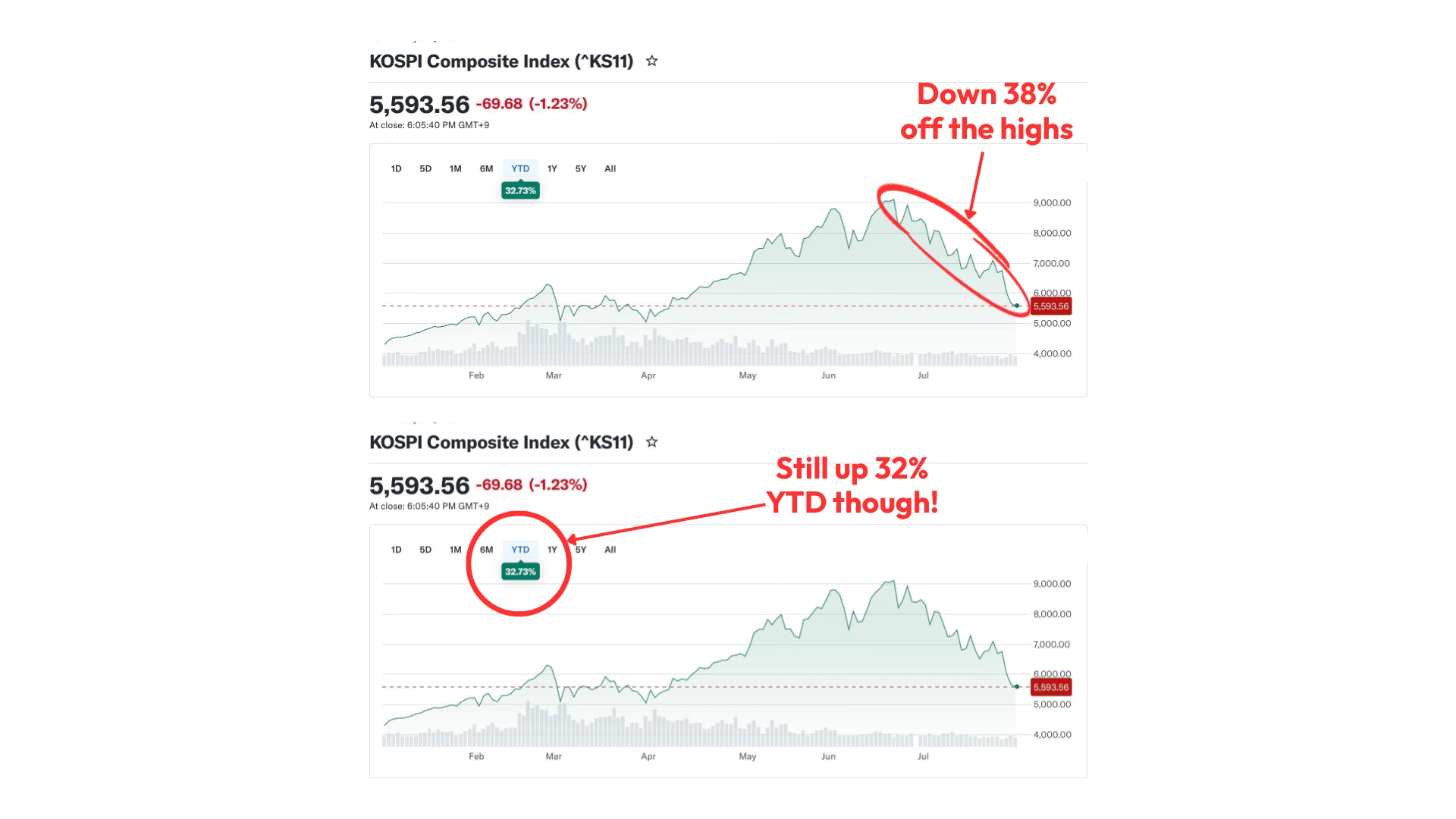
This was a function both of the scarcity — only 6.73% of the shares were freely tradable at listing — but it literally made global waves. BOTH Samsung and SK Hynix are listed on the KOSPI (the main Korean stock exchange), and if you don’t know anything about the KOSPI, it’s basically just a bunch of semiconductors. They are its heaviest weights by a high margin, so disruption in the memory maker space is crushing the whole thing. As of the time of writing, the KOSPI has tripped the circuit breakers in the last two overnight trading sessions, and is down 38% off the highs. TO BE CLEAR THOUGH, it’s still up 33%!!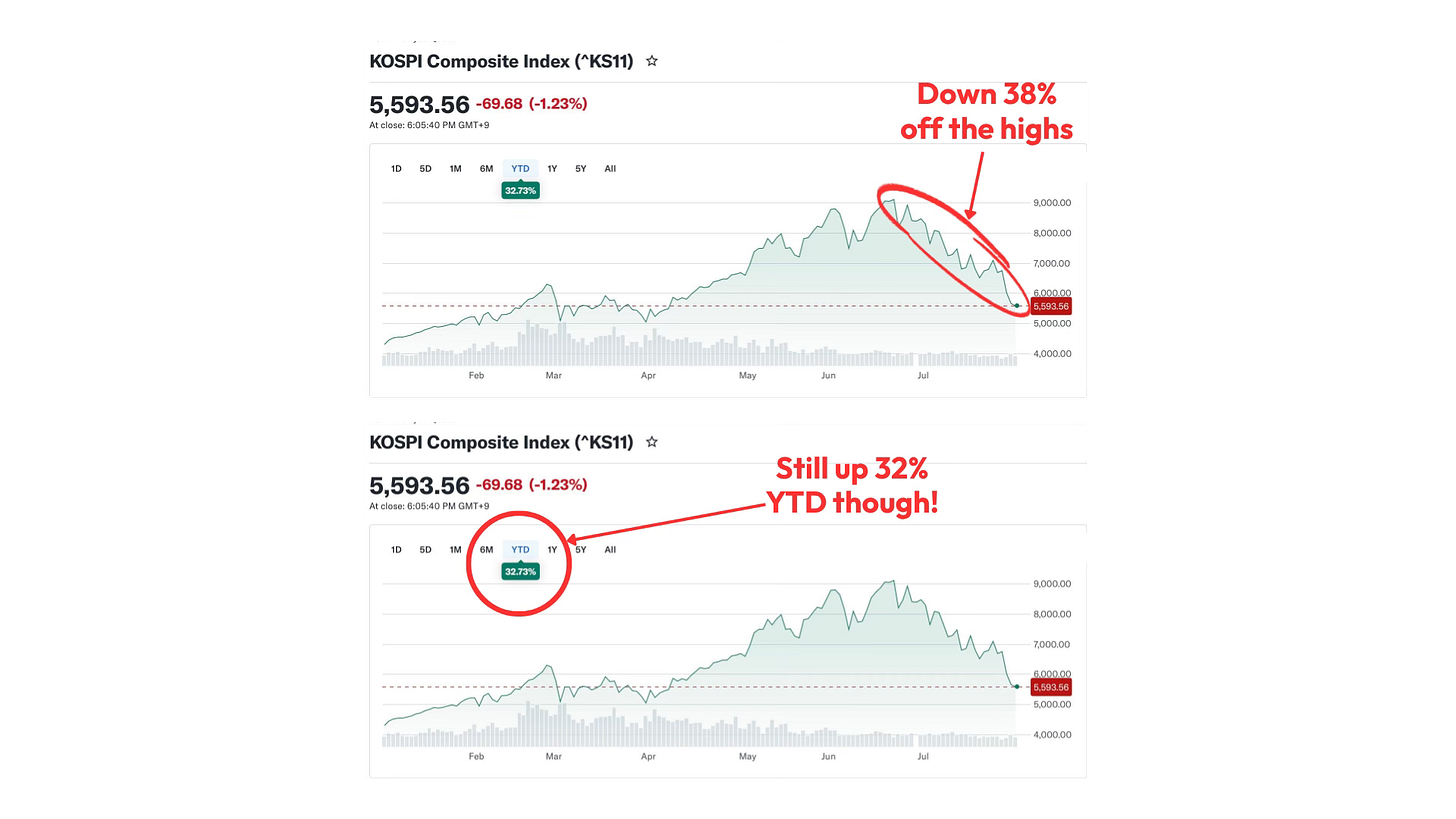
The next place where China is breaking through is on the manufacturing side. In a recent interview Elon Musk gave to The Economist, he said: “China is closer than most people think to solving the lithography problem.” Last week, there was an article floating around that a state-backed Chinese Manufacturer has entered mass production of domestically developed DUV lithography machines — I need to get a better understanding of what these are, but the way I understand them is that these are the UV light/stencil/lens combinations that print transistor patterns onto chips. It’s what would let Chinese chipmakers expand production capacity without relying on Western suppliers.
And then finally there’s the model side. Last week, a Chinese company called Moonshot AI released a model called “Kimi K3”, which is an open-source model that apparently is performing ON PAR WITH the American frontier models…but at half the cost. So this is DeepSeek on steroids. This kicked off a whole other conversation about whether or not the white house should ban Chinese open-source AI models…which Polymarket apparently has the odds for close to a coin toss…which was discussed on the All In podcast and we will get to that.
On Friday, NVIDIA announced they were going to commit $250bn towards a massive data center project tied to OpenAI. They’re going to guarantee $250bn of the lease and construction debt (i.e., building and borrowing costs) to finance a 10-gigawatt data center in southern Ohio, being developed by SoftBank’s energy arm SB Energy, going to be leased by OpenAI. The whole point of this project is that OpenAI wants to own its own compute rather than renting it from MSFT, AMZN, and ORCL. But OpenAI — ALSO STILL NOT A PROFITABLE COMPANY!!! — can’t borrow at investment grade spreads on its own. So they need NVIDIA to do their dirty work for them, I mean….lend them their credit rating. What does NVIDIA get in return? Why, a loyal customer to buy their chips of course! It truly does just feel like moving money from your left hand to your right and telling investors you’re creating massive value when you say it like this.
And in the midst of all of this, two very interesting conversations about the long game in AI.
The first, on the All-In Podcast, was an argument about the pitfalls of blocking Chinese Open Source models. The broader philosophical argument that that was couched in is basically, who’s stealing from whom? They positioned it as Anthropic leading the charge, effectively saying that China was distilling from American models’ output, that the government should intervene to protect them — how convenient ahead of their forthcoming IPO, which they can’t be feeling too good about roadshowing in the midst of this overall market rout. But Anthropic is themselves part and parcel of an AI buildout that is distilling from the knowledge of EVERY OTHER CREATOR IN THE HISTORY OF THE WORLD.
The reality, as David Friedberg explained it, is: America got rich converting bits — a.k.a the knowledge and services economy. If open source AI commoditizes bits completely, then all the leftover scarcity value in the world sits in molecules and energy — a.k.a, manufacturing capacity and power generation.
GEE, WHO IS BETTER AT THAT, CHINA OR THE US??
And the more insidious take is that is China’s long game strategy to basically put the US out of business. That segues us really nicely into the
When it comes down to who’s on top in the AI race, Elon was clear — again, this is only as of last week — that China doesn’t lead in AI YET. He was explicit in saying that America’s best models are still the smartest, with Anthropic’s Fable the current leader.
But as we’ve talked about, the “I” part of “AI” doesn’t exist in a vacuum. AI compute is part of a five layer cake where you can’t get intelligence without ELECTRICITY.
Outside China, the bottleneck for AI buildout is energy and cooling. Inside China, the problem is the chips — and it looks like they’re starting to solve that. If they can solve the chips and memory portion of the problem, there’s nothing stopping them from winning. That’s why he wants to build data centers in space — solve the energy and cooling problem with infinite energy from the sun in the freezing cold of space. Whether or not that is feasible is another question entirely.
So when Elon was asked if Washington should ban Chinese open-source models, Elon made the point that a ban doesn’t stop the rest of the world from using them.
Where it got really scary though was Elon’s prediction for what an “age of abundance endgame” looks like in 10 years, the timeline he envisions for Artificial Super Intelligence.
Most people care about what happens to all of us in a knowledge and service economy, the question of “commoditized bits” that Friedberg brought up. And Elon’s answer was: no one will need jobs because AI will just make all products and services and knowledge so abundant that humans will need to do nothing. Say what now?
He’s envisioning a “utopia” that sounds so insane that literally only one sci fi book can be pointed to that supports it, while all others warn of the dangers.
Dune 3 is about to come out in movie theaters, and for those of you who are Dune fans, the whole Dune-i-verse takes place 10,000 years after the Butlerian jihad, which was when humanity fought and won an existential war against thinking machines, a.k.a. AI. There is a canonical commandment within the Dune books from what they call “The Orange Catholic Bible” that literally says “Thou shalt not make a machine in the likeness of a human mind”.
Both Elon Musk and Gustav Söderström, the co-CEO of Spotify, recommended reading Iain M. Banks’ The Culture Series for insight into the vision of a post-AI future that informs their view of AI as a force for good. So guess what we’ll be reading next….
But by the way, as Zanny pointed out, WTF are we supposed to do in the meantime to avoid, you know, GLOBAL WARFARE as everyone’s jobs and incomes are phased out in the time between Men’s World Cups? Elon’s answer? Universal high income, funded by the Treasury just writing checks to people. Imagine the PPP loans from COVID….for 8 billion people. Elon countered that It might sound crazy, but there’s certainly theoretical and historical precedent.
The basic formula for inflation is simply M*V = P*Q, where:
M is the amount of money in the system
V is the velocity of money — say, how many times one dollar trades hands in a year
P is the price of what a thing costs — say, how much it costs for a cookie
Q is the quantity of cookies in town
It’s a lever or a seesaw that balances. If you increase the amount of money in the system, but keep the quantity of cookies the same, prices have to rise because there’s more dollars competing for the same amount of stuff. That’s inflation. But if you massively increase the amount of cookies in the system without raising the amount of money commensurately, prices come down.
Look at the cost of flat screen TV’s. I’ve been watching Back to the Future with my 10 year old, and there’s a scene from 1955 where George McFly lets it slip that his family in 1985 has THREE TVs. His smitten MOTHER in the movie says “wowww you must be rich,” and his grandfather in 1955 scoffs — “NOBODY has three TVs!”.
Today, you can get a flat screen TV at Walgreens. They cost nothing.
Same thing with services. Elon gave the example of office buildings full of workers CALLED “computers”. The word “computer” used to refer to people performing computations, whose entire job back in the day was to compute the interest on your mortgage, and they all used to get paid a living salary. Now modern day computers (PCs, iPhones etc.) can do that in a fraction of a second on a device that fits in your pocket that 16 year olds run around with. Nobody wants to pay thousands of workers a full year’s salary to do what costs virtually zero.
But, spoiler alert, just because the prices of SOME goods and services came down doesn’t mean we have deflation. Look at the cost of healthcare, housing, food…none of these things cost less today than they did ten years ago.
Who knows. Maybe Elon’s right — after all, artificial super intelligence is referred to as a SINGULARITY.
A singularity is what we use to describe a black hole. A black hole, for those of you who aren’t astro geeks like me, is a point in space where gravity is so high that the escape velocity for anything that falls into it is higher than the speed of light. So we literally cannot see beyond it. Artificially Superintelligence (“ASI”) is a singularity, because the point at which artificial superintelligence outpaces the ability of humans to ever keep up with it will be one at which change compounds so quickly that no one can possibly predict what happens after that. …..But Elon
And he thinks it will within the decade.
No posts
Comments
Nothing yet. Say the first thing.
Sign in to join the conversation.