
Welcome to the inaugural issue of The Walldog!
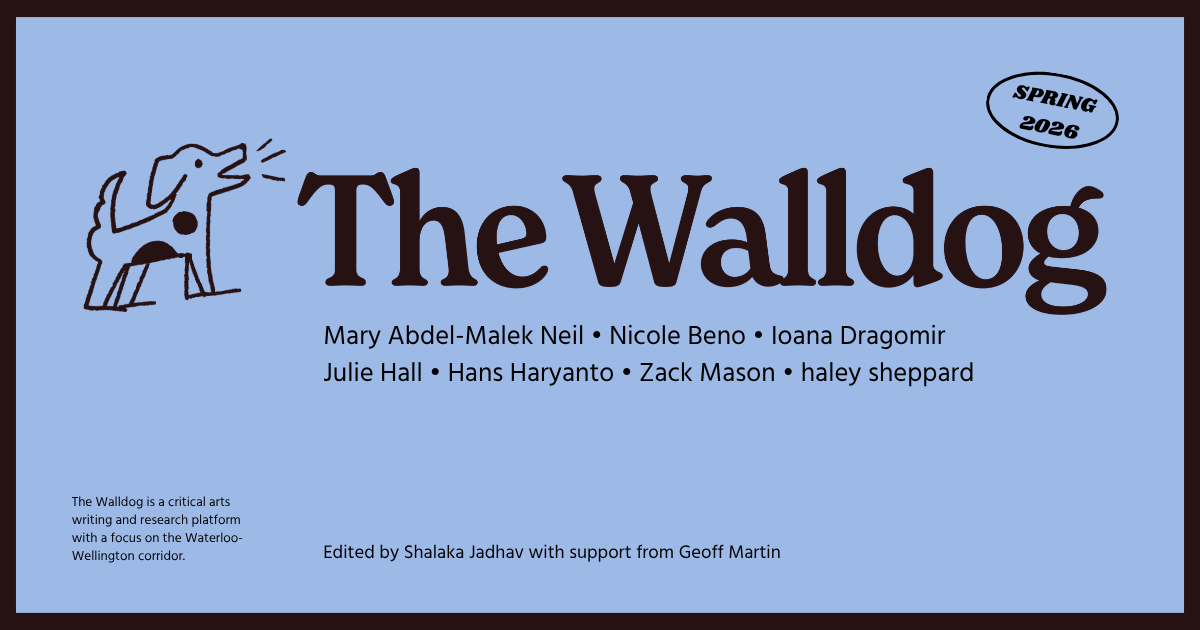
Named after the sign painters who once scaled the sides of buildings to leave their mark across North American cities, The Walldog takes its cue from this precarious act of labour. Faded ghost signs cling to brick facades across the Waterloo-Wellington corridor, and this editorial project extends from a similar premise: that what remains on walls, in archives, and across material cultures of the corridor can tell us as much about a place as what is newly emerging.
Launched at a moment when critical arts infrastructure feels both urgent and uncertain, The Walldog is committed to cultivating a space for sustained, critical engagement with the cultural life of this corridor. This editorial project is interested, yes, in documentation, but also, in building up our muscles to practice cultural memory work by reading the built environment, tracing lineages, and making visible the social and political conditions that shape artistic production.
The Waterloo-Wellington corridor is shaped by global flows of capital, migration, and culture, and the inaugural Spring 2026 issue gathers together contributors who tend to the textures of place, negotiating questions of value, belonging, and transformation. By centring artists, writers, and cultural workers whose practices often unfold outside dominant narratives of innovation and progress, The Walldog seeks to widen the frame through which these regions are understood.
Across the Spring 2026 issue, writers and artists circle a shared set of questions, about how value is assigned, how memory is carried, and how we locate ourselves inside systems that feel, more often than not, extractive.
In The Currency of Hope, Mary Abdel-Malek Neil considers Jenine Marsh’s Harbinger and How to Fulfill a Wish through the roles of ritual and belief under the growing pressures of precarity, wherein the simple act of tossing a coin, becomes, in Marsh’s hands, a charged gesture that exposes the uneasy overlap between longing and economic exchange.
Questions of value and surplus arise in Ioana Dragomir’s reading of Miles Rufelds’ Salvage Archives. By intertwining conspiracy, documentary, and speculative fiction, Rufelds destabilizes what we take for granted, and in turn, Dragomir traces how narratives proliferate in conditions of uncertainty. If Marsh’s work interrogates the symbolic “currency of hope”, Rufelds’ turn towards speculative economies reveals how systems of abundance coexist with deprivation, and how belief—whether in markets or conspiracies—structures our understanding of both. At the scale of the everyday, Zack Mason’s Pristine Alleyways, Or, Erasing The Record of What is Actually Going On reframes graffiti as an informal, living archive of communication.
In Trimmings, an artist project by Nicole Beno and Following a wax-resist dyed thread home by Hans Haryanto, textiles unfold their function as “domestic” carriers of memory. Through the hybrid visual language of ornamentation, architecture, and the political histories embedded in batik, these contributions explore the persistence of cultural meaning.
How can performance serve as a site to negotiate vulnerability and control? In Exposure Therapy: Performance as People Practice, Julie Hall’s conversations with Megan Arnold and Tess Martens position performance as practices of embodied risk. Across their conversation, vulnerability is the practice, revealing social contracts that underpin the tensions between exposure, safety, failure, and connection.
Listening is both active and passive: the sound of paramedic sirens may rush through the body, signalling the urgency of an emergency stop; a slow, controlled sigh or hum activates the vagus nerve; the sound of protest brings about a collective courage. With the strike of a match traces haley sheppard’s inquiry of how we might attend to the world, without reproducing extractive habits of perception as they pertain to our listening practices. sheppard also devised when light meets water…, a graphic score commissioned as part of With the strike of a match, performed as part of The Walldog launch (April 18, 2026) at Whoopsie Daisy Drinks.
Across the issue, these contributions converge around a shared set of questions: what do we choose to hold onto, what do we allow to fall away, and how might we resist fixedness, to keep poking these systems to remain responsive, and up for re-negotiation? Together, they ask what it means to pay attention at a time when attention itself is so often exhausted. If The Walldog begins from the traces left behind on walls, it is less concerned with permanence than with endurance, to look towards acts of making, remembering, listening, and refusing, and to stand in as an invitation to stay with those practices.
With care,
Shalaka Jadhav
Editor, The Walldog (Spring 2026)
Shalaka Jadhav (@shalaks_j) is an independent curator, writer, and cultural strategist working across multimedia practices with a place-based lens. They develop interdisciplinary projects connecting artists, communities, and institutions through experimental and collaborative approaches, and explore spatial positionalities, grief geographies, and public memory. They are a co-founder of Dirty Work Studio, a project space and small-scale risograph print shop in Waterloo Region.
Comments
Nothing yet. Say the first thing.
Sign in to join the conversation.