
Photography by LF Documentation, courtesy of Kitchener-Waterloo Art Gallery
Tossing coins into fountains dates back to ancient times, when people believed water sources held spiritual power. An offering, such as a coin, was believed to secure protection or good fortune, while the absence of the ritual risked inviting bad luck. Over centuries, this ritual shifted from appeasing spirits to expressing personal wishes, a small act of hope shared across cultures worldwide.
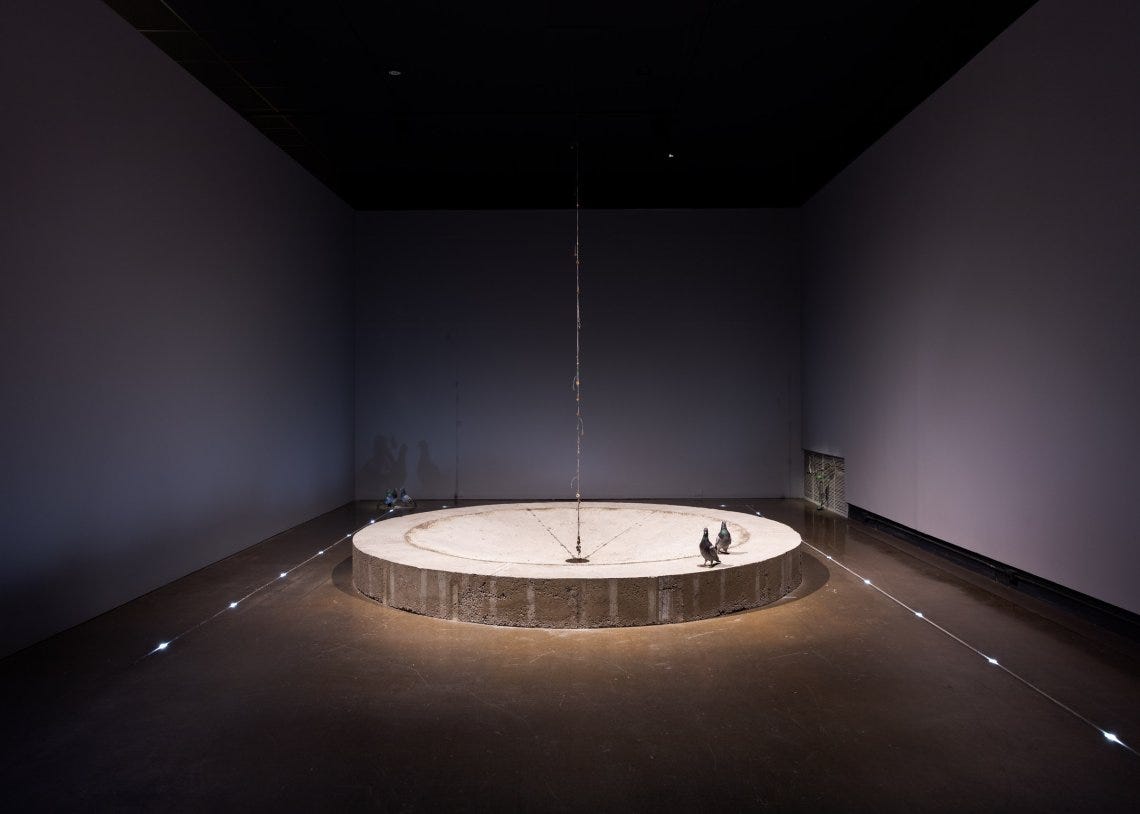
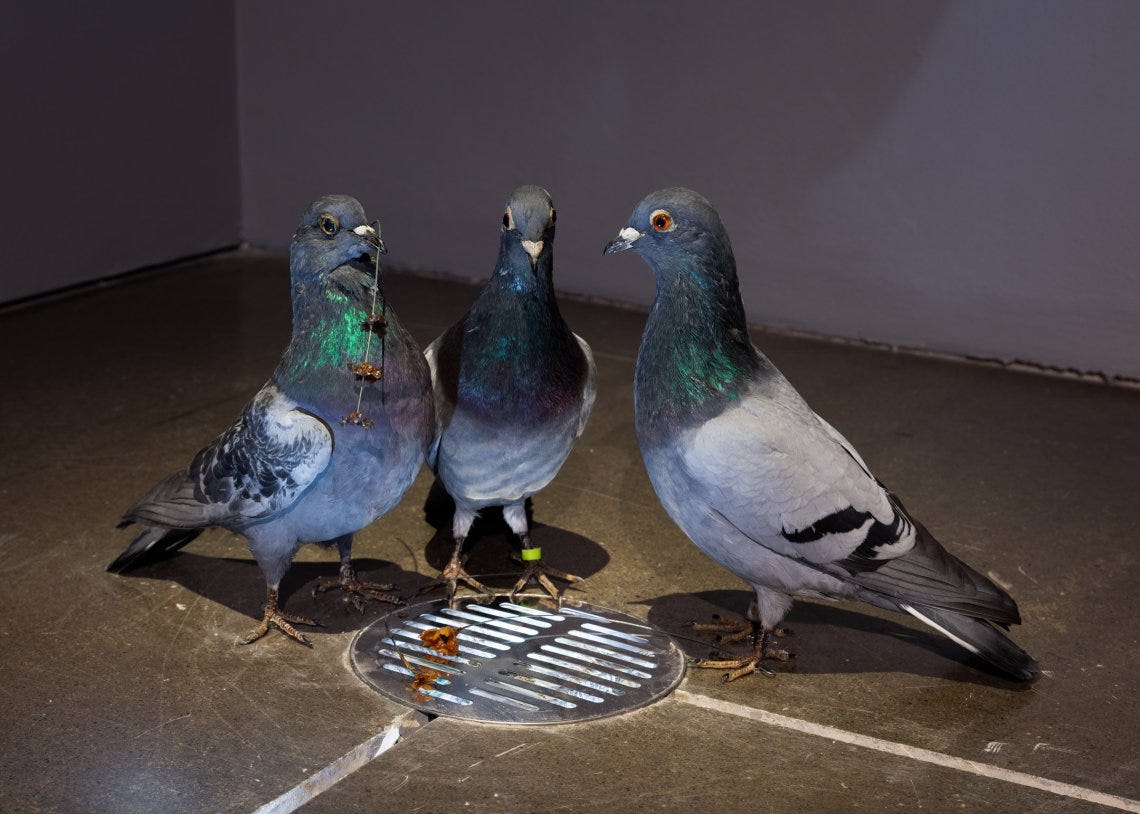
Jenine Marsh’s Harbinger considers these histories, the installation suspended somewhere between excavation and ruin. I was mesmerized by the sound of a chime swaying in a vent’s breeze, its metallic clinking echoing like coins being dropped into a wishing well. The gallery space itself has been physically changed, too: trenches carved into the floor to allow lighting to seep through, vents left exposed, and a large-scale concrete structure anchoring the room, with coins slipping through a grate at its centre.
Photography by LF Documentation, courtesy of Kitchener-Waterloo Art Gallery
What struck me was the physicality of the room, desire rendered as something you could hear, touch, and lose. Coins moved through the space as small, illicit gestures of faith within a system that promises abundance while quietly rehearsing scarcity. Harbinger reminds me how deeply trained we are to express longing through money, even across gestures meant to transcend it.
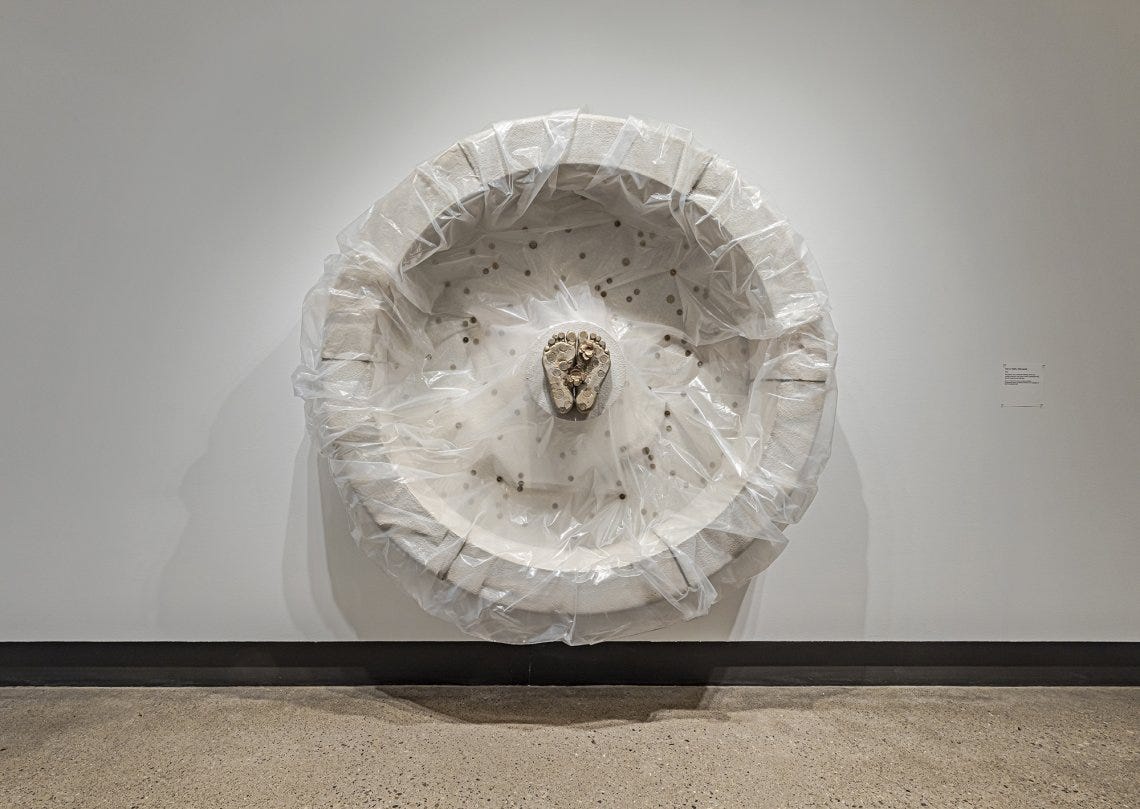
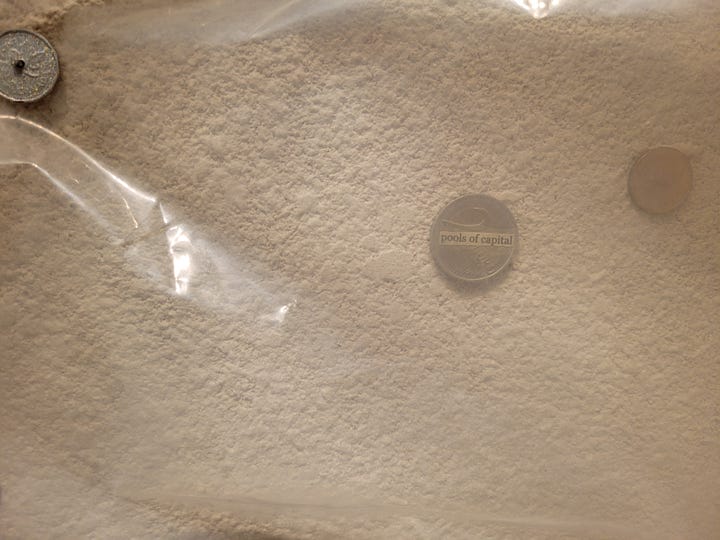
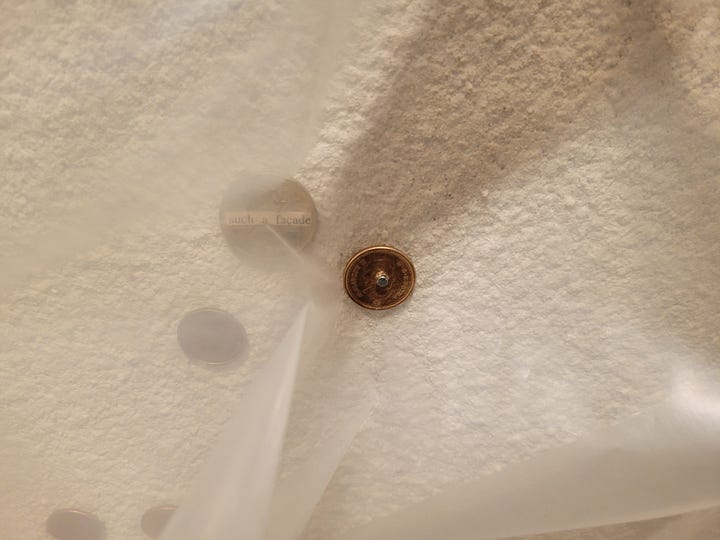
If Harbinger explores the wish as a small rupture in the circulation of capital and a gesture that subtracts value from a system, How to Fulfill a Wish carries that thinking forward with an expanded gaze. In the hallway, Marsh amplifies the stakes: three fountains shrouded in plastic, the basins scattered with coins labelled “pools of capital,” “and hope,” and “such a façade,” extending the conversation on post-capitalism to question the possibilities of utopia.
Photography by LF Documentation, with gallery documentation by Toni Hafkenscheid,
courtesy of Kitchener-Waterloo Art Gallery
Standing in front of the fountains, I was transported back to my childhood, begging my mother for a penny to toss into the mall fountain. For my immigrant family, every cent mattered. I’d wear her down and gleefully toss in a penny, whispering wishes for toys or games I couldn’t have.
What struck me most standing in front of Marsh’s fountains was the quiet absurdity of the wishful hope itself, the way we continue to perform small rituals of belief inside systems we know are broken.
As I left the gallery, I noticed a line of cars waiting to pull into a nearby church parking lot. Curious, I walked over to see what was drawing people to church on a weeknight, learning that the Church of the Good Shepherd rents its parking lot on evenings when the Centre in the Square hosts shows.
The sight of attendants collecting coins sparked another story, one far older than mall fountains, in the form of the biblical tale of the widow’s two mites. In the Gospel of Mark, Jesus observes a poor widow placing two small coins into the temple treasury. Though her offering is insignificant compared to others, he praises her gift as the greatest, precisely because it comes from her poverty and faith. Hope is a common thread across childhood desires at the fountain and the widow as she gives away her last coins in hopes that God answers her prayers. Both gestures are small, yet they carry a weight in the currency of longing.
Photos by Mary Abdel-Malek Neil
Just down the street from the gallery, copies of hundreds of World War I parish registrations rest in the nave of St. John the Evangelist Anglican church. The original documents, yellowed with age, were uncovered in 2008 in a forgotten basement closet, and remind me of a time when churches more visibly anchored a community’s identity, memory, and connection.
Erected in 1862, St. John’s stood alongside St. Mary’s Our Lady of the Seven Sorrows Roman Catholic Church (1856) and St. Andrew’s Presbyterian Church (1857) to form a sacred downtown triad. The sacred downtown corridor continued to blossom over the decades. Nowadays, a quick Google Maps search yields at least half a dozen churches within the boundaries of Queen, Victoria, and King.
In the 1980s, St. John’s became the first home of a local soup kitchen and drop-in hub for those experiencing homelessness. Many churches followed suit, housing Out of the Cold programs and offering emergency shelter and social support.
The holy trinity of spires still grace the downtown skyline as the sacred and the secular negotiate space. What looks like an architectural shift is also an economic one: sites of faith are being quietly reorganized by market logic. There are fewer congregants in the pews, fewer coins in the collection plate, and an increasing reliance on rental income to sustain buildings originally designed for faith.
In 2021, just down the street from the gallery, St. Peter’s Lutheran Church announced plans to convert its upper two floors into affordable housing units in partnership with Indwell, an organization that had purchased St. Mark’s Lutheran Church for a similar project only a year earlier.
Watching these transformations unfold makes the themes in Marsh’s work feel less like metaphor and more like mirror. The artist’s interventions, just down the street from the city’s historic core, invite us to recognize how our own histories of sacrifice and utopic hope echo through near-universal rituals of tossing coins into fountains and wells, sacred and secular alike. What do our wishes reveal, and what happens when the spaces that once held these desires transform into something entirely different? It’s a complicated crossroads: spiritual aspiration and quickly shifting economic realities colliding in plain sight. We’re seeing closures, amalgamations, conversions to affordable housing, and the rather unexpected pivot to landlordism. It’s a fascinating integration into capitalist culture, one Jesus himself appeared to have reservations about (a few overturned tables come to mind).
Mary Abdel-Malek Neil is a Kitchener-based feminist writer whose work traces the meeting points of history, faith, and culture. Through storytelling grounded in place and community, she explores how belief shapes identity and how inherited narratives continue to echo through contemporary life, revealing overlooked connections across time.
Comments
Nothing yet. Say the first thing.
Sign in to join the conversation.