
I had only been living in Kitchener-Waterloo a few months when my partner Emily took me out for a walk along the trails. It was a hot summer afternoon in the middle of June. We walked past parents with strollers chatting about their evening plans, and cyclists ringing their bike bells as they navigated around us. Cardinals fluttered overhead between branches, calling to one another in the warm breeze.
We arrived at Len’s Mill, nestled along the Spur Line Trail, where Emily wanted to take a look at fabric for a pair of pants, a gift for her mom. I followed her around a bit, offering unhelpful opinions on what might work well. Eventually, boredom took over and I turned my attention to the vastness of the store and all its stacks, taking in what felt like every fabric to have ever existed. I wandered, letting my fingers feel past the different rolls of fleece, linen, animal-themed patterns, hockey-themed prints, some cotton blends patterned with blueberry muffins, and a neighbouring one with strawberry shortcakes. At some point I noticed a row of fabrics featuring patterns I recognized, colours that called forth something familiar: they were rolls of batik.
In 1949, the Kingdom of the Netherlands finally relinquished its sovereign control over Indonesia and the Indonesian National Revolution was finally won. After four years of armed conflict, President Sukarno held the task of leading a newly formed, post-revolution country with 600+ ethnic groups through a period of recovery. Part of his policy agenda as the new nation’s founding president was to deliver on his vision of unity and establish a pan-Indonesian identity. One piece of material culture engaged in this project was the promotion of batik, a style of garment traditionally made through a process of wax-resist dyeing in which a tjanting–a pen-like tool with a copper spout–is used to create intricate designs. Although the first documented use of the term batik is credited to the 17th century, some scholars argue that the style dates as far back as 650-850 AD, during the period of the Kalingga Kingdom in Java1. Today, the different textures, styles and motifs on modern batik reflect a broad diversity of Hindu, Buddhist and Islamic cultures that have made their mark on Indonesian tradition. Cultures that have long been intertwined amongst the numerous ethnic groups that inhabit the country’s over 6000 islands3.
I was born in Jakarta, as were both my parents, and their parents as well. Far back within my line of ancestry, Chinese descendants made the move to the Indonesian archipelago, just as Arabs, Indians and Malays did. It is not common to identify these historically acculturated ethnic groups as distinctly as is done with Chinese-Indonesians. It is a complicated history, defined in part by Dutch colonial policy that prevented social integration of ethnic Chinese with the Indigenous population, instead systematically positioning them as an “other”. The impacts of these policies saw a continuation under the second President Suharto’s heavily anti-Chinese regime, culminating in the 1998 riots that saw mass violence targeted towards Chinese-Indonesians in Medan, Surakarta and Jakarta.4
My family was fortunate enough to be able to flee the country. I was only a baby when we moved to Mississauga, and having grown up in Canada, I never thought of myself as anything other than Indonesian. I knew we celebrated Chinese New Year and that I had a Chinese name, Kho Ie Hao. I knew that my last name Haryanto was not a family name and instead made up by my Opa, though I didn’t know much about the 1966 policy passed by Suharto’s government that “strongly encouraged” Chinese-Indonesians to adopt names that sounded more Indonesian. I grew up oblivious to this history, and I wore my batik and we ate rendang and gado-gado and martabak manis and we kept our IndoMie branded grocery bag folded by the stairs for errand runs to the store. Never did it cross my mind that the place from where we came from might have ever rejected us.
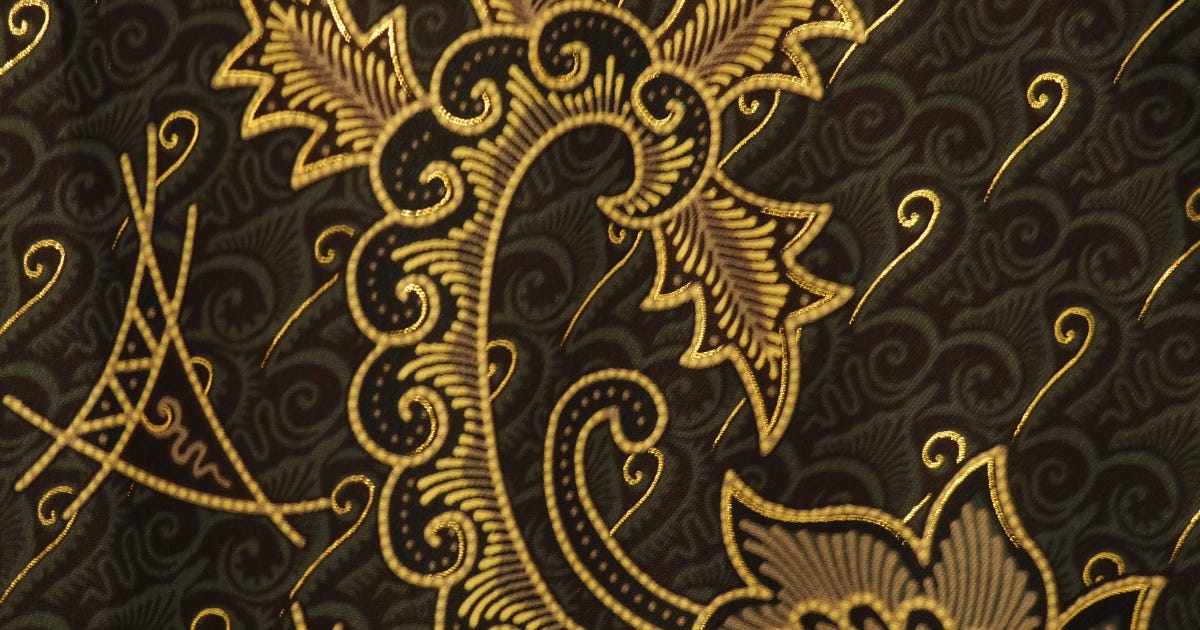
As far removed as I am from these events, what remains in their aftermath is a history that has left me with questions and loose threads about my cultural identity. I’ve since outgrown my childhood batik, though I now keep one in my apartment here in Kitchener-Waterloo. Handmade in Jakarta and adorned with elaborate motifs of plants, vines and leaves, my batik features a style known as lung-lungan5, referring to the spiral nature of the patterns, outlined in gold dye over navy blue fabric. This textile treasure of mine sustains in me an unshakeable belief in what I might call “the homeland”, though the reality is that my home is not in an archipelago some 15,000 kilometres away. Rather, my home sits along an intersection on King and Water.
I do find a bit of magic in this moment of reckoning at a fabric store on Union and Moore, in a region dyed in its own history of textiles. I live mere footsteps from where the John Forsyth Shirt Company building stood on Duke and Young. When I bring my batik with me back to Mississauga for special occasions like weddings or Christmas, I take the bus down Highway 401, right past Hespeler Village, once home to a number of wool and textile mills, including the mighty Dominion Woollens and Worsteds Mill, touted as the largest woollen mill in the British Empire. While many of these buildings were torn down, many still remain, a visceral reminder that the past rarely fully disappears; rather, it lives on and realizes itself in unforeseen ways.
My parents don’t talk much about the 1998 riots, though they certainly have not forgotten. Brought about by small, unexpected encounters, we stitch together what has been carried, forgotten and reshaped. As time moves us along, we are left with these threads, helping us trace through a process of returning. I struggled that day to articulate exactly what batik was, how they were made, why we wore them, or what any of the colours and textures symbolized. When I returned home from our walk, I sat at my desk ruminating the early beginnings of these questions, the answers to which I continue to seek out. The setting sun filtered through my window, casting a warm glow against the door of my room, from which hung a large size batik shirt, its gold patterning illuminated in the evening light.
1 Febriani, Rina, L.W.J Knippenberg, and Noelle Aarts. 2023. “The Making of a National Icon: Narratives of Batik in Indonesia.” Cogent Arts & Humanities 10 (1). https://doi.org/10.1080/23311983.2023.2254042.
2 Handhayani, Teny. 2023. “An Introduction to the Process of Making the Indonesian Handmade Batik Lasem.” ABDIMAS: Jurnal Pengabdian Masyarakat 6 (2): 3367–74. https://doi.org/10.35568/abdimas.v6i2.3142.
3 Steelyana, Evi. 2012. “Batik, a Beautiful Cultural Heritage That Preserve Culture and Support Economic Development in Indonesia.” Binus Business Review 3 (1): 116. https://doi.org/10.21512/bbr.v3i1.1288.
4 Hoon, Chang-Yau. 2006. “Assimilation, Multiculturalism, Hybridity: The Dilemmas of the Ethnic Chinese in Post-Suharto Indonesia.” Asian Ethnicity 7 (2): 149–66. https://doi.org/10.1080/14631360600734400.
5 Behrens, Kristian, Brahim Boualam, and Julien Martin. 2018. “Are Clusters Resilient? Evidence from Canadian Textile Industries.” https://economie.esg.uqam.ca/wp-content/uploads/sites/54/2020/01/2018-15_docdt_eco.compressed.pdf.
Hans Haryanto (@hans.haryanto) was born in Jakarta, grew up in Mississauga, and now resides in Kitchener. He studied Environmental Economics and Policy at the University of Guelph, and holds a Master of Climate Change from the University of Waterloo. His interests include fiction writing, and the film Yi Yi.
Comments
Nothing yet. Say the first thing.
Sign in to join the conversation.