
It’s a Sunday newsletter this week - 2 days late - for two reasons: school holidays, plus I’m spending quite a few of my work hours on finalising my talks for Science Week. I thought I could just re-use my AI as clinical decision making tool from last year’s Singapore Vet Show, but things have changed so much in in the Ai space over 6 months that I’m having to re-do the entire talk. If you’re interested in how AI faired vs experienced vets (including myself!) as decision maker on complex cases in a study I did, come join me on the Sunday afternoon. I also compared a bunch of AI models with each other, including a few vet specific tools, to try and figure out which ones performed the best, with some surprising results.
If you can’t make it to Science Week, I’m also talking about AI at this year’s ASAV conference in August and at the Greencross Connect conference in November (Claim a 20% discount to GreencrossConnect with code VETVAULT20). Or come have philosophical conversations about AI and life with me on a ski lift in New Zealand or Italy, or in a safari vehicle in the Ngorongoro crater on one of our upcoming Vets On Tour conferences. Wānaka ticket sales close at the end of this week.
From Episode 229 ECC Feed With Prof Søren Boysen and Dr Julie Menard
Dog attack patient - lots of tooth marks over the abdomen. The important question is: did any of them penetrate into the abdominal cavity? I’ve spent many hours over the years carefully interrogating abdominal walls with an ultrasound probe, hunting for a break in the wall to help me decide whether I should be heading to ex-lap. Usually with minimal success. Turns out I was looking for the wrong thing:
Penetrating abdominal wounds aren’t typically associated with much internal bleeding. But that tooth, stick, fence post or whatever else stabbed into your patient’s belly will usually take a bit of free air in with it. So finding free air in the abdomen of a trauma patient is a clear signal that you should go exploring.
Did you know that it’s possible to detect as little as 0.2 mL of air on ultrasound. Not 0.2 mL/kg. 0.2 mL TOTAL.
Despite what you might think, finding that little bubble isn’t hard. Prof Søren showed in a study that novice second-year vet students could diagnose free air in the abdomen with 87.5% accuracy once they knew what to look for and where to look for it. (I’m sure you can do better than a second-year vet student.)
Here’s the proof that I should have been looking for that we’re going to ex-lap:
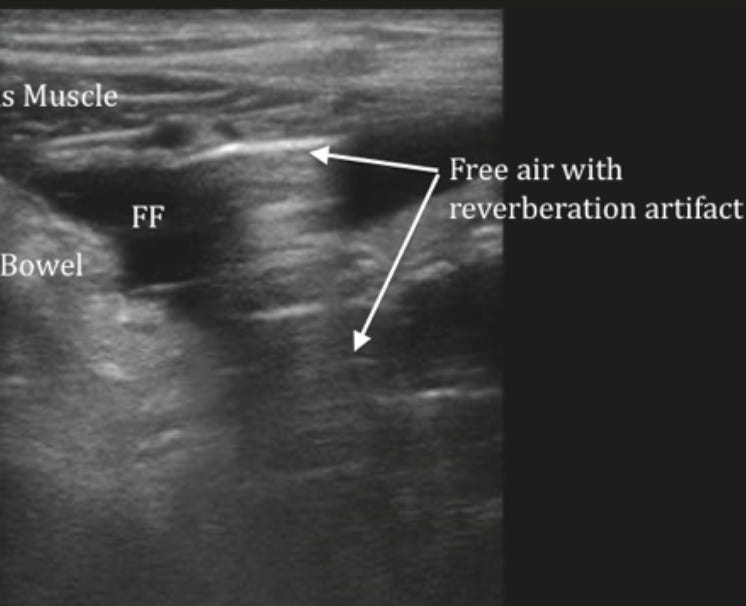
This episode has a lovely guide on exactly where to go hunting for that air, how not to confuse it with gas in the GI tract, and what else you should always be looking for with your probe in a trauma patient.
From Episode 226 Surgery Feed, with Prof Vicky Lipscombe
More wounds: the wound in front of you is big. Large hole, not so much skin to cover it. You THINK you can get it closed, but it’s going to be tight… I walked away with this pro tip for this exact situation from our lovely session with Prof Vicky on acute traumatic wound management:
Towel clamps are your friends here: use several of them to pinch the wound edges together before you attempt definitive closure.
Not only does this give you a great little preview into what your closure will look like - ie can you get the wound edges together, and how much tension is there…
A good rule of thumb: if a towel clamp can’t hold it, you probably need another procedure.
If you leave the clamps in place while you suture, it also does a bit of pre-stretching of the skin, so that by the time you get to that trickiest bit of the wound it’s not quite as tight as it was when you placed your first suture.
Oh - and have a plan B. Prof Vicky said that the biggest pitfall is not having a fallback option from the start. This episode is full of wonderful fallback options.
From Episode 228 ECC Feed With Dr Michael Kato
If you regularly work with sick - like, proper sick - animals, then you’re well versed in all things hypotension. It’s nemesis number one in the ICU. But in this session criticalist Dr Michael Kato reminded us that the opposite end of the blood pressure scale is nearly as common in the emergency department (although a lot more sneaky), and also not without consequence:
“I would argue that there’s an equal amount of hypertensive disorders that we see in emergency medicine. And both ends of the spectrum are going to be detrimental to your patients.”
I don’t know about you, but I’m nowhere near as ready for hypertension as I am for hypo. Here are a few high-pressure basics I’ll be taking into my next shift with me:
When we talk about hypertension, we mostly care about the systolic blood pressure. (Vs hypo, where MAP is our main concern.)
Numbers: less than 140 systolic is normal. 140-160 is mild hypertension, 160-180 moderate, 180+ is severe.
But first we need to get those numbers accurately, and we all know that our non-invasive measures are far from perfect. But how imperfect?
Oscillometric and Doppler BP will both fudge the number by as much as 20 points, so your patient with a BP of 160 may well be in the danger zone.
Note: those little Doppler machines don’t actually measure systolic pressure. It’s not the MAP either, but it’s closer to MAP than to systolic.
So how do we make practical sense of these vague measurements?
Look for target organ damage, with ocular changes being the easiest to find: retinal detachment, retinal haemorrhage, tortuous retinal vessels. If your patient is reading 180+ and you see these changes, they’re in a hypertensive crisis, and you need to act NOW.
If your patient is reading 180+ without evidence of target organ damage, then they’re experiencing a hypertensive urgency. You still need to treat, but you don’t have to rush it. Oral anti-hypertensives may well do the job here.
160-180: keep in mind that the true value may well be higher and that your patient may be in an urgency situation. Keep checking that blood pressure and looking at those eyes, and if over a few days to weeks the systolic pressure keeps hanging out in that zone, we’re also treating.
Check out the full episode for treatment guidelines, and the show notes for Dr Kato’s lovely hypertensive medication cheat sheet.
2 Other Things
Until we understand the assumptions in which we are drenched we cannot know ourselves.
Adrienne Rich
And in the same vein…
When you come to see you are not as wise today as you thought you were yesterday, you are wiser today.
Anthony De Mello
There’s this one case from when I was a recent grad that still makes me feel sick when I think about my failure. It’s by no means the only one, but it’s the worst. My stuff-up was so vast, and the repercussions of my stupidity so profound, that I’ve never told anyone about it. It’s a shame I’ll take with me to the grave. And if there’s anyone waiting beyond that grave to hold me to account for the things I did, then I hope that, when it comes to the living creatures who were assigned to my care, I’ll be judged on my intentions, not the outcomes. Because I promise - my heart was always pure.
I’ve heard about some truly dodgy vets. People who wilfully deceive, neglect their duty of care and are callous in the face of the suffering they swore to help alleviate. But you my friend, are not one of them. You who, years - sometimes decades - after you wrestled with death and its minions and lost, still lies awake at night reliving your failures. You need no judge or jury to list your many sins, because no jury could ever be as thorough or as merciless as you. Guilty. Guilty. Guilty. If you have sinned in your role as a veterinarian - and we all have - then our transgressions are likely these: ignorance, laziness, carelessness, even neglect. But a lack of caring is not on that list. Your heart was always pure.
How do we live with our own failures? How do we look back at our younger, more inexperienced selves with empathy and avoid dragging a lifetime of guilt behind us for the times we failed to do what we now know is best for the creatures in our care? I came across this saying, and adopted it as a life motto:
I think you did.
Much love,
Hugh
How to connect with us:
Comments
Nothing yet. Say the first thing.
Sign in to join the conversation.