
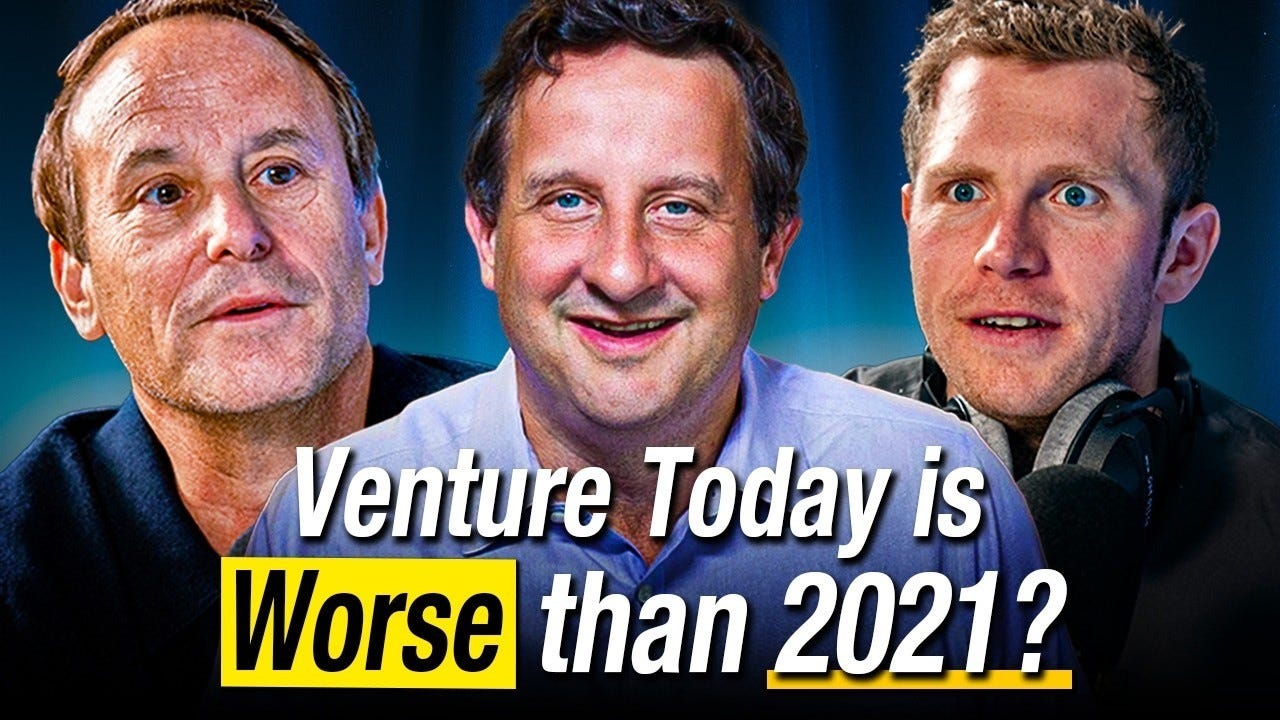
On April 17, 2025, something unusual happened on the 20VC podcast. Harry Stebbings brought together Jason Lemkin (SaaStr, operator-founder and solo GP) and Rory O’Driscoll (Scale Venture Partners, growth investor) for a live pricing debate. The audio quality was terrible 😂 — neither Rory nor Jason had a proper mic. The format was rough. But the intellectual electricity was unmistakable.
They kept doing it. Every week. Sometimes with a guest — Tom Tunguz, Jeff Lawson, Mike Cannon-Brookes — but increasingly just the three of them: Harry, Jason, and Rory, dissecting the price of real companies — Figma, Cursor, Anthropic, Sierra, OpenAI — with the numbers on the table, in real time.
I haven’t missed a single episode. I’ve re-listened to some of them twice.
And somewhere around episode 20, a thought started forming: what if I took these frameworks — the growth tiers, the Fortnite Effect, the maiming thesis, the bedrock multiple — and applied them systematically to European unicorns?
That thought became a study. I spent months building a database of European unicorns, collecting data points, stress-testing valuations against the heuristics that Jason and Rory debate every Thursday. In January 2026, Sébastien Couasnon invited me on his podcast to present the early results — the interview has since crossed 25,000 views (interview in french 🇫🇷).
The full study comes out in mid-March 2026. This article is its intellectual prologue. Consider it a field guide to the pricing frameworks that power the analysis — straight from the source. If you want to understand how I’m marking European unicorns to market, you need to understand how the best investors in the world talk about price. And nobody does it more candidly than these three.
I’ve focused on episodes #18 through #45, where the analysis became sharper and a clear intellectual thread emerged. What follows isn’t another guide to SaaS multiples. It’s something more interesting: two first-rate minds looking at the same data and reaching opposite conclusions, week after week. And it’s in that gap that the most useful pricing frameworks live.

To understand the heuristics that follow, you first need to understand the lenses.
Jason thinks like an investor-operator. His mental framework: VC is a machine that converts high revenue multiples into cash — through IPOs or M&A — before companies have earned it in free cash flow. His most revealing line (Ep. #40): “Our job is to convert very high revenue multiples into cash almost unnaturally. If we have to go to an EPS world, we’re dead.” Jason plays the windows. He knows they’re only open about 20% of the time. The other 80% is “crap.”
Rory thinks like a fundamental analytical-investor. He anchors everything to financial gravity. His mantra, borrowed from Graham: the market is a voting machine in the short run, a weighing machine in the long run. His most repeated phrase: “Price clears all markets.” Assets always end up trading at what they’re worth, not what you hope. Rory is the guy who, when everyone’s getting excited about a deal, pulls out his calculator and brings the conversation back to earth.
Harry plays the catalyst — but not from the sidelines. As one of Europe's most active investors, competing for the highest-momentum deals against top-tier US and European funds, he brings a real-time read on what's actually clearing in the market. Hundreds of founder interviews and deep relationships across the ecosystem give him a pattern library most hosts don't have — and you get the sense he's holding back more than he shares. That restraint is what makes the format work: he knows exactly where to push and which deals to throw on the table, not because he's reading from a brief, but because he's already done the work himself.
This dynamic — the operator vs. the analyst, momentum vs. value — is the engine of every episode. And it’s what makes their heuristics so useful: they were forged in disagreement, not consensus. For my European unicorn study, this tension became the analytical backbone: for each company, I tried to see the price through Jason’s lens and Rory’s lens, and to measure the gap between the two.
The market is a voting machine in the short run, a weighing machine in the long run
The most recurring framework on the podcast is the multiples grid by growth tier. Jason and Rory converge on the numbers but diverge on the interpretation.
The tiers (source: Jason’s basket + Rory’s framing, Ep. #33):
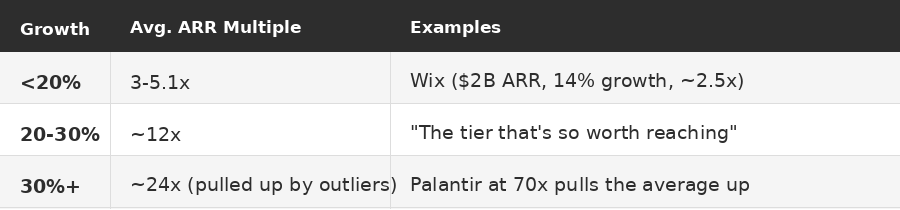
These numbers seem stable. What isn’t stable is the bedrock they rest on.
This is where Rory drops one of his best metaphors (Ep. #25): the median public SaaS multiple is the equivalent of the 10-year Treasury rate for the VC world — it’s the bedrock from which everything else is priced. For 15 years, a 30% growth SaaS company traded at 6–7x NTM revenues (Next Twelve Months revenues). Today, that same growth trades at 15–20x. Double the historical average.
The implication is staggering: if this bedrock reverts to its historical norm (7–8x), everything else comes down with it — just as everything linked to the 10-year Treasury moves with it. Every private valuation is, in reality, a spread above this base rate. And nobody prices it explicitly.
That’s the revenue floor. But there’s a deeper one. Rory’s terminal anchor (Ep. #40): ~12x free cash flow for a mature company. That’s the end-state gravity — where multiples converge when growth fades entirely and the market stops valuing you on revenue and starts valuing you on cash generation. Think of these as two steps on the same descending staircase: first you compress from 20x revenue to 7x as growth slows, then further to ~12x FCF (Free Cash Flow) as the company matures into a cash cow. Figma, despite a $12B market cap and 30%+ growth, trades at 10x forward sales — and Rory calls it an “awesomely good” business. The problem isn’t Figma. The problem is anchoring: late-stage investors who entered higher are underwater on a healthy business.
The hidden heuristic inside the tiers: Rory points out (Ep. #33) that for companies showing ~15% growth, probably half comes from price increases (8–9% per year). That’s “fake growth.” To move into the higher tier, you need new logos that actually want your product — not just existing customers paying more.
This was one of the first frameworks I applied to the European unicorn dataset — and the results were sobering. When you strip out price increases from reported growth, many European unicorns that appear to be in the 20–30% tier are actually in the sub-20% tier. The multiple implications are dramatic.
But the tiers are a snapshot. The real question is movement between them — and almost all the movement is down. Rory offers a growth decay rule of thumb (Ep. #35, analyzing Harvey): each year’s growth is roughly 85% of the prior year’s. A company growing 60% this year should expect ~51% next year, ~43% the year after. This is the natural decay curve for hypergrowth companies.
The math on paying up for growth follows directly. Rory (Ep. #19, on Databricks at $100B): paying 25x run rate revenue is a bet that growth holds for 2–3 years at 50% then 40% then 35%. If it does, the company normalizes to 8–9x run rate and the investment is “money good.” If growth drops faster, you’re trapped — just like the 2021 vintages.
And the base rate for recovery is brutal (Ep. #18): only 1 in 3 companies re-accelerates after a year of deceleration. Only 1 in 9 or 10 re-accelerates two years running. The implication: when you see a company slip from the 30%+ tier to the 20–30% tier, the odds overwhelmingly favor continued descent, not a return to the top.
But the most operationally honest heuristic in the whole series lives one level deeper. Jason (Ep. #40): “Your $100 million revenue SaaS company is an awesome entrepreneurial achievement. You are to be hugely congratulated. It’s magnificent. It’s just not something that we can properly finance.”
This line drew silence on the podcast. Jason is saying that the vast majority of funded SaaS companies are in an unfinanceable zone — they’ve reached respectable revenue but lack the growth trajectory or AI narrative to command venture returns. In the old model, you’d own 20% at a high-teens pre-money. Today, you own 5% at a $50M post-money after demo day. At 4% ownership of a $4–5B outcome, it barely moves the needle for a fund.
Rory extends this with the grind exit math (Ep. #40): “Grow at 50% then 40% then 30%, get to $200M of revenue, sell at 5x — that’s a billion dollars.” Perfectly respectable. But then the killer line: “That last sentence, because it’s a grind, explains exactly why venture guys aren’t investing. Because grind is not in our MO (modus operandi).”
This creates a structural gap: companies too good to fail, too slow to finance. And the gap is getting wider as AI raises the bar for what counts as “breakout” growth. In the European context, this gap is even more pronounced — many of the continent’s most celebrated unicorns sit squarely in this zone.
Jason uses Figma as the ultimate quality benchmark (Ep. #40): if arguably the best product in enterprise software can’t command a strong public market valuation, what hope for the rest? Rory adds the nuance that saves this from being fatalistic: Figma at $12B is still an “awesomely good company” at 10x forward sales. The issue isn’t that Figma failed. It’s that investors anchored to higher prices feel like it failed. The business is healthy. The psychology isn’t.
This anchoring trap repeats across the portfolio. At a $12B market cap, Figma is 30–40% below the Adobe acquisition offer when adjusted for dilution, time value of money, and risk (Ep. #33). Jason’s conclusion: “I don’t think we earned it this year. I don’t think we have so many companies better than Figma.” If the best can’t clear the bar, the bar itself might be the problem.
Rory crystallizes perhaps the most important meta-heuristic of the entire series (Ep. #32): “Entry price counts when TAM is unclear. Winning is the only thing that counts when TAM is huge.”
This single line explains why Cursor at $29B is rational (developer TAM is proven and massive, the only question is who wins) while Harvey at $8B is risky (legal tech TAM is uncertain, the entry price determines everything). In the episode’s quick-fire round, all three choose Cursor at $29B over Cognition at $12B, and Legora at $2B over Harvey at $8B. The logic is consistent: when the TAM is obvious, pay for the winner. When it isn’t, pay as little as possible.
For the European unicorn study, this became a critical sorting mechanism. For each company: is the TAM proven and large? If yes, the question is whether they’re winning. If no, the entry price is everything — and most 2021 entry prices assumed TAMs that haven’t materialized.
Rory operationalizes this into the most structured investment test of the series (Ep. #22, analyzing Sierra at $10B): three boxes to check. One: does the category support a big winner? Two: is this team positioned to win? Three: am I being paid for the remaining risk? All three must be checked. Sierra ticks the first two but strains on the third — and that’s where Rory hesitates. His warning: when category and execution risks evaporate, valuation risk expands to fill the vacuum.

If multiples are the skeleton of the podcast, the Fortnite Effect is its most recent — and perhaps most important — muscle.
Jason introduces this metaphor in episode #45: like in Fortnite, where the playable circle progressively shrinks, foundation models are nibbling away at the defensible surface area of incumbent SaaS vendors. It’s not instant destruction. It’s continuous shrinkage.
And when you trace back through the episodes, you realize Jason had been building this concept for months through at least five distinct mechanisms:
AI doesn’t kill incumbents — it maims them (Ep. #36). Existing customers stay (98% GRR), but they buy fewer seats, NRR (Net Revenue Retention) drifts downward, and new customers defer. Jason cites UiPath: $1.8B ARR (Annual Recurring Revenue), 98% GRR (Gross Revenue Retention), but NRR fallen from 140% to 107%. The business doesn’t die. The circle shrinks.
The benchmark to know if you’re in the right circle: Databricks at 150% NRR on $5B ARR. If your NRR is approaching 100%, you’re retreating.
The most tangible one. Jason (Ep. #42): at every renewal conversation, customers only want 90% of last year’s seats. Workday has declared this an existential threat. Shopify has maintained flat headcount for 3 years while doubling revenue to $12B (Ep. #45).
The churn hierarchy is telling (Ep. #44): Monday (SMB) churns faster than HubSpot, which churns faster than Salesforce, which churns faster than ServiceNow (99% GRR, 5-year contracts). The Fortnite circle closes at different speeds depending on the segment.
Jason (Ep. #28): “I see TAM exhaustion everywhere and you got to run so fast as a founder to keep ahead of it.”
His heuristic: at $100M ARR, you want to have ≤1% market share. That’s the signal that there’s massive TAM ahead of you. And if your TAM isn’t growing faster than your revenue, his recommendation is unequivocal: take the acquisition offer. His prediction: ~80% of VC investments in vertical AI B2B will get caught by the TAM headwall.
He uses Toast ($22B market cap) as the ceiling benchmark for vertical SaaS (Ep. #28): restaurants are the largest SMB vertical, and Toast is as big as it gets. For any vertical AI bet, the question is simple: will this be bigger than Toast? If the answer isn’t clearly yes, the math gets very tight very fast. Especially when the key question — can those same 10,000 customers spend $100K instead of $10K? — hasn’t been answered yet. If they can, you get $1B instead of $100M. If they can’t, every VC in the space gets crushed.
Rory adds a structural warning (Ep. #28): if your entry valuation equals your total TAM, you’ll never make a dime. And in several AI verticals, that’s exactly where we are.
The most counterintuitive. Jason estimates (Ep. #28) that in normal B2B, only ~5% of the market is in-market at any given time. AI has pushed that number to ~100% — every CIO got the order “bring in AI or get fired.” This creates a demand spike that will be mistaken for permanent demand.
Rory validates and names the pattern: “the COVID mistake.” If true, extrapolating 2025 growth rates could be “catastrophically wrong.” The precedent: Zoom, which went from stratospheric growth to 10% after post-COVID saturation.
The Fortnite effect doesn’t just play vertically (fewer seats). It also plays horizontally: categories merge. Jason (Ep. #36): in 2026–27, AI will trigger massive convergence. In e-commerce, marketing, sales, and support are already converging into a single agent. In coding, Cursor is expanding into design. The key insight: “We all want to talk to the same agent.” Separate tools for design, prototyping, and production won’t survive.
The most striking proof: Shopify trades at 15x ARR vs. Klaviyo at 5x (Ep. #42), even though Klaviyo is growing just as fast with better margins. The explanation: the market is pricing in Shopify absorbing its entire partner ecosystem via agents. For SMBs, the agent will do everything — no room left for point solutions. The circle closes horizontally too.
And Rory delivers the devastating conclusion for value investors tempted by the discount (Ep. #45): the bargain hunt on these dislocated names is a trap, because the adjacent platform — in this case Shopify — has to absorb you to survive. When the platform adjacent to you must kill you in order to defend its own business, your “discount” isn’t an opportunity. It’s a warning.
And the catastrophic scenario? Tom Tunguz raises it (Ep. #32): if AI products become DRAM-like commodities, we’re talking 50–80% price declines. Rory calls this scenario “beyond terrifying.” Today, an AI agent costs ~$100K to deploy. If a price war pushes that to $2K, it’s devastating for venture returns. Jason’s #1 predictor of survival: the number of integrations. What’s easy to rip out will be ripped out.
On each of these points, Rory provides a healthy brake (Ep. #45): enterprise contract inertia is strong. It will be a “long 5-year grind,” not a cataclysmic collapse. Diffusion almost always takes longer than expected. In an earlier episode (Ep. #27), he credits Aaron Levie for a useful diffusion rate framework: fast (dev tools, 6 months to dominate), slow (complex medical, regulated, 2+ years). But even he concedes — a rare move — that “the momentum play is what’s worked.”
The podcast’s third axis is as emotional as it is analytical. The ghost of 2021 haunts every discussion.
Jason wants to turn the page. Ep. #24: “January 1, 2026, no one is allowed to talk about their 2021 valuations.” Mark them down and move on. His “hubristic financing” framework identifies the round too far — the one where the music stops. Brex at $12B in 2021, exited at $5.15B. His philosophy: “The bad feelings last for a day and the $5 billion lasts forever.”
Rory brings the cold math. Notion at $500M ARR, growing 30%+? That prices at 7–9x NTM revenue, or ~$4–5B — a long way from the $10B or $20B peak 2021 marks. His framing line: “Stories at the forefront can be priced on sizzle. Stories that are 10 years old are going to be priced on fundamentals.”
And the backlog is staggering (Ep. #41): ~7,800 unicorns in the pipeline. About 30% have a decent growth profile and the necessary scale. At a pace of 1 IPO per week: 4 years to clear the backlog. Down rounds and M&A aren’t failures — they’re necessary.
A structural inversion makes it worse (Ep. #32, Tom Tunguz and Rory): the historical 20–30% illiquidity discount for private companies has flipped into a 20–30% access premium. The best companies don’t need to go public — secondary liquidity suffices. Late-stage investors now pay more for private than for public, in a market where public comparables are already at all-time highs. For European unicorns, where secondary liquidity is even scarcer and the IPO path even narrower, this inversion is particularly perilous.
But where the podcast gets really sharp is when Rory twists the knife (Ep. #24): “We seem determined to make exactly the same mistakes in 2025.” AI deals are receiving less due diligence than 2021 deals. Term sheets are signed on Saturday. Diligence happens afterward, during the closing period — and sometimes the term sheet gets pulled. The trust required for these “Saturday decisions” is under-discussed.
The warning signs pile up: $20B pre-revenue seeds, $25M ARR companies valued at $5–10B (Ep. #25). Rory invokes Irving Fisher in 1929 — “permanently higher plateau.” Fisher was wrong by 90%.
Tiger Global embodies the full cycle (Ep. #35): massive funds in 2021, when every recurring revenue company could IPO at “$200M revenue growing 50% with 140% .” Now, back to discipline: a new $2.2B fund with a 20% GP commit (~$400M+), vs. ~1% industry average. Only 9 deals this year. Rory’s comment: “Money is a great truth serum. Don’t tell me what you think, tell me what you do.”
Where Jason and Rory converge is on the math of what 2021 marks actually mean today. Rory’s framework (Ep. #33): if a company is at 6x revenue and has validated its growth, the 2021 mark is defensible. But at 20x revenue without validation, it needs a markdown. The dividing line is razor-thin — and it runs straight through the growth tiers. A company growing 25% gets ~12x ARR. A company growing 15% gets 3–5x. The difference between those two growth rates might just be 8–9 points of price increases. That’s the margin between a validated mark and an embarrassing write-down.
The data makes this concrete. Rory cites Carta data on 547 Series B investments from 2018 (Ep. #29): ~35% returned less than 1x, ~50% returned 1–5x, ~18% returned over 5x, and a single deal — Figma — returned 100x. Two-thirds of all Series B deals return less than 2x. This is the base rate that every 2021 valuation was implicitly betting against. And now, with the backlog of 7,800 unicorns and the Fortnite circle closing, those odds haven’t improved.
This mark-to-reality framework is the beating heart of the European unicorn study. When you take a European unicorn valued at $5B in 2021 and run it through Rory’s tiers — what’s the real growth net of price increases? Which tier does it actually belong to? What’s the implied fair value today? — the answers are often uncomfortable.

The podcast’s final major thread has only intensified over time, culminating in the “SaaS massacre” of early 2026 (Ep. #42): Atlassian down 37% YTD and 67% over 12 months, Shopify down 25%, Gartner down 71%.
Rory provides the most structural framework (Ep. #43): in normal times, capitalism produces an organic death rate of 5–10% per year among software companies. But every 10–15 years, an architectural shift compresses that attrition into 2 years with a death rate of ~50%. The question: is AI a normal evolution or a platform-shift moment?
Rory’s data (Ep. #42) is sobering: every single quarter since Q1 2022, growth has declined across all public SaaS stocks. Every quarter. Only Palantir has re-accelerated. He describes it as “dying of cancer in 20 years.”
But Jason refuses the eulogy. Salesforce wins a $5.6B Army contract (Ep. #41). “SaaS is not dead. And now SaaS has an army.” Systems of record won’t be replaced by vibe-coded products.
But even the quarterly decline data understates the problem. Rory flags a massive survivorship bias in public SaaS indices (Ep. #43): the median public SaaS company has shown ~30% growth for 15 years — but that’s a statistical artifact. Companies that decelerate below 10% exit the index (acquired, privatized, marginalized), while 60%+ of new IPOs entering are by definition hypergrowth. The index perpetually refreshes with winners. Anyone using public SaaS comps to price private companies needs to account for this: the “real” median growth of all SaaS companies ever created is far lower than what the index shows.
And Rory draws a critical distinction (Ep. #18): “SaaS is dead” applies to startups trying to enter established markets. Not to the public market category kings — Shopify, Palantir, HubSpot. They have market leadership, strong founders, and are adding AI to defend and grow. HubSpot is 2.8x more efficient than in 2021. Palantir is running a Rule of 94 with 10% fewer employees (growth rate + profit margin = 94%, vs. the 40% industry benchmark). The valuation premium for a category king is justified. The valuation for the “next Shopify at $1M in revenue” is not.
The sharpest nuance comes from Jeff Lawson, guest on episode #22: AI doesn’t make humans 10% more efficient. The real demand is for a product that eliminates 75% of headcount. Every seat-based seller faces an innovator’s dilemma: they can’t build the product their customers actually want.
And that’s where the new pricing economics emerge. Jason (Ep. #43): the era of $8–12 per seat is over. Agentic products sell at $50–100K per deployment because they replace humans. Gamma at $100/month vs. Canva at $8. Cursor at $500/month vs. Jira at $3.
Rory frames the evolution more structurally (Ep. #34): per-seat pricing existed because you couldn’t measure value delivered. AWS introduced usage pricing as a more rational buyer-seller allocation. Now, AI demands value-based pricing — but measuring value is vastly harder than counting seats. This creates both opportunity (charge for outcomes) and risk (pricing complexity, competition erosion). His warning (Ep. #34): when 2–3 competitors emerge in the same AI category, the ability to charge $500 erodes fast. The $1,000 labor savings gets split across 3 providers at $100 each.
And the floor? Rory’s SaaS floor (Ep. #42): you don’t see the real bottom until stocks trade at free cash flow multiples, net of actual dilution — not SBC (Stock‑Based Compensation), but dilution. That’s when you’re comparing a former growth darling to a bank. At that point, you need years of flat stock price and reasonable growth before you earn a 10–15x FCF multiple. We’re not there yet for most names.
If I had to distill 30 episodes into a single framework, it would be this:
VC pricing rests on three pillars, and all three are moving simultaneously:
The multiples bedrock is trading at double its historical norm (15–20x vs. 6–7x for 30% growth). Every private valuation is a spread above this bedrock. If the bedrock reverts to the mean, everything comes down.
The Fortnite circle is closing — through seat compression, TAM exhaustion, the COVID mistake, and category convergence. The question isn’t whether it happens, but how fast. Jason says weeks. Rory says years. The truth is probably somewhere in between — and varies drastically by segment.
The ghost of 2021 hasn’t been exorcised — it’s simply dressed up as AI. Less diligence, Saturday deals, $20B pre-revenue valuations. Rory puts it best: assets always end up trading at what they’re worth.
These are mostly US-centric frameworks, built on US-centric data. But the underlying forces — multiple compression, seat contraction, TAM exhaustion, the 2021 anchor — are universal. If anything, they hit harder in Europe, where liquidity is scarcer, exits are rarer, and the IPO window is even narrower.
The 5 questions I’m asking every European unicorn:
What is your growth net of price increases? If half of your 15% comes from pricing, you’re in the 3–5x tier, not 12x.
What is your NRR net of seat compression? If customers renew at 90% of seats each cycle, your 110% NRR hides a structural problem.
At $100M ARR, what percentage of your TAM have you captured? At or below 1% means massive runway ahead. Above 5% means the headwall is in sight.
If the SaaS bedrock reverted to 6–7x NTM — its 15-year historical average — what would your company be worth? That’s Rory’s stress test.
Did your most recent investor pay an access premium or an illiquidity discount? The answer fundamentally changes the “real” price.
That’s what the study attempts to do: take these battle-tested frameworks and apply them, company by company, to the European unicorn landscape. Not to be pessimistic. Not to be a bear for the sake of being a bear. But because price clears all markets, and the first step to understanding where European tech stands is to be honest about where the marks are.
The genius of the Harry Stebbings format is putting an operator and an analyst side by side every week. Jason tells you when to play momentum. Rory tells you when gravity will catch up. Both are right — just not at the same time.
Rory, in a moment of unusual generosity toward the model Jason calls “a bit of a scam,” provides what may be the best single-paragraph defense of venture capital pricing ever articulated (Ep. #40): “The surviving tech companies at scale are astronomically good businesses. So you want to own that, and you work backwards: at the point when I don’t know which company is Microsoft, I can’t wait until it’s trading at 10x EPS to buy. So I buy a basket on forward sales. Four out of five turn out not to be Microsoft. But it doesn’t matter because the winner will be worth $4 trillion.”
The revenue multiple isn’t irrational. It’s the price of optionality on an exponential outcome. The system works — in aggregate.
But the system only works if the windows stay open, the circle doesn’t shrink too fast, and the 2021 ghosts don’t come back wearing AI costumes. Right now, all three of those assumptions are being tested simultaneously.
And if you doubt the gravity, Rory has one last data point for you (Ep. #36): Cisco, the absolute darling of 1999, took 25 years — until that very week — to get back to its ‘99 stock price. Twenty-five years. The weighing machine always finishes its work. The question is whether you’ll be on the right side of the Fortnite circle when it does.
The European unicorn study drops mid-March 2026. Stay tuned.
This article is based on an analysis of episodes #18 through #45 of the weekly 20VC series with Harry Stebbings, Jason Lemkin, and Rory O’Driscoll, aired between August 2025 and February 2026. The first episode of the series aired on April 17, 2025.
📚 Resources — All Analyzed Episodes of the 20VC Weekly Debate
#18 — August 14, 2025 🎬 YouTube GPT-5 vs Anthropic token price war (8-10x cheaper), OpenAI and Anthropic as future $500B+ companies without AGI. The beginning of the inference pricing war.
#19 — August 21, 2025 🎬 YouTube Databricks at $100B and the “cheap or bubble” debate, Chamath’s SPAC return as peak bubble signal, CoreWeave as the canary in the coal mine, and AI consolidation approaching faster than expected.
#22 — September 11, 2025 (Guest: Jeff Lawson, ex-Twilio CEO) 🎬 YouTube Tesla valued at 75% Elon premium, Ramp at $1B ARR and Brex at $700M — fintech pricing between SaaS and financial services. Jeff Lawson on post-founder board governance.
#23 — September 18, 2025 (Guest: Cass, OpenDoor CEO, ex-Shopify) 🎬 YouTube Oracle up 38% on $300B OpenAI RPO (non risk-adjusted), collapse of due diligence on AI deals, and the mantra “valuation ≠ liquidity” in private markets.
#24 — September 25, 2025 🎬 YouTube Nvidia invests $100B in OpenAI (circular financing), $4.5T market cap on 6 customers, $600B AI capex against $30-40B in revenue. IPO game theory: Navan vs Brex vs Ramp.
#25 — October 2, 2025 🎬 YouTube Rory’s takedown of the burn multiple (4 hidden assumptions), the zero-value sub-scale company problem, EA going private at 5-6x revenue, and the backlog of 6,700 unicorns against 15-20 IPOs per year.
#26 — October 9, 2025 🎬 YouTube OpenAI Dev Day and the AMD deal (penny warrants for 10%), Nvidia at 50% operating margins (inverted component economics), Polymarket at $9B, Replit/Lovable churn segmentation.
#27 — October 16, 2025 (Guest: Roger, seed investor) 🎬 YouTube Goldman acquires Industry Ventures at ~10% of AUM, asset manager valuation benchmarks (Carlyle/KKR at 20%), Thinking Machines founder departure, and AI diffusion rates by sector as an investment framework.
#28 — October 23, 2025 🎬 YouTube Revolut at $75B and the “≤1% market share at $100M ARR” heuristic, TAM exhaustion as Jason’s new obsession, the COVID/AI parallel (”everyone’s in-market”), Deel vs Rippling, and the inevitability of boom/bust.
#29 — October 30, 2025 🎬 YouTube OpenAI restructuring at ~$500B (40x GAAP revenue), a16z raises $10B, Mercor at $10B, spray vs pick at Series B, Synthesia and the diverging VC/founder M&A calculus, IRR vs multiple.
#30 — November 6, 2025 🎬 YouTube Navan IPO “bummer” at ~$5B on $700M+ revenue, 6-7x NTM as “the 10-year treasury equivalent of SaaS” (Rory), Harvey at $8B (~20x forward revenue).
#31 — November 13, 2025 🎬 YouTube Shorting Nvidia and Palantir — Rory’s put math, $20B ARR projected for OpenAI, defensibility dead at seed (5 clones in 30 days), and the risk-reduction pricing framework from seed to Series B.
#32 — November 20, 2025 (Guest: Tom Tunguz) 🎬 YouTube Cursor at $29B (~30x NTM), developer TAM at $500B-$1T, Rory’s key heuristic: “Entry price counts when TAM is unclear. Winning is the only thing that counts when TAM is huge.” OpenAI IPO timing and the inverted illiquidity premium.
#33 — November 27, 2025 🎬 YouTube Anthropic’s $15B from Microsoft/Nvidia at $350B (roundtrip revenue), Nvidia customer concentration (4-5 = 70-80% of revenue), Jason’s multiple tiers (<20% growth = 3-5x; 20-30% = 11.8x; 30%+ = 23.7x), GEO as “snake oil or billion-dollar category.”
#34 — December 4, 2025 🎬 YouTube Databricks at $134B (32x revenue, 55% growth) vs Snowflake at 20x, reacceleration at scale as an infinite valuation driver, Palantir as the only public company above 30% growth trading at 80x sales.
#35 — December 11, 2025 🎬 YouTube SpaceX at $800B (40x revenue for 30% growth and the Elon premium), “every 2025 IPO was a down round” (Rory), $900M seed in stair-step tranches as a bubble signal, the spiciest exchanges of the series (Jason vs Harry on AI defensibility).
#36 — December 18, 2025 🎬 YouTube Lightspeed raises $9B (seed pricing irrelevant at this scale), “leaders not IPOing is the greatest gift to venture in our lifetimes” (Jason), Tesla IPO at $1.7B vs SpaceX potential IPO at $1.5T.
#37 — December 22, 2025 (The Big Fat Quiz of the Year) 🎬 YouTube Year in review: Anthropic/OpenAI valuation convergence, Scale AI as the perfect acqui-hire playbook (4x TVPI in world impact, 10-20x in investor returns), Robinhood +220% with 9 products each above $100M.
#38 — January 8, 2026 🎬 YouTube Groq acquired by Nvidia for $20B (strategic, not financial — <1% of Nvidia’s market cap), Navan IPO, OpenAI SBC, and the “invisible unemployment” of the AI era.
#39 — January 15, 2026 🎬 YouTube Anthropic at $350B ($10B raise, ~17x NTM — cheaper than Palantir), Cursor at $27B and platform risk, a16z’s $15B fund, early-stage = uncorrelated business risk vs late-stage = 100% correlated valuation risk, 11 Labs at $11B and substitution risk.
#40 — January 22, 2026 🎬 YouTube Elon/OpenAI lawsuit, ClickHouse and risk layering, LLMs as the new discovery platform ($240B Google Ads as upper bound), Replit at $9B, “Series A/B at 100x ARR = dummies game.”
#40’ DEEP DIVE — Extract from Episode #40 🎬 YouTube Jason deconstructs the VC model in 6 heuristics: the revenue-multiple conversion machine, “if we have to go to an EPS world, we’re dead,” and why venture is fundamentally a narrative-to-liquidity game.
#41 — January 29, 2026 🎬 YouTube Brex acquired by Capital One at ~7x revenue ($5.15B), “hubristic financing” and Ali Ghodsi’s Databricks rule (never raise more than 2 years ahead of the valuation you can justify), Open Evidence at $12B, EquipmentShare IPO at $8B as the “effortless IPO benchmark.”
#42 — February 5, 2026 🎬 YouTube SpaceX/xAI merger at $1.25T, “rehabilitation of the IPO” and the end of stay-private-forever, SaaS massacre and the new IPO threshold ($4B revenue + 50% growth), 10-15x FCF as the floor for ex-growth SaaS.
#43 — February 12, 2026 (Guest: Mike Cannon-Brooks, Atlassian CEO) 🎬 YouTube Anthropic targets $149B ARR by 2029 (half the global software market), the revenue stacking effect Atlassian→AWS→Anthropic (”the same billion counted 3 times”), and $1T in consulting as TAM expansion.
#44 — February 19, 2026 🎬 YouTube Anthropic at $380B (”cheaper than last round on forward revenue”), SaaS at 8-9x cash flow (”are they really going away?”), the bifurcation of ServiceNow/Palantir vs everything else, “willing AI into existence” and Rory’s market sequencing strategy.
#45 — February 26, 2026 🎬 YouTube Anthropic launches security → $20B wiped from cybersecurity stocks, CrowdStrike “priced for perfection,” Rory’s basket heuristic (20 stocks at 3x revenues / 8x EBITDA), momentum vs value: Jason goes momentum, Rory goes value (Atlassian as the best dislocation).

Do you have a compelling story to influence the best VCs?
We are a VC fundraising investment bank.
VC Game by Mighty Nine is your indispensable guide to understanding how venture capital really works and learning to play the VC game like the best founders.
To receive new posts and support my work, consider becoming a free or paid subscriber.
No posts
Comments
Nothing yet. Say the first thing.
Sign in to join the conversation.