
In February 2026, I published the State of the European Unicorns Ecosystem, a 109-page mark-to-market stress test of all 199 VC-backed European unicorns.¹ Every company analyzed across a 9-dimension grid. Every valuation rebuilt from current-state fundamentals, not anchored to the last press release.
One of those 199 companies was Intercom.
At the time, Intercom hadn’t raised a priced round since March 2018, a $125M Series D at a $1.3 billion valuation. Eight years of cap table silence. No IPO. No new investors. The company had spent most of 2022 and 2023 laying off staff, watching its growth rate collapse from 40%+ to 10%, and quietly rebuilding around an AI agent product called Fin.
When I ran the numbers, I estimated a mark-to-market value of approximately €2.7 billion, applying a 6x revenue multiple to estimated 2025 revenues of ~€450M. A deliberately conservative multiple relative to AI-native comps. But already 2.3x above their 2018 last round. I classified them as an Emerging Leader: strong re-acceleration signals, genuine AI premium, improving fundamentals, but no new priced round to anchor, still loss-making on net income, and operating in a brutally competitive market.
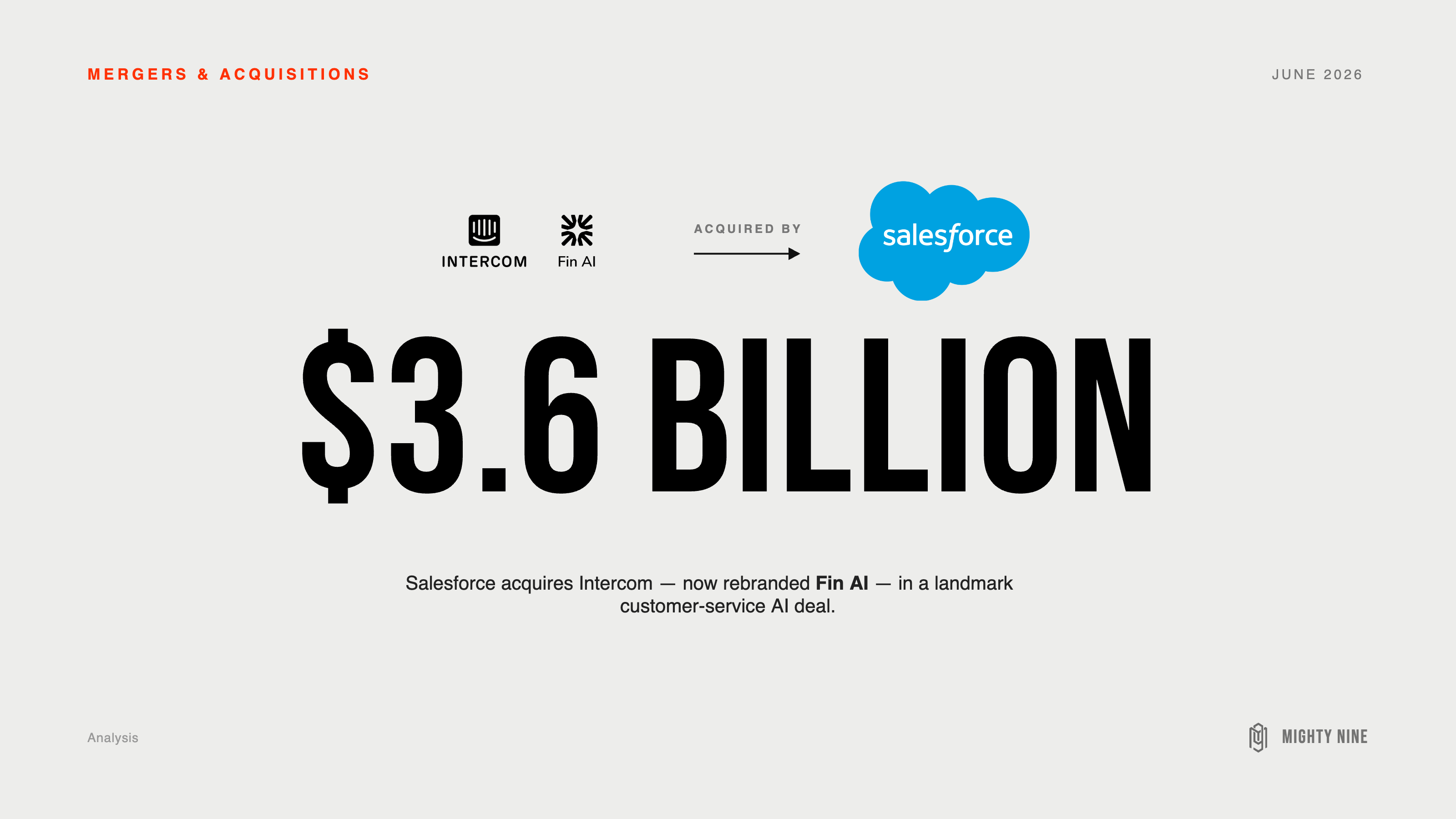
On June 15, 2026, Salesforce announced it was acquiring Fin for $3.6 billion.²
I’m not writing this to score points. I’m writing this because the gap between what I calculated and what the market had implicitly priced tells you something important about how private company valuations actually work and what founders and investors consistently get wrong.
👇Watch: cap table and the proceeds distribution at the end of the article👇
By late 2023, the consensus on Intercom was quiet but clear. The company looked like what the ecosystem privately calls a zombiecorn, not dead enough to write off, not healthy enough to excite anyone.
The facts were hard to argue with. Growth had fallen to 10% year-over-year. Two rounds of layoffs in 2022, 49 employees in September, 124 more in November, had reshaped the team. The co-founder who had stepped back from day-to-day operations returned as CEO. And the SaaS multiples that had made a $1.3B valuation look reasonable in 2018 had compressed industry-wide.
Run a back-of-the-envelope in late 2023 and you get somewhere between $700M and $800M, roughly 3x ARR on a flat-growth SaaS business. Below the last round. The kind of number that explains why nobody was writing breathless profiles about Intercom anymore.
That consensus wasn’t irrational. It was just extrapolating from a snapshot.
And snapshots, in private markets, are the single most dangerous input to a valuation decision.
The framework I built for the European unicorn study doesn’t anchor to the last round. It doesn’t extrapolate from current-quarter growth. It asks a different set of questions.
For Intercom, the 9-dimension grid surfaced signals the snapshot missed.
The company had turned cash-flow positive by late 2023, with $129M in cash reserves. No distress. No bridge round desperation. A business that had cut costs aggressively and reached operational stability without external capital.
Revenue had re-accelerated to approximately 25% year-over-year growth in 2024, after the 2023 trough. Not explosive. But directionally decisive. In a market where, as Rory O’Driscoll has noted on 20VC, only 1 in 9 companies re-accelerates for two consecutive years,³ a confirmed re-acceleration is a significant signal.
The Fin AI Agent, outcome-based pricing at $0.99 per resolved ticket, resolving over one million tickets per week, wasn’t a product rebrand. It was a structural innovation in pricing mechanics. The business had moved from seat-based SaaS to value-based AI outcomes. That’s a different business model, with different margin characteristics, commanding different multiples.
Their AI team had scaled from fewer than 10 to 50+ researchers. They had shipped Apex, a proprietary model purpose-built for customer support, not a wrapper around a foundation model, but genuine product depth with demonstrable resolution rates above commercially available frontier alternatives.⁴
When I applied 6x revenue, the conservative end of the range for a company showing these characteristics, I got €2.7 billion. That felt like the floor.
The actual acquisition price of $3.6 billion was 33% above my estimate. It wasn’t a surprise. It was a confirmation.
The $3.6B headline requires some disaggregation to understand what Salesforce actually bought.
Fin’s total ARR at acquisition was approximately $400M. But that figure is composite in ways that matter enormously for valuation logic. Roughly $300M was legacy SaaS ARR, the classic Intercom help desk, customer messaging, product tours. Good, recurring, defensible revenue. Not what moved the needle.
The other $100M was Fin’s AI agent ARR, growing at 350% year-over-year.⁵
Back-solve the implied multiple on that $100M and you get somewhere between 27x and 36x, depending on how much credit you assign the legacy book. The blended headline of 9x total ARR dramatically undersells the transaction logic. Salesforce wasn’t acquiring a $400M ARR business at a moderate multiple. It was acquiring a category-defining AI agent platform at a price that reflects what outcome-based customer service infrastructure is genuinely worth in 2026.
This distinction matters beyond the Fin deal. The next time you see an acquisition at “X times ARR,” ask yourself how much of that ARR is growing at 30% and how much is growing at 300%. The multiple on the headline number is almost never the multiple on the asset the acquirer actually wanted.
In the study, 199 companies fall into five tiers: Outperformers, Emerging Leaders, Neutral, Under Pressure, and Distressed.
Intercom sat in Emerging Leaders, defined as companies with confirmed re-acceleration, genuine AI premium, and a current implied value above their last round, but carrying unresolved risks that prevent full Outperformer confidence.
That classification now looks precise in retrospect. In February 2026, Intercom wasn’t an Outperformer, the AI revenue wasn’t yet dominant enough, the exit signal hadn’t materialized, the net income picture was still mixed. But it absolutely wasn’t Neutral. The directional signals were unmistakable if you were asking the right questions.
The 60 companies I classified as fallen unicorns, with a median MTM value today of €480M against last-round valuations above €1 billion, share a different profile. Valuation expansion driven by 2021 multiples. No fundamental re-acceleration. A growth trajectory that was decelerating when the market changed, and stayed decelerating. Intercom had that same profile in 2023. The difference is what the company chose to do next.
Fin’s story will be read as a redemption arc about AI transformation. That reading is accurate but incomplete and in its incompleteness, potentially misleading.
What Intercom actually did was structurally rare and brutally difficult. They identified, while staring at declining growth and a disappearing IPO window, that optimization wasn’t the answer. The business model itself needed to change. Not the product. The pricing mechanics, the positioning, the technical talent strategy, and eventually the company name. They executed that transformation over three years, without raising external capital, while achieving cash-flow positive operations.
They built a proprietary model. They invented an outcome-based pricing structure that the industry hadn’t seen at scale. They scaled an AI research team from scratch. And then, six weeks before the Salesforce deal closed, Eoghan McCabe renamed the company after its AI product.⁶ That rebrand wasn’t cosmetic. It was a deliberate signal: we are the AI product. Price us accordingly.
Most companies in analogous situations and the study contains dozens of them, sitting in the Neutral and Under Pressure tiers make a different set of choices. They optimize headcount. They extend runway. They launch a product with “AI” in the name and report it as transformation. They wait for the multiple environment to recover.
The multiple environment doesn’t recover on its own. The category moves on without you.
The 76 companies I currently have in the Under Pressure tier collectively need to create approximately €378 billion in additional value to generate a 2x return for their last-round investors. The required CAGR over six years: 40%+. For most of them, that math requires the same kind of fundamental re-invention that Fin pulled off — not incremental improvement, but a structural change in what the business is and how it charges for value.
The 9x blended multiple Salesforce paid was generous. The 30x on the AI layer was earned.
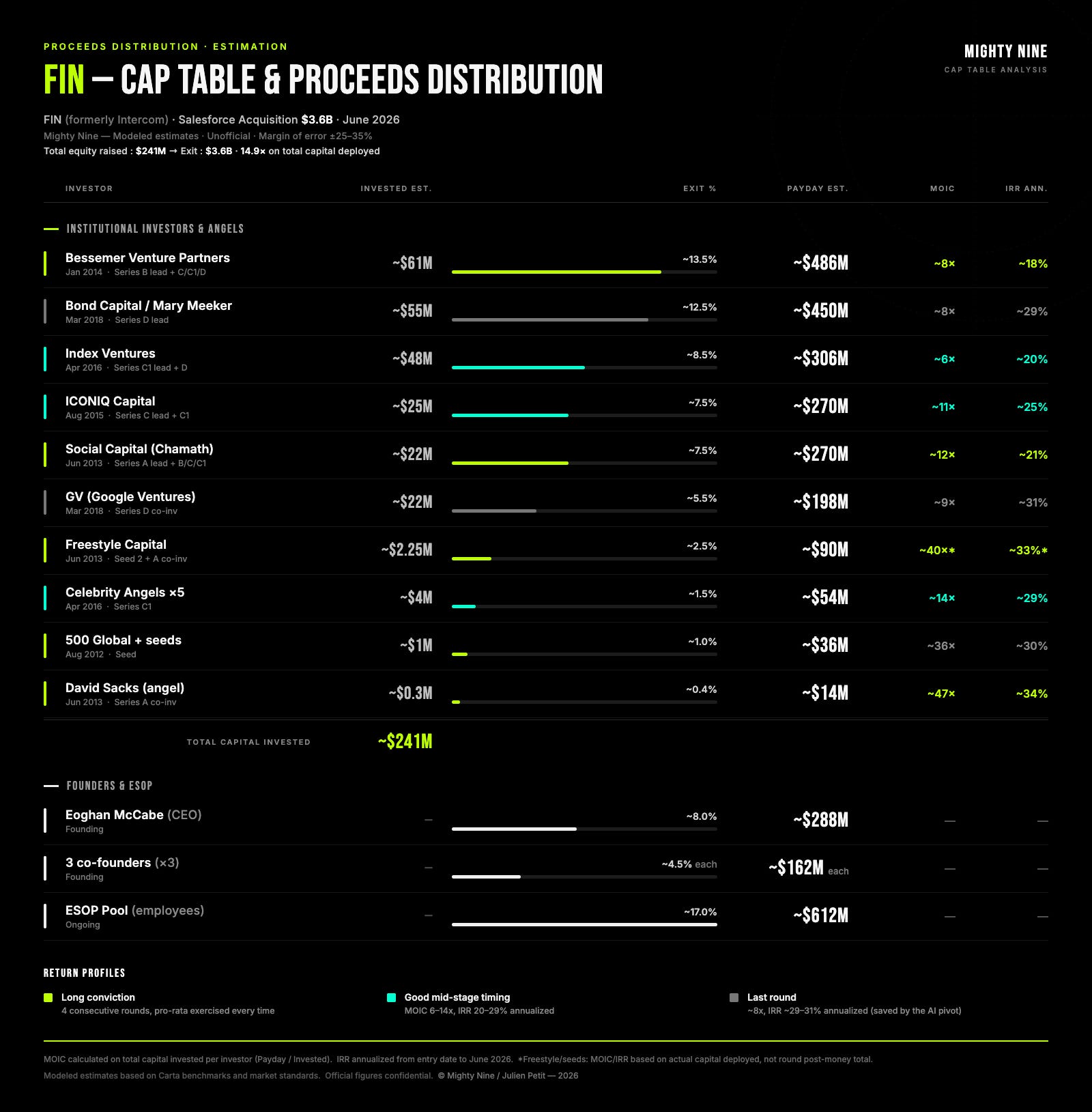
A $3.6 billion exit doesn’t distribute evenly. It distributes according to who got in, at what price, and critically, who had the discipline to keep writing checks when the story got harder.
Fin’s cap table is one of the most decorated in venture history. But the aggregate hides an internal hierarchy of returns that’s worth unpacking round by round.
The seed (August 2012). 500 Global and a group of angels, Biz Stone, Dan Martell, and others, put in $1M at a ~$4-5M post-money. Estimated exit ownership: ~1%. Payday: ~$36M. A ~36x return on invested capital over 14 years. Still an extraordinary outcome on a $1M deployment.
Seed 2 + Series A (June 2013). Freestyle Capital led the $750K Seed 2, then co-invested in the $6M Series A months later, two tickets on the same company inside a year. Total deployed: ~$2.25M. Estimated payday: ~$90M. A ~40x return on invested capital. Social Capital led the Series A at a ~$28M post-money, deploying ~$22M across four consecutive rounds. Estimated payday: ~$270M. A ~12x return on invested capital, ~21% IRR annualized over 13 years, if the position was held without secondary sales, which is far from certain given Social Capital turmoil in 2018. David Sacks came in as an angel co-investor on the same round: ~$0.3M deployed, ~$14M payday, ~47x return.
Series B (January 2014). Bessemer Venture Partners led the $23M Series B at an estimated ~$65M post-money. This is the entry point that defines the entire Bessemer story on this deal. Not just because of the numbers — ~$61M deployed across four rounds, ~$486M payday, ~8x return on invested capital, ~18% IRR annualized over 12 years. But because what Bessemer did next is what separates them from every other investor on this cap table: they followed on Series C, Series C1, and Series D. Four consecutive rounds. Pro-rata exercised every single time. Estimated exit ownership: ~13.5%. The most patient investor. The most rewarded.
Series C (August 2015). ICONIQ Capital led the $35M Series C at an estimated ~$185M post-money. This is the round that gets overshadowed by the celebrity-filled Series C1. It shouldn’t be. ICONIQ deployed ~$25M across Series C and C1, walked away with an estimated ~$270M payday, ~11x return on invested capital, ~25% IRR annualized. Bessemer and Social Capital co-invested as follow-ons.
Series C1 (April 2016). Index Ventures led the C1 at an estimated ~$375M post-money, deploying ~$48M across Series C1 and Series D. Estimated payday: ~$306M. ~6x return on invested capital, ~20% IRR annualized over 10 years. Alongside one of the most remarkable angel syndicates ever assembled: Zuckerberg, Dorsey, the Collisons, Butterfield, each walking away with an estimated ~$11M on a ticket likely under $2M, a ~14x return.
Series D (March 2018). Kleiner Perkins led the $125M Series D at a $1.275B valuation, with Mary Meeker personally leading the deal. Six months later, she left Kleiner to found Bond Capital, taking this investment with her. The ~$450M payday from this exit does not go to Kleiner Perkins. It goes to Bond Capital, which was built with Intercom as its founding asset. GV co-invested alongside her. Bond and GV each deployed ~$55M and ~$22M respectively, both walking away with ~8x and ~9x returns on invested capital, ~29% and ~31% IRR annualized. Correct. Not spectacular in MOIC terms. But it looked like it might be 0.6x without the AI pivot.
When I launched the European Unicorn study in February 2026, the goal was the one I’ve held since founding Mighty Nine: give founders the same calibration tools that institutional capital uses quietly, and share the conclusions publicly with the methodology visible.
Intercom, now Fin, was one of 199 companies I marked to market with that discipline. The €2.7B estimate wasn’t a prediction of the Salesforce deal. It was a reflection of what the business was genuinely worth in early 2026 if you applied current-market methodology honestly, asked the right questions, and didn’t anchor to an eight-year-old Series D.
The deal came in at $3.6B, 33% above my floor estimate, because the AI premium accelerated faster than conservative projections anticipated. The direction was right. The market consensus was wrong.
That gap, between what companies are actually worth today and what the last funding announcement says, is where the most consequential decisions get made. Founders who believe they’re still worth 2021 multiples raise at the wrong moment, dilute unnecessarily, or turn down acquisition offers that are, in fact, fair. Founders who understand their real position can move, the way Fin moved.
The full 109-page study is available at mightynine.co. If you requested it and this piece is how you found out it exists: everything behind the methodology is waiting for you there.
The next Fin is in that dataset. Whether it gets there is the question only the founding team can answer.
¹ State of the European Unicorns Ecosystem — Mighty Nine (February 2026) Julien Petit — The VC Insider, Substack https://thevcinsider.substack.com/p/state-of-the-european-unicorns-ecosystem
² Salesforce Signs Definitive Agreement to Acquire Fin — Salesforce Press Release (June 15, 2026) https://www.salesforce.com/news/press-releases/2026/06/15/salesforce-signs-definitive-agreement-to-acquire-fin/
Salesforce to Acquire Fin — Fin / Intercom Blog (June 15, 2026) Eoghan McCabe, CEO & Co-Founder of Fin https://www.intercom.com/blog/salesforce-signs-definitive-agreement-to-acquire-fin/
³ The 20VC Pricing Playbook: What 30 Weeks of Stebbings, Lemkin & O’Driscoll Reveal About the Real Price of Tech — Mighty Nine (March 4, 2026) Julien Petit — The VC Insider, Substack https://thevcinsider.substack.com/p/the-20vc-pricing-playbook-what-30
⁴ Intercom Mark-to-Market Research — Mighty Nine Internal Dataset (V5, Early 2026) Proprietary 9-dimension analytical grid. Full methodology available at mightynine.co.
⁵ From Unicorn to Zombiecorn to a $3.6B Acquisition — OnlyCFO (June 16, 2026) How Intercom (Fin) went from a ~3x ARR multiple to a 36x ARR multiple
⁶ Today Intercom Becomes Fin — Eoghan McCabe, LinkedIn (May 12, 2026) https://www.linkedin.com/pulse/today-intercom-becomes-fin-eoghan-mccabe-7ov5c/

Do you have a compelling story to influence the best VCs?
We are a VC fundraising investment bank.
No posts
Comments
Nothing yet. Say the first thing.
Sign in to join the conversation.