
When you measure success by number alone, where More is ALWAYS Better, then your value system is based on an unnatural principle with no concept of sufficiency. If we give that value system total dominance, we use math (instead of reality) to pursue numeric ‘success’ to infinity and fail catastrophically in that attempt.
Around 2004, I experienced an incident that most unexpectedly propelled me down the path that I am on. (It was the precursor to this other tiny pivotal moment.) I tell the story in my first book - I’ll share a simpler version here:
I had sold my house in Toronto, but there was a hitch in the closing. I ended up negotiating a $5000 price cut to close the deal. Driving away from that, I began to brood about how much money that was to ‘give away’. However, on the same trip, I avoided getting sucked in by an expensive gas station and found a later option that probably saved me $1.50(!). What struck me was how much better I felt about taking the cut on the house price, having scored a ‘great deal’ on the gas. I had always thought of myself as having a rational mathematically-oriented mind, and suddenly my emotions were not making any sense. As best as I can recall, that was the first time I ever consciously examined how my values worked. Weirdly (for me), I did that processing by writing things down - and then just kept writing.
Since that time, I have learned that the practical application of most of what I wrote about is a well-established and burgeoning field of study: Ecological Economics. So here’s the thing: I have no degree in Ecology, or Economics, or Psychology, or Biology, or Philosophy. Within a traditional academic framework, I have absolutely no claim to credibility in this discipline. Nor do I suffer from any delusions that having a solid grasp of scientific discipline and a strong foundation of the existing knowledge are not critically important prerequisites. This is not some conceited early-stage Dunning-Kruger effect here.
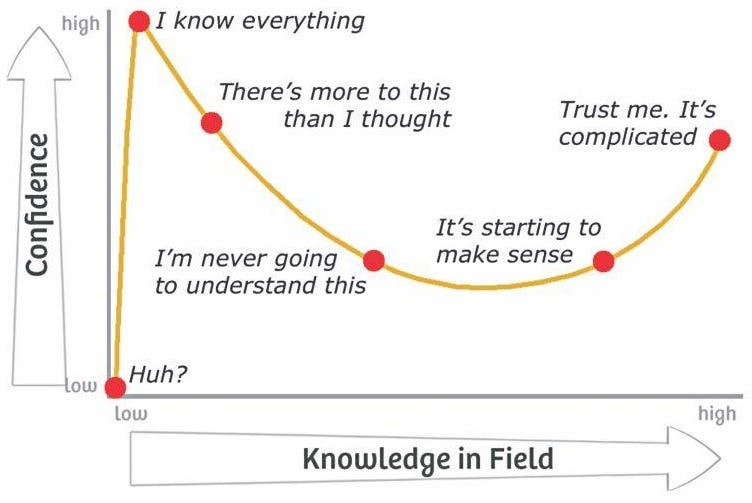
I’ve learned a great deal about ecological economics in the past 20 years - enough to know that I could easily have chosen the path of well-informed activist instead of the audacious track of becoming a writer. But here’s the thing:
The perspective that I stumbled upon for myself - the one that forms the core of my Value Crisis proposition - is essentially this: When you measure success by number alone, where More is ALWAYS Better, then your value system is based on an unnatural principle with no concept of sufficiency. If we give that value system total dominance, we use math (instead of reality) to pursue numeric ‘success’ to infinity and fail catastrophically in that attempt. (A fuller description of the Value Crisis can be found in this essay.) Every single component of ecological overshoot can be traced to this flawed value principle. What I don’t understand is: this is a framework that I can’t find in precisely that form anywhere else - certainly not as a proposition that can be universally applied.
Clearly, what I talk about is not (yet?) mainstream. And yet, even though I lack the standard academic credentials, I’m invited to lecture to Masters students and give keynote addresses at universities and conferences. In other words, a few academics and experts, who know what they’re talking about, believe that this perspective which I bring is a useful contribution. They graciously endow me with some of their own credibility. So, there seems to be something worthwhile here, and I try to explore it through writing.
Beyond that, I mostly take what other learned people write about in this field and attempt to share it with others in accessible (non-academic-speak) language, often putting it out within my Value Crisis framework. Still, who am I to presume that my contribution is worthy of the time and energy that I invest in this forum? My readership is the tiniest fraction of the reach of plenty of other writers out there.
I’ll try to frame my answer in an anecdote. Thanks to some relevant genes and excellent voice training, one of my other unique pursuits of the past 15 years is that of being a official, council-appointed, award-winning Town Crier in three counties - yep, the person in the tricorn hat with a bell who loudly voices proclamations. A couple of years ago, I was asked to deliver an opening for a handbell choir concert. A handbell choir is a group of people who play melodies on one-note bells (with a much sweeter sound than my attention-gathering device produces), where each member plays one or two (or more, with extra skill) bells at a time. It’s like each person provides a unique note from a piano keyboard, and then the whole group work together to perform the piece of music. Each bell supplies one note that is not available from any other bell. So, if even a single bell is missing, the music suffers.
I would happily set aside the work of ecological economics and exploring the world’s deadliest threats, leaving it to others with far more expertise and far larger audiences than I. Except that I can’t help brazenly feeling that if no one is playing the note that was given to me - well, what if that’s important to the piece? When we discuss values, we struggle with their complexity and nuance. What if the simplicity of the Value Crisis proposition is one of the keys to moving forward? (Perhaps in the same way that my 94/98.9 dB town crier voice provides a unique format for my messages. ;-)
I’m also painfully familiar with this popular idea:
To every complex problem there exists a simple solution that is neat, plausible, and wrong. *
While the Value Crisis is a framework, not a solution per se, it could just as easily be too simple to be useful. So far, no one has stepped forward with that assertion - and it would do me a great service if someone could legitimately do so, so I could drop this pursuit and retire. :-)
Until then, I’ll continue to ring my one bell, and seek forums which are missing my note, in the audacious hope that their composition might somehow be noticeably improved by my effort.
I don’t have a large following. My writing is not the level of thought that most people would choose to adopt. But if you’ve read this far, you might appreciate that the community value of my curiosity (and perhaps yours) is improved by conversation. Please share a thought below, and we’ll pursue it!
So that’s why I write. Is it worth it? I don’t have a clear answer. Might you be part of the reason? Do you think I should keep going? Because frankly, it’s getting tougher.
(Truth be known, I do have a few other (so far) unique bells - such as applying polarities to qualitative values and a novel concept of ‘qualitative economies’ - but the Value Crisis is probably the best one.)
I’m trying to reach the people who’ll bring value to this conversation, and for that, sharing is more important than subscribing. Please…
* The original quote by H.L. Mencken (1920) was “There is always a well-known solution to every human problem—neat, plausible, and wrong.” The Value Crisis is not well-known. Perhaps there’s hope yet…!

No posts
Comments
Nothing yet. Say the first thing.
Sign in to join the conversation.