
Over 30 nations are conducting or have conducted official inquiries into their responses and follow-up to the COVID pandemic. Most were conducted by government agencies. A few countries like the United Kingdom, the inquiry is conducted by an independent group, not associated with the government.
In the next couple of weeks to follow, I will be writing in detail how the United States inquiry conducted by Congress, differs from other nations.
Please enjoy the following:
An interview with Caroline Pover from the United Kingdom.
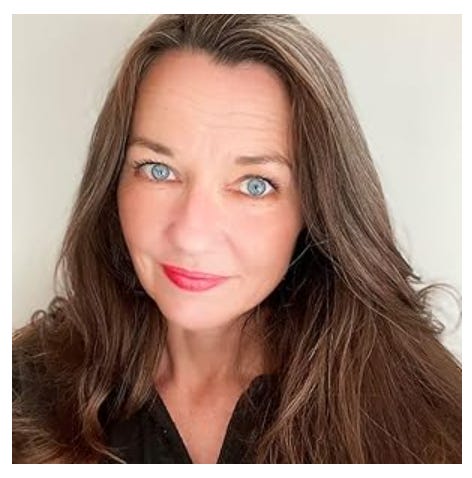
Caroline Pover on Vaccine Injury, the UK COVID Inquiry, and the Fight for Recognition
Interview conducted by Wayne Rohde
Caroline Pover speaks with a clarity forged through adversity. As chair of trustees of UKCVFamily — a UK-based charity supporting those injured or bereaved following COVID-19 vaccination — she has spent years navigating a health system ill-equipped for the complex, ever-shifting nature of vaccine injury, and a public inquiry that, in her view, prioritized the expansion of future vaccine development and rollout over the needs of those who have already been damaged or bereaved by them. In a wide-ranging conversation with author and researcher Wayne Rohde, Pover discusses the UK COVID Inquiry’s Module 4 on Vaccines and Therapeutics, the shortcomings of the Vaccine Damage Payment Scheme, her own experience as a vaccine-injured person, and what prompted her to publish a book in just five days.
Module 4 of the UK COVID Inquiry — the section dedicated to vaccines and therapeutics — ran to some 300 pages. Pover attended every day of hearings, either online or in person, and came away with a distinct impression of its purpose.
“It became very clear to me that the purpose of that module was to get more vaccines produced in the UK, to have more clinical trials run in the UK, and to get more British people to participate in more clinical trials,” she says. “What happens when something goes wrong was a very tiny part of that module.”
The entire inquiry, she notes, operated on a foundational assumption: that the COVID vaccines were safe and successful. There was no space within the module’s framework to challenge that premise, a reality that shocked many of the vaccine-injured people following the proceedings.
Pover is careful about what she will and won’t say on the question of vaccine safety itself. UKCVFamily has a deliberate policy of neutrality on that topic, because its membership spans a wide range of views, and the charity is committed to being a safe space for anyone injured or bereaved, irrespective of their views on the Covid vaccine, or any other vaccine. What she will say is that the inquiry’s only meaningful recommendation for the injured and bereaved was reform of the Vaccine Damage Payment Scheme (VDPS) — a scheme she describes as fundamentally broken.
She also highlights a detail that most readers of the report would likely pass over without registering its significance: a statement that the inquiry saw no basis for making the reporting of suspected adverse reactions mandatory. “Most people in the UK would assume that if something happened to them, their doctors would have to report it,” Pover says. “But they don’t. And the report has made that very clear.” Without mandatory reporting, it is impossible to know the true scale of vaccine injury — a point Rohde reinforces from his experience in the United States, where the equivalent reporting system carries no enforcement mechanism.
As a core participant in the inquiry, UKCVFamily submitted an extensive witness statement and, crucially, the personal case studies of 238 of its members. Co-editor Charlet Crichton, the charity’s founder, had worked one-to-one with each contributor to help them shape their stories. The expectation was that these accounts would be published alongside the main submission.
They were not published. No reason was ever given. The group’s lawyers repeatedly requested an explanation. None came.
“The day after the inquiry report came out, I woke up very distressed,” Pover recalls. “I just felt like an answer was going to come to me. Their voices were going to be heard — I didn’t know how. And literally the idea of the book popped into my head. I could see the cover, the title, the color. I could envisage the whole thing.”
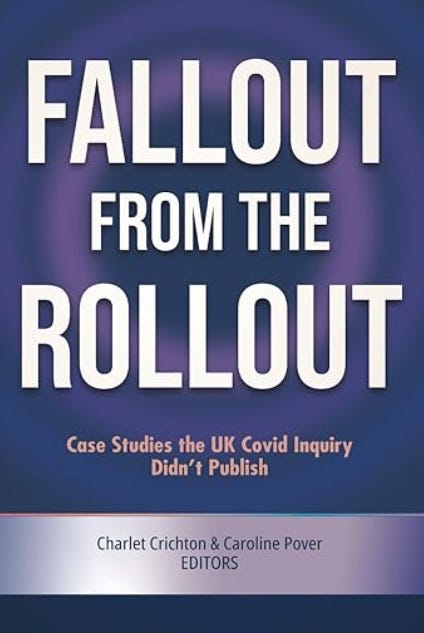
Three people dropped everything to work nonstop for five days, and produce “Fallout from the Rollout” — a collection of member case studies that the inquiry had chosen not to publish. All proceeds from sales go directly to UKCVFamily’s grant scheme that provides financial assistance for treatments, since the inquiry made no recommendations for treatment pathways or funding for the injured.
“We are definitely on our own,” Pover says simply. “There’s no help, no practical help.”
One of the defining characteristics of COVID vaccine injury, both Pover and Rohde agree, is its instability. Unlike many injuries associated with traditional vaccines — which tend to manifest in consistent, well-documented ways — COVID vaccine injury appears to shift and evolve over time, presenting different symptoms and affecting different systems as the months and years pass.
“I actually use the word morph when I talk about my own situation,” Pover says. “This cascade of symptoms that then morphed into an ongoing, ever-changing condition. It took two and a half years for my own combination of symptoms to stabilize.”
This presents a profound challenge for both patients and clinicians. The NHS, structured around specialists who deal with single organ systems, is poorly suited to conditions that affect the whole body simultaneously. A person with cardiac, renal, and neurological symptoms will be referred sequentially to a cardiologist, a nephrologist, a neurologist — each seeing only their slice of the picture. By the time an appointment arrives, the symptom it was booked for may have resolved or been replaced by something else entirely.
A survey conducted by UKCVFamily found that 40% of members had vaccine injury documented in their medical records, and a further 30% had been told verbally by a healthcare professional that their illness was vaccine-related — though that professional declined to put it in writing. “So we have 70% who have been recognized in one way or another,” Pover says. “Most people assume none of us have been. But actually 70% of us have. I take that as something positive.”
The Vaccine Damage Payment Scheme is not, Pover is careful to note, a compensation scheme. The British government has deliberately avoided that framing. It is a payment — one that might then enable a claimant to pursue compensation through litigation. The distinction is not merely semantic; it is a statement about responsibility.
By December 2025, the scheme had received 22,819 applications related to a Covid vaccine. Of those, roughly 2.64% had been approved — the lowest approval rate of any comparable scheme in the world. Japan’s equivalent scheme has an approval rate of 74%.
The reasons for this are structural. Applicants must clear two thresholds. The first is causation: a private company with undisclosed assessors reviews medical records in search of any alternative explanation for the applicant’s illness. There is no face-to-face assessment, no contact with the applicant. The assessors consult a document called the Green Book — but that document only lists conditions associated with vaccines currently in use. Someone applying now for an injury from the AstraZeneca vaccine, which was withdrawn in 2024, will find no relevant entry.
If causation is established, the assessor will then decide whether the applicant is 60% permanently disabled — a threshold originally designed around workplace accidents, specifically the loss of a limb. “It’s very difficult to apply that to the kinds of conditions you can develop after a vaccine,” Pover says. “We don’t know if they’re temporary or permanent. Temporary can mean something that completely resolves in 10 years. None of us can say that, can we?”
The payment amount itself has not been increased since 2007. UKCV Family is calling for it to be raised to reflect inflation, with immediate top-up payments to the 246 people who have already received awards under the COVID provisions. They are also calling for the removal of the permanence threshold, the inclusion of temporary as well as permanent injuries, and — most fundamentally — the involvement of the injured and bereaved in designing whatever new scheme replaces the current one.
More than a month after the inquiry report was published on 16 April, recommending “urgent” VDPS reform, UKCVFamily had still not been contacted by government. “We’ve contacted the former health minister,” Pover says. “We haven’t heard anything.”
Pover lived in Japan for fifteen years. When the COVID vaccines rolled out, she watched from a distance as friends sent her photographs that struck her as unimaginable in a British context. One showed a poster in a healthcare setting stating that discrimination based on vaccination status was prohibited. Another showed a screening form that asked detailed questions about autoimmune conditions and blood-clotting disorders — and withheld the vaccine from those who answered in certain ways.
“A friend had an autoimmune condition, her doctor wouldn’t give it [the Covid vaccine] to her in Japan,” Pover says, describing a friend’s experience. “The COVID vaccines were not tested in clinical trials on people with an autoimmune condition — they weren’t allowed to participate. So it was interesting that what seemed to be happening in Japan was that those exclusions were being respected.”
Beyond screening practices, Pover points to something deeper: a cultural orientation toward collective responsibility. Japan has a history of pausing vaccines when injuries emerge — a teenage girls’ reaction crisis in the 1990s led to a vaccine being withdrawn. “It’s a country where the community matters. If somebody does something for the group, and it goes wrong, the group has a responsibility to care for that person.”
When Rohde asks Pover what she expected of the inquiry before it began — whether she thought it would be fair, or whether the fix was already in — her answer is disarming in its equanimity.
“I have a policy now of keeping an open mind with anything,” she says. “One of the reasons is that I try not to promote fear or anxiety in my body. Through this experience of being vaccine injured, and putting my health first, I’ve learned not to do that. I believe what I see with my own eyes or hear with my own ears, rather than what is reported.”
It is a philosophy born of necessity — of someone who has learned, through illness and institutional indifference, to conserve her energy for what she can actually change. What she can change, apparently, includes publishing a book in five days, chairing a charity for thousands of injured members, attending every session of a government inquiry module, and continuing to press ministers who do not reply raise awareness.
The 238 people whose case studies the inquiry declined to publish are now in print, their stories available to anyone who buys the book. The money goes toward treatments the NHS will not fund. The voices that were meant to go unheard, went heard after all.
―
Resources
UKCVFamily charity and donation: ukcvfamily.org
Fallout from the Rollout: available on Amazon https://www.amazon.com/dp/B0GY7RQ2MJ/
Vaccine Damage Payment Scheme (UK): gov.uk/vaccine-damage-payment
Keep Learning, Keep Challenging Yourself, and Always, Always question Authority.
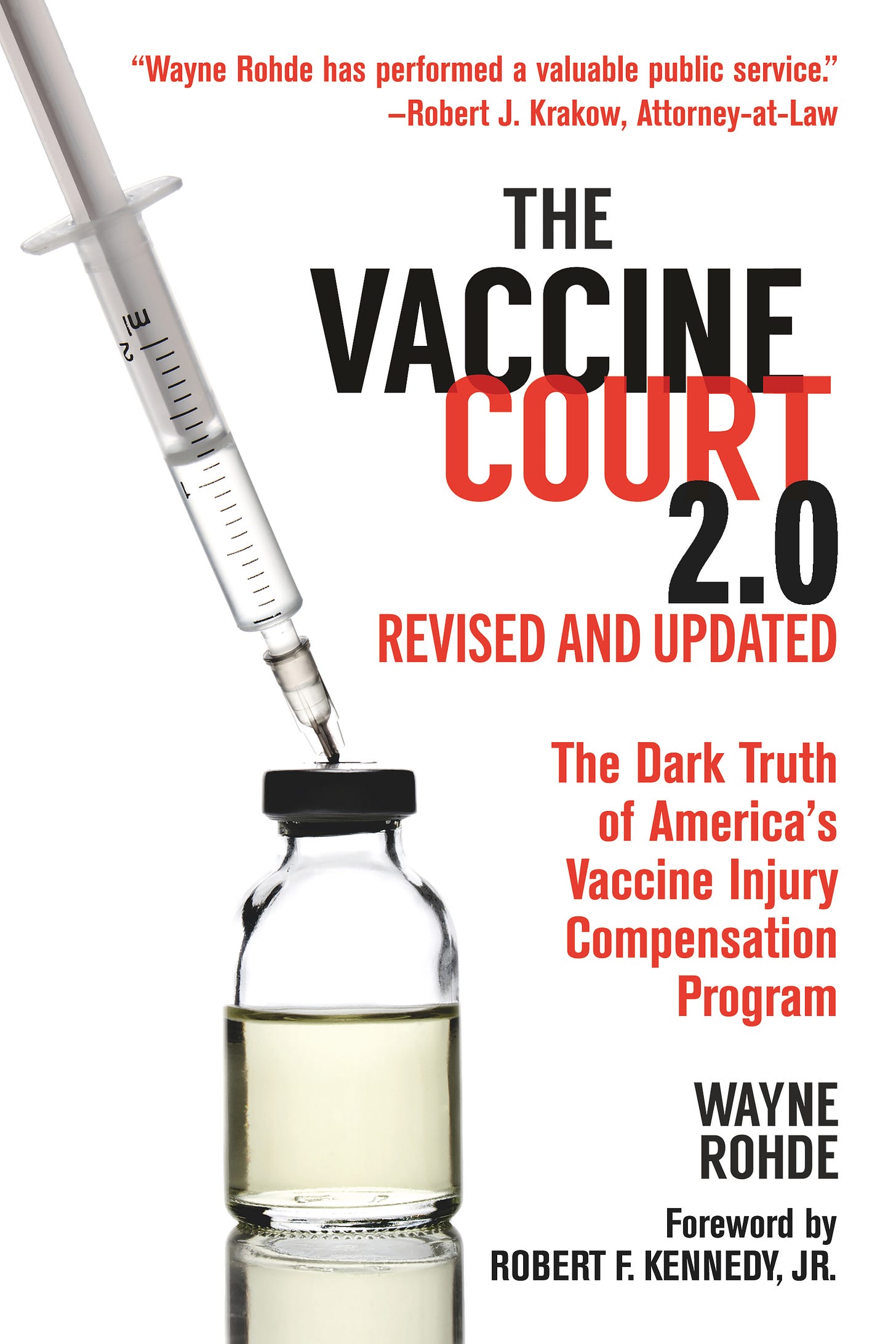
Wayne Rohde, author of two books on the National Vaccine Injury Compensation Program (NVICP), researcher of the CounterMeasures Injury Compensation Program (CICP) and Legal Research Fellow at IPAK-Edu.org
No posts
Comments
Nothing yet. Say the first thing.
Sign in to join the conversation.