
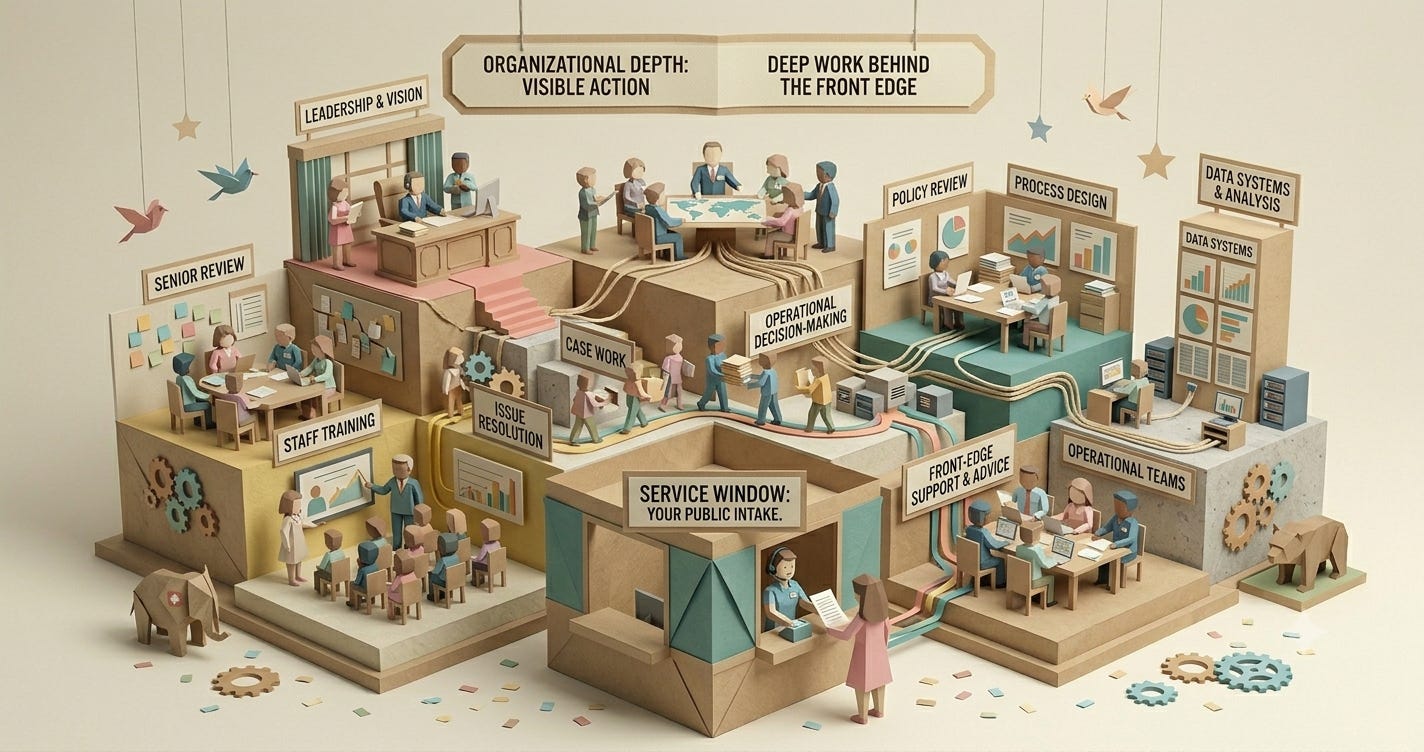
A service is not something an organisation delivers. A service is how an organisation behaves when someone needs something from it. That distinction matters because it moves the work of service design away from the visible edge of the service and back into the organisation that produces it.
For years, service designers have often been asked to make services — or, for many UK civil servants, products — clearer, faster, simpler, more cost efficient, less reliant on humans in the loop, or easier to understand. We map journeys. We remove friction through better interactions and automation. We have replaced paper-based application forms with digitised ones, and then replaced those with intentionally designed online systems. Anyone who has been at the coal face of designing public services knows the front stage matters. The touchpoint a person engages with can make a difficult moment feel either bearable or brutal.
But when we only work on the front stage, we can start to mistake the surface of the service for the service itself. The service is also the decision an employee is allowed to make when the situation does not fit the prescribed process. It is the quality of information passed between teams, and between the organisation and the people who depend on it. It is the confidence of a frontline worker who knows they will be supported if they use judgement. It is the way a complaint becomes organisational learning, or disappears into a spreadsheet. It is the budget line that keeps a support channel open after launch, the investment in continuous development, and the choice to measure impact and outcomes over the number of customers served or units shipped. It is the board meeting that asks whether people are better off, not whether a milestone has been met on a project timeline.
What people experience as a service is usually the public surface of a much deeper organisational design. The interface should be reflective of the organisation providing it. Every interaction carries something of what the organisation stands for: its voice, its tone, its shape, its attitude to people. Most critically, it amplifies the people within it, and the thing we often call culture. That is why a service cannot be fully understood by looking only at its touchpoints. The touchpoint is where the organisation becomes visible.
You can see this clearly in organisations where the moment of interaction between a person and the organisation really matters. The RNLI is easy to describe through its most dramatic scenes: a lifeboat launching in rough weather, a volunteer crew moving quickly, someone pulled from the water. But the rescue is only the visible edge of the organisation. Behind it sits training, equipment, local stations, fundraising, water safety education, lifeguard services, flood rescue, operational discipline and a culture of readiness. Its annual report describes volunteer lifeboat crews providing a 24-hour rescue service across the UK and Ireland, while its wider work stretches into prevention, supervision and education. The person in danger experiences the rescue. The organisation has created the conditions in which that rescue can happen. (RNLI (download Impact Report on page)
That is what makes the RNLI a useful example. It does not simply respond to emergencies. It has designed itself to be capable of responding. The competence is not accidental, and it does not only live in the courage of the crew. It lives in the way the organisation recruits, trains, equips, funds, governs and learns. The visible act of service depends on a much larger system of preparation.
Public services rarely operate in conditions as dramatic as a lifeboat rescue, but the principle is the same. A person may experience a housing application, a disability assessment, a school placement, a visa process, a planning appeal or a social care referral as a single service. Inside the organisation, that experience is produced by policy, funding, technology, casework, risk appetite, leadership, procurement, data, culture and the everyday habits of teams. When we only redesign the touchpoints, we improve what the person can see. When we redesign the organisation, we change what the organisation is capable of doing.
This is where many public service design efforts reach their limit. A team can make a digital journey clearer, but still leave people caught between departments. A form can be improved, while the decision-making model behind it remains opaque. A service can pass through discovery, alpha and beta, while the organisation remains unable to learn from what happens after launch. The result is a familiar kind of partial success: the interface improves, the content improves, the front door becomes easier to use, but the deeper behaviour of the organisation stays much the same. The service looks better, but the conditions that shape people’s experience have not necessarily changed.
Buurtzorg, the Dutch home-care organisation, offers a different kind of lesson. Its reputation does not rest on a beautifully designed website or a more efficient booking process, but on an organisational model built around small, self-managing nursing teams, professional autonomy, continuity of relationships and a deliberate reduction in bureaucracy. Buurtzorg describes its model as neighbourhood teams with professional freedom and responsibility; The King’s Fund describes teams making clinical and operational decisions themselves, supported by coaches and a central back office. (Buurtzorg International)
That matters because home care is not a neat transaction. It is relational, contextual and full of judgement. A nurse entering someone’s home is not simply delivering an intervention; they are noticing what has changed, understanding family dynamics, reading confidence and risk, and helping someone live with dignity and independence. If the work requires judgement, continuity and trust, the organisation has to be designed to support those qualities. If it is designed only to manage throughput, compliance and cost, then that is what the service will express.
Buurtzorg’s model is not a template that can be lifted and dropped into every public service. Attempts to adapt it in other systems have shown the importance of context, funding, data and local conditions. But its lesson is useful precisely because it is organisational rather than cosmetic. It shows that the quality of a service depends on the organisation’s theory of work: what it thinks the work is, who it trusts to do it, what it measures, and how much freedom it gives people to respond to reality.
John Lewis gives us a different example again, and one that needs to be handled with more caution. No retailer is a perfect organisational story, and the Partnership has been through a difficult period of commercial pressure, restructuring and recovery. Its usefulness is not as a simple story of “good customer service”, but as an example of the relationship between organisational form and service culture. John Lewis describes itself as one of the UK’s oldest employee-owned businesses, founded on a belief in a better way of doing business, with Partners rather than external shareholders. That ownership model has historically been central to its public identity: the idea that the people serving customers have a stake in the organisation, its reputation and its future. (John Lewis Partnership)
The example is more interesting because it is not clean. Recent reporting shows improvement, including a restored staff bonus, but also a cautious outlook, redundancies and continued pressure to modernise. That makes it a better case for the point I am trying to make. Service culture is not a slogan. It has to be carried by incentives, ownership, training, management decisions, commercial choices and the way people inside the organisation experience their own agency. When those things weaken, the customer experience eventually feels it. When they are invested in, the service has a better chance of feeling coherent, knowledgeable and human. (Reuters)
Across these examples, the point is not that public services should become like a charity, a Dutch nursing organisation or a department store. That would be far too easy, and wrong. The point is that in each case the service people experience is inseparable from the organisation that produces it. Readiness, judgement, continuity, care and trust do not appear at the touchpoint by accident. They are made possible by the way an organisation is structured, funded, led and allowed to learn. They show up in the moment of interaction because they have already been designed into the conditions behind it.
This is the shift public service design still needs to make. Too often, design is invited in at the level of the service expression and asked to make an existing system easier to navigate. That is worthwhile work, but it can also become a trap. We make the burden more legible without changing why the burden exists. We improve the route through the maze without asking why the maze is there. We make the organisation easier to deal with, while leaving the organisation fundamentally unchanged.
A better ambition would be to design organisations that are easier to trust. That means asking what the organisation needs to know, remember and take responsibility for, not only what the user needs to do next. It means looking for the places where the organisation has made a person carry complexity that belongs elsewhere. It means questioning why responsibility is being handed off in a particular way, rather than only improving the handoff itself. It means treating launch as the beginning of organisational learning, not the end of delivery.
These are not just design questions. They reach into governance, operating models, funding, data, workforce, policy and leadership, which is why service design can feel powerful in theory and strangely limited in practice. It is often given permission to describe the organisation’s behaviour, but not to change the conditions that produce it. If public services are serious about outcomes, they have to become serious about the organisations that create those outcomes. A service that is compassionate at the front end but punitive in its decision-making is not compassionate. A service that is simple to apply for but impossible to challenge is not simple. A service that is easy to access but unable to remember people’s circumstances is not joined up. A service that launches successfully but cannot adapt is not complete.
Good services come from good organisations. Not perfect organisations, and not organisations without constraints, contradictions or failure, but organisations that know how to stay close to reality. Organisations that treat frontline knowledge as intelligence, support judgement rather than suppress it, and understand that efficiency without responsibility simply moves cost and effort onto the public.
For public service design, this should be a moment of maturity. The work is not only to design better interactions between people and the state. It is to help design the kind of state that can interact well with people in the first place. That means designing for the moment of need, but also for everything that makes that moment possible: the team, the policy, the funding, the decision, the data, the escalation route, the feedback loop, the leadership habit and the organisational memory. When someone needs something from a public service, they are not really meeting a website, a form, a call centre or a caseworker. They are meeting the organisation, and the organisation shows them what it has been designed to do.
Comments
Nothing yet. Say the first thing.
Sign in to join the conversation.