
Each week during the 110th anniversary of UTEP’s establishment, the UTEP History Mine will revisit the top 52 findings discovered about the institution’s history during the 2014 centennial celebration.
Several of the findings were documented in the peer-reviewed journal Southwestern Historical Quarterly and the Texas Handbook, published by the Texas State Historical Association. Others appeared in the Encyclopedia of UTEP History and the UTEP History Sourcebook.
On August 25, 1957, Texas Western College of the University of Texas etched its name in Texas civil rights history. On that day, Gwendolyn Lila Toppin of Anniston, Alabama, walked across the stage of Magoffin Auditorium. With one hand, she shook hands with President Dysart Holcomb, and with the other, she clutched a diploma, signed by the University of Texas System Board of Regents, which conferred upon her the degree of Bachelor of Arts.
Toppin holds the distinction of being the first Black undergraduate to receive a bachelor’s degree from a formerly segregated four-year public university in Texas. In September 1955, Toppin transferred to TWC from Alabama A&M, joining its first cohort of Black students. Following the completion of a master’s degree in education, Toppin joined the El Paso Independent School District, where she remained until her death in 1981.
In the annals of Civil Rights history, James Meredith is generally credited with being the first Black individual to attend and graduate from a Jim Crow college or university. In 1963, six years after Toppin, Meredith graduated from the University of Mississippi. The year before, his successful enrollment at the Oxford institution broke the color barrier in a state that, like Texas, had a history of segregation in higher education. His admission to the university encountered significant resistance, leading to federal intervention to ensure his enrollment and safety.
Toppin’s achievement was far less dramatic. TWC, the UT board of regents, and the media in 1957 took little, if any, notice of Toppin’s milestone. At the time, the nation’s attention was focused on UT Austin and the challenges faced by Barbara Smith, a Black singer who had been prevented from performing in an integrated performance by the school’s president. Even though Thelma White’s historic lawsuit against TWC rendered null and void the clause in the Texas constitution prohibiting segregated colleges and universities, Jim Crow Texas legislators insisted that UT Austin continue its segregationist policies regarding student housing and gatherings. (Ironically, Toppin, a theatre major, had appeared on the Magoffin Auditorium stage two years earlier in the first desegregated performance on a Texas university or college stage. This historic first also went unnoticed.)
Toppin’s journey began in 1955 when Thelma White initiated legal action against Texas Western College and the University of Texas System, demanding the immediate desegregation of the state’s public universities and colleges. A pragmatic UT System board of regents acknowledged the need for desegregation but feared backlash from Jim Crow legislators who threatened to cut the university’s funding. The regents instead proposed the immediate desegregation of Texas Western College while requesting additional time for UT Austin. Federal Judge R. Ewing Thomason, in a historic ruling terminating segregation in Texas, sanctioned a one-year delay for the flagship Austin campus.
This postponement enabled UT El Paso to take the lead in statewide desegregation efforts. In the fall of 1955, Toppin was among the thirteen Black students who comprised the first desegregated class admitted to a baccalaureate program at a previously segregated public college in Texas. Thelma White, however, chose not to attend UTEP. She opted to remain at New Mexico State University after being denied admission to TWC. UT Austin would not admit its first desegregated class until 1956.
Three decades later, UT Austin sought to address its historical record regarding segregation. In February 1987, regents recognized engineering student John W. Hargis as the UT System’s first Black baccalaureate. UT Austin honored Hargis – who had graduated two years after Toppin – by naming a building on the Austin campus after him. Subsequently, they discovered they had made an error. In 1958, a year preceding Hargis, Edna Humphries Rhambo had obtained her bachelor’s degree. The regents acknowledged Rhambo with a reception but allowed Hargis's name to remain on the building. Despite having acknowledged Toppin as its first Black graduate as early as 1973, UTEP made no effort to correct the historical record.
For most of its history, UTEP operated in the shadow of UT Austin, acknowledging its subordinate status to the UT System’s Austin flagship. Gwendolyn Toppin, however, merits recognition for her role as a pivotal figure in the history of Texas civil rights and the University of Texas System.
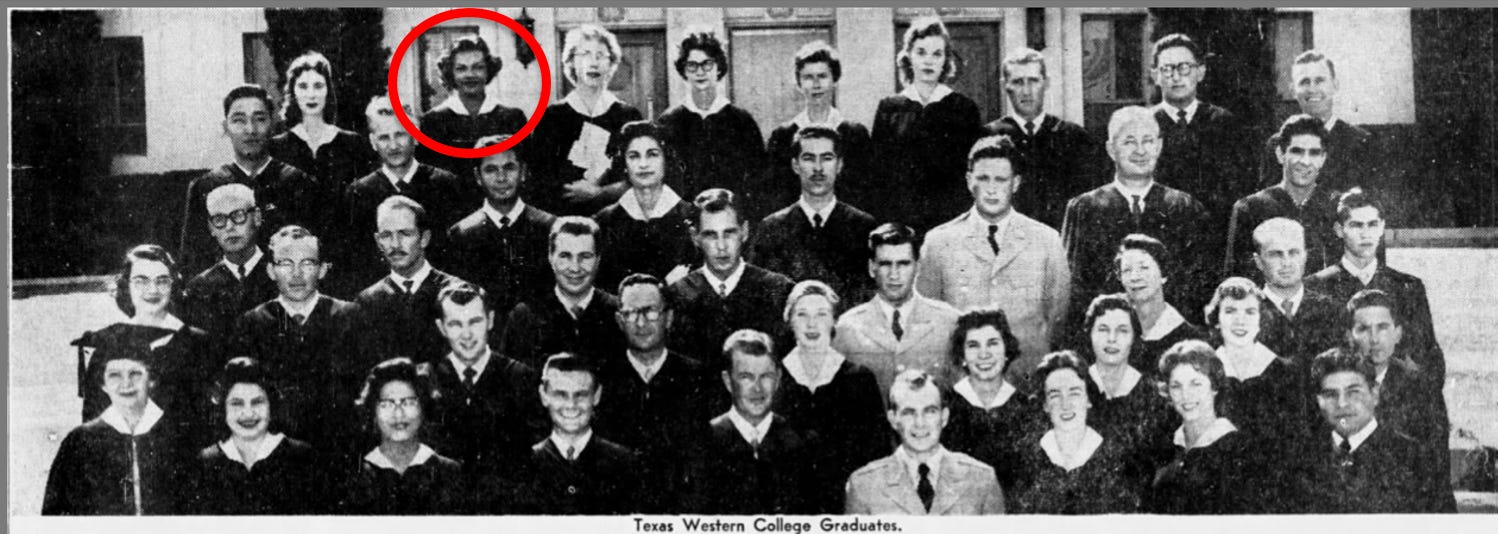
El Paso Times, 26 Aug. 1957
Comments
Nothing yet. Say the first thing.
Sign in to join the conversation.