
On April 1st, the UN’s biggest joke just took a new turn.
You may remember that the UN - which is supposed to ensure our basic rights - chooses its chief in a process that would make the maddest dictator ashamed. In short: every five years, a few world powers choose the Chief of the United Nations behind closed doors and without any public involvement, resulting in a man being selected to preserve the status quo.
That’s obviously an oversimplification, but it’s the gist of it.
The current UN Secretary-General’s term ends on December 31st, 2026. The UN has thus launched its usual untransparent and undemocratic process, dressing it up with a few open Q&As and other cosmetic changes. In short, countries were supposed to nominate candidates by today. Interactive dialogues happen at the end of April. Then the five permanent Security Council members — the US, UK, France, Russia, and China — will make the actual decision later this year. What is the point of dialogues without a real vote?
I campaigned for the last two years for the position, and will continue to do so in a bid to force reform and push forward a progressive political agenda (find my latest update on my campaign here), despite not being nominated. You see, I never sought to appease countries but to force into the open race so that the biggest challenges of our times might finally be tackled.
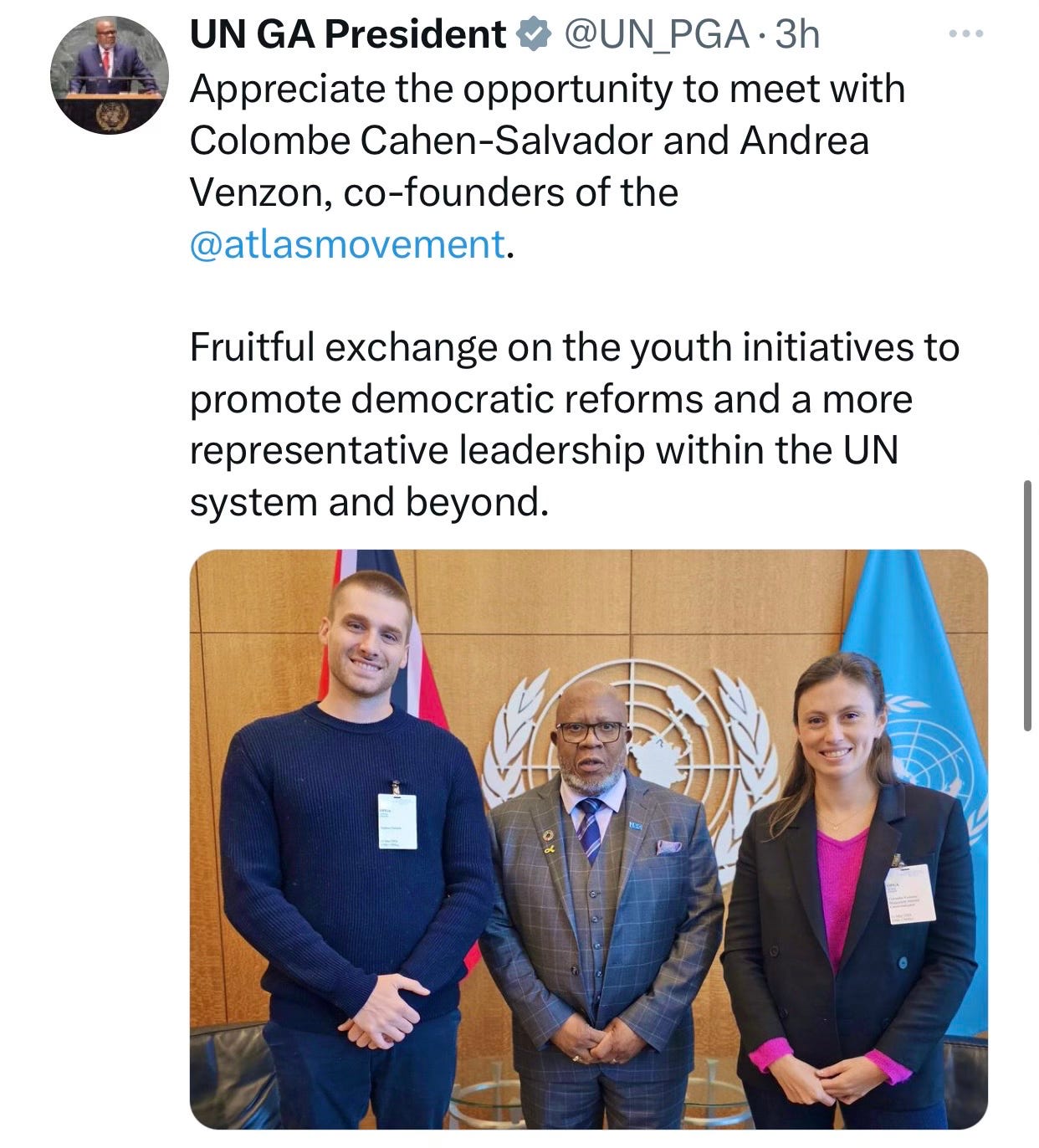
Rebeca Grynspan, former Costa Rican vice president and current head of the UN’s trade and development agency. She was nominated by Costa Rica.
Michelle Bachelet, former president of Chile and former high commissioner for human rights. She is supported by Mexico and Brazil. Chile’s President, Jose Antonio Kast, withdrew Chile’s support.
Rafael Grossi, director-general of IAEA. He was nominated by Argentina.
Macky Sall, former president of Senegal. He was nominated by Burundi.
The median age of UN chief candidates is 67.5. Consider that the global median age is 31. Obviously, age isn’t the main issue in this opaque and broken UN Chief selection process. What matters is whether candidates have real plans to end genocides, wars, climate collapse, and rising inequality.
But:
Where are those plans? I’ve read each vision statement at least three times. They are so vague it’s hard to remember a single idea (but for Grynspan’s, who dives further into some topics such as artificial intelligence.) That’s not a mistake. The UN Secretary-General is selected by five countries, all with veto power and involved in some of the worst crises we face. Say something bold, and you’re out.
There is something deeply wrong with a system where the future is systematically shaped by people who won’t live with its consequences for as long as the rest of us.
Also, consider that by the time they take office, all candidates would be above the UN’s own mandatory retirement age…
I’ve read each one at least three times. Here’s what I found.
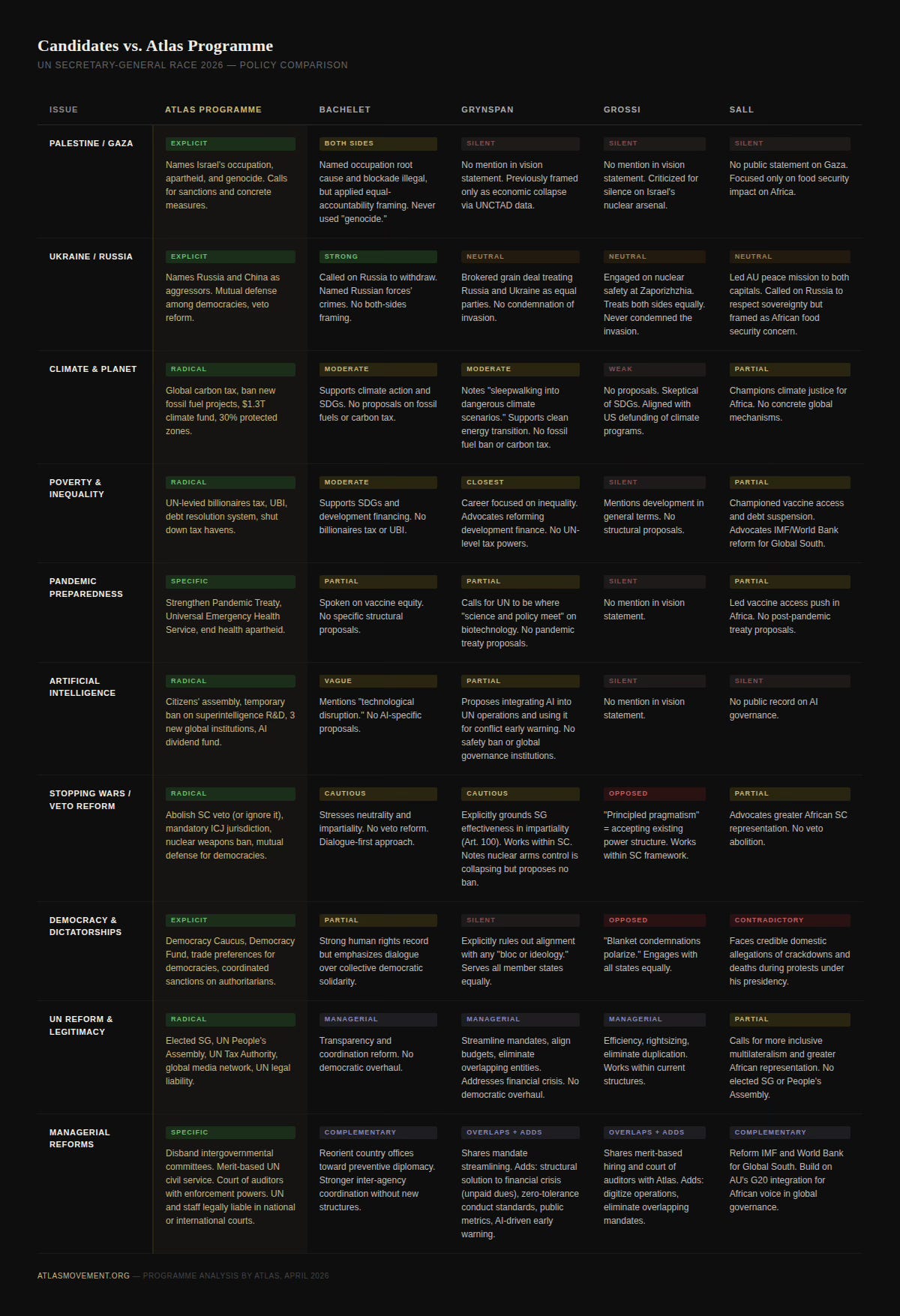
You won’t read a word about Palestine or Ukraine — the crises where the P5 are either accomplices in war crimes or committing them directly. You won’t find a fossil fuel phase-out. You won’t find a plan for sovereign debt or a billionaires tax or anything that would threaten the people who hold the veto. What you will find is that multilateralism matters, that this is an inflection point, that good management is important. Weak as hell.
That’s not an accident. Say something bold, and you’re out. That said, some distinctions matter.
Bachelet and Grynspan are meaningfully closer to what this campaign stands for than the rest of the field. Bachelet named Russia’s crimes in Ukraine without both-sidesing it. During her mandate, she called the Israeli blockade of Gaza illegal, named the occupation as the root cause of “the conflict”, and documented the killing of Palestinians including children by Israeli forces. She never used the word “genocide.” But compared to a field where every other candidate is completely silent, her prior record at least shows she is capable of naming things.
Grynspan has spent her career on inequality, advocates reforming development finance, and is the only candidate whose vision statement goes into any real depth on topics like artificial intelligence. Neither goes far enough. But the distance between them and the rest of the field is not nothing.
Then there’s Grossi. There seems to be a quiet understanding amongst UN insiders that he has the best chances of being deemed acceptable by the P5. Another man. One who refused to step down from his official role during the campaign, despite it being a General Assembly guideline. One whose vision statement contains nothing on climate, poverty, AI, or stopping wars. One whose approach to every crisis is studious neutrality. If the P5 preference for Grossi holds, it will be the system selecting exactly what the system was designed to produce.
It’s also high time to have a woman at the helm of the UN. There is absolutely no justification for 80 years of men, full stop.
I’ll continue to campaign for the role and refuse to play by the rules of a rigged game to force other candidates to be more accountable, while pushing countries that may still have a moral backbone to reform this system together and bringing to the top of the news a radical and progressive political agenda that could then be implemented.
The nomination window closed today. The fight didn’t. So endorse my campaign, and let’s continue to work toward a better and fairer world for as long as needed!
Onward,
Colombe
--
Colombe Cahen-Salvador (she/her)
Co-Founder & Candidate for United Nations Secretary-General
Atlas
Youtube | Substack | Facebook | X | LinkedIn | Instagram | TikTok | Threads | Bluesky
PS: Here’s Claude’s analysis of their statements and vision statements, versus our programme at Atlas.
Comments
Nothing yet. Say the first thing.
Sign in to join the conversation.