
Deal table in the middle, plain chairs all round the walls, on one end a large shining map, marked with all the colours of a rainbow. There was a vast amount of red—good to see at any time, because one knows that some real work is done in there, a deuce of a lot of blue, a little green, smears of orange, and, on the East Coast, a purple patch, to show where the jolly pioneers of progress drink the jolly lager-beer. However, I wasn’t going into any of these. I was going into the yellow. Dead in the centre. And the river was there—fascinating—deadly—like a snake. Ough! —Conrad, Heart of Darkness
The quality of uncanniness can only come from the circumstances of the “double” being a creation dating back to a very early mental stage, long since left behind, and one, no doubt, in which it wore a more friendly aspect. The “double” has become a vision of terror, just as after the fall of their religion the gods took on daemonic shapes. —Freud, The Uncanny
Listen: walls can speak. The walls of our homes speak to us in voices so familiar don’t hear them anymore. An empty bedroom cries out for a bed and dresser and we dutifully put them there; the kitchen gets messy and we clean it up before the flies come out. The very familiarity of these rooms dulls our senses and lulls us to sleep. A critic who cannot reawaken their ears to the voice of a space will not understand Backrooms. They will see an interconnected series of ugly, yellow hallways lit with hideous fluorescents and nothing more. But for those with ears to hear, the Backrooms scream out, and have so much to say.
Directed by Kane Parsons from a script by Will Soodik, Backrooms is a fundamentally incoherent film. Parsons, who is only 20 years old, began making YouTube shorts set in “The Backrooms” when he was 16, posting the first in early 2022. By 2023, major studios were looking into adapting his work slash the greater Backrooms concept as it originated on 4chan and developed through various creepypastas. Because of Parsons’ age and lack of development experience, I take it, A24 basically hired him as director and took care of the rest themselves. They recruited Chiwetel Ejiofor and Renate Reinsve and handed him the script. “The script is the place where I consistently had the least creative control,” Parsons told Interview Magazine. “If I could go back in time, I would have liked spending more time developing it, but there was a narrow window where we either made the film or we didn’t.” This yielded a final film often at odds with itself, in which the script constantly tries to move toward conventional character beats and plot resolutions, while at the same time Parsons attempts to assert a vision very much at odds with previous generations of filmmakers, both in style and substance.
That Parsons succeeds in conveying his vision within the confines of the script he was bound to is a testament to his immense filmmaking skill and clarity of purpose. Backrooms is a fascinating document of an industry undergoing immense stress and change and is a preview, I think, into the future of film as it will be understood by generations raised within the logic of video games and the internet.
No spaces speak as loudly, or at least as overtly, as virtual spaces. It is often neglected just how much video games are an architectural medium. From the dawn of the 3D era with Super Mario 64, game designers have closed players up in little boxes and set them loose to run around. These virtual playgrounds demand things from the player. At this point video games have a fairly developed grammar that operates entirely through the medium of space. Some of this is obvious—when Mario walks into Peach’s Castle, he is met with a foyer, empty but for the many doors leading off it. This space, ostensibly a home, has been problematized by Bowser’s takeover and is now hostile, challenging Mario to open each door and overcome the challenges within.
I could tell instantly that Parsons is a gamer. His filmmaking, while elegant and functional (the movie looks great), operates according to a logic of space and architecture that is unmistakably inherited from video games. It’s quite hard to quite articulate what I mean but it’s just so clear to me that when Parsons shoots down a hallway he does not see the hallway of a house he’s lived in, he sees a corridor of the Black Mesa Research Facility. This is, to be clear, perfect for the project. Backrooms faces a major storytelling hurdle in that any sane person would take one step into the Backrooms and flee immediately because it is so viscerally repellent and eerie.
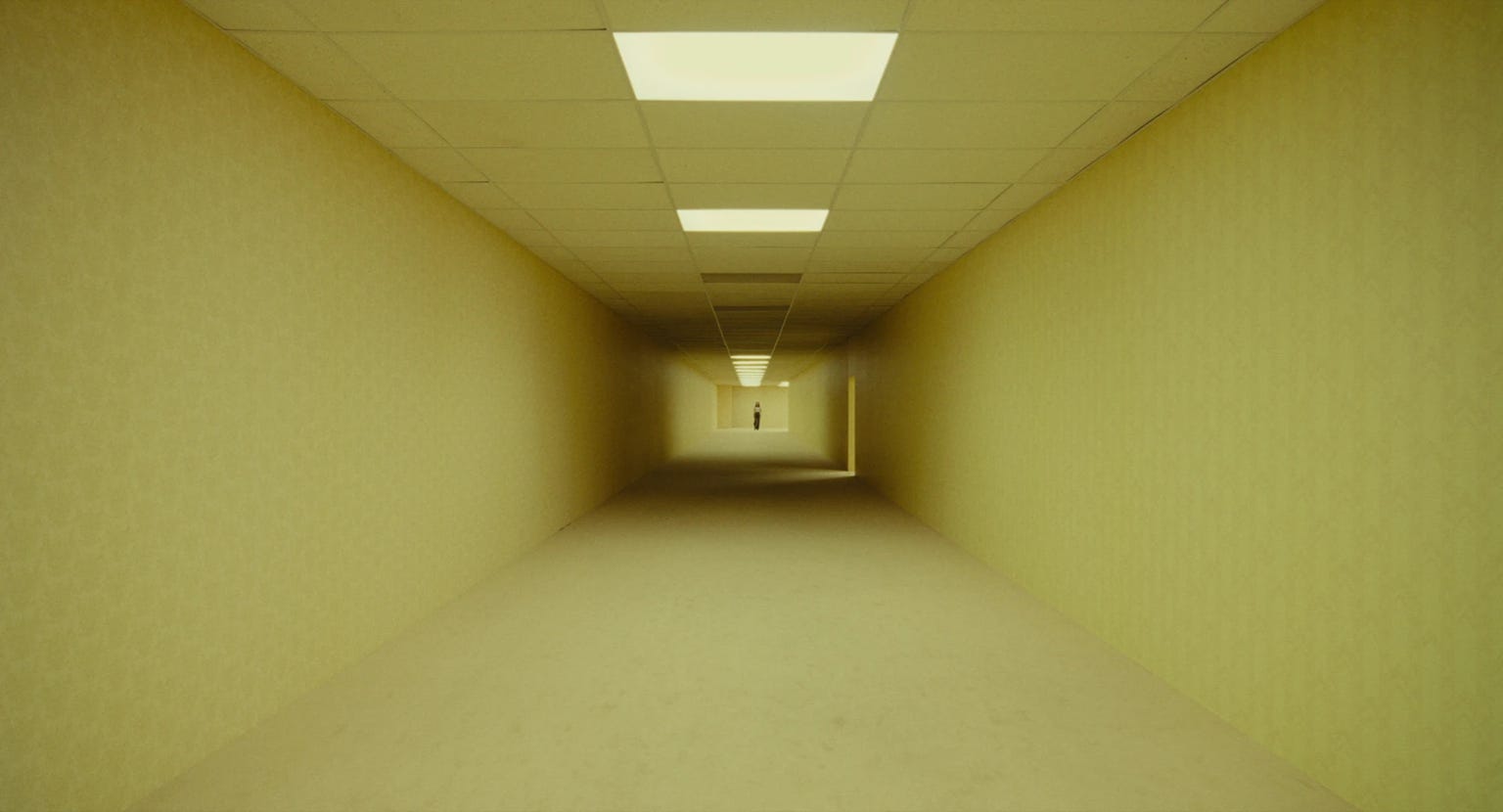
The Backrooms are not a place you want to be. But being in a video game is a fraught proposition to begin with. The hardest thing to do in a video game is stand still. If you try to, Sonic taps his foot impatiently and Mario eventually falls asleep. Video games are a medium of motion; all video game spaces are made to be moved through. Until recently most games did not allow the main character to sit on a chair—more do now but why?, as long as I’m sitting there I’m not touching the controller, not playing the game. So, when Clark (Chiwetel Ejiofor) stumbles into the Backrooms, Parsons takes it for granted that he would start exploring. Clark looks at the sprawling, disjointed tableau of his entrypoint in the Backrooms and obviously, Parsons postulates, wants to know what’s around that corner and the next and the next.
This contradiction between exploring and inhabiting a space is what makes the Backrooms such a compelling and terrifying proposition to me. By their very presence, the Backrooms challenge anyone who finds themself there to explore but they are an (effectively? literally?) infinite maze—moving through them in a meaningful sense is impossible because there is no progress toward infinity and nowhere else at which to arrive. And with every step one takes, every corner turned and door stepped through, one gets farther from a way out, risking getting lost and becoming an unwilling inhabitant of a space impossible to inhabit.
The German word Freud uses for “uncanny” is unheimliche, or, quite literally, “unhomelike.” Heimliche connotes coziness, safety, familiarity, but also contains a secondary sense of secret and hidden away. The concept itself is constantly in danger of running away from itself, that which is heimliche tipping over into unheimliche. The unheimliche is thus something familiar rendered unfamiliar, something thought to be benign shown to hold sinister depths. It occurs to me that video games are bursting with spaces like this, such as Peach’s Castle and particularly Black Mesa, but many others as well.
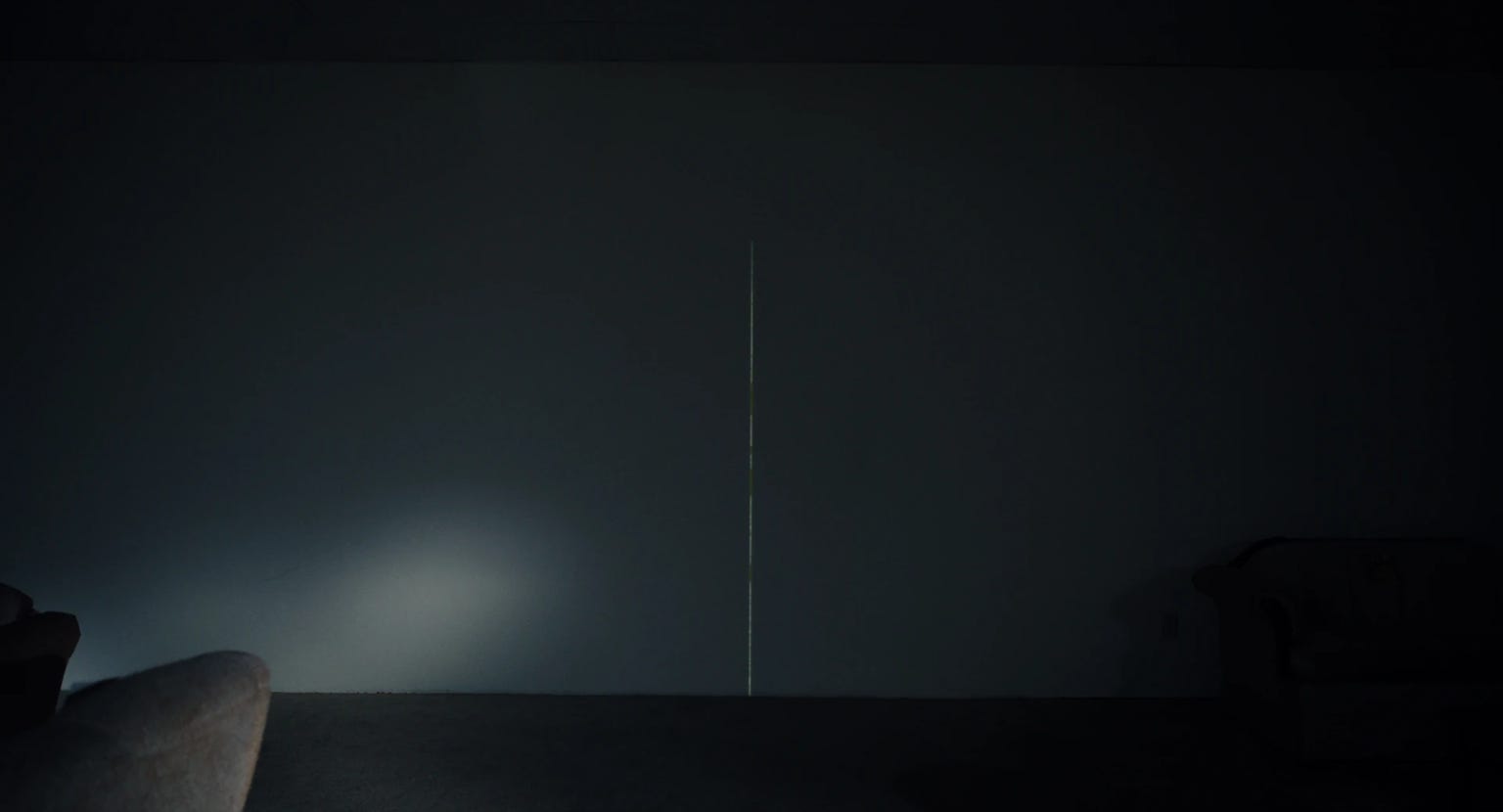
In Backrooms, Clark is a divorced, failed architect running a furniture showroom. It is 1990. The store has been experiencing weird power fluctuations. One night (Clark is living in the store), he goes down to the darkened below-ground floor of the store where the fusebox is. As he moves to leave, he looks at a blank stretch of wall and sees… a seam—a straight line of light peeking through. He moves an inch and he loses sight of it. He’s found another phenomenon familiar to gamers, a gap between polygons and the possibility of getting out of bounds. He presses to the wall and falls right through; the whole texture has lost its collision. On the other side he finds the Backrooms, which, with their convention center conference room look and the piles of duplicated furniture, he takes to be some bizarre extension of his store. This is so perfect I could scream—what could be more heimliche—or rather, what could cue the viewer to the disjunction between canny and uncanny—than a furniture store its owner is squatting in, and what could be more unheimliche than that space reduplicated endlessly, maniacally, hidden away behind the wall waiting to be discovered?
Backrooms would not work as a film if the Backrooms were inert. If the viewer felt nothing upon Clark’s first visit, the movie would be over. But the Backrooms are so alive. The Backrooms speak. The Backrooms scream with a silent fury. Two voices speak at once. One says, leave now, this place is not for you, you have stumbled into something not meant for mortal eyes. We know this voice is telling the truth. This place is wrong, this place is death. The other voice says, come in, come in, I can offer you everything you’ve ever wanted, all you need do is explore. The Backrooms repulse us, but we can’t turn back.
Clark’s first foray into the Backrooms ends with him rushing back to the exit after he comes into near-contact with something else in there, something violent and dangerous. Yet he returns with his employee Kat (Lukita Maxwell) and her boyfriend Bobby (Finn Bennett), armed with a camcorder. This trip ends (predictably) badly for Kat and Bobby and ambiguously for Clark. We return to his therapist Mary (Renate Reinsve, heart eyes emoji), who receives a cryptic voicemail from Clark that amounts to “Don’t look for me, I’ve found where I belong.” Between his first and second excursion Clark tried to tell Mary about the Backrooms but she of course thought he was delusional. Now concerned, she goes to the furniture store, finds the doorway, and enters the Backrooms.
This is where Parsons vision of a Backrooms film and Soodik’s script are most at odds with each other. After a good hour of vibing out, Soodik thinks he needs to scaffold a bit more narrative and integrate character traits with the themes. He gives us pretty directly Heart of Darkness For Indoor Kids. Mary, our Marlow, goes looking for Clark, who has become one with his environment and gone mad, like Kurtz. He chokes her unconscious and she awakens tied to a chair in a freaky simulacrum of a suburban kitchen/dining room. He tells her the Backrooms are made of memory and the memory degrades as it’s remembered over and over, a Xerox of a Xerox, ad infinitum. Mary tells him she has no idea how to fix his problems because he can’t face the fact that his life has fallen apart because of his choices and actions.
Their conversation is interrupted by the monster who stalked Clark earlier—it is a gigantic Cap’n Clark, the pirate mascot of his store, whom we saw Clark in costume as to shoot a humiliating local commercial. Clark tells the pirate, “It’s okay, she says we don’t have to change.” This is all good and thematically coherent. Clark is unable to change. His self-destructive tendencies are what Freud called repetition-compulsion:
How exactly we can trace back the uncanny effect of such recurrent similarities to infantile psychology is a question I can only lightly touch… It must be explained that we are able to postulate the principle of a repetition-compulsion in the unconscious mind, based upon instinctual activity and probably inherent in the very nature of the instincts—a principle powerful enough to overrule the pleasure-principle, lending to certain aspects of the mind their daemonic character, and still very clearly expressed in the tendencies of small children.
Clark is a prisoner of his repetition compulsion, which explains why the Backrooms drew him so powerfully: they are a space of ultimate repetition, where that compulsion would find free play and the illusion that it might be sated.
But then Cap’n Clark lifts Clark, bites viciously into his shoulder and breaks him like a toy. With Clark’s death, the idea of the Backrooms as instantiated memory begins to collapse. Shouldn’t Cap’n Clark be a creation of Clark’s mind? In a conventional film, the Backrooms would be entirely a construction of Clark’s unconscious, meaning that they could not survive his death. But also, that he shouldn’t be able to die within the world he has constructed. But the Backrooms are not amenable to this sort of economy of storytelling and neither is Parsons. The Backrooms are an objective space—they are real—and Clark and Mary are incidental to them, mere interlopers. Therefore both Cap’n Clark and the Backrooms can survive Clark’s death, leading to what I can’t deny is a pretty amazing chase sequence through Backrooms that look like walled in neighborhood streets with facades that open onto further corridors, shifting from homelike spaces to liminal hallways and back.
The thing that strikes me about Clark’s death is that he is afforded no redemption. Kurtz, dying on Marlow’s boat, cries out “The horror! The horror!” and redeems himself in Marlow’s eyes. Marlow believes that in the end Kurtz came to some true knowledge:
I was within a hair’s-breadth of the last opportunity for pronouncement, and I found with humiliation that probably I would have nothing to say. This is the reason why I affirm that Kurtz was a remarkable man. He had something to say. He said it. Since I had peeped over the edge myself, I understand better the meaning of his stare, that could not see the flame of the candle, but was wide enough to embrace the whole universe, piercing enough to penetrate all the hearts that beat in the darkness. He had summed up—he had judged. ‘The horror!’ He was a remarkable man. After all, this was the conviction of some sort of belief; it had candour, it had conviction, it had a vibrating note of revolt in its whisper, it had the appalling face of a glimpsed truth—the strange commingling of desire and hate.
Clark gains no such insight and finds no such redemption. But how could he? His gaze could never encompass the universe—he’s locked inside.
The timeline of the Backrooms phenomenon cannot be ignored. The original post appeared in 2019 and Parsons began making his web series in 2022. In between, when Parsons was 15, the pandemic and its year of lockdown happened. I missed both Eddington and Weapons so Backrooms stands for me as the most profound reckoning with Covid I’ve seen on-screen.
Mary’s backstory stands in here: as a child her mother was mentally ill and eventually institutionalized. Before that she kept Mary locked in the house, newspaper covering the windows, warning her that it was dangerous outside and she could never go out there. She is keeping them holed up even as the city moves to demolish their house. The flashback ends with their front door exploding inward—an unmistakable vision of the virus finding us even as we kept isolated.
When Mary steps into the Backrooms, she has come home. Where Clark saw an expression of his repetition compulsion, Mary sees her childhood trauma. She knows the horror of a windowless room, knows what happens to your mind when it’s deprived of the sun too long. I’ve not found an interview where Parsons mentions the pandemic but to me it seems pretty obvious he started making his Backrooms shorts when he did as a form of processing what he and we all endured during that time.
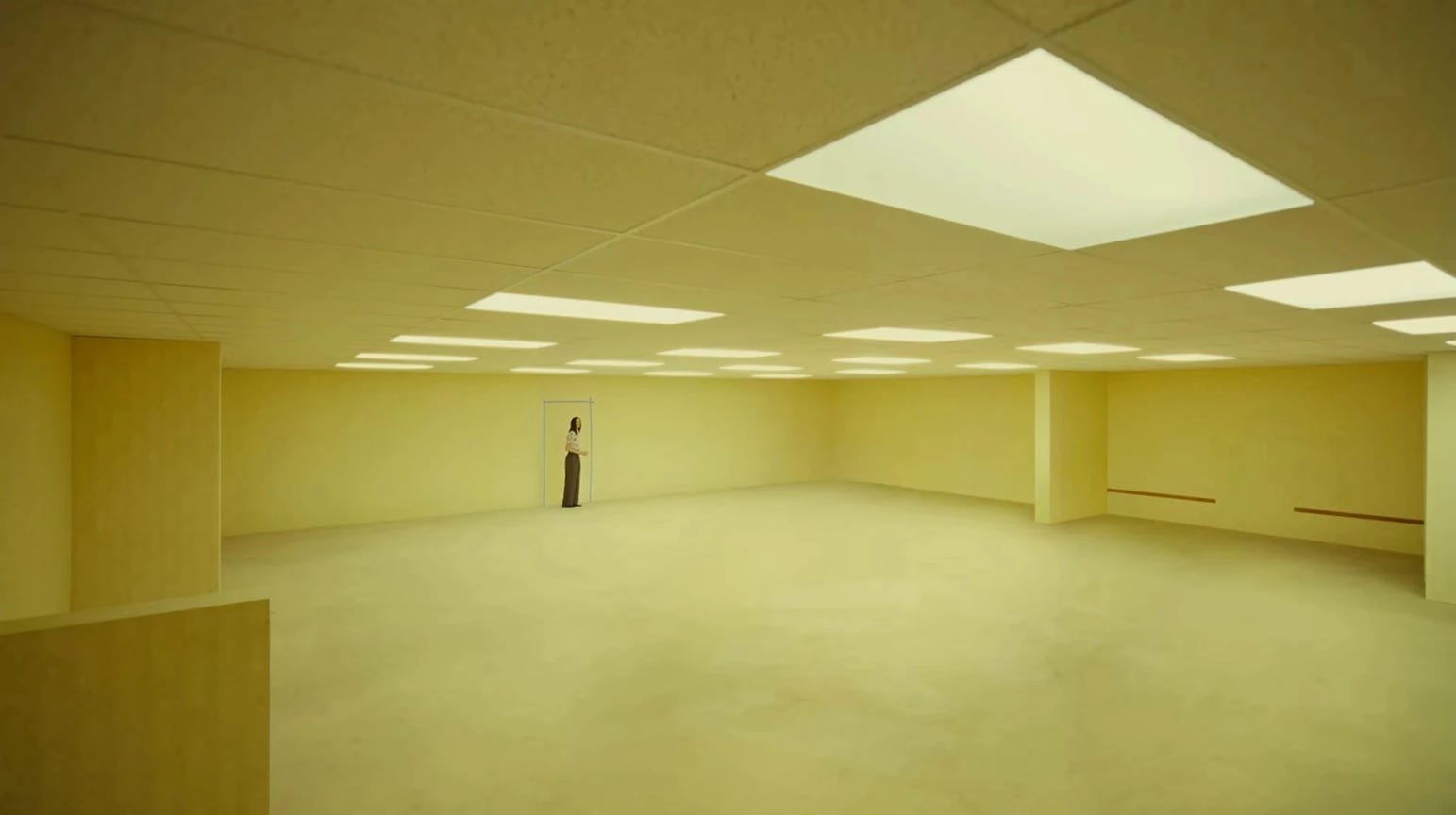
Part of what I find so terrifying about the Backrooms is the sense that in this place, the rules do not apply. Such a place I dub a Zone of Encounter, for with the rules of everyday life suspended meeting another person comes with the possibility of types of interactions beyond what convention and civilization allow. One might also encounter oneself in new and profound ways in such a space. History and literature are full of such spaces—to leave one’s life behind to heed the call is the essence of Campbell’s Hero’s Journey. But traditional Zones of Encounter have been, for instance, the battlefield, the frontier, or, problematically, colonial Africa. It is a grim portent that a filmmaker raised fully within the developed internet and the post-9/11 security state, when seeking to conjure such a mythic space, would imagine not endless vistas but an empty warren of twisting nothingness.
The fundamental question that sustains our attention throughout Backrooms is: “What are the Backrooms?” For me, with my fixations, the answer is so glaringly obvious it threatens to shut down my critical faculties. The Backrooms are the ὑποκείμενον. This word, which we can transliterate as hypokeimenon, means substrate, literally “underlying thing.” I’ve been fascinated by the idea ever since I learned the word—that there is something undergirding our reality, a substance or set of principles upon which everything else relies for existence and coherence. I swear one of the Pre-Socratics speaks of it. Whereas it seems every religious and mystic tradition envisions transcendence and enlightenment as a journey upward, seeking for the ὑποκείμενον is a descent toward the bones of reality. I think I find Kant so intuitive because his whole project is dancing around such an idea and his conception of our intuitions of time and space constitute a sort of substrate of human perception, while simultaneously proscribing the possibility we could ever access the true ὑποκείμενον of the world, as it would be the ultimate form of the thing-in-itself.
When I look at the Backrooms I see a very specific type of substrate, again pulled from the world of video games. I see an asset dump. I see the area under the map where all the objects and architecture are stored as a reference. I see that scary tab in the Excel spreadsheet holding all the values that will break the entire program if you touch anything. I see Garry’s Mod. I see Glitch City from Pokémon Red.
It is hard for me to imagine a more nihilistic vision of the ὑποκείμενον than this. Instead of a reservoir of infinite understanding, a glimpse of the secret truth of existence, the Backrooms represent the ultimate truth of the cosmos as the maximally banal. There is no secret—the world is just objects placed haphazardly in space, pulled out of storage as need be.
But it’s worse than that actually, because the Backrooms don’t appear to be a repository of possibility. Rather, the Backrooms seem to say that everything and everywhere reduce to blank walls and featureless chairs. It is, in a word, a ὑποκείμενον of slop. The Backrooms devour every object and place and grind them down into pure homogeneity. Any attempt to create something of beauty or meaning is just delusion and self-indulgence—no matter how much you manipulate the clay or paint the canvas, at its heart your masterpiece is nothing but crumbling yellow wallpaper.
The Backrooms are a double to our world. Of the double Freud writes:
The idea of the “double” does not necessarily disappear with the passing of the primary narcissism, for it can receive fresh meaning from the later stages of development of the ego. A special faculty is slowly formed there, able to oppose the rest of the ego, with the function of observing and criticizing the self and exercising a censorship within the mind, and this we become aware of as our “conscience.”... The fact that a faculty of this kind exists, which is able to treat the rest of the ego like an object—the fact, that is, that man is capable of self-observation—renders it possible to invest the old idea of a “double” with a new meaning and to ascribe many things to it, above all, those things which seem to the new faculty of self-criticism to belong to the old surmounted narcissism of the earliest period of all.
The Backrooms thus function as a criticism of our reality. A substrate that manifests so dismally must reflect a certain dismalness already present.
There is a sequence in Backrooms. When Mary falls unconscious, we see a vision of her childhood home as it was. The camera tracks down through the floor into another version of the same room, but the furniture is starting to warp and sink into the floor. The camera continues downward to a third iteration, a fourth, on and on. All the furniture vanishes. Then the windows and light fixtures, save a bare bulb. Soon it is a perfectly empty room. On next pass a crack opens in a wall. It becomes a gap, then a black hallway.
Liz and I were out at dinner the other night. I forget even what I told her, maybe Elon becoming a trillionaire, who knows, and she replied, “It feels like everything is just degrading more and more.” As she said it I thought of that montage of Mary’s home. For a filmmaker Parsons’ age, this is what the world looks like, this is what the future looks like. Emptier and emptier, harsher and harsher, opening onto a great and terrible darkness.
No posts
Comments
Nothing yet. Say the first thing.
Sign in to join the conversation.