
For many years and even though it appeared annually in the TV schedules - and indeed right now at time of typing - I had absolutely no idea where the Queen’s Tennis Club tournament was held. I got it confused somehow with Eastbourne and assumed I was watching somewhere in Sussex for the few seconds my TV showed it. I was never that interested in tennis and would change channel.
You will know no doubt be very pleased to know that I’ve found the Queen’s Club. Hurrah! It’s hidden away in the back streets of Barons Court in west London.
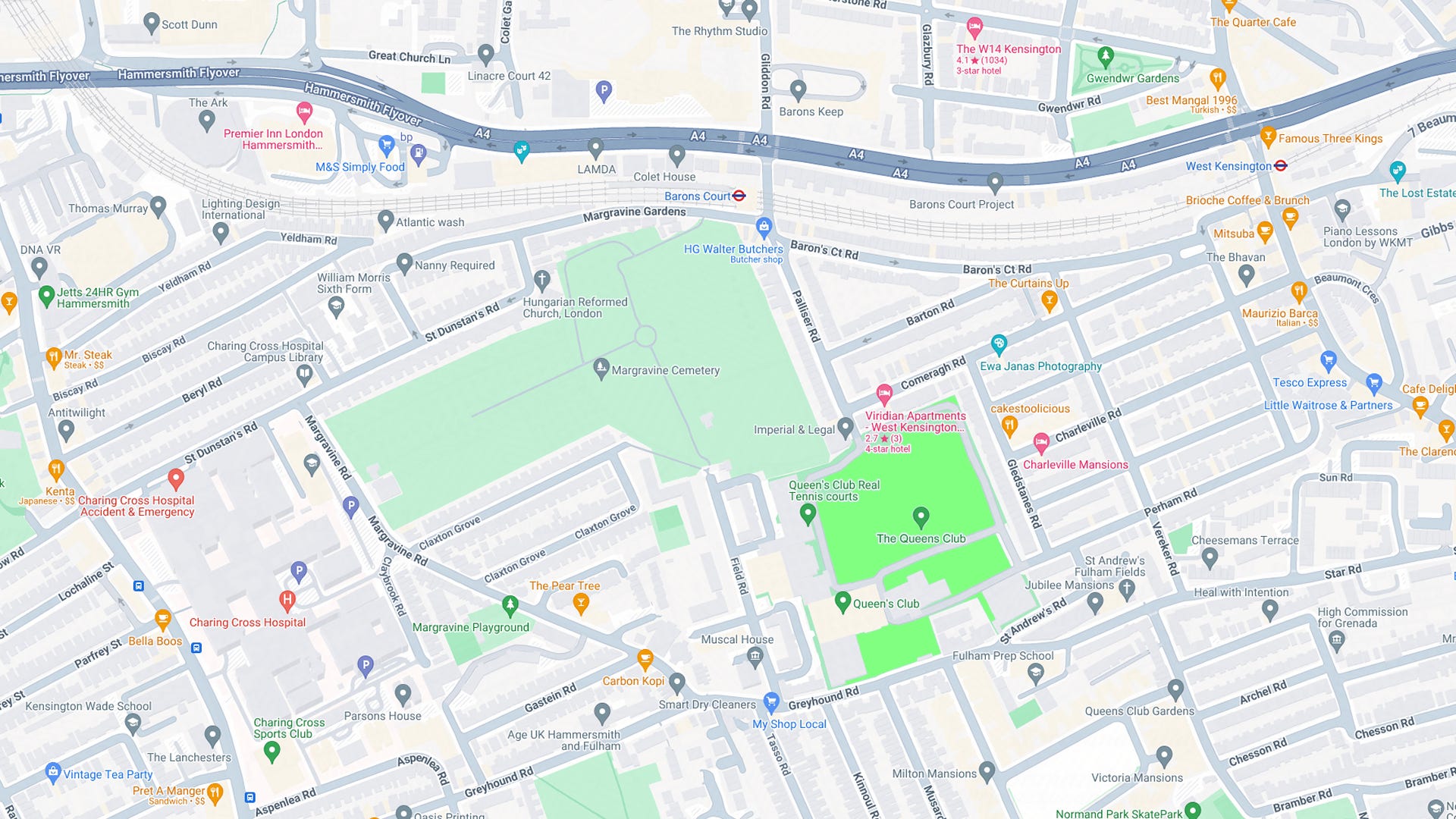
If you move your eyes up to the swath of land which the dual-carriageway of the A4 ruined, you can maybe spot the mini roundels which Google Maps has added of Barons Court station (top centre) and West Kensington station (top right).
Sir William Palliser owned the land hereabouts during the 1860s. It was all vegetables - carrots, lettuce and green leaf things back then.
The map below dates from 1867 and is on exactly the same footprint as the Google Map shown above. Nothing 2026 is obvious - well, maybe the word Fulham on the workhouse. The road names here are unfamiliar - North End Lane, Old Greyhound Road and Great Church Lane. Locals back then would called the area ‘Fulham’ if it had a name at all
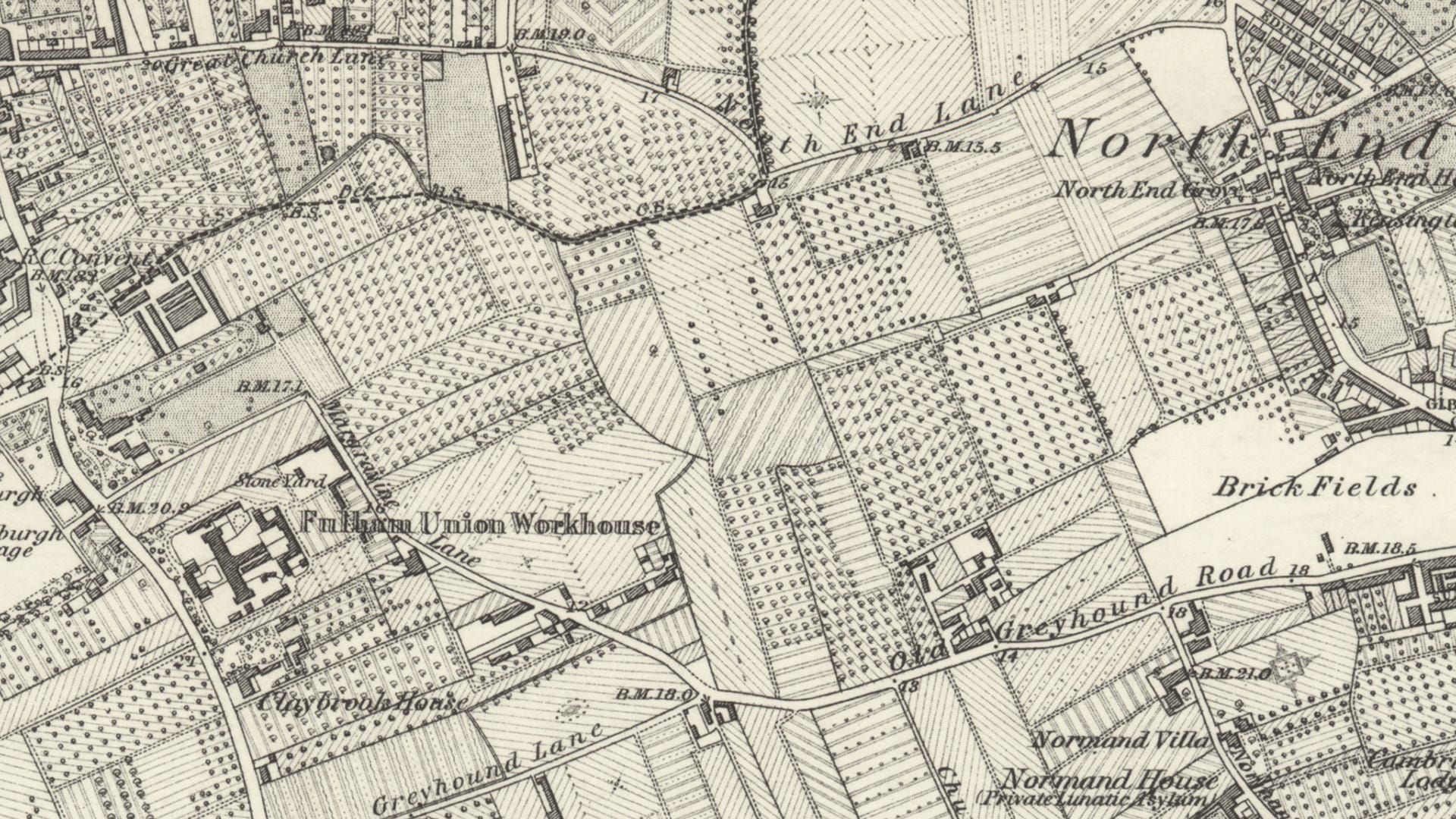
All those dotty fields are market gardens and orchards. I assume the Ordnance Survey are representing uniform sown fields of vegetables and equally-spaced apple trees with the graphic. William Palliser owned a good deal of the fields depicted.
Palliser’s thoughts hadn’t all turned to cabbages. He donated some land to establish Hammersmith Cemetery in 1868. This had its name changed to the Margravine Cemetery.
The London sprawl to the east was expanding, vastly helped by the accessibility which the Metropolitan’s first 1863 underground railway demonstrated. The District Railway - later the District line - got in on the act and they ran a railway through the area of our maps. On 9 September 1874, the District Railway opened an extension from Earl’s Court (opened as a terminus in 1871) to Hammersmith.
Somehow, the railway company decided that they didn’t like the village name North End. The railway opened a station on North End Road in 1874. The word ‘Kensington’ had a cachet as a name and the station became called West Kensington despite not being in Kensington or indeed, if it was, west of it.
The new trains on the new line sped on from ‘West Kensington’ to Hammersmith.
Palliser decided that his land would be better value as housing and he started to petition the District Railway to build a new interim station. There was a stately home in Ireland called Baronscourt. It is assumed that Palliser looked at the station name Earl’s Court and decided to call his potential new suburb ‘Barons Court’ in a play on words. It sounded posh.
It took until 1905 until a new station called Barons Court was opened, once housing had covered the area.
I’ve adapted the 1867 Ordnance Survey map to show where Barons Court station (BC) and West Kensington station (WK) would be built.
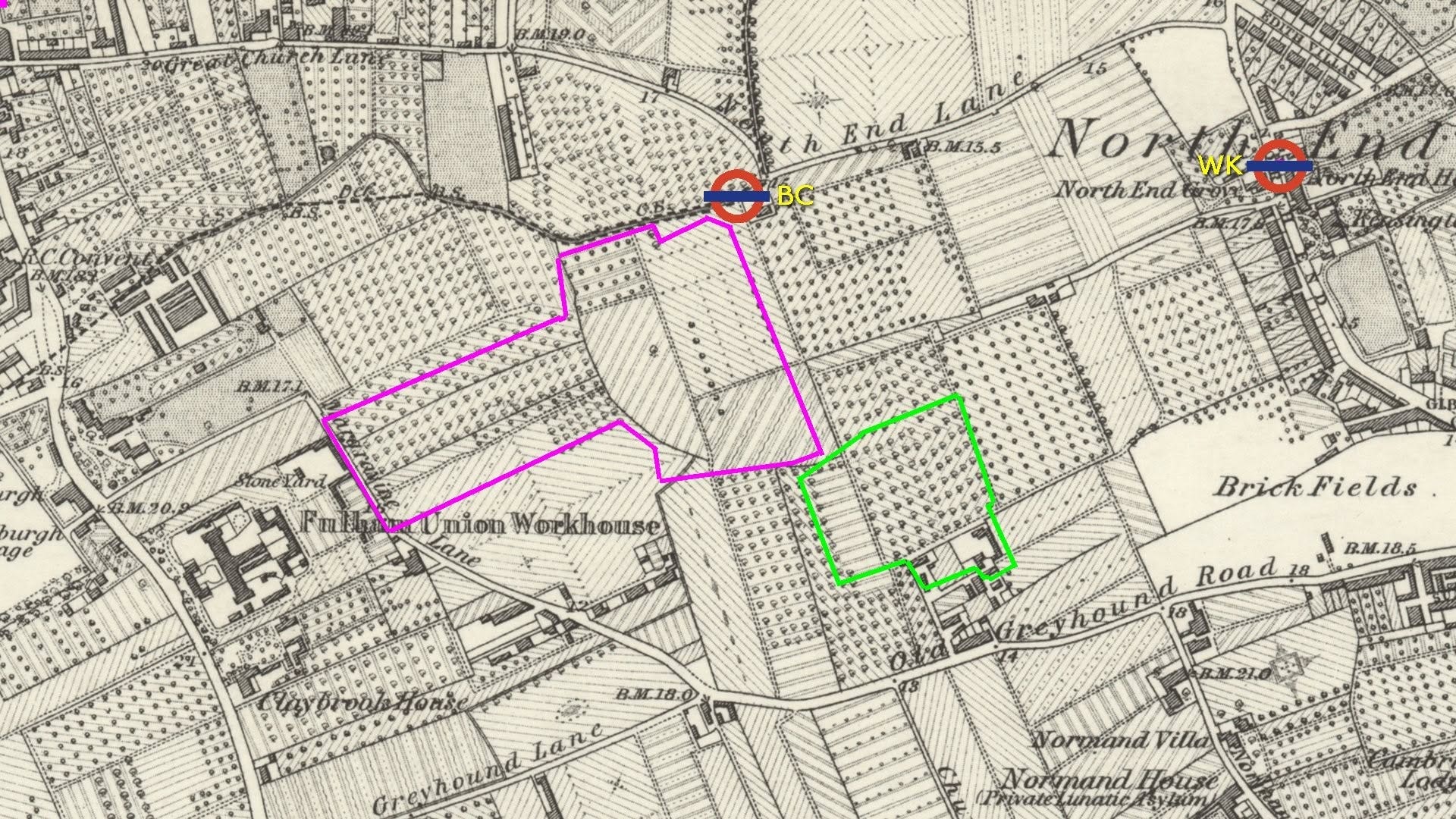
I’ve outlined the 1868 Margravine cemetery land in purple.
As for the green outline. Well, in 1883 and 1884 the vicar of nearby St Andrew’s church on Star Road (West Kensington), the Reverend John Cardwell, was granted permission to play some cricket matches there. St Andrew’s Cricket and Football Club was formed.
Palliser soon decided to sell this tranche of former turnip fields to entrepreneurs Evan Charteris, George Francis and Algernon Grosvenor. St Andrew’s Cricket and Football Club was evicted.
The three new owners founded the Queen’s Club there in August 1886. It was the world’s second multipurpose sports complex (after the Prince’s Club which ended up in Knightsbridge and lost its field in the process). As Barons Court followed Earl’s Court, the Queen’s Club followed the Prince’s Club. Theoretically the club is named after Queen Victoria, its first patron, but that naming is all rather convenient as an origin story. It had been a marketing ploy.
Among the initial sports offered at the club were real tennis, Eton Fives, rackets, football, rugby, cricket and athletics.
According to the Wikipedia, the first lawn tennis courts were opened on 19 May 1887, and the first sporting event was held on 1 and 2 July 1887 when Oxford played Cambridge. The club buildings were opened in January 1888.
The Queen’s Club went from strength to strength and is now the precursor during June to the annual Wimbledon tennis championships.
But there’s more to this green-outlined field.
The Reverend John Cardwell was no doubt a bit miffed about the eviction of St Andrew’s Cricket and Football Club.
Ever resourceful (apparently - I wasn’t around to verify), St Andrew’s began to migrate to a series of local venues without ever settling down. The team began to concentrate on association football rather than cricket and called itself Fulham Football Club.
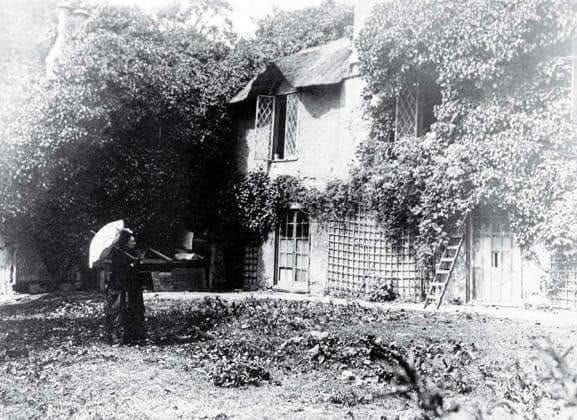
On the banks of the River Thames there was a cottage. It burned down in 1888.
Fulham FC was once again looking for an area for a new ground and found the very overgrown area around the burnt-out shell of Craven Cottage in 1894 to its liking. It had to clear all the brambles to make space for a pitch. Fulham started playing at Craven Cottage in 1896, their first game against now-defunct rivals Minerva. Fulham FC has been there ever since.
One obscure patch of market gardens has given the world two famous sporting venues - the Queen’s Club which stayed there and Fulham Football Club which didn’t.
In due course a road called Baron’s Court Road was laid out. Baron’s Court Road has an apostrophe but Barons Court the station doesn’t have an apostrophe, whereas Earls Court Road doesn’t have an apostrophe but Earl’s Court station does have an apostrophe. That’s quality London trivia — where else do you get trivia like that? (Answer: lots of other places)
No posts
Comments
Nothing yet. Say the first thing.
Sign in to join the conversation.