
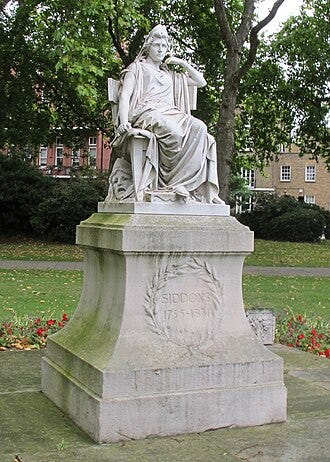
I wrote a little while back about how - until the Paddington Green statue of Sarah Siddons came along in 1897 - there were no statues erected in London depicting a non-royal woman. This gender bias is a bit shocking. In 1915 the second one had gone up (Florence Nightingale, Waterloo Place). Over the course of the twentieth century a few more female statues but it’s still nearly all men, men, men on those plinths.
I was having a drink outside the St George Wharf concrete monstrosity and taking a look at Vauxhall Bridge. You can’t help but notice that all of the statues underneath the bridge are female figures. According to my on-the-fly Google query, they are “allegorical statues, four by Frederick Pomeroy on the upstream side (Agriculture, Architecture, Engineering, Pottery) and four by Alfred Drury on the downstream side (Science, Education, Fine Art, Local Government), installed in 1907, a year after the bridge itself opened. Each is bronze, roughly twice life-size, and weighs about two tonnes.”
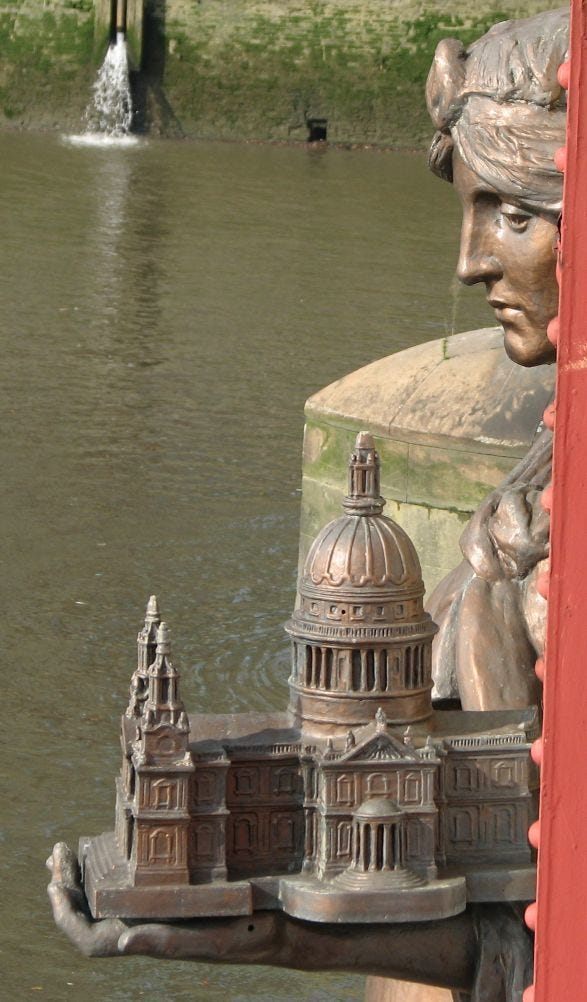
As it was 1907, the female depiction came between Sarah Siddons and Florence Nightingale. But these were made-up women so it doesn’t count.
Four bridges downstream and we arrive at Waterloo Bridge.
Standing midway across, it’s one of the great views of London - St Paul’s thataway, the Houses of Parliament thisaway and the curve of the Thames laid out like it’s showing off.
Thames tourist boat pilots have long told their passengers that the white bridge ahead had been built by women. It sounded like the kind of story tour guides invented but it wasn’t. The story of the construction of Waterloo Bridge was nearly written out of history entirely.
The original Waterloo Bridge opened in 1817. Claude Monet painted it from the window of his room at the Savoy Hotel. He was a bit obsessive about the view of Westminster too, which he also painted from the same window.
By the 1920s it was sinking.
Uneven settlement of the piers had left it structurally unsound, and after years of make do and mend, London County Council decided in the 1930s to tear it down and start again. Architect Sir Giles Gilbert Scott - him again! - was brought in to design a replacement.
Work started in 1937, but in 1939 the Second World War arrived, and with it the problem that almost every man qualified to build such a bridge was suddenly needed somewhere else.
The construction industry solved this the way most British industries did - by asking for ‘green labour.’ Nobody wanted to say the word women out loud, so they invented a euphemism that let everyone avoid saying it.
By 1944 around 25,000 women were working across the UK’s construction industry, and on Waterloo Bridge specifically, historians now estimate that as much as 65% of the workforce was female.
These were women in overalls doing the skilled, physically demanding work that bridge-building requires - operating cranes, welding girders with acetylene torches, pouring and finishing concrete, dismantling the old structure piece by piece before the new one could be built. A witness who later came forward, whose father had worked alongside them, remembered “two grades of ladies”. Most were in dungarees doing the heavy manual work, and there was a smaller, more senior group in all-in-one overalls who were trusted to operate the vehicles and machinery.
The new Waterloo Bridge opened on 10 December 1945, five months after the war in Europe had ended. The Deputy Prime Minister, Herbert Morrison, stood up and declared that “the men that built Waterloo Bridge are fortunate men.” The official record of Waterloo Bridge’s construction contained no women at all.
Can I be charitable for a moment? The contractor, Peter Lind & Company, went out of business, and much of its archive was scattered or destroyed in the process. There’s no evidence of a deliberate cover-up - nobody sat in a room and decided to erase women from the record. Nobody thought their contribution was worth recording in the first place.
Thames boatmen did keep telling tourists that there was a rumour that Waterloo Bridge was largely built by women. The rumour might have stayed a rumour forever if it weren’t for Christine Wall, a historian who began investigating the story in the early 2000s alongside filmmaker Karen Livesey.
Together they made a documentary, The Ladies’ Bridge, tracking down elderly Londoners with any memory of the construction and combing archives for evidence. Accounts of women in munitions factories or on the railways were everywhere, but construction work, it turned out, had been documented almost nowhere.
In 2015, Wall found what she’d been looking for in the archive of the National Science and Media Museum: a photograph, taken by the Daily Herald in 1944, showing women working as acetylene welders on the bridge. From the interviews conducted for the project, she also found other evidence of the women of Waterloo Bridge.
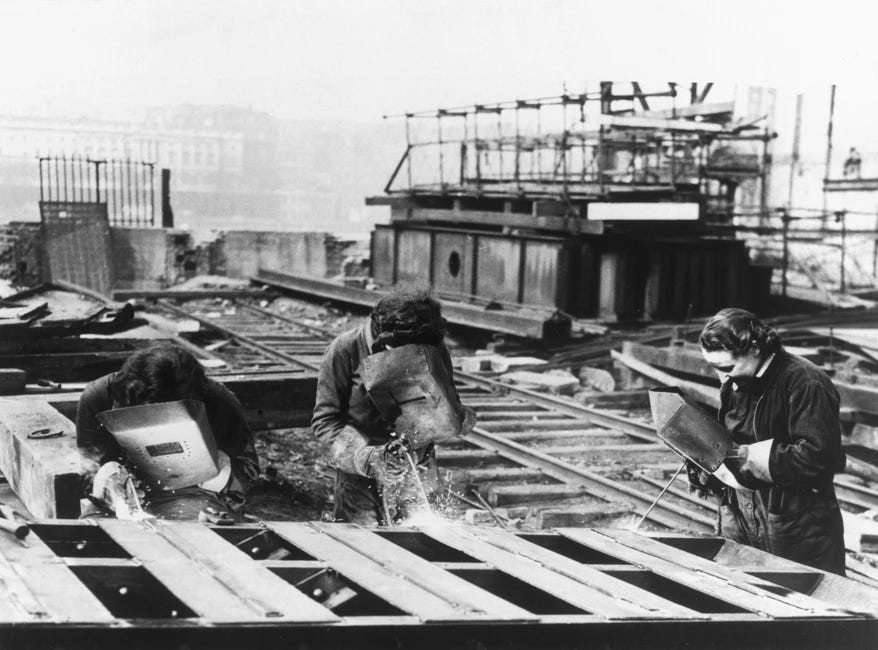
The discoveries mattered enough that Waterloo Bridge was given an upgraded Grade II* listing specifically to recognise the women’s role in its construction. It’s a strange kind of retrospective justice - a bridge re-classified by Historic England because a photograph caught up with the actual story.
The photograph Wall found in 2015 shows a woman doing her job, welding torch in hand. It's not a dramatic photo but it's what took seventy years to surface in an archive nobody had thought to search properly, until Dr Wall went looking.
There’s an ongoing campaign, backed by the Women’s Engineering Society, to install a blue plaque somewhere on the bridge.
Across the UK and US combined, there are fewer than ten memorials specifically dedicated to women’s contribution to the Second World War. London’s most prominent, the Monument to the Women of World War II on Whitehall was unveiled only in 2005.
No posts
Comments
Nothing yet. Say the first thing.
Sign in to join the conversation.