
In my first post, I examined existing research on the context, meaning and legacy of Milton Friedman’s 1970 New York Times essay - the focal point of most histories of Corporate Social Responsibility (CSR) - and added my two cents based on archival data and my previous research on Friedman’s worldview. I made two points: (1) Friedman’s piece did not launch a “shareholder primacy” movement. By 1970, he was expressing what had become a minority view (more on this below). Nor did he “turn the tide.” The piece was influential, but citations and businessmen’s reactions were initially critical. It served as a trigger, but shifting corporate governance toward shareholder primacy required additional work (for instance Jensen-Meckling), a presidential election, shifts in business practices and a large wave of corporate takeovers primacy – this transformation only occurred at the turn of the 1990s. (2) Though Friedman’s mix of clarity and ambiguity has generated many interpretations, his goal was to write a political think piece aimed foremost at businessmen themselves. The focus on this single essay has therefore overshadowed the substantial literature that US economists produced on CSR between the 1950s and the 1970s – research that combined positive and normative analysis but usually stemmed from theoretical and empirical efforts to understand which objectives firms actually pursue.
This second post examines a sample of that research. While not exhaustive, I've selected studies that were (1) influential and (2) produced by economists who both worked on firm-related topics and wrote or testified specifically about CSR—criteria that significantly narrowed my sample (tell me who else I should cover in the comments!). I want to show how economists' empirical work on firms shaped both their general views about whether companies should pursue goals beyond profit maximization and their opinions about whether such goals could be practically implemented. Summarizing their positions coherently has proven challenging—this remains very much work in progress and may evolve in coming weeks. Their normative stance on CSR emerged from their positive research, which was itself shaped by debates about what makes a good theoretical model of firm behavior and what counts as acceptable evidence.
Corporate Social Responsibility as an empirical fact, not just a normative goal
Before diving into the details of this work, let me establish the context. One crucial point is that when economists turned their attention to Corporate Social Responsibility after World War II, they did not do so because they supported its rise. Rather, they viewed this rise as an established fact worth studying. This is exemplified by Howard Bowen's landmark 1953 book Social Responsibilities of Business. The Federal Council of Churches of Christ in America commissioned the book as part of a series on Christian ethics and economic life, and it included a full chapter on "Protestant views" of CSR. But it also examined changing social attitudes toward laissez-faire and featured two long chapters surveying businessmen's own views of their social responsibility, based on hundreds of individual and collective statements by top executives from General Electric, Ford, and many other major companies, all listed in a detailed appendix. The book cited a 1946 Fortune poll showing that 93.5% of surveyed businessmen believed companies should consider social responsibilities, and 60% believed that at least half of US businessmen displayed such "social consciousness."
Businessmen's soul-searching both fueled and was further encouraged by transformations in business education. In 1960, journalist Leonard Silk wrote a report on The Education of Businessmen for the Committee for Economic Development, following studies conducted by the Carnegie and Ford foundations. All advocated for "broadening the business school curriculum to include increased emphasis on the social role of business." Business schools consequently established courses in business ethics on a massive scale. A 1960 report on "The 'business and society' course in the business school" opened with the question: "how is this 'social responsibility' to be taught?" Not whether, but how. While some professors assigned Thomas Mann, others gave students readings by Berle and a growing number of economists (including Kaysen and Rostow).
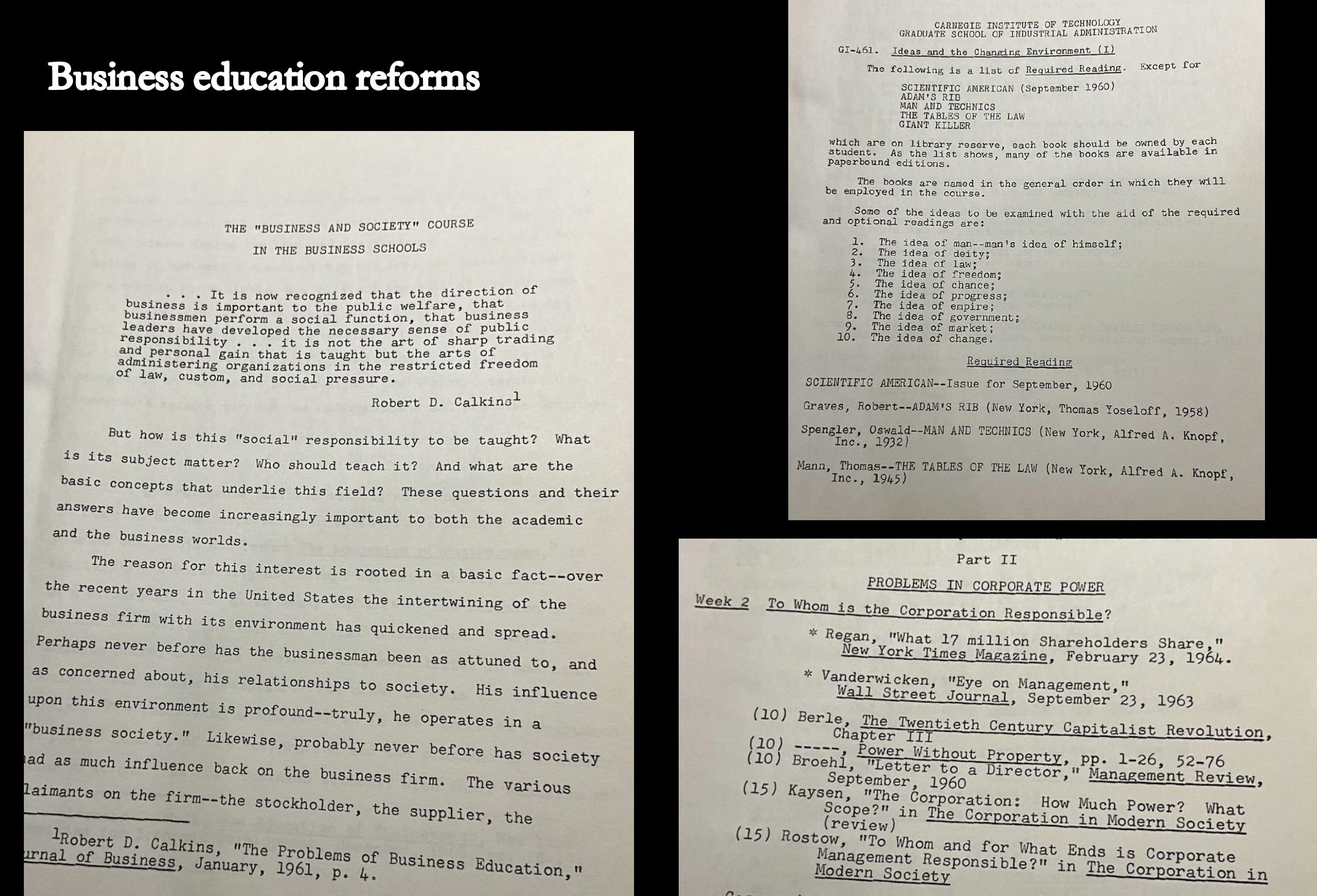
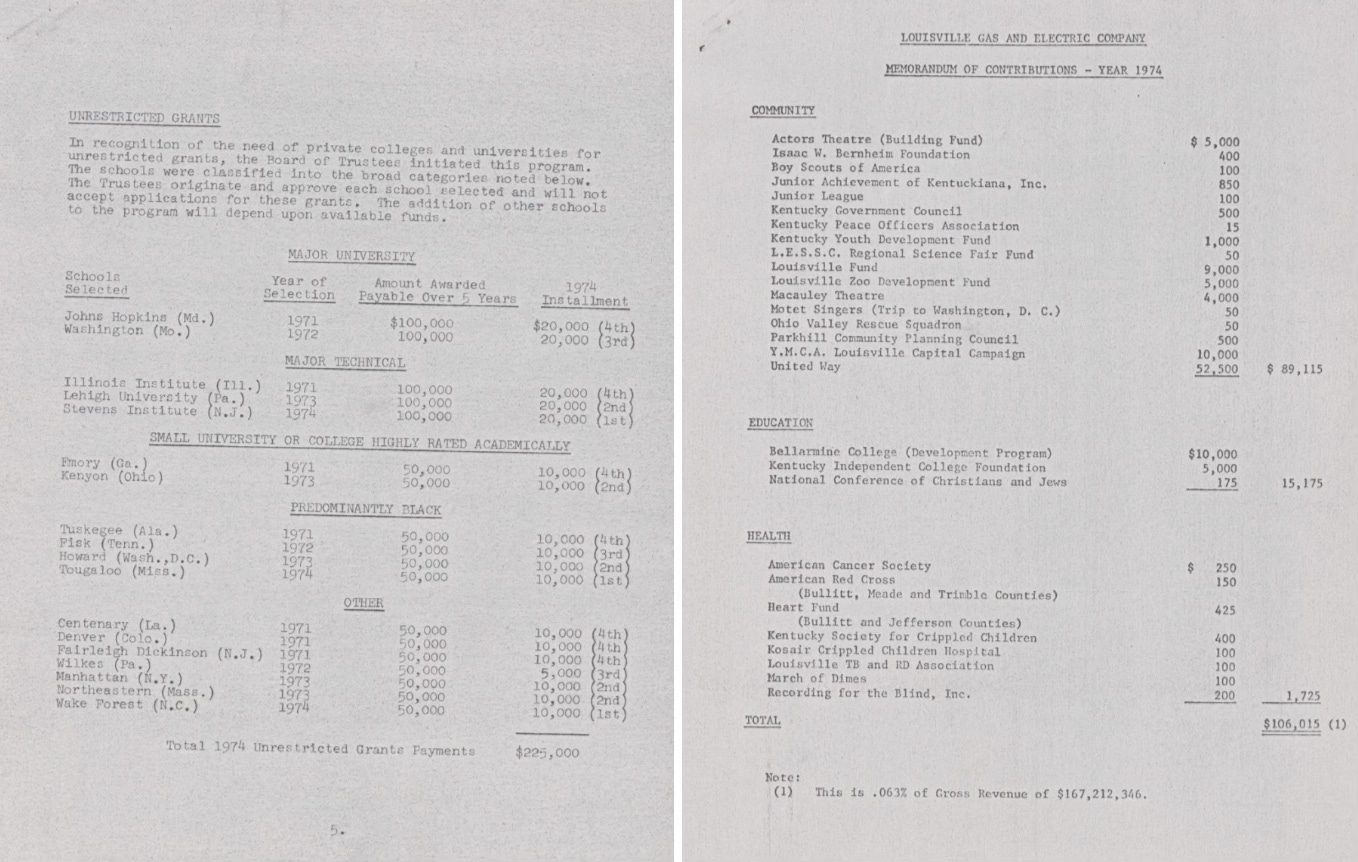
CEOs' statements reflecting growing soul-searching as their companies had grown large enough to acquire market power that could shape the lives of workers, customers, and citizens were widely cited by researchers. Another source of evidence that sparked economic research was the related growth of corporate philanthropy and charitable donations. The year Bowen's book was published, the New Jersey court issued A.P. Smith Manufacturing Co. v. Barlow, allowing corporate charitable donations for purposes other than direct business benefit. By the early 1970s, such donations had increased by 300%. Evidence of charitable giving by individuals was, as Philippe Fontaine has shown, a recurring entry point for theorizing social interactions (for scholars like Becker, Boulding or Vickrey) and empathy. Similarly, corporate charitable giving offered firm economists a pathway to writing about CSR. Indeed, most of Friedman's archival folders on his 1970 piece contain data on corporate charitable giving, particularly to educational institutions, gathered by an independent researcher—he didn't approve of the practice, much less the tax advantages the government offered.
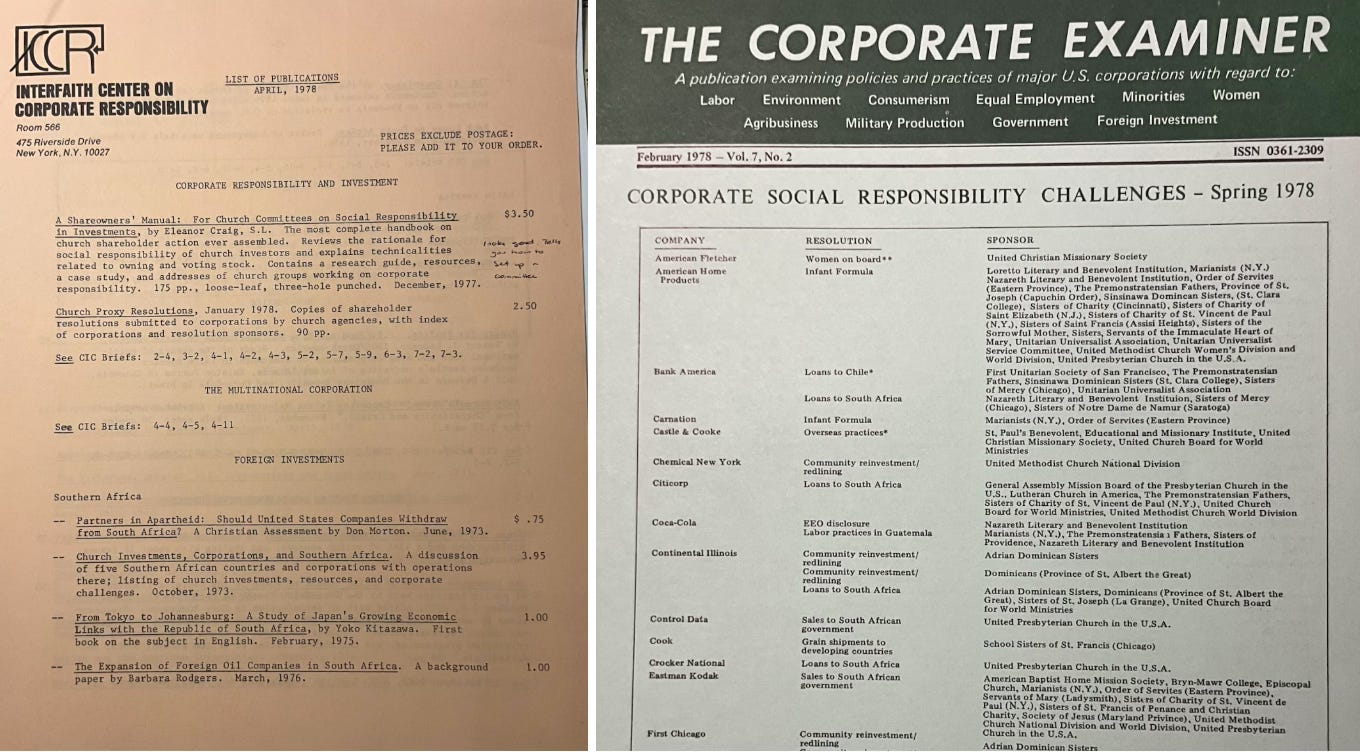
Beyond voluntary business initiatives, every segment of US society seemed to be calling for CSR, sometimes in reaction to growing evidence that business was causing harm. From the 1950s onward, the federal government passed a series of acts to protect workers and consumers on topics as broad as wages (1963), pollution (1969), and road safety (1966), and as specific as packaging (1960) and textiles (1958). Pollution and road safety, among other business scandals, were taken up by activists. They picketed against Dow's production of napalm for the Vietnam War, wrote books on pesticides (Carson's Silent Spring) and road safety (Nader's Unsafe at Any Speed). Nader's followers launched the GM campaign that formed the backdrop to Friedman's 1970 Times piece, and techniques for pressuring corporations through divestment or shareholder activism were adopted by many groups. Below is an example from the archives of the Interfaith Center on Corporate Responsibility, which spent the 1970s and 1980s advising local churches on how to pressure major corporations into fighting sexism and diversifying boards of directors, refusing loans to South Africa due to apartheid, avoiding weapons or chemical sales, combating discrimination, and selling safer products like infant formula.
Nader and other lobbyists convinced the government to consider federal chartering, and in 1976, Senate hearings were organized on "Corporate Rights and Responsibilities." These included lawyers, activists, businessmen, and academics from management and economics.
It thus seemed that businesses pursuing objectives beyond profit maximization (taking into account the interests of what were increasingly called stakeholders) was both a collective aspiration and, despite the many business scandals of these decades, somehow an established fact. This was reflected in popular economic education. In the 1950s, the US Chamber of Commerce published a series of pamphlets designed to introduce citizens to basic questions that together formed "the American competitive enterprise system": "The Mystery of Money," "The National Income and Its Distribution," "Demand, Supply and Prices," along with pamphlets on taxes, labor, and "Why the Businessman?" This last one clearly stated that he was "assumed to have important social and community obligations."
One academic path to the CSR debate was researching market failures. Kenneth Arrow perfectly exemplifies this approach. More or less in reaction to Friedman's 1970 piece, he wrote a long column for non-economists in Public Policy. The title, "Social Responsibility and Economic Efficiency," illustrates the mix of normative and positive arguments it contained, as did the paper's opening question: "under what circumstances is it reasonable to expect a business firm to refrain from maximizing its profits because it will hurt others by doing so?" In it, he explained that "it is clearly desirable to have some idea of social responsibility, that is, to experience an obligation, whether ethical, moral, or legal," but only because of the many market imperfections that prevent profits from reflecting the residual social good provided by firms. He quickly addressed congestion, returned several times to pollution and issues of chemical use, before turning to what he saw as a less understood problem: imperfect information. He then offered a popularization of Akerlof's Market for Lemons (making no explicit reference to any specific research), describing at length how asymmetric information shaped and possibly destroyed used car markets.
Unlike Friedman, however, he didn't merely discuss business's voluntary focus on goals other than profit as a solution. He also mentioned regulation and taxes, discussed legal liabilities, before turning to voluntary CSR measures such as "codes of conduct" as guarantees for consumer safety. The latter "may seem to be a strange possibility for an economist to raise" but represents "a great contribution to economic efficiency," Arrow explained, developing the example of medical ethics that he had encountered in his research on the medical sector. "Purely selfish behavior of individuals is really incompatible with any kind of settled economic life. There is almost invariably some element of trust and confidence," he noted. But in the end, he didn't believe these "desirable" codes of conduct could be implemented in areas other than medicine because of the lack of enforcement mechanisms, even social ones ("pressures"). If society wanted a solution to pollution, ethical codes were wishful thinking, regulation wasn't flexible enough, and litigation wouldn't work for "continuing problems." The best option was taxes. Arrow's research therefore informed both his view of CSR's desirability and his assessment of its practical impossibility.
The same ambiguities pervade William Baumol's approach to CSR, which combined theoretical models of how firms behave, confidence in businessmen's morality, and doubts about implementing corporate objectives beyond profit. Here too, disentangling positive from normative elements of his intellectual development is difficult. As Alexandre Chirat has documented here and here [French], Baumol developed his theory of firm behavior through constant exchange with other economists who came to be grouped together as the "managerialists." These economists had very different epistemological preferences, but together they produced work that challenged the idea that firms maximize profit. They all endorsed Berle and Means's diagnosis that large corporations were now characterized by a separation of control and ownership, and they sought to understand the social consequences of the discretionary power recently acquired by managers, or as Galbraith wrote, the "technostructure." In 1958-1959, exchanges with Galbraith pushed Baumol—the Princeton all-around theorist equally interested in welfare economics, growth, money demand, macroeconomics, and entrepreneurship—to develop and model the view that in oligopolistic markets, managers don't maximize profit but rather sales.
Baumol relied on standard mathematical marginalist models, an approach that Harvard professor, diplomat, and Kennedy advisor Galbraith rejected in his books investigating the evolution of capitalist structures (American Capitalism, 1952) and consumers (The Affluent Society, 1958). As he worked on the next volume of his trilogy, The New Industrial State (1967), he articulated more clearly what he thought were the goals of the "technostructure" and, given its rising power, its influence on society at large: first, survival, and "once it is ensured by a minimum level of earnings…the greatest possible rate of corporate growth as measured in sales" (not revenue as for Baumol). Oligopolistic firms were influential enough to affect the functional distribution of income and even business cycles. Another member of that group was Cambridge institutional theorist Robin Marris, who instead considered that what firms maximize is the growth of corporate capital.
Though he wasn't an economist, the group also came to include Berle who, after collaborating with institutional economist Gardiner Means, had famously debated CSR with law professor Frank Dodd in the Harvard Business Review. Berle feared that now unchecked managers would form a "tiny, self-perpetuating oligarchy" and should discipline themselves by pursuing stockholders' interests—that is, profit. Dodd countered that "public opinion, which ultimately makes law [viewed] the business corporation as an economic institution which has a social service as well as a profit making function." In a 1954 book, Berle conceded. He argued that Dodd was right and that "[t]he corporation, almost against its will, has been compelled to assume in appreciable part the role of conscience-carrier of twentieth-century... society."
As Harvard industrial organization specialist Ed Mason pointed out, this trust in managers' social conscience was shared by Baumol, Galbraith, and other managerial theorists. Calling them "corporate apologists," he saw in all of them a belief that businessmen indeed exhibited a social conscience—a willingness to participate in the public good, whether because of their training, protestant ethics, or the social ethos of the day. Monopolistic power thus didn't have the deleterious effects one might have expected.
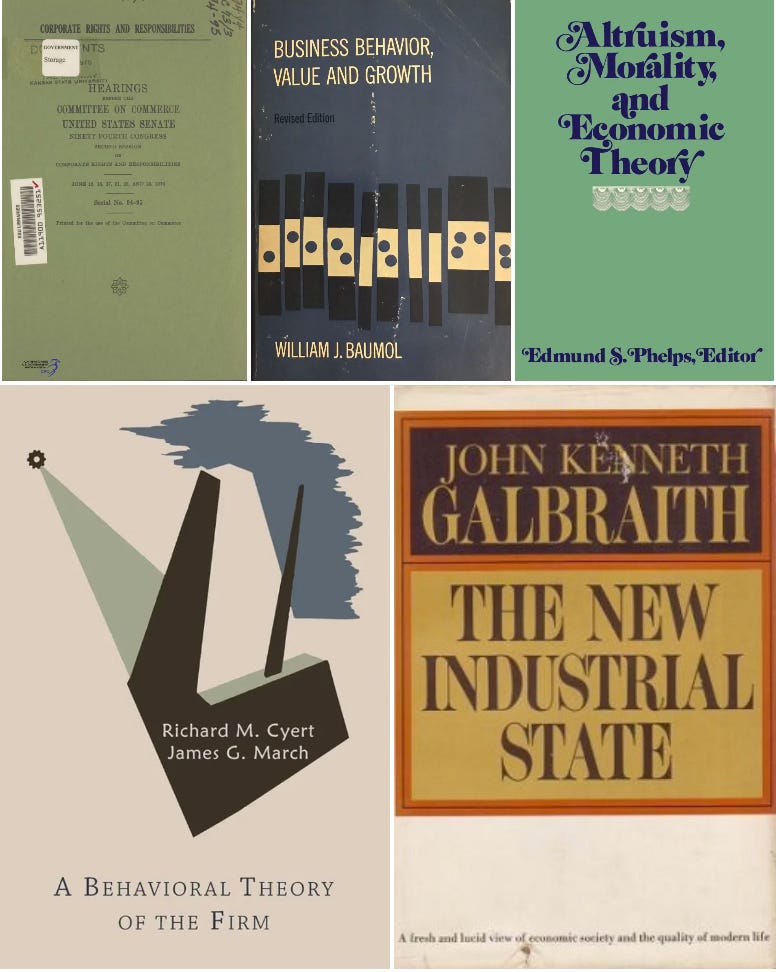
By the turn of the 1970s, Baumol held positive views that firms' objective was not profit, plus an additional belief that managers were somewhat guided by social conscience. As he turned more specifically to CSR, you would thus expect him to endorse it. But just like Arrow, his writings display skepticism that leaving the resolution of social problems to voluntary measures by business would work. Baumol contributed one of three 1970 articles that formed the research material for a Committee on Economic Development report on "Social Responsibilities of Business Corporations." The main argument was that taking stakeholders' interests into account was not inconsistent with shareholders' long-term goals. The CED report called this complementarity "the doctrine of enlightened self-interest." The term came from Baumol's title ("Enlightened Self-Interest and Corporate Philanthropy"). He sought to explain why corporations had come to supply 5% of total private philanthropy in the US. He provided extensive data and concluded that this level of giving could not merely be explained by enlightened self-interest defined as concern for public image and social conscience. So he added another "self-enlightened" motive: the provision of public goods. Because they were non-excludable, they were in short supply, yet crucial to corporations' long-term profitability. Indeed, 40% of corporate gifts went to education, then hospitals. "As businessmen see more clearly and are able to show more effectively to their stockholders that the company's prosperity depends on the health of the communities in which it operates, it will become clearer that self-interest is indeed served by corporate contributions," he concluded.
A few years later, Baumol returned to CSR with less optimistic conclusions. From the outset, he explained that "the primary job of business is to make money for its stockholders," and that a "massive outburst of altruism" is neither desirable (it would be tokenism, and "business is likely to prove inefficient as a voluntary healer of the ills of society") nor achievable. He didn't seem to believe that social goals and profit maximization were generally consistent with one another in the long term. At that time, Baumol and William Oates had proposed cost-efficient set-ups for pollution taxes because Pigovian taxes seemed impossible to implement. The pair was working on their book The Theory of Environmental Policy. Addressing pollution as well as consumer safety problems was thus paramount in his piece. He focused on the failure of voluntary social responsibility initiatives by corporations. He repeated that he didn't see businessmen as having less "integrity" than the rest of the population, but reminded readers that voluntary anti-pollution initiatives would probably result in loss of competitive advantage. So the only solution was changes in the corporate environment's rules (such as taxes that would make polluting "costly").
Baumol's paper was reprinted in a 1975 volume on Altruism, Morality and Economic Theory edited by Edmund Phelps. This shows the broader intellectual context shaping economists' CSR research at that time, but also how attempts to integrate altruism into theories of firm behavior diverged from economists' modeling efforts to integrate other-regarding preferences in models of individual behavior. Phelps's project explicitly aimed to move from this early research to a comprehensive "theory of altruism" as a solution to opportunistic behavior when information is imperfect—the same concern that motivated Arrow's work. But like Arrow's analysis, the corporate altruism chapters in Phelps's book delivered disappointing conclusions. Alongside Baumol's skeptical assessment, former RAND researcher Roland McKean contributed an equally pessimistic analysis of corporate "non-rule oriented unselfishness" across defense, environmental, and apartheid contexts. McKean's verdict was blunt: "If we wish to alter business behavior affecting health or environment, we must turn to legislation and formal means of enforcement,"he concluded, citing Dales's work on pollution rights and transaction costs more generally.
The same blend of positive research, moral endorsement, and practical skepticism emerged among a third group of economists who were also challenging profit maximization as the sole driver of firm behavior. At Carnegie, Herbert Simon had developed his bounded rationality approach specifically to explain actual business decision-making within firms—work that his colleagues Richard Cyert and James March would extend in significant ways.
Their 1963 collaboration, A Behavioral Theory of the Firm, proposed a positive theory of how organizations actually form collective goals. Their theory held that firm goals derive from a dual process of bargaining and learning, whereby individuals with conflicting interests and bounded rationality come to form an organization. "As a result," they wrote, "recent theories of organizational objectives describe goals as the result of a continuous bargaining-learning process. Such a process will not necessarily produce consistent goals." Their goal was to challenge "neoclassical" theories of the firm where, as Cyert and Charles Hendriks remarked, "even the sole objective of the firm, profit maximization, is determined by the environment because any other behavior of the firm will lead to its extinction." A graduate student working on their book—which featured contributions by team members beyond the core text by Cyert and March—was Oliver Williamson. His transaction cost theory was influenced by this Carnegie context and sought to bridge the (economics) theory of the firm and the (management) theory of organization, as well as rational and behavioral models of individual decision-making.
While Cyert and March applied their behavioral framework to organizational choices as well as production, pricing, and investment behavior, the aforementioned 1976 Senate hearings offered an opportunity for Cyert to address CSR concerns. By then Carnegie's president, Cyert offered a testimony in which he acknowledged that a series of corporate scandals, together with firms' increased size, legitimately raised social responsibility concerns. But citing his work and Williamson's on organizational structure, he explained that vertical integration was indeed a response to the uncertain environment in which corporations operated—one that allowed them to gather and process information. Antitrust policies "which are directed toward enforcing competition by enforcing uncertainty, by restricting the exchange of information," should therefore be rejected. He concluded that "to retain the discipline of competition that pushes for lower prices, higher quality—the consumerism aspect of competition—we must rely increasingly on the ability of businessmen to behave like statesmen." Cyert’s positive theory of the firm had thus led him to endorse a "trust businessmen" approach.
My interpretation of economists' debates on CSR from these decades goes beyond noting their reliance on a mix of positive and normative arguments that are sometimes difficult to disentangle. Underlying their disagreement on whether corporations do and should pursue goals other than profit were diverging approaches to both theoretical modeling and what constitutes acceptable empirical evidence - what historians and philosophers often call "epistemic values." That's an interesting takeaway given that economists have shown renewed interest in CSR after decades of neglect (next post), raising the question of how their new models and empirical designs shape this latest round of research.
Epistemic debates, for instance, pervaded the 1940s exchanges over firm maximization behavior, known as the "marginalist controversy." What began as a debate about the consequences of raising the minimum wage evolved into a broader dispute over the relevance of marginalist theory—specifically, how firms actually set prices and wages. Labor economist Richard Lester challenged the idea that business decisions had anything to do with profit maximization and related calculations, while Austrian economist Fritz Machlup and Chicago theorist George Stigler argued that Lester had fundamentally misunderstood how formal theory should be applied. This was the debate that Friedman addressed in his influential 1953 methodological essay, which endorsed the inescapable lack of realism in modeling hypotheses as necessary for developing parsimonious yet widely applicable theories of human behavior.
The status of (unrealistic) theoretical assumptions surfaced again in the 1960s-1970s debates around CSR. Galbraith's The New Industrial State wasn't simply arguing that firms don't maximize profit – it mounted an epistemological attack against those economic theorists who dared employing conventional mathematical equations reflecting profit-maximizing firms, rational consumers, and efficient markets. Such modeling, he contended, represented either gross misunderstanding or deliberate misrepresentation of economic reality. Bob Solow responded with a scathing review in The Public Interest, defending profit maximization as a legitimate theoretical hypothesis among other counterarguments:
Galbraith doubled down in a rejoinder and suggested that such assumptions not only reflected bad methods but also ideological biases (Verena Halsmayer and Eric Hounshell thoroughly analyze the controversy here).
All these controversies were equally empirical—that is, economists' stance on CSR largely relied on which empirical evidence they saw as acceptable (remember Bowen's long list of CEOs' statements). One method that proved central and contentious in research on firm behavior was the use of surveys. It was pivotal in the 1940s marginalist controversy, as Lester's attack on the idea that prices and wages are set to maximize profit relied on questionnaires sent to 430 businessmen asking how they would respond to wage increases—they responded that they would not lay off workers but rather try to improve efficiency and increase their sales efforts. Both Machlup and Stigler criticized the method. Questions were badly phrased and proved nothing, the first argued. "We shall not accept this result even if Lester obtains it from 6,000 metal-working firms," Stigler declared.
From the start, the Carnegie behavioral program had aimed to unite theoretical research with rigorous and novel empirical techniques. At the AEA in December 1961, Simon's lecture about new developments in the theory of the firmencapsulated its ambiguous views of surveys. He argued that "management scientists are not concerned with systematic surveys of business practices" because it was impossible to generalize from them and because self-reporting was "lacking independent checks of actual behavior." At the same time, he cautioned against dismissing this type of evidence. He pointed to intensive interviews and on-site observation studies (costly and also difficult to scale up), as well as laboratory experiments and computer simulation as rising empirical techniques to test alternative theories of firm behavior. The Cyert-March book relied on a combination of such techniques: a long appendix presented simulations of a complex decision model developed by Cyert and K.J. Cohen and inspired by Forrester and Orcutt's work. One of the chapters introduced experiments by Cyert, March, and William Dill: they tested their administration graduate students to understand how framing and communicating investment choices affect decisions, and had their undergraduates play a team game in the lab to understand information processing and conflict resolution under various sets of rules. Recent empirical research on CSR largely relies on such games and surveys embedded in physical or online lab settings: how much is the acceptance of their results underpinned by the changing status of these methods?
Overall, these economists mixed theoretical and empirical, positive and normative arguments to develop complex stances on CSR: they rejected profit maximization as an accurate depiction of business behavior, generally believed that businessmen possessed social consciences and should care about their impact on stakeholders and social problems, yet often doubted that voluntary initiatives running counter to stockholders' short-term interests could be reliably sustained. This complexity illustrates a point Columbia law professor Dorothy Lund made at a recent conference when we discussed why the "shareholder view" of corporate governance seems stickier than the "stakeholder" alternative. She attributed this to the lack of consistent legal foundations for the stakeholder view, and my account suggests that in economics too, the rationale for CSR was often more plural and diffuse than arguments against it.
The likes of Friedman and Henry Manne, who outright rejected any appeal to CSR, were actually a minority at the time. Throughout the 1970s, CSR opponents built on theorists like Armen Alchian and Harold Demsetz to develop a theory of the firm as a nexus of contracts. The making of Jensen and Meckling's work—the topic of my final post—connects to a question I can't definitively answer. While their contribution is usually credited with providing intellectual foundations for both law and economics and the "shareholder primacy" approach in business, I wonder whether it instead killed mainstream economists' interest in CSR for the next three decades.
No posts
Comments
Nothing yet. Say the first thing.
Sign in to join the conversation.