
There’s an episode of The Office where corporate sends over a sexual harassment training video that keeps earnestly asking, “Where is the line?” Michael talks through basically the entire thing, then spends the rest of the episode crossing the line in increasingly spectacular ways. It ends up being considerably more instructive than the video.
Yesterday, life imitated art. A big part of what we do at Unbiased Science is anticipate vaccine hesitancy and figure out how to talk about it, which means spending a lot of time thinking about what makes a parent pause in the exam room. The signing of the executive order on childhood vaccines was a demonstration reel of every technique we warn people about, delivered from the most powerful podium in the country. If we were building a training module on how to manufacture parental doubt, we’d have a hard time improving on it.
So, what actually happened, and what does it mean for our families? Let’s discuss…
President Trump signed an executive order titled “Gold Standard Childhood Vaccine Recommendations.” By its own account, it builds on a December 2025 presidential memorandum and a May 2026 executive order that committed the administration to the same policy, so this is the third pass at it rather than a standalone action. Two provisions matter most for parents:
The measles, mumps, and rubella (MMR) vaccine should be given as three separate single-disease shots, once such products become available domestically.
All childhood immunizations should be administered at separate medical visits, to the maximum extent feasible. The president illustrated this at the signing by suggesting that at one year of age, a child should have five separate visits rather than getting the vaccines on the same day.
The order also advises states to reconsider school requirements, directs the attorney general toward litigation over religious and medical exemptions, and calls for alternatives to aluminum adjuvants. It makes no mention of autism anywhere in the text, though autism came up repeatedly at the signing. It does instruct the Department of Health and Human Services (HHS) to guarantee continued availability of combination vaccines, so nobody is pulling MMR off the shelf.
It also sorts vaccines into three tiers: recommended for all children, recommended only for high-risk populations, and left to shared decision-making between parent and doctor. Hepatitis A, hepatitis B, and meningococcal vaccines each appear on two of those lists at once. The apparent effect is to move them out of the universal column, though the order never says so, which is a bit of a headscratcher.
The order’s stated premise is that we should align with peer, developed countries. We spent an entire piece on that argument back in December, when the plan was to copy Denmark’s schedule, and the core problem is this: comparing schedules across countries with different healthcare systems, population sizes, and disease burdens is comparing different things, not different choices. But even on its own terms, the comparison doesn’t work. The United Kingdom, Israel, and Australia all recommend more childhood immunizations than the US would under the pared-down schedule this administration has been pushing since January (more on that shortly). And Europe combines more than we do rather than less. Two six-in-one vaccines were licensed there in October 2000, protecting against diphtheria, tetanus, pertussis, polio, hepatitis B and Hib in a single shot, and hexavalent vaccines are now built into schedules across much of the continent.
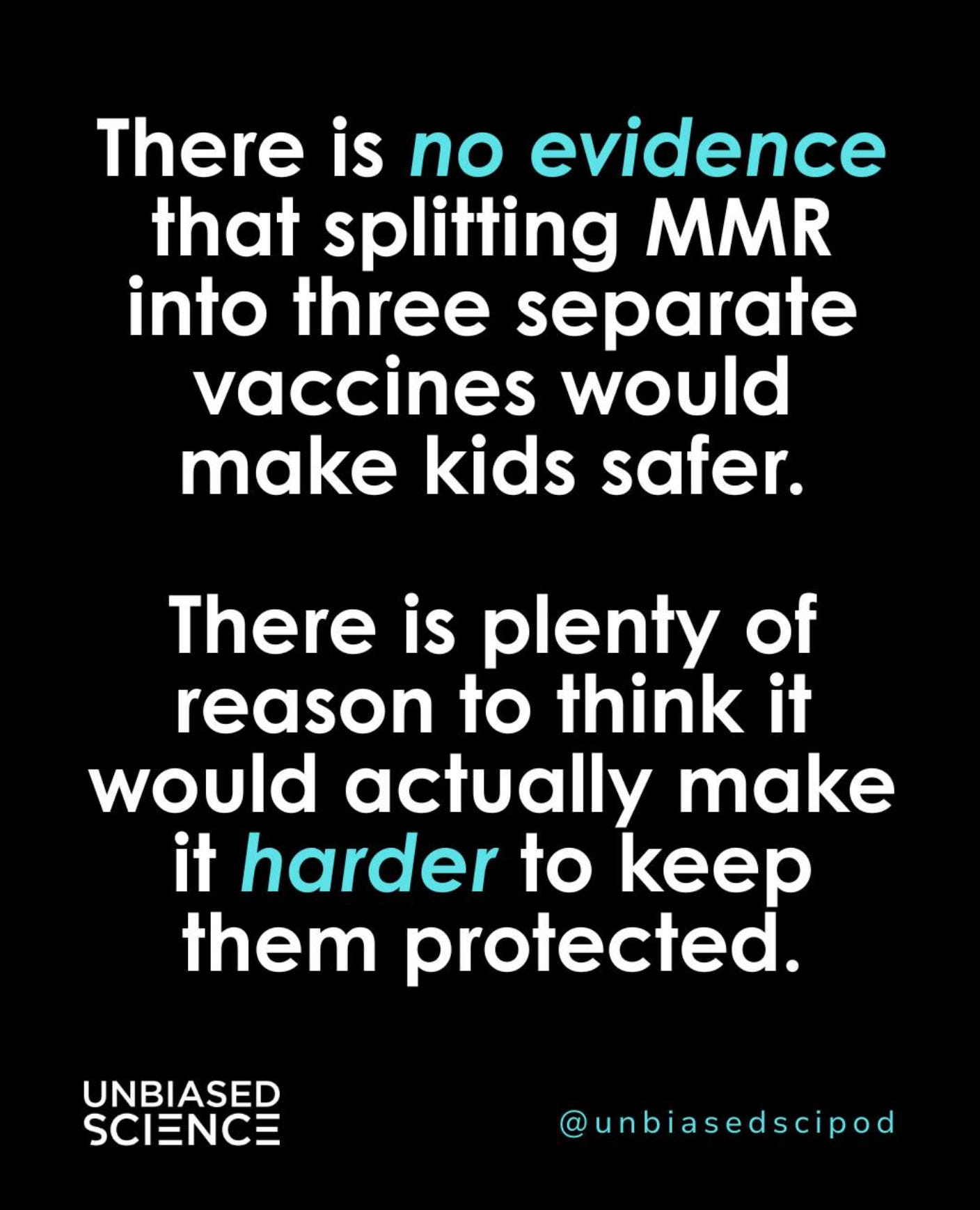
There are no standalone measles, mumps, or rubella vaccines licensed in the US. Merck stopped making them and announced in October 2009 that it would not resume production, saying at the time there was no medical reason to give the three vaccines separately. Bringing them back would require a manufacturer to restart production, generate the evidence FDA requires, and secure approval. That doesn’t happen overnight.
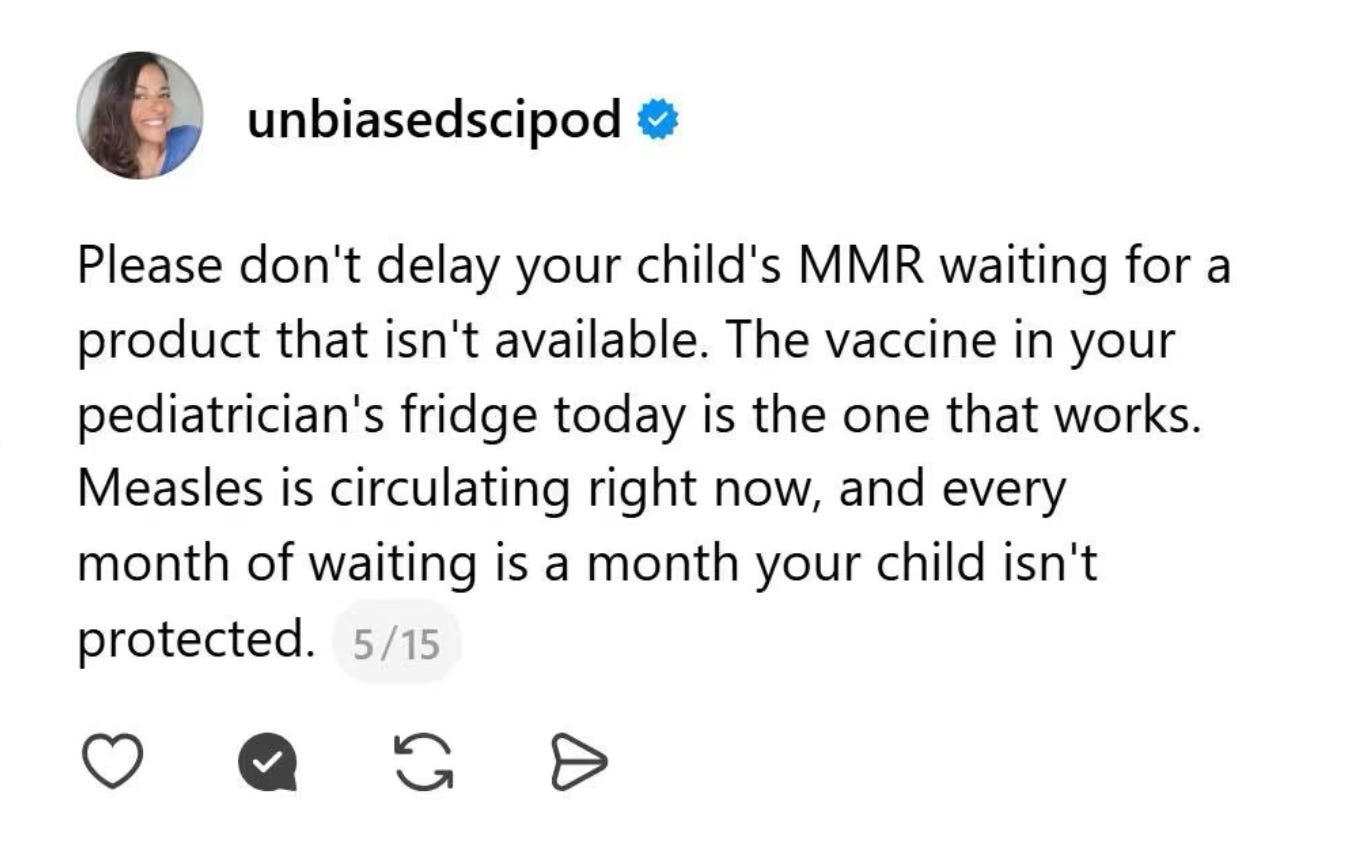
The risk is that many people won’t hear that conditional language and will assume that separate shots are coming, causing some to delay their child’s MMR while they wait for a product that doesn’t exist.
There is nothing on the other side of that trade. CDC’s own page on MMR safety states that no published scientific evidence shows any benefit to separating the combination vaccine into three individual shots. What splitting would produce is six injections instead of two, and read alongside the same order’s guidance on separate visits, six appointments instead of two. A family that delays is giving up real protection in exchange for nothing, during a year in which the US has already logged more measles cases than any year since the disease was declared eliminated here in 2000.
For this I turn to Dorit Reiss, who is a professor of vaccine law at UC Law San Francisco and has been walking through the order’s mechanics. The order has a few moving parts:
1. The schedule downgrades. The order restates a change the Secretary attempted in a January memo, moving six vaccines out of the universal column: hepatitis A, hepatitis B, meningococcal, rotavirus, influenza, and COVID-19. In March, a court stayed that change, along with the newly reconstituted Advisory Committee on Immunization Practices and the votes it had taken. The court found that CDC couldn’t bypass ACIP and that the new committee itself wasn’t lawfully constituted. This order bypasses ACIP too. And having the President sign it rather than the Secretary doesn’t get around the March ruling, because that injunction binds Kennedy, HHS, and CDC, and the President can’t direct those agencies to do what a court has forbidden them to do. On Reiss’s reading, the change remains legally vulnerable. The practical effect is confusion, not a change in the law.
2. Splitting MMR into single-disease shots. There are no licensed products, and the older licenses have lapsed. Bringing one back would require FDA approval of the product along with its manufacturing process and facilities. Importing a product made abroad wouldn’t solve it either, since those aren’t licensed here. The practical effect on MMR availability is therefore likely to be nothing for quite a while.
3. Alternatives to aluminum adjuvants. Calling for alternatives plants the idea that something is wrong with the current ones. Aluminum salts have been used for decades to help vaccines produce a stronger immune response, and we’ve written a full piece on why the evidence doesn’t support the harms critics attribute to them, including the claim that injected aluminum behaves differently from the aluminum we eat every day. Practically, replacing them would mean reformulating vaccines and generating the safety and effectiveness data FDA would require. No manufacturer appears to be rushing toward that.
4. Pressure on states. The administration has run into legal limits trying to change federal vaccine policy directly, but states control school vaccine requirements. So the order advises states and territories to revise their recommendations and requirements, directs the Justice Department to challenge states whose mandates lack sufficient religious and medical exemptions, and directs Education and HHS to pressure grantees on the same issue. Section 1 even acknowledges that prior federal efforts have been held up by litigation, then instructs agencies to advance the new recommendations to the fullest extent allowable by law. They may not be able to rewrite the federal schedule this way, but they can pressure states to change what happens on the ground. Reiss suspects that may be the main goal, and I think she’s right.
CNN and the New York Times have fact-checked these thoroughly. A brief recap with some Unbiased Science flair:
On the number of shots. He said children were receiving 72 jabs, and described doses “the size of a bottle of soda.” PolitiFact took that number apart in January, when the White House put it on a graphic. Seventy-two appears to come from counting every recommended dose across eighteen years as a separate injection (including doses given orally or by nasal spray) and not from an actual injection count. About half are annual flu and COVID vaccine doses, which no state requires for school attendance. Many vaccines are also combined, so a single injection can count as several doses. Most shots contain between 0.25 and 0.5 milliliters, roughly a twentieth to a tenth of a teaspoon.
On antigen load. The shots themselves have gotten dramatically leaner. In 1986, childhood vaccines protected against seven diseases and exposed a child to more than 3,200 antigens, most of them from a single whole-cell pertussis shot that contained roughly every protein the bacterium could produce. Today’s entire schedule protects against 18 diseases using between 165 and 315 antigens, depending on how they are counted. More shots, far more diseases prevented, and roughly 95% fewer antigens than children encountered through vaccination in 1986.
On autism prevalence. He said it was 1 in 10,000 twenty years ago, but CDC surveillance put it at 1 in 110 in 2006. Even going back to the early 2000s, it was about 1 in 150. Shrinking that starting figure makes the rise look far steeper than it was. Diagnostic criteria also broadened substantially over this period, awareness grew, and screening improved, all of which help explain why we identify far more autistic children now than we did in 1990. I wrote about this for the New York Times last year. You can debate how much of the increase those factors account for (and I’d argue the answer is a lot). What you can’t do is assert that they don’t account for it while offering nothing at all in support.
On MMR itself. He said that given together the three components “could be quite lethal.” When a reporter asked whether he had evidence for that, he said what he’d heard is that some people say it that way.
On whether any of this has been studied. A senior White House aide said at the event that nobody has studied the childhood schedule, nobody has looked at it, nobody has thought about it. If I am being generous, the fairest reading is that he meant the schedule as a whole, rather than the individual vaccines. There’s a kernel of truth there. When the Institute of Medicine reviewed the entire schedule in 2013, it found that research hadn’t been designed to evaluate the full schedule as a single package. But it also found no evidence that following the schedule raised major safety concerns, and recommended studying it further using existing health databases, since randomly assigning children to receive all recommended vaccines or none would be unethical. Researchers have done that work since. A 2018 JAMA study used Vaccine Safety Datalink records to test exactly that question, comparing cumulative antigen exposure in the first two years of life against later infections vaccines don’t target, and found no difference. “Nobody has studied it” simply isn’t true.
Aside from the fact that none of this rests on science, it reads as a dangerous and ill-informed political move. And the majority of Americans support vaccines. Kindergarten vaccination rates are slipping and exemptions have hit an all-time high, but most parents still vaccinate their kids, which makes targeting them confusing on its own terms.
Thinking back to The Office, there’s another part of the analogy that stuck with me. Michael isn’t confused about where the line is. He crosses it because the warehouse guys are lapping it up, and they’re the room he’s trying to win over even though they’re not most of the office. Whether that’s what’s happening here I can’t tell you. But the rest of the office did not respond well.
We won’t know the full cost of this for a while, but we can make an educated guess. Andrew Racine, president of the American Academy of Pediatrics, said the announcement’s only purpose is to sow confusion so more people doubt the importance of vaccines. When families get conflicting messages from people who are all supposed to be authoritative, confidence erodes, and it’s children who absorb the consequences. All of this lands with measles at a 35-year high, respiratory virus season approaching, and kids heading back to school.
Though this may have been a lot of talk without teeth, there are three developments I’m watching especially closely.
Adding autism to the Vaccine Injury Table would open the compensation program to a volume of claims it was never built to absorb. The table works by presuming causation when a listed injury occurs within a specified window after a listed vaccine, so claimants don’t have to prove it from scratch. That’s a good mechanism when the listings are scientifically sound. Autism isn’t, since decades of research across seven countries have failed to link it to vaccines. We’ve written about the injury table twice this summer, and the concern is unchanged: vaccines don’t have to be outlawed to disappear. They just have to become too costly and too legally risky to keep making.
Congress cutting or dismantling the Vaccines for Children program would do more damage to childhood vaccination rates than any recommendation change on paper. VFC was created in 1994, in direct response to the measles outbreaks of 1989 to 1991, and provides recommended vaccines at no cost to children who are Medicaid-eligible, uninsured, underinsured, or American Indian or Alaska Native. It distributed more than 74 million pediatric doses in 2023.
Federal leverage used to force states to change exemption laws is the one this order already reaches, through the Justice Department and through conditions on grantees. It’s why the fourth item above carries more weight than the rest of the document combined.
Nothing changes today. An executive order does not itself rewrite the federal immunization schedule, and states, not the federal government, set school requirements. At least 23 have said they will continue following AAP guidance, and the order itself states that it creates no enforceable rights.
Nor can you walk into your pediatrician’s office and ask for separate measles, mumps, and rubella shots. They aren’t licensed in the US, so no pediatrician can offer them, regardless of what the order says.
The same goes for insurance. Free coverage under the ACA and eligibility for Vaccines for Children are tied by statute to ACIP recommendations adopted by the CDC director, which an executive order can’t reach.
None of this means Monday didn’t matter. Confusing parents about vaccines has consequences, and the pressure on states could change policy on the ground. But for families wondering what to do today, the answer hasn’t changed. The vaccines your pediatrician recommended last week are still available, and they are still the best protection your child has. The science hasn’t changed either. Measles is exactly as contagious as it was, and your child’s immune system works exactly the way it did before anyone signed anything.
Stay Curious,
Unbiased Science
Comments
Nothing yet. Say the first thing.
Sign in to join the conversation.