
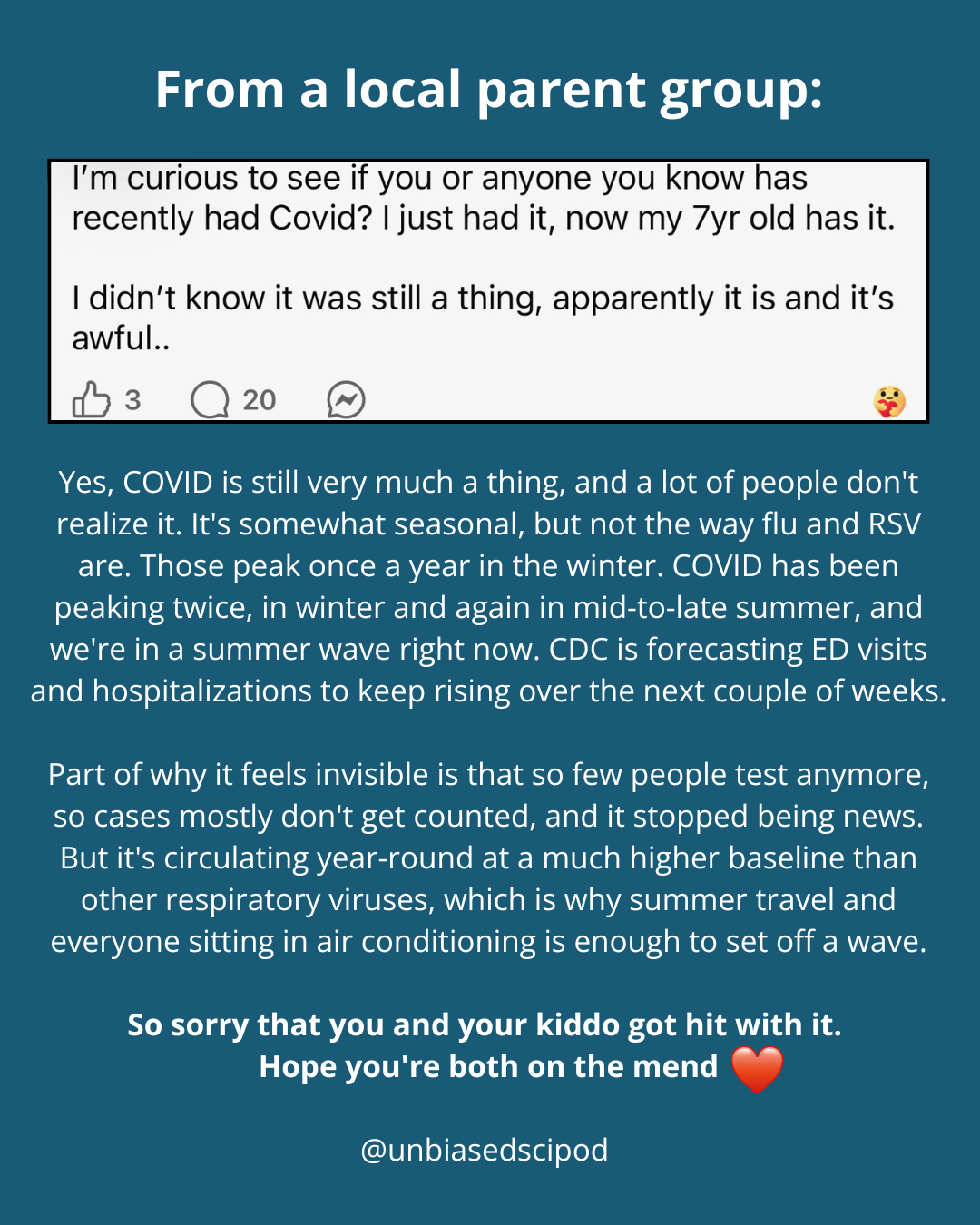
A mom in my local parent group posted last week asking whether anyone else had recently had COVID. She’d just gotten over it, her seven-year-old had it now, and she said she hadn’t realized COVID was “still a thing.” Last I checked, the post had dozens of comments from parents expressing similar surprise. Gone are the days of 2020 and 2021, when we hung on every update, and I don’t think anyone wants those days back. But COVID is absolutely still around. So, is it surging right now, and what should our families do about it?
Let’s discuss…
CDC’s modeling estimates that COVID infections are growing or likely growing in all 50 states as of August 12, with no state showing a decline in infections. That might sound scary (and we absolutely need to be cautious), but let’s give a little context.
This figure tells us about direction only, not how much disease is out there. On that, the picture is calmer. CDC’s weekly respiratory summary has COVID activity low in many regions and increasing in the West and South, with emergency department visits very low. About 4% of tests came back positive last week compared with over 9% at this time last year, and CDC’s wastewater dashboard had national activity in the “very low” category for the week ending August 8. Stanford’s WastewaterSCAN network shows a sharper rise, with concentrations up about 106% in August over July. The two networks aren’t in perfect agreement, though both point upward from a low starting point.
Hawaii and Mississippi are the only two states in the moderate wastewater category. If you’re in New England (hi, neighbors!), you may not be seeing much of this yet, because summer waves have tended to start in the South and move north later in the year.
Most of us learned that respiratory viruses are a winter thing, and flu and RSV do behave that way. COVID settled into a different rhythm. One analysis of U.S. incidence found three recurring annual rises, a main winter peak plus smaller ones in spring and mid-to-late summer. Why that happens is still an open question, and anyone telling you COVID’s seasonality is worked out is ahead of the evidence. What we have are some reasonable hypotheses:
Immunity timing. Most people who got vaccinated did it in the fall, and most people who got infected did it during the winter wave. By August, both are six to eight months back. A recent infection does buy you a few months where you’re less likely to catch it again, and for most people that window has closed by late summer, leaving more of us susceptible at the same time.
Climate and where we spend our time. In the hottest parts of the country, summer pushes people indoors into air conditioning just like winter pushes people indoors for the heat in colder states. Researchers have described COVID transmission oscillating between southern states in summer and northern states in winter, which fits the pattern we’re seeing now. CDC’s own summer scenario modeling anticipated increases in the South and West, the regions that didn’t see much activity last winter.
Travel and mixing. Peak travel season, weddings, camps, and family reunions all stack up in the same few weeks, and now schools are reopening too.
Variant turnover. SARS-CoV-2 keeps generating variants that partially evade existing antibodies. The most common lineage in sequenced specimens right now is XFG.1.1, a recombinant in the omicron family. BA.3.2 (nicknamed Cicada, so the word can now ruin your summer in two entirely separate ways) is also circulating here, and while it carries more than 70 mutations, several of which may help it evade immunity, it hasn’t become dominant.
A higher year-round baseline. Flu drops to very low levels between waves, so there’s little virus left to work with even when conditions are right for spread. COVID keeps circulating substantially all year, so there’s already more virus around when immunity wanes, behavior shifts, or a fitter variant shows up. The four factors above simply have more fuel to work with.
Yes. The test sitting in your medicine cabinet still works. Rapid tests look for a different part of the virus than the part that keeps changing. Most of the mutation happens in the spike protein, which is what your antibodies are trained to recognize. Rapid antigen tests target the nucleocapsid protein, which has stayed relatively stable over time. That’s why a variant can dodge your antibodies and still light up your test strip.
Rapid tests can still fall short when it comes to the timing of the test and your viral load. Studies have shown that these tests generally pick up roughly 80-90% of infections in people with symptoms, but drop to roughly half or less in people without symptoms. A positive result is highly reliable either way and false positives are rare. A negative result is a different story, though. In someone with symptoms, it’s still a meaningful “maybe”, and in someone without symptoms, it’s an even bigger “maybe”, which is why the FDA recommends re-testing after 48 hours have passed.
And before you toss the box in your junk drawer, check the FDA’s extended expiration list, because a lot of kits are still good past their printed date. The expiration date isn’t just a suggestion though, and false negatives become much more common.
The list looks a lot like it has for the past few years, since these are all Omicron descendants. Cough, sore throat, congestion, fatigue, fever, chills, shortness of breath, headache, and GI symptoms like nausea and diarrhea are all on the CDC’s list, typically showing up two to fourteen days after exposure.
The “this variant has its own signature symptom” claim comes around every wave (you may remember “razor blade throat” attached to Nimbus last year). It usually starts with a handful of anecdotes or a small survey, gets amplified, and then doesn’t hold up when anyone looks at systematic data. How your illness feels depends on your age, your vaccination and infection history, and the variant itself. So, you often can’t tell COVID from flu, RSV, or strep by symptoms alone, which is the whole argument for testing rather than guessing.
Most people recover at home, and by now the drill is familiar: stay home until your symptoms are improving and you’ve been fever-free for 24 hours without medication, then be careful around anyone vulnerable for a few more days. CDC’s guidance here is the same across COVID, flu, and RSV.
The antiviral question is where things have shifted. Paxlovid is a pill you start within five days of your first symptoms, and it built its reputation on a 2021 trial that found a large drop in hospitalizations and deaths. Two new trials published in April tested it in today’s world, in more than 4,200 higher-risk adults who were almost all vaccinated, and found no reduction in hospitalization or death.
The numbers underneath explain most of that. In the 2021 trial, roughly 1 in 15 people in the comparison group were hospitalized or died. In the new trials, fewer than 1 in 100 were. Vaccination and prior infection have pulled the risk of severe COVID down so far that there’s much less severe illness left for any drug to prevent, and when events are that rare, a trial can’t rule out a smaller benefit either.
So, the practical advice hasn’t changed much. If you’re at higher risk, call your clinician in the first day or two rather than waiting to see how bad things get. Wait too long and the option is gone. Go in with the right expectation, though. For many higher-risk vaccinated adults, the clearest benefit may now be a shorter illness rather than a prevented hospitalization, and observational data still point toward benefit in the oldest and highest-risk patients. It also has side effects and interacts with a lot of common medications, so talk it through with your clinician before you start it.
A well-fitted N95 or KN95 works well to reduce exposure in crowded indoor spaces, and it’s a reasonable thing to wear on a flight, in a packed waiting room, or on a grocery run during a local spike. Ventilation matters too, since this is an airborne virus and more fresh air means a lower concentration of virus in the room. Opening a window, running a HEPA filter in the room where people gather, or moving a get-together outside all lower the dose you’re exposed to.
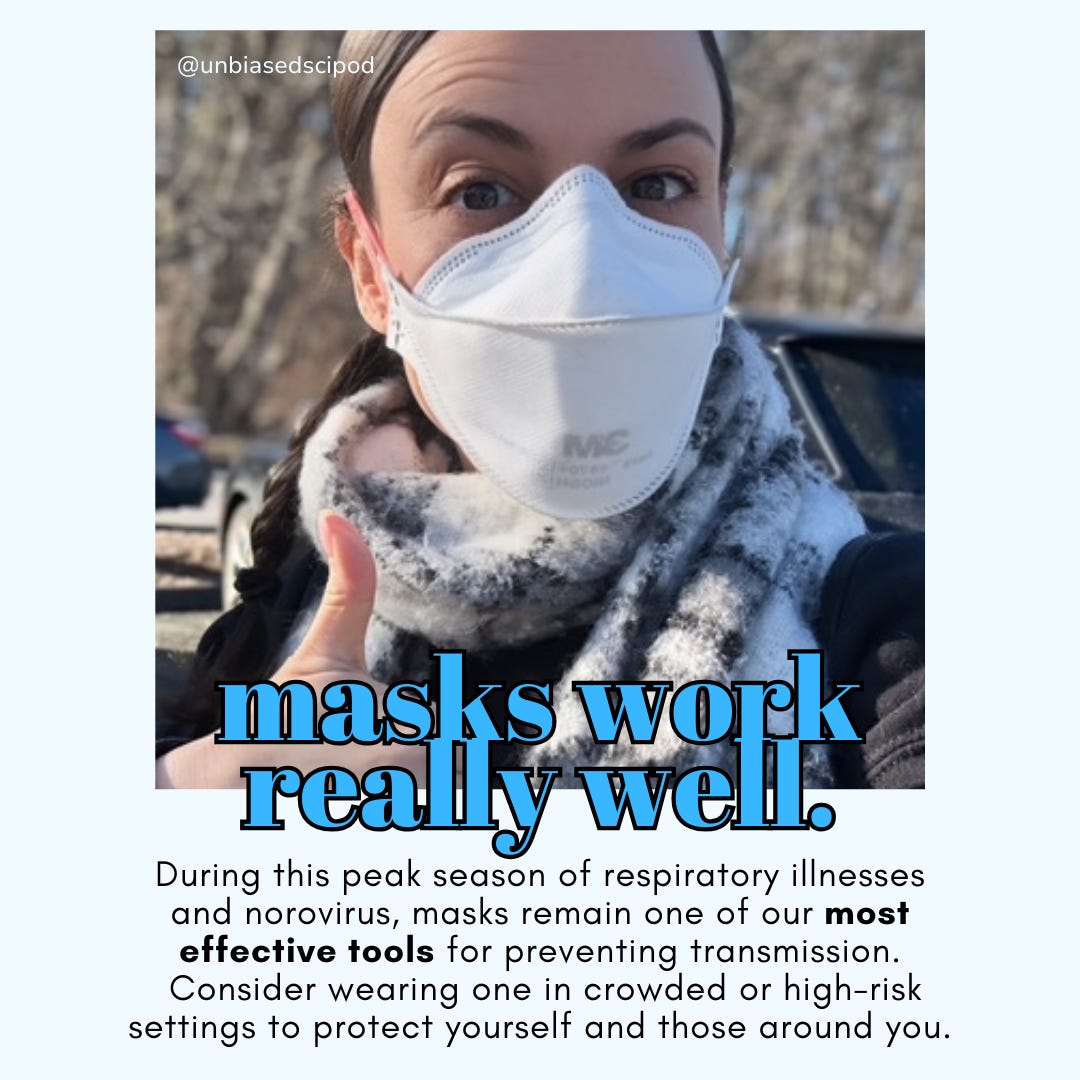
None of this is all or nothing. Every layer you add lowers the amount of virus you’re exposed to, and the more you stack, the better protected you are. For people who are immunocompromised, or are caring for someone who is, these may need to be a regular part of life, not just spike-season measures.
Better than the “I got vaccinated and still got COVID” stories suggest. CDC’s surveillance system put last season’s vaccines (combined across manufacturers) at 58% effective against hospitalization and 49% against emergency department and urgent care visits, measured through six months after vaccination and strongest in the first couple of months. A separate analysis of the Pfizer version found about 57% effectiveness against emergency and urgent care visits four weeks out. For context, flu vaccine effectiveness usually lands somewhere in the 40% to 60% range in a decent year.
What the vaccine is not is a force field against catching the virus. Whatever protection it offers against infection itself is modest and fades within months, while the protection against ending up in the hospital holds up considerably longer. That’s the trade it’s built around. If you get vaccinated and still get COVID, the vaccine did not fail you.
Yes, and if the timing works out, do them together. CDC has concluded that co-administration is safe, and a study of more than three million adults found similar protection against hospitalization and emergency department visits whether the shots were given together or separately. You may feel a little more achy or tired for a day, which is a fair trade for one trip to the pharmacy instead of two. The single visit is also the version people actually complete, since two trips means two chances for life to get in the way.
The 2026-2027 formula targets XFG, which is a good match for what’s circulating. All three manufacturers showed it generating high antibody levels against the JN.1 family, though less against BA.3.2, which is part of why surveillance for that one matters. It isn’t available yet. FDA issued the strain guidance in May, and as of last week state health departments were still reporting that ordering hadn’t opened. Last year the updated shots were approved in late August and reached most pharmacy shelves through September, so late August into September is the reasonable expectation this year, though timelines can slip.
I can’t give medical advice, and the right answer depends on your age, your health, and your risk tolerance. Here’s what my family is doing. In a typical year I’d get my COVID shot later in the fall to line protection up with the winter peak, and we’d get flu vaccine at the same visit. Because we’re in a surge, I’m not waiting on the COVID shot this year, and I’ll get the updated formulation as soon as it hits my local pharmacy. My husband and kids will do the same. Flu is different. We’re waiting until late September or early October to get that vaccine, and will adjust earlier if it looks like a fast start to the season, because flu protection wanes and getting it too early risks it fading before flu season peaks.
If you’re at high risk and in a place getting hit hard right now, the current formulation may still be in stock nearby, and taking that versus waiting a few weeks for a better-matched shot is a real tradeoff to raise with your clinician.
Your body builds two layers of defense after a shot, and they don’t fade at the same rate. Antibodies come first. They peak within a few weeks, then drop off over the following months, and they’re the layer that most affects whether you get sick at all. That decline is the six-month number people are citing, and it’s real.
The second layer is memory B cells and T cells. They stick around much longer, and they’re what keep an infection from turning severe. A systematic review found that all forms of immunity waned over six months, and that protection against severe disease was by far the most durable. Vaccine schedules are built around that second layer rather than around keeping antibodies at their peak year-round, which is why a second annual dose isn’t part of the schedule for most healthy adults under 65.
Two doses in a season is already the recommendation for adults 65 and older, generally spaced about six months apart, and people who are moderately or severely immunocompromised follow a separate schedule that may include additional doses. Since November 2025, CDC has framed COVID vaccination for everyone 6 months and up as individual-based decision-making rather than a universal recommendation, so “recommended” now means something closer to “have the conversation and decide” than it used to. The American Academy of Pediatrics (AAP) breaks from away from that framing for children. Its 2026 schedule recommends COVID vaccination universally for children 6-23 months, and on a risk-based schedule for ages 2-17. AAP also recommends it for any child 2-17 years whose parent wants the protection, even outside a high-risk group.
So yes, COVID is very much still a thing. It isn’t 2020, and the tools we have now are better than the ones we had then. But it’s circulating, it’s climbing, and a little attention right now costs almost nothing.
Stay Curious,
Unbiased Science
Comments
Nothing yet. Say the first thing.
Sign in to join the conversation.