
Reading a thing that cracks your brain open is one of the most distinctly pleasurable experiences available to a person. Being lit up by someone else’s obsession has undoubtedly sparked most of my own work.
And god, sometimes I come on here and I read and I save and I restack articles that thrill me… and six hours later, I emerge with every idea in my brain, a swollen little hoard of other people’s live wires, and promptly pass out in bed. Consume, get inspired, mental bloat, do nothing, repeat.
Lacking inspiration is hardly ever my problem. It’s the inability to (metaphorically) unlock my knees when I (metaphorically) want to hit the ground running. I’m filled to the brim with ideas, so why are my knees locked?
We’re coming to a close on our summer of re-enchantment, in which we discussed ad infinitum that re-enchantment is mostly about choosing to notice what’s around you instead of speedwalking past your own life. But realizing things (cue the KyJen meme) is only half the work. The other half, unfortunately, is doing. And the Doing is significantly harder than the Seeing.
So, this is a guide to doing the other half when it sometimes feels impossible. Consider it a companion piece, or a corrective, or an apology, depending on how many of these 33 mystical projects you actually started.
Whether I like it or not, there are a handful of people who seem to flow in and out of my algorithm’s attentional radius every few months; their reels or TikToks somehow seem to find me, their Substack posts end up on my feed, their ads are smashed between a video stories of my college bestie’s baby gnawing on watermelon for the first time and an open application announcement from a writer’s retreat in Maine I like to follow and daydream about.
[Yes, I do have a specific person in mind when I say this, but I’m putting this mention behind a paywall.]
And every twelve to fourteen months, this person arrives with an announcement: I found it — this is the best way to do [INSERT THEIR THING]. Everything I did before was wrong. Forget all of it! THIS IS BIBLE NOW.
My hackles are up. Then my suspicion sharpens into a razor-edged side-eye when the new gospel meets two conditions: it’s been in practice for max three months, and they have already trademarked it and are now teaching it back to you, or selling it to you, or both.
Bee stings are the cure for autoimmune stuff. No wait, it’s going vegan. No wait, it’s eating a plate of organ meat every 16 hours. No wait, it’s beans. BUT A TON OF THEM. Like, waaaaaaay more than you’d expect. Actually, no no, it’s manifestation — sorry, not manifestation, I meant human design — sorry, not human design, the answer is actually quitting the podcast and moving to Substack.
Now listen: A lot of what we do at Holisticism is hand you tactics to experiment with so you can live a better life, do more fulfilling work, or become the spookiest witch available to you. But there’s one line I work very hard not to cross, and the line is this is THE way, disregard everything else I’ve ever said, this is the one true truth. Partly because it’s a trap for me, a person constitutionally incapable of doing the same thing twice. Mostly because of what it does to you.
I’m completely empathetic to — actually, deeply in favor of — someone changing their mind. Change your mind! Please! Changing your mind is a sign of a functioning nervous system and an oxygenated brain.
But “one” “right” “way”? That’s just never vibed with me. Sure, I’m a routines and rituals person, but I’m not a same-breakfast-every-day-since-I-was-17-years-old person. Things that are right are usually only right for right now, and a tactic that carried you through February can be completely inert by August, which seems closer to a weather report than a personal failing.
So what follows is not The Way to do things. It’s a mess of ways, a pile of ways, a cacophony of ways to get going and get doing. Take a few, leave the rest. See what sticks.
I have learned time and again that I cannot “keep thinking” on an idea forever. When I stay stuck in what I call “let it brew” time, my awareness rarely progresses. The thought needs to be agitated somehow.
I think of it like this: an idea in your head is etheric. Vaporous, floaty, technically real but not yet matter. A great deal of great and mysterious stuff happens in the ether, and you need ether time. But eventually the idea is ready to be born and made material, and enchantment lives in that transformation from ether to matter. Most of the actual formation of an idea can only happen in the making.
Which is why so many of us only figure out what we think when we’re forced to sit down and write about the experience, or teach it to someone, or talk through the shape of it out loud to a friend who did not ask. The phase change is the big reveal. Not the noticing. The phase change.
Worth ruling out before you read one more word. When I am genuinely fried — burnt out beyond recognition, nervous system zoinked, brain wrinkles steamed out smooth — there is no rhythm to find and no flow to enter, full stop, and no list of anything is going to help.1
If I’m not burnt out but I’m still kicking rocks… I’m avoiding. Usually because I’m unclear about what I want the outcome to be, or unclear about my own motives for doing it at all, so I go full escapist: fourteen podcast episodes, some very serious fake research, five hours spent looking at business cards I do not need for a business I will never start. In small doses this is fine. Cute, even. On brand for a triple water. Day after day, distinctly ill-advised.
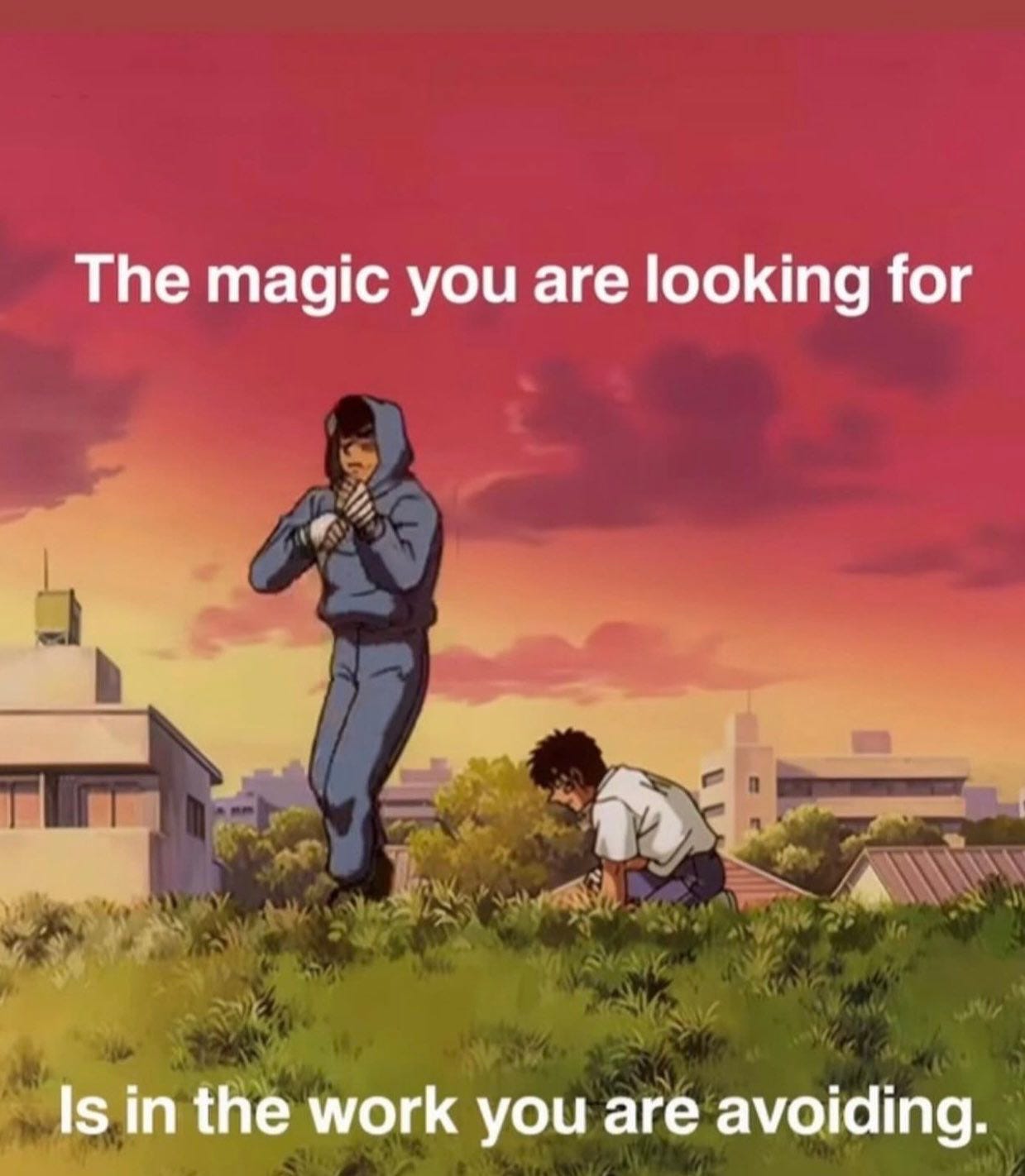
This summer, when routines went blessedly sideways, I found myself reaching out for the tricks and tactics that have worked over the years to unlock my knees and get me and my unmedicated ADHD back into motion.
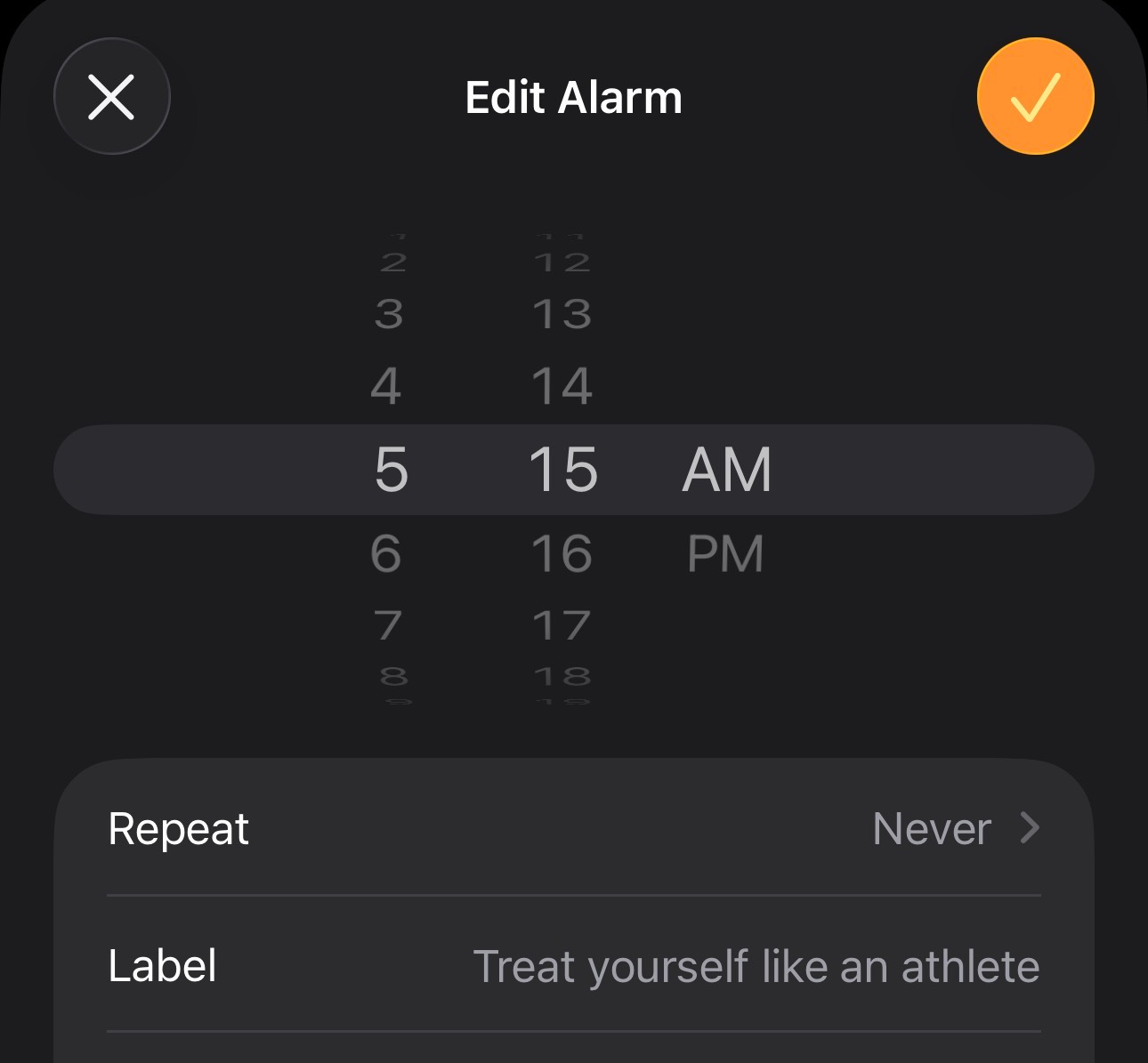
Reframe discipline as devotion. Discipline is not the opposite of softness. It’s a form of self-respect — a promissory prayer to your future self and the version of you you’re trying to become. When I think of devotiopline icons I think of professional athletes deep in training, prostrate monks, and octogenarian choreographer Twyla Tharp hailing a taxi at 5:30am to get to her daily gym sesh. It’s silly, but the alarm on my phone is labeled “Treat yourself like an athlete,” and something about that phrasing dials me in before my feet hit the floor. Also worth noting: this is the one act that cannot be outsourced to an LLM. You cannot fake devotion with a chatbot.
Subtract before you add. When I’m locked, my instinct is to add. A new app, a new system, a new productivity influencer, just a sprinkle of novelty to entertain myself. Resist. Whenever I take something off the plate first, wiggle room appears and things start moving on their own.
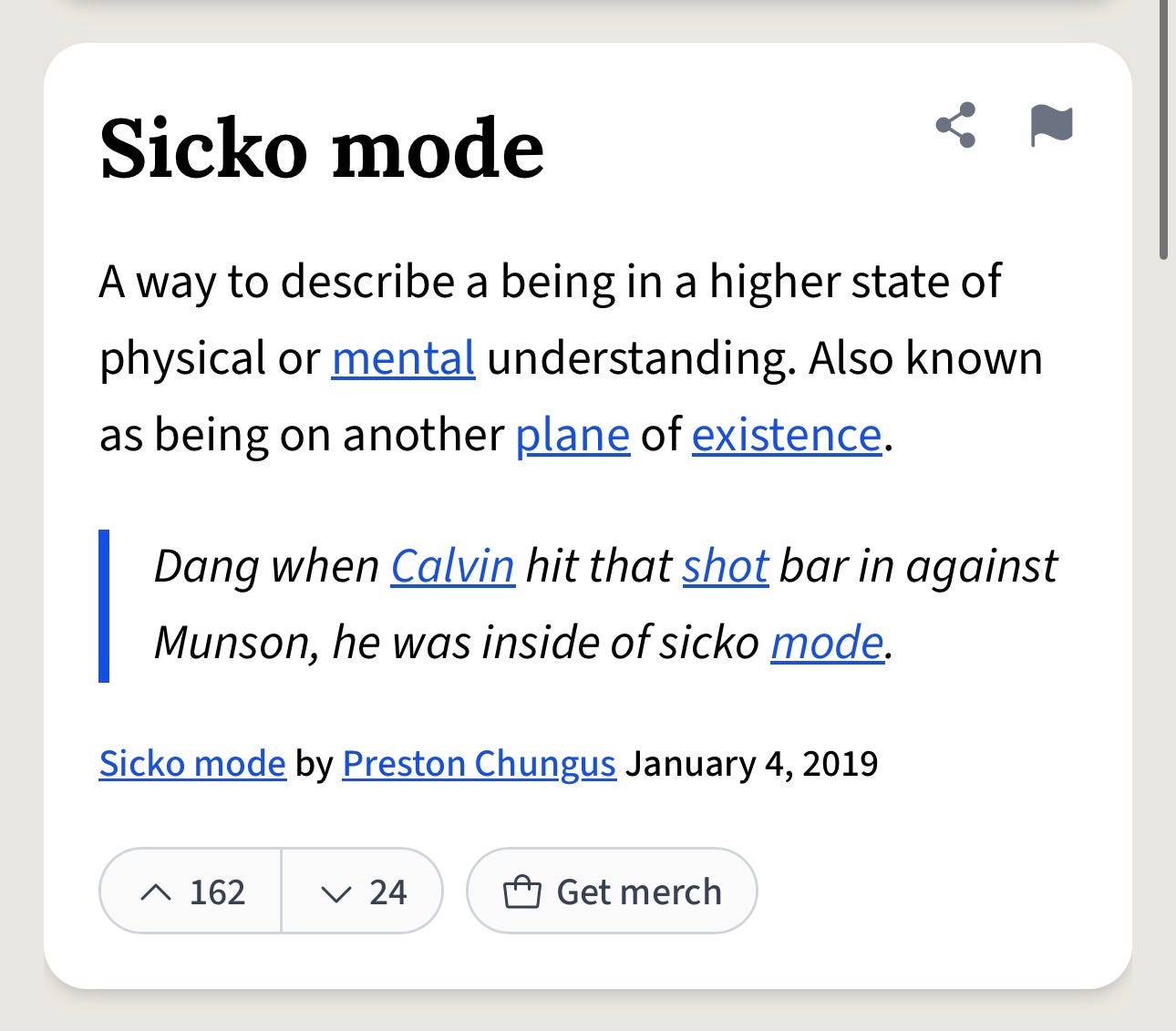
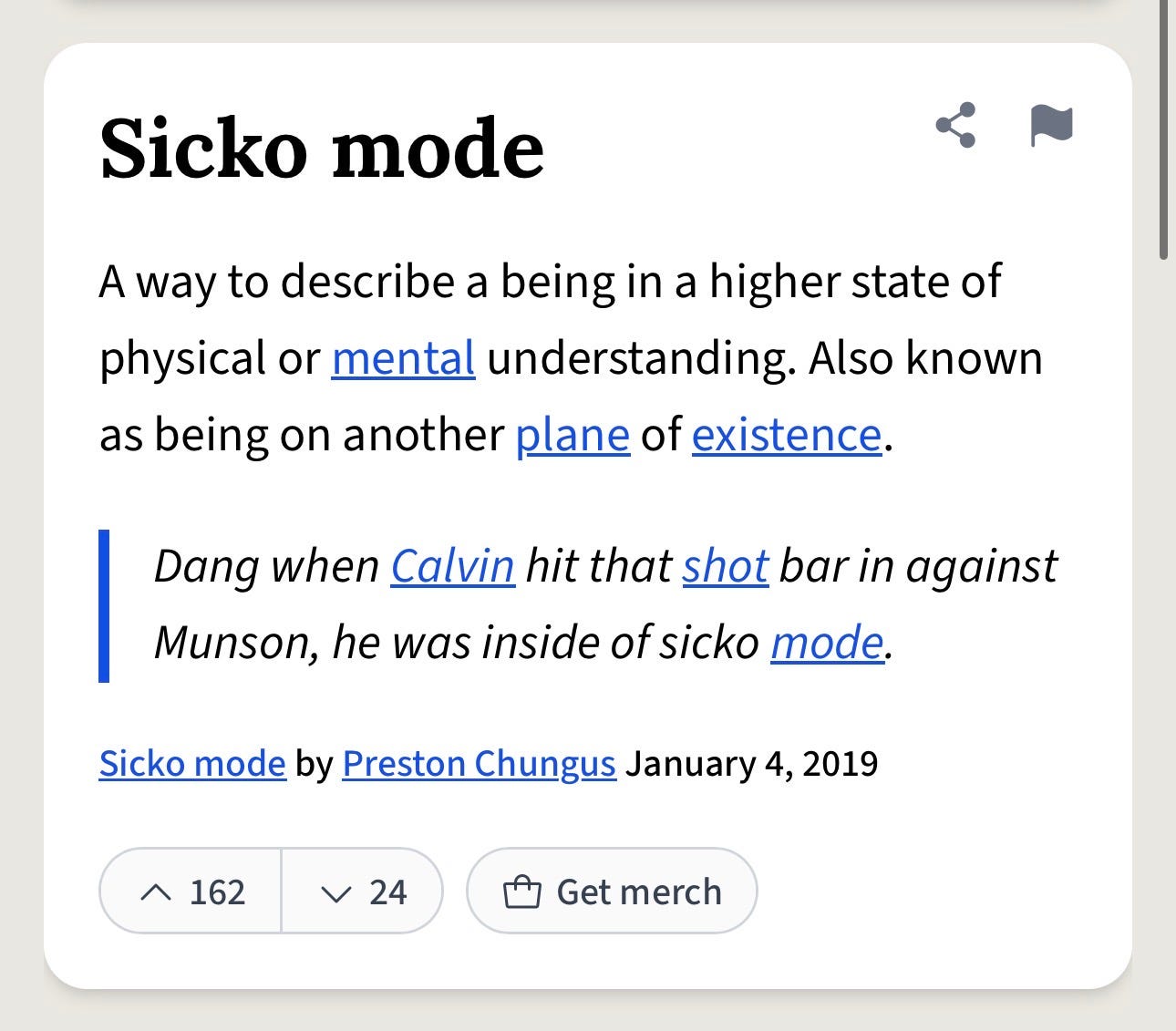
had to pull this up to explain to my husband what sicko mode was. I’m grateful to live in a world in which urban dictionary has never failed me. Go Sicko Mode. My favorite, and more mindset than method. You wake up early and go to the ugliest coffee shop in your neighborhood (interestingly enough there seems to be a direct correlation between opening time and aesthetic challenge), the one with bad wifi and worse music and zero cute people. Order a black coffee. And for exactly one hour you go ovaries to the wall on one thing. Not gentle. Not easy mode. Sicko mode. It works because of the constraints: you’re undistracted, you’re cosplaying a Serious Person, and you physically cannot get your car washed or go grocery shopping or pick up your dry cleaning at 5 a.m., so the only thing available to do is the work. One hour. Often it’s the most I get done all day. Sometimes it’s the only thing I get done all day.
Borrow a nervous system. When almost never ask for help, which is its own diagnosis. But when I was really struggling with getting to all I wanted to get to earlier this summer, I cornered my husband and said, “I NEED YOUR HELP.”
“How?”
“I don’t know, maybe you can wake up and make me a coffee so I have some accountability to wake up?”
Shockingly, he did not immediately jump at the chance to become my own personal pre-dawn barista, but he does roll over when my 5:15a alarm goes off to dreamily mutter, “Go sicko mode, babe.” And it does the trick. I guess I just sort of needed a witness. Not more time. Not a system. A witness. Working next to someone a la body-doubling or even telling one person I’m about to do that thing co-regulates you into motion.
Keep a daily log. This one sucks because it works. Disgustin’. As you move through the day, write down what you did and roughly how long it took. Resist the urge to narc on yourself and to weaponize your daily productivity against your self-worth. Kill the cop in your head, honey — we’re not policing your time here. Nah, the log is really more of a mindfulness exercise. It brings me back down to earth when I’m totally orbiting the wrong planet. Within a day of re-implementing, I find myself catching patterns (every twenty-minute meeting apparently earns me an hour of decompression scrolling… very curious… provocative…) and, if you have my obscene level of time blindness, actually feeling the shape of your hours for once.
Pick your (other) big three. Not from your natal chart — straight from Monday Hour One. On Sunday night or Monday morning, look at the week and choose the three big things that want to get done this week. If nothing else happens, those happen. Schedule them into your week. Don’t over do it — the reason this works is because it forces you to figure out what your hierarchy of importance is, vs. just filling your calendar with inessential busy work. When you're really in the weeds, expand it to what are the three things I'm doing today, chosen at the top of the day, non-negotiable.
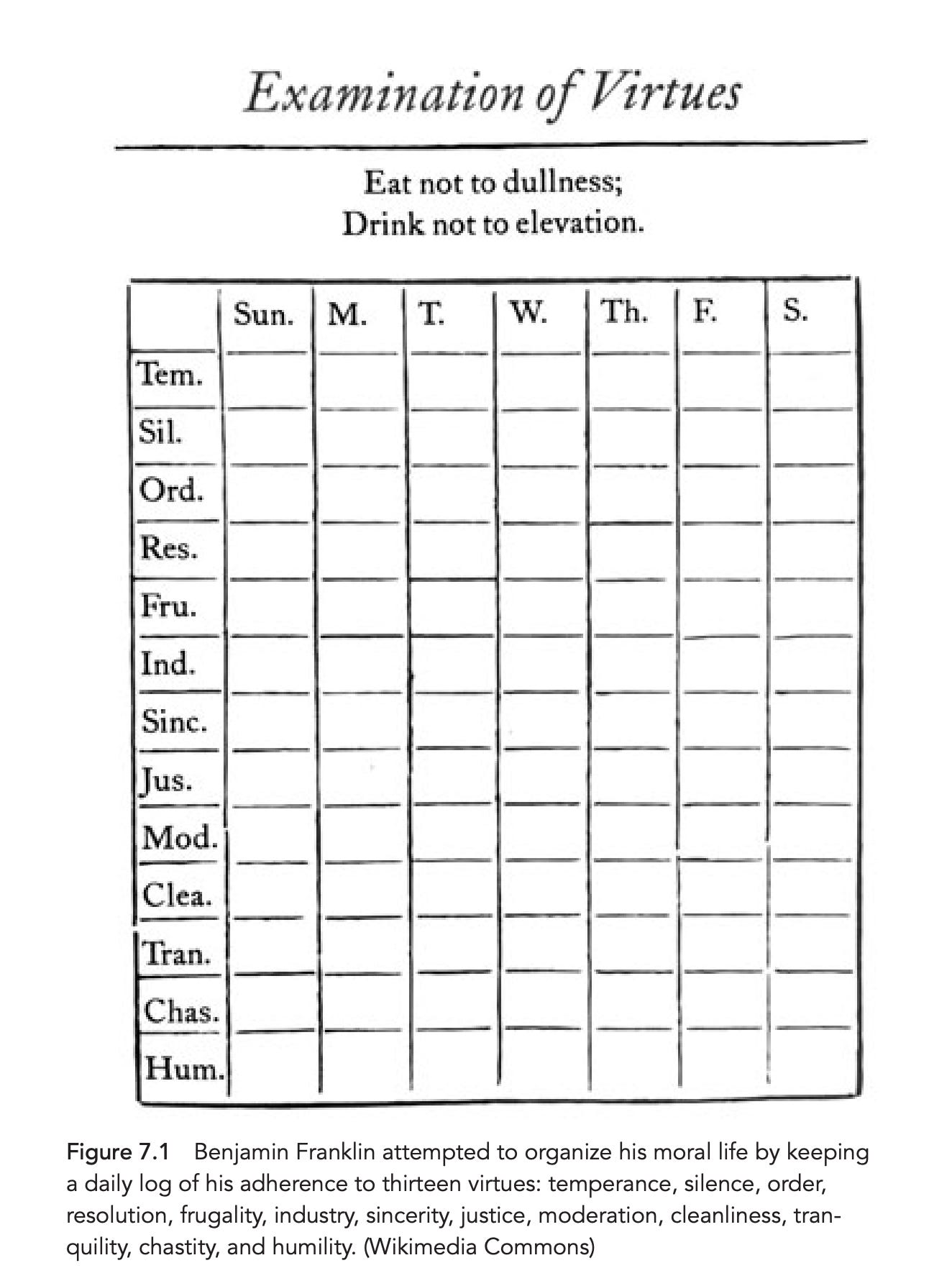
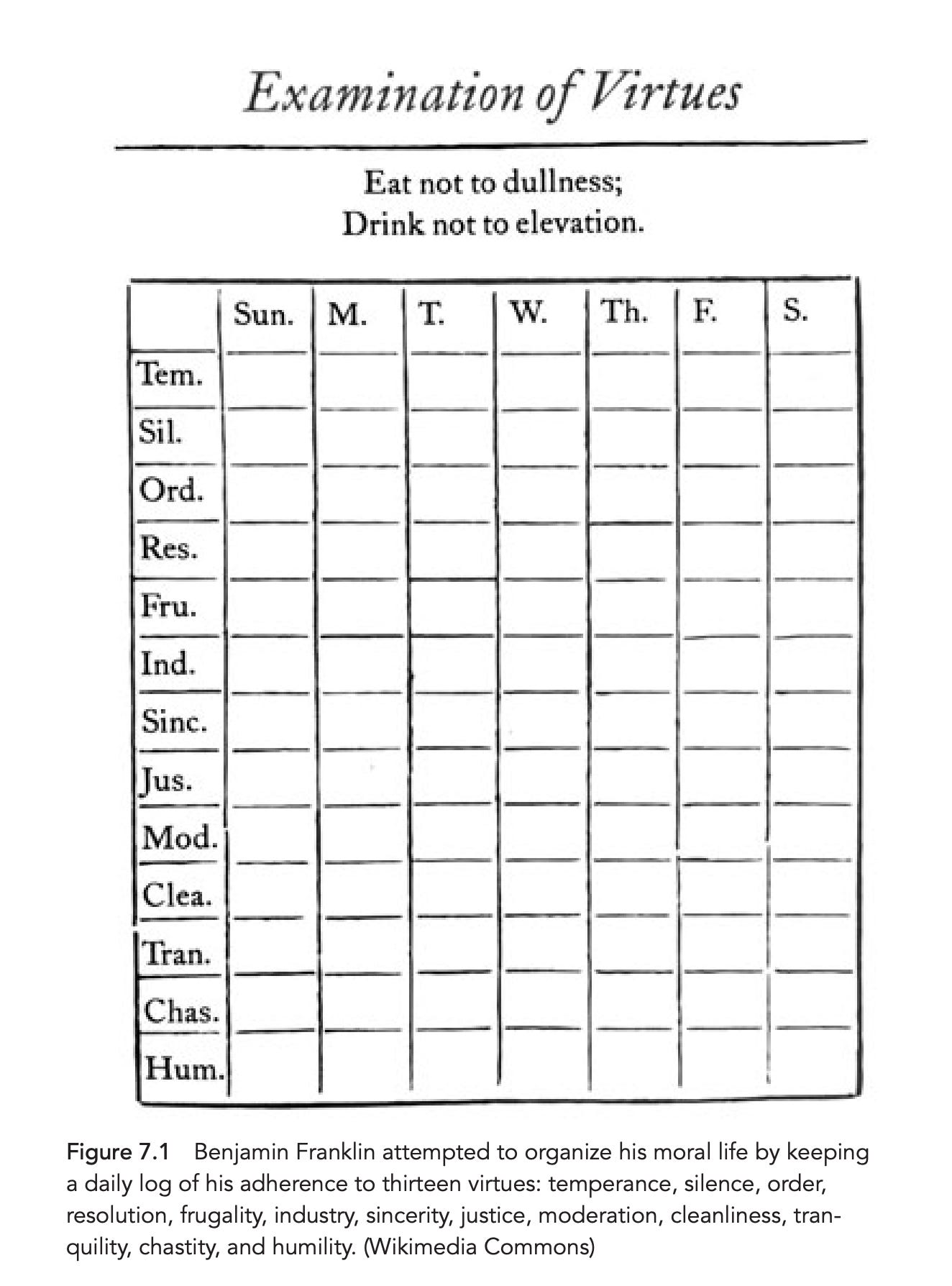
I’m not nearly as virtuous as Benny Franks but daily habit logs are a tale as old as time for us ADHD heads (strongly suspect BF was one of us) Make it a game. When I was younger, I used to make little bets with myself. I’d see how many days I could go wearing a matching underwear and bra (I vaguely remember this stemming from advice from Kris Jenner, because you “never know when you’re going to be caught in your underwear”… uhhhh), or how long I could go without buying anything new. There’s probably something undiagnosed mental illness there, but I have to say my little personal challenges and streaks have always been a reliable short term strategy for tricking myself into self-motivation. I also love doing a weekly habit checklist — mine is simple stuff, like walk, Pilates, read for 15-minutes, write 50 words, daily journal, make something art-y — where I don’t have to do every habit every day, but I do need to score at least 15 points a week. Your brain will chase a game long past the point where it will chase an obligation, and it is remarkably easy to trick — I have never once beaten my own resistance with reasoning, and I have beaten it dozens of times with a kitchen timer.
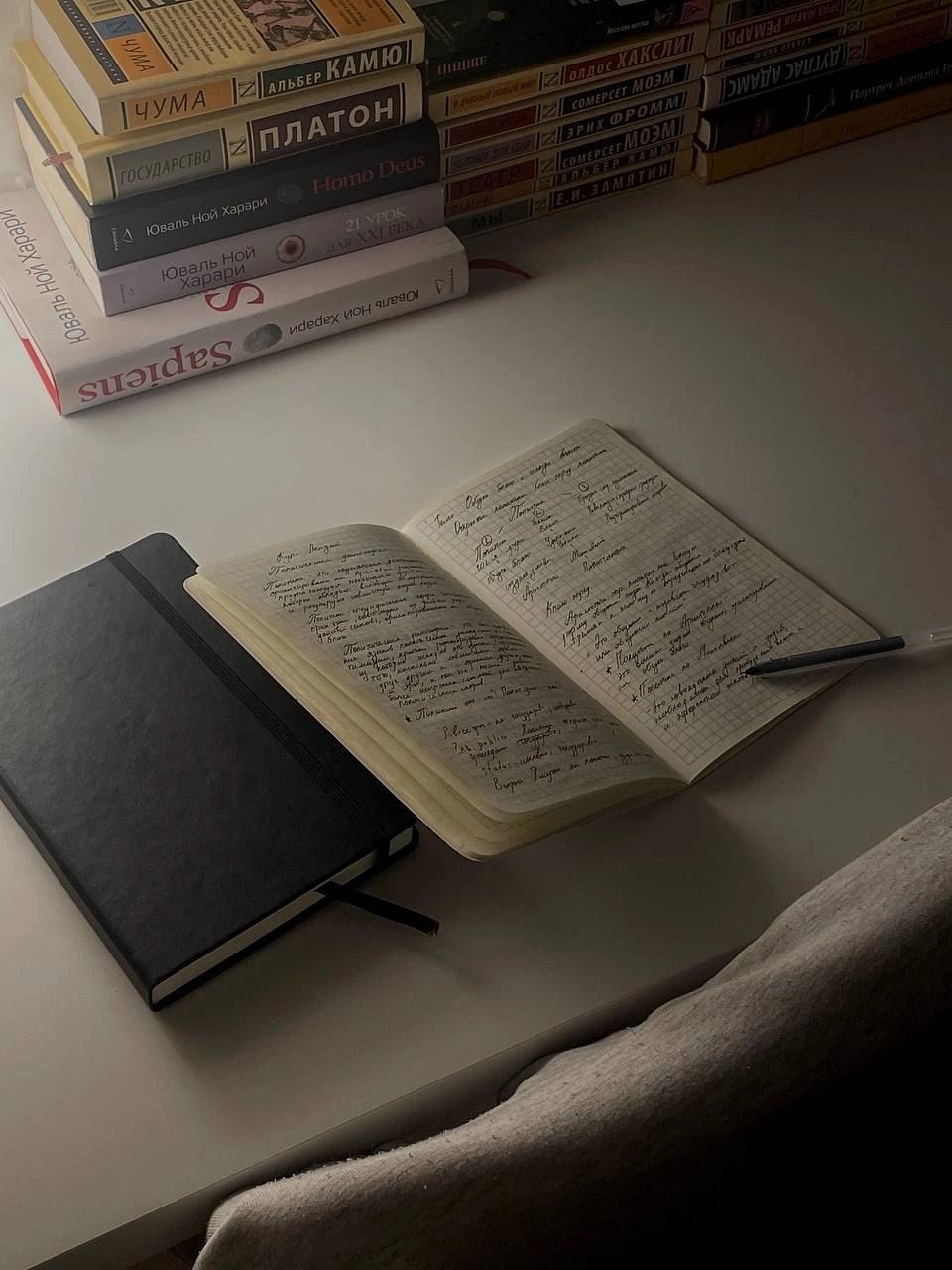
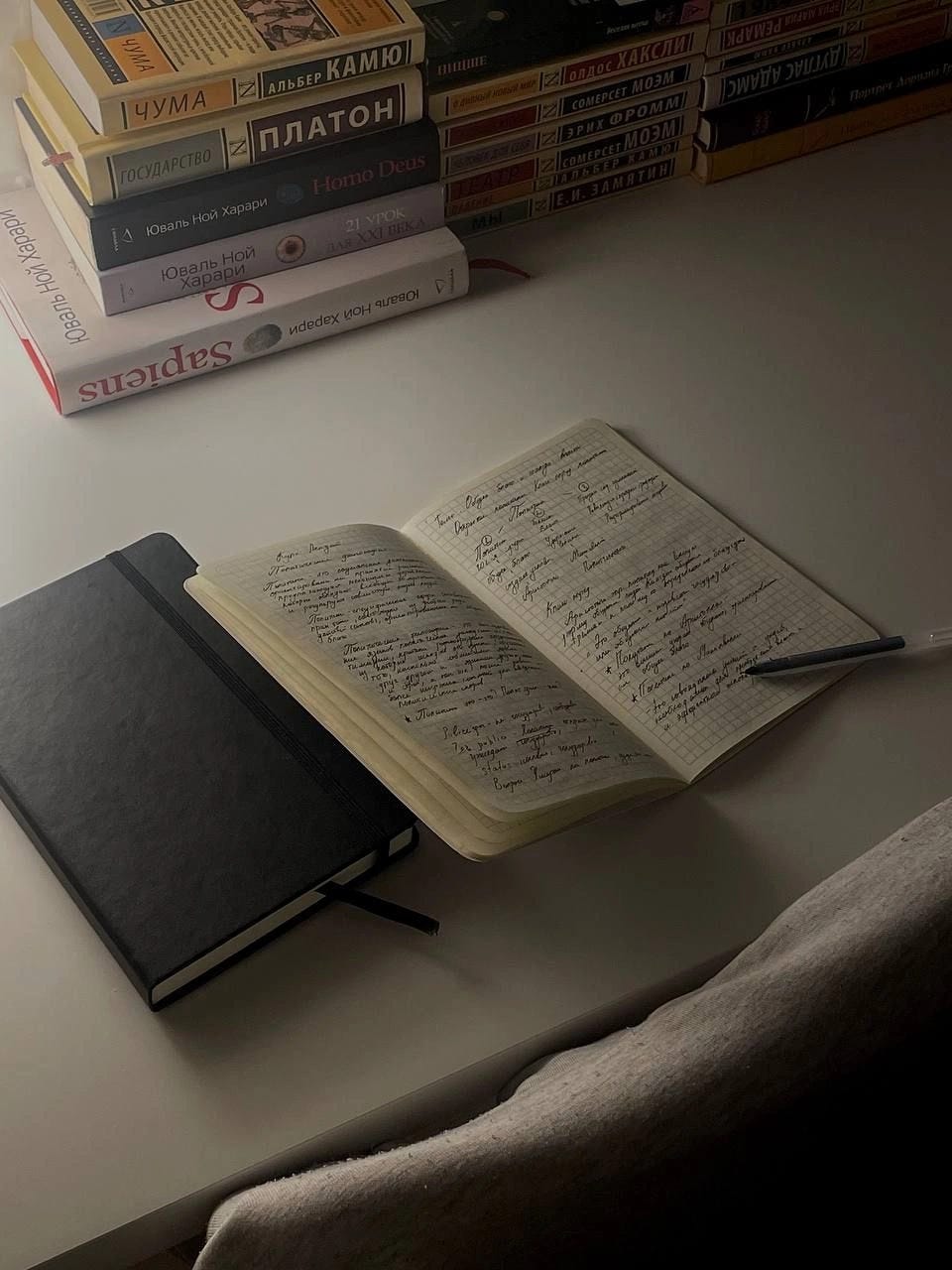
Write end-of-day notes. God, this one sucks, too. It’s so simple and it works, which means there’s really no reason not to do it and that is what actually sucks about it — it’s all gain, no pain. I tell myself I don’t have the three minutes before bed to write down what I read and thought about and consumed each day, but wouldn’t you know it? The reflective notes I do take the time to write down are often where I have an epiphanic breakthrough, or where I achieve mental clarity on a problem I’ve been stuck on for months. It happened to me yesterday: I was writing notes on an article I’d read a few days ago, and I was struck by the revelation that this article I’d annotated about the connection between leisure and numinous experiences was actually integral to a paper I’d been stuck writing all summer about algorithmic automation. I did not see the connection when I was in the midst of reading. It was only when compiling my notes that things solidified for me.
Embrace the season you’re in (sprints, not deep work sessions). I loved reading about Tess Guinery’s work process for SPACIES — my son was a year old at the time, and I’d kept telling myself that I need a big ol’ chunk of time to embark on my creative projects. But really, I could get a lot more done in 15 minutes than I realized. Sometimes you’re in a season of sprints, not a season of deep work. It’s not that deep, work with what you’ve got.
Do the daily mark. On Kawara painted the date. Every day, the same small act, and if he didn’t finish before midnight he destroyed the painting. Evil genius, truly. The destruction clause is what makes it a practice instead of a nice intention. You need a mark — one tiny non-negotiable action toward the thing, every day, regardless of mood. Smaller is better. Fifty words a day for ten weeks (roughly one text between me and my sister) will get you further than 500 words a day if you don’t reliably open the document. Get the reps in. The consistency is the foundation, and the foundation is what lets the work run freely later.
I have soooooo much more to say on burnout, and even wrote a whole course for the North Node on what helped me get out of a pretty tough burnout nosedive. Is that something people want more of?
Comments
Nothing yet. Say the first thing.
Sign in to join the conversation.