
Last year, I had so much fun drawing some of the candidates which deserved more attention in the Bird of the Year competition that this year I’ve gone even further. I am officially the campaign manager for the tītī or Cook’s petrel. Over the next couple of months, I’ll be sharing images and information about the tītī and other members of the Seabird Party, both here and on social media.
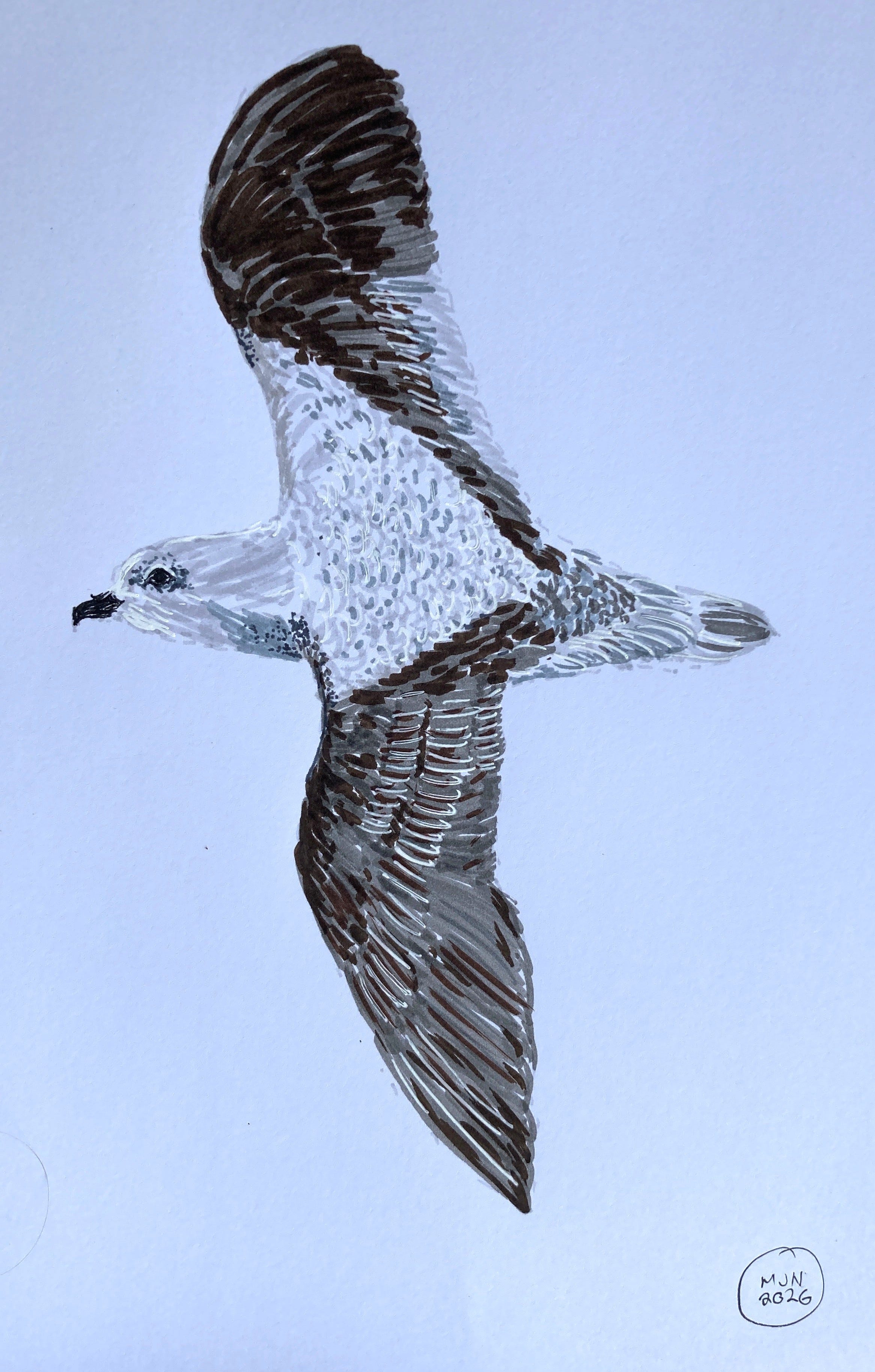
So, to launch the tītī campaign, I’ve decided to write about the remarkable travels of the tītī and some of our other seabirds. Usually, these journeys are something to celebrate, but this year they are also cause for concern. We’ve already had a couple of bird flu detections in New Zealand, but when our wandering seabirds come home to roost in the spring, we can expect to see many more cases. That’s if they return at all.
Many of you will have heard about the extraordinary flights made by the 2015 Bird of the Year, the kuaka or bar-tailed godwit. The birds which arrive on our shores in the spring of each year have made a non-stop 8-9 day flight from western Alaska. The spend the spring and summer feeding in harbours and estuaries, then those which are ready to breed depart for Alaska in March. One way, it’s over 11,000 kilometres, and the first time the kuaka makes this journey, it’s only four months old.
The journeys made by seabirds such as the tītī are different. When tītī depart from New Zealand in the autumn, they are not heading for land, but the vast expanse of the Pacific Ocean. They spend most of their time in flight, and rest only on the water. The next time they touch the ground, it will be when they return in the spring. Some will have been feeding off the coast of California and Mexico, where an upwelling of cool water carries nutrients from the sea floor and supports abundant squid (their main food) and other marine life. Others will have been feeding off the coast of Peru and Chile, where a similar upwelling creates another rich bounty of food for seabirds. While tītī don’t travel quite as far as the kuaka, they still make a round trip of more than 20,000 kilometres.
The name tītī refers to more than one type of seabird. The best-known is probably the species known in English as the muttonbird or sooty shearwater, a large, dark seabird which is still found in the millions on some of our southern offshore islands. Another species of tītī is also known as the grey-faced petrel, which mainly breeds on northern offshore islands, but does still breed on the mainland in a few areas. The third common species to bear the name tītī is the tītī wainui or fairy prion. In the north, it breeds only on the Tawhiti Rahi or Poor Knights Islands, but breeds on many islands and rock stacks from Marlborough southwards, as well as Rēkohu (the Chatham Islands) and the Subantarctic Islands.
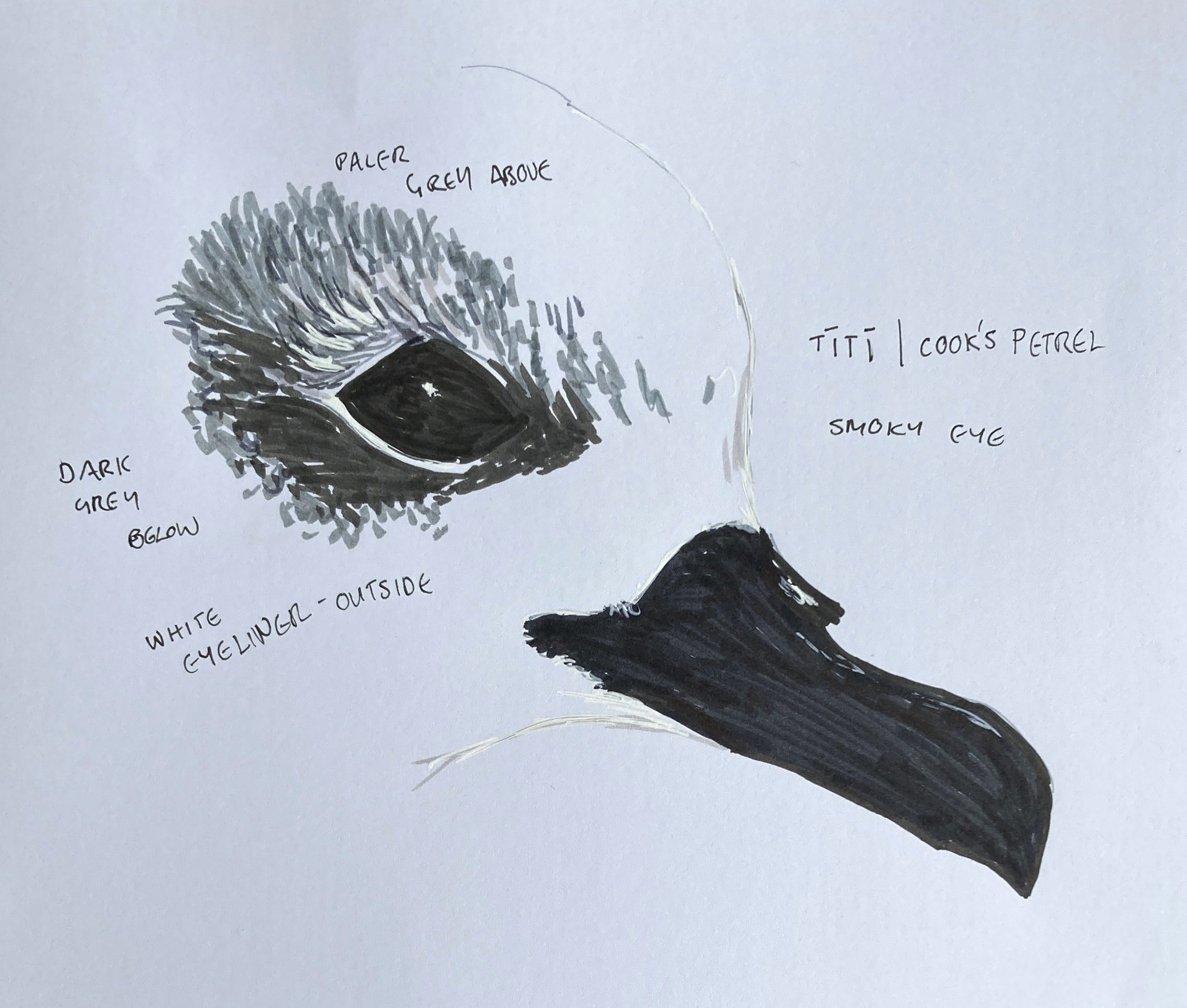
Cook’s petrel is one of two much rarer tītī species. It breeds only on Aotea (Great Barrier Island) and Te-Hauturu-a-Toi (Hauturu or Little Barrier Island), to the north-east of Auckland, and Whenua Hou, near Raikura (Stewart Island). The birds which breed north of Auckland are different from the birds which breed on Whenua Hou, and they are considered to be two separate subspecies.
The other rare tītī is the Kaikōura tītī, or Hutton’s shearwater, which breeds high in the Kaikōura Ranges. It’s an extraordinary bird, with adults foraging up to 250 kilometres offshore to feed their chicks which are in burrows around 1200 metres above sea level. It’s also in trouble, classed as Nationally Vulnerable and with only two colonies remaining. A small backup colony has been established on the Kaikōura Peninsula, safely behind a predator-proof fence. Establishing seabirds in new locations is extremely difficult and from the many hundreds of birds moved to the site, there’s now an average of 30 eggs laid and 22 chicks fledged each year. It doesn’t sound like much, but it’s huge progress1.
The birds which fall under the name tītī all belong to a family of birds known in English as petrels, shearwaters, prions or fulmars . They are cousins to albatrosses, mollymawks and storm petrels, but are not closely related to gulls, terns and skuas. Cook’s petrel is one of the gadfly petrels, so called because their flight is rapid, weaving and erratic, much like that of gadflies, which are large, biting flies. It’s a close relative of one of my favourite seabirds, although not a Bird of the Year candidate this year, the Chatham Island tāiko, which was thought to be extinct for over a century before its rediscovery in 1978.
In the past, all of our tītī species, as well as the other petrels and related species, would have bred in massive colonies on New Zealand’s two main islands. These birds, however, all nest on the ground. They lay a single egg, large in relation to their body size, usually in a burrow. It isn’t only the eggs and chicks which are vulnerable on the ground. Apart from the giant petrel, which can strut around and squabble over carrion as well as any seagull or skua, petrels and their relatives are largely unable to walk. On land, they shuffle and stumble, and sometimes assist themselves with their wings, as you can see in this entertaining encounter between a kākākpō on her nest and a kōrure which blundered into her burrow (click the link to see the short video).
Kākāpō vs. petrel (Department of Conservation YouTube channel)
It doesn’t take much to imagine what happened when introduced mammal predators arrived. A bird which comes off second-best in a fight with a kākāpō doesn’t stand a chance against a stoat or a cat. And eggs and chicks lying on the ground were defenceless against rats, pigs and all manner of other mammals. Almost all of our mainland tītī and other petrel colonies have been wiped out. Even those not classed as threatened now confine their breeding to a tiny remnant of their former range. Some ended up in desperate trouble, and we came close to losing Cook’s petrel forever.
Although it clung to survival on three islands, none of these islands was free of introduced predators. On Aotea, it had to contend with two species of rat, cats, dogs and feral pigs. On Hauturu there were feral cats and Pacific rats. On Whenua Hou, there were possums and Pacific rats as well as weka, a feisty, flightless bird native to New Zealand but not Whenua Hou. Although weka are a much-loved native bird, they can also be predators. On islands which are crucial for the survival of endangered species and where weka aren’t native, they can be a problem.
By the 1970s, the southern subspecies of Cook’s petrel was close to extinction. On Whenua Hou, where there had been around 20,000 burrows in the 1930s, there were perhaps as few as 100 breeding pairs remaining. There were more birds of the northern subspecies, with tens of thousands of birds breeding on Hauturu, although only a dozen burrows had ever been found on Aotea, despite extensive searching. However, even the birds on Hauturu were far from secure. Hundreds of birds killed by cats were found during studies on Cook’s petrel in the 1970s and taking into account the areas not searched, it’s likely that many thousands of adult birds were being killed every year. Fewer than half of the eggs laid survived to the point where the chicks fledged in any of the colonies. For bird which lay clutches of several eggs, that might not be a disaster, but petrels and their relatives lay a single egg each year.
Cook’s petrels go to extraordinary lengths to care for their single egg. For around 50 days, they take turns incubating it. Once the chick hatches, one or other parent will initially stay to guard it, while the other forages. Soon, however, the chick is left alone in its burrow while the parents gather food. Their foraging trips last 2-12 days, covering hundreds of kilometres, and they are in flight for around three quarters of that time.
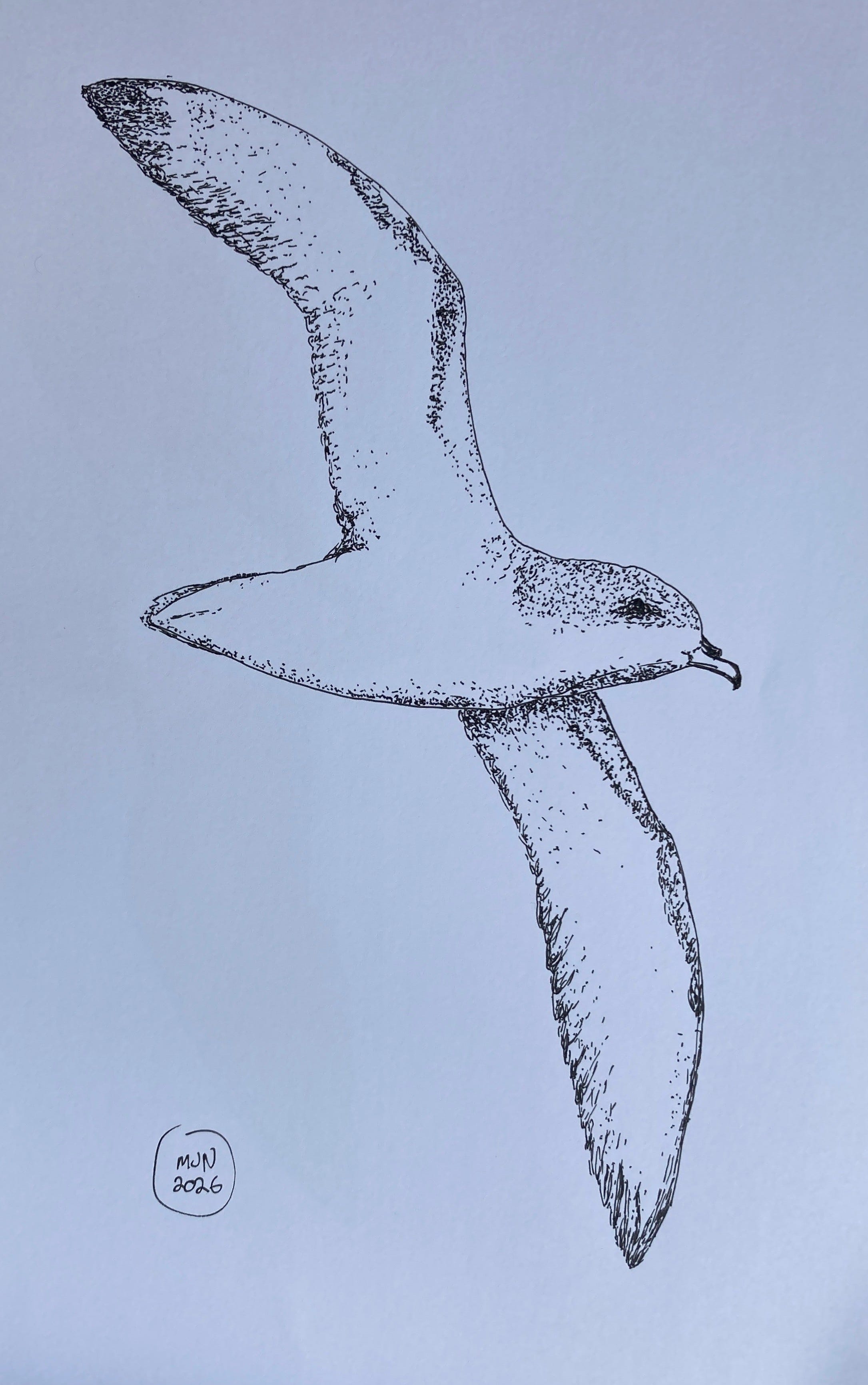
These extraordinary efforts, however, often came to nothing in the presence of mammal predators and weka. And Cook’s petrels were far from the only species in serious trouble on islands such as Hauturu and Whenua Hou2. So, from the 1970s on, serious efforts began to control the predators. Cats were eradicated from Hauturu in the late 1970s and possums eradicated from Whenua Hou in the 1980s. Weka were also recognised as a threat on Whenua Hou, and removed in the early 1980s, a decision which almost certainly saved the Whenua Hou birds from extinction.
But the birds on these islands, including Cook’s petrel, were not out of trouble. On Whenua Hou, the number of breeding birds increased steadily following the removal of weka, but breeding success fluctuated considerably from year to year. In those years with a strong El Niño, there were much greater losses, while rats continued to kill eggs and chicks. On Hauturu, Cook’s petrel first showed signs of recovery following cat eradication, but within a couple of years their situation had worsened. Prior to the eradication of cats, 25-40% of chicks survived to leave the nest. Once the cats were gone, the rats increased and began to kill more eggs and chicks. At best around 20% of Cook’s petrel chicks on Hauturu survived following cat eradication.
Rats were eradicated from Whenua Hou in 1998 and Hauturu in 2004. A survey in 2007 found that there were around 5000 pairs of Cook’s petrel on Whenua Hou. It may take some time for the birds to reach their former numbers on the island, but they are certainly recovering.
The picture is less clear for Hauturu, simply because Cook’s petrel is a difficult bird to monitor. Breeding success has improved, but I haven’t found precise numbers. A study published in 2007 estimated that there were more than 280,000 pairs on Hauturu. This number is sometimes compared with the estimated numbers in the early 1980s, around 50,000, to indicate that the species is recovering. However, it’s not that simple.
A close look at the 2007 paper shows that most of the field work was done from November 2004 to March 2005. This work began less than 6 months after the rat eradication took place. That’s far too soon for a slow-breeding bird which was losing most of its nests to rats to have recovered. There are two possible explanations for the numbers. The first is that despite the losses attributed to rats, Cook’s petrel recovered strongly following the cat eradication. It’s certainly plausible that the losses to cats exceeded the increased losses to rats, especially as cats were killing adult birds. However, the authors of the 2007 paper suggest another reason. It’s difficult to count a bird which, during the breeding season, spends its days at sea and returns to land only at night, to nests which are underground in steep areas of dense forest, then, once breeding has finished, disappears to the far corners of the Pacific Ocean. The authors state that the difference in bird numbers is likely to be because they used a better method for counting them.
With two of the three populations of Cook’s petrel now on islands free from introduced predators, the species is no longer in serious trouble, although the colony on Aotea remains in a precarious situation. But bird flu brings a new threat. So far, there have been only two New Zealand detections. However, many of the seabirds which breed around New Zealand are currently far away from here. So, too, are shorebirds such as the kuaka which breed overseas but spend their summers feeding here. In a month or so, they will begin returning. I don’t know for certain, but I suspect that it will be spring and summer when bird flu becomes more apparent here. That’s been the pattern overseas.
As our wanderers return and congregate in the few locations which are safe for them, they are extraordinarily vulnerable. Whenua Hou is home not only to the southern form of Cook’s petrel and a large proportion of our kākāpō, it’s also the only place where the Whenua Hou diving petrel breeds, and a backup site for Subantarctic birds such as the Snares Island snipe and Campbell Island teal. The picture is similar on Hauturu and other offshore islands.
Conservationists have long understood the vulnerability of these islands to the arrival of a single pregnant rat or stoat, or even a determined wildlife smuggler. We’ve learned to manage these risks and brought a number of species, including Cook’s petrel, back from the brink. But whether we can do anything about such an intangible, elusive threat as a virus carried by birds which fly thousands of kilometres is another matter.

I know that the Bird of the Year competition is supposed to be fun, but I’ve decided that it’s also a great opportunity to highlight the threat of bird flu to our sea and shore birds. I’ll be sharing images and information here and on social media over the next few weeks and will share the voting link when the polls open on the 4th of September.
By the way, there are still a few birds who don’t have campaign managers, so if you’d like to help out one of our under-appreciated species, here is the link: Apply to be a Bird of the Year 2026 campaign manager | Forest and Bird.
I’ll return to the topic of seabird translocation another time, because it’s important and fascinating. It’s much, much harder than moving land birds, where you basically just catch a few birds, putting them in a box and releasing them somewhere else.
No posts
Comments
Nothing yet. Say the first thing.
Sign in to join the conversation.