
In the previous article from this series, I discussed why the miniature of an unknown woman, currently labelled as ‘Anne Boleyn’ in the newest exhibition at Hever Castle, has been proposed as her contemporary likeness.
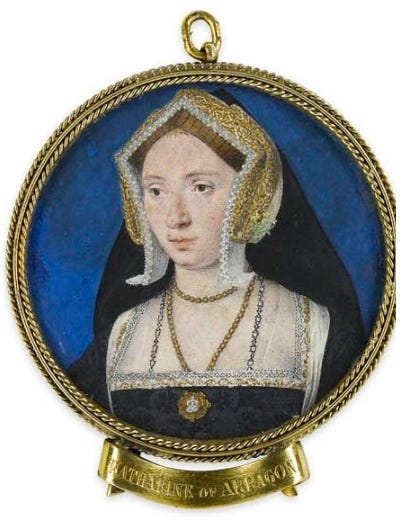
As I’ve noted in that article, there is nothing in the miniature that could lead back to Anne; no inscription, no coat of arms, no heraldry, no symbols and no documentation.
And yet, despite the lack of convincing evidence, the miniature is labelled as ‘Anne Boleyn’ in the exhibition at Hever Castle.
Historians at Hever base their attribution of the miniature to Anne Boleyn on a 2021 article by art historian Dr Susan James, who argued that the sitter is Anne because:
‘She wears a gold brooch that emulates a Tudor rose, mounted with a cameo carved with what appears to be a figure enthroned, as well as two chains, one of silver and one fashioned from tiny, linked daisies or marguerites made of gold with a small pearl in the center of each. To the Tudors, the daisy represented innocence or virginity, an interesting symbol for Anne to choose at a time when the king was pressing her to become his mistress. Tucked into her headdress is a sprig of yellow wallflowers (erysimum) whose meaning in the Tudor language of flowers is “perseverance”, a chivalric virtue. This floral symbol is particularly significant as Lady Perseverance was the role which Anne played at her first court pageant in March 1522 upon her return to England from France and would therefore have been the first time she was brought to the king’s attention’. [1]
However, Dr James’s interpretation of the symbolism is incorrect.
There are no daisies in the sitter’s chain, as Dr James claims. What if there were? In portraiture, daisies (marguerites) were usually associated with the sitters who were named Margaret. Famous Margarets of the fifteenth and sixteenth centuries, including Margaret of York, Margaret of Anjou, Margaret of Austria and Margaret, Queen of Navarre, used daisies as a recurring motif in their books of hours, poetry and portraits.
The presence of daisies would suggest that the sitter’s name is Margaret.
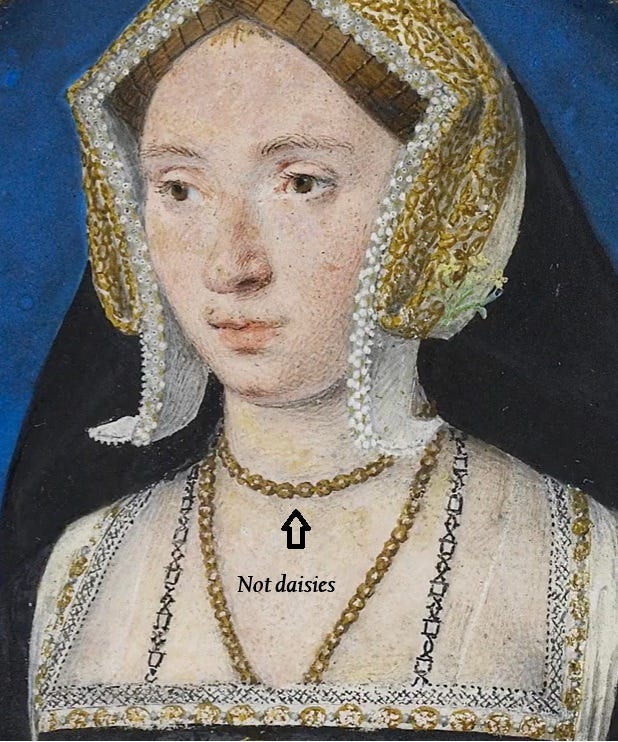
A sprig of wallflowers is pinned to the sitter’s headdress. Dr James interpreted wallflower as a symbol of perseverance but provided no source. She argued that the presence of wallflowers fits Anne’s story because Anne played the role of Perseverance in the Chateau Vert pageant of 1522. However, in medieval and early modern portraiture, wallflowers symbolised fidelity and devotion, not perseverance.[2] There is also no contemporary evidence that Anne played the role of Perseverance in the Chateau Vert pageant.
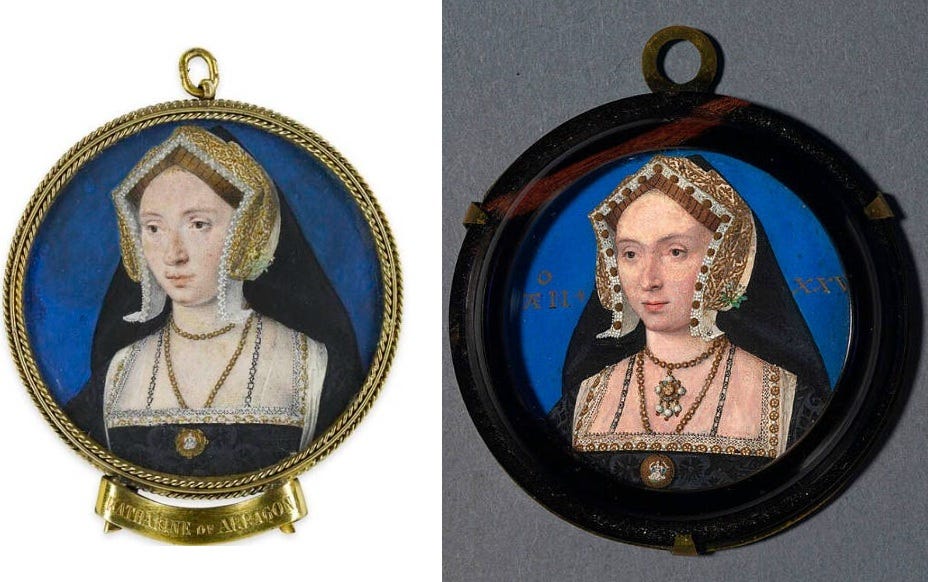
Dr James’s arguments are closely repeated in the Capturing a Queen: The Image of Anne Boleyn exhibition catalogue, with Dr Emmerson and Kate McCaffrey further arguing that the Buccleuch and the Royal Ontario Museum’s versions bear similarities to the so called ‘Windsor sketch’ by Hans Holbein.
The ‘Windsor sketch’, inscribed as ‘Anna Bollein Queen’, is widely accepted by scholars as a contemporary likeness of Anne. But is the sitter from the Buccleuch collection the same person as the one from the ‘Anna Bollein Queen’ sketch?
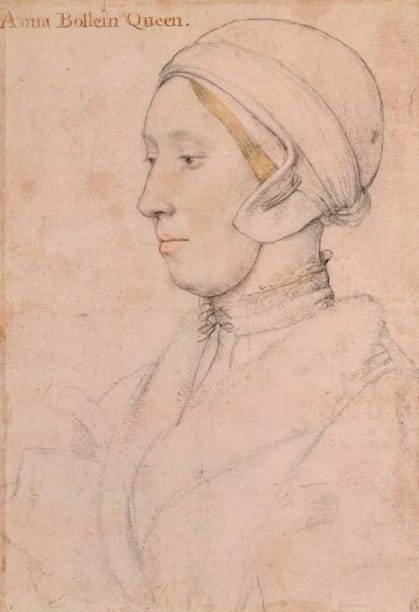
Resemblance is an objective observation. Bold claims require strong supportive evidence, and none is provided in this case. Dr James’s interpretation, repeated in Capturing a Queen exhibition catalogue, is riddled with inaccuracies.
The miniature from the Buccleuch collection has been linked to Anne Boleyn solely because earlier historians, who had never examined the miniature in person, mistakenly believed that the brooch pinned to the sitter’s gown depicted a falcon, Anne’s heraldic badge.
The search for Anne Boleyn’s face continues.
Sources:
[1] Susan E. James, The Horenbout family workshop at the Tudor court, 1522–1541: Collaboration, patronage and production, p. 32. See also Owen Emmerson & Kate McCaffrey, Capturing a Queen: The Image of Anne Boleyn, pp. 91-95.
[2] In Flowers in Medieval Manuscripts, Dr Celia Fisher writes that a wallflower ‘became a Troubadour symbol of fidelity to a lost love’. In Flowers through the Ages, Gabriele Tergit pointed out that ‘medieval knights wore wallflowers as a symbol of unvarying devotion to the mistress of their heart’.
—
Interested in Tudor portraiture? I wrote a book about it: Secrets of the Tudor Portraits.
No posts
Comments
Nothing yet. Say the first thing.
Sign in to join the conversation.