
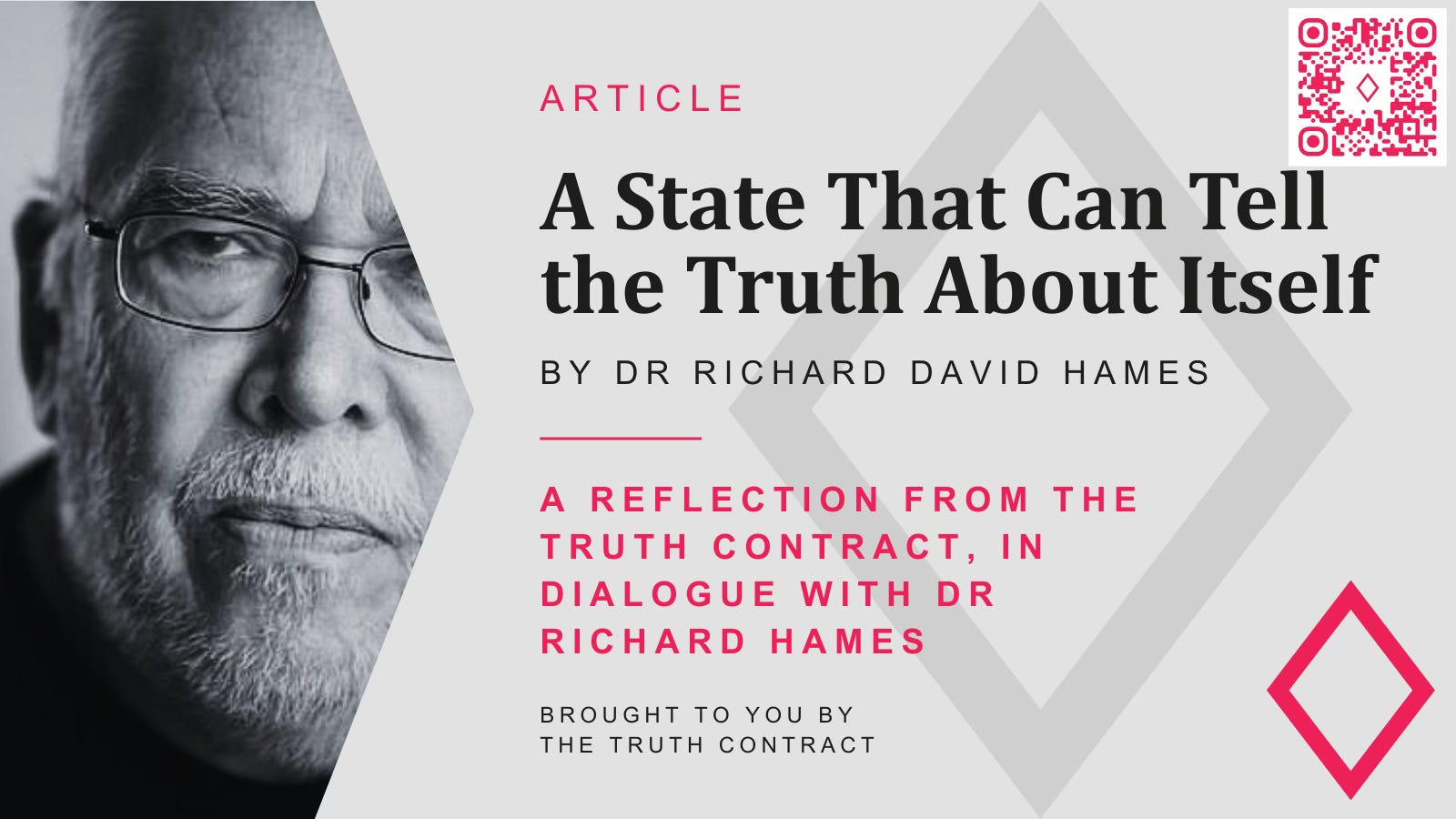
Dr Richard David Hames (The Virtual Activist) is a philosopher-activist and strategic foresight practitioner known for his work on governance, systems change, and civilisational metamorphosis. A pioneer of Deep Design, his work challenges the assumptions of industrial economism and technocratic power, emphasising learning cultures, truth, and institutional legitimacy. He has advised governments, global enterprises, and heads of state worldwide, and writes extensively on humanity’s capacity to adapt in times of systemic disruption.
Richard originally published this Truthful State piece through The Virtual Activist on Patreon. What follows is a reflection from The Truth Contract – offered in dialogue with his exploration of the Truthful State, rather than as summary or endorsement.
Some essays arrive as arguments. Others arrive as pressure points. Richard Hames’ exploration of what he calls a Truthful State belongs firmly in the latter category. It does not attempt to resolve the crisis it describes; instead, it sharpens it – bringing into focus the question many institutions now strain to avoid: what would governance look like if truth were treated not as a slogan, but as a discipline?
The exchange that frames Richard’s essay – between himself and David CM Carter, co-founder of The Truth Contract – is one TTC recognises well. It is the kind of long-running, friction-rich conversation that resists neat agreement yet continues because the stakes are too high to abandon. How do societies take truth seriously in cultures that increasingly treat it as optional? And what kinds of institutions could survive such seriousness?
A central insistence of Richard’s piece is that misinformation and fake news are symptoms rather than causes. The deeper wound is epistemic: the erosion of a shared sense of what truth looks like, how it is tested, corrected, and held accountable. From TTC’s perspective, this diagnosis is crucial. Truth cannot function as a civic foundation if it is reduced to content alone. It must operate as a practice – one that binds disclosure to responsibility, evidence to consequence, and correction to legitimacy.
This is where Richard’s anxiety about capture becomes decisive. History offers no shortage of regimes that invoked “truth” while hollowing it out, redefining it to suit power, continuity, or growth. Industrial economism – the extractive logic still dignified as “the economy” – is perhaps the most sophisticated contemporary example. It presents itself as neutral fact while quietly encoding contested assumptions about value, labour, nature, and human worth. Awkward evidence is dismissed as extremism; alternatives are labelled unrealistic. In that context, any project that claims truth must assume contest, subversion, and pressure from the outset.
A Truthful State, if it were to mean anything at all, could not simply place a new banner over old structures. It would need to reach into how decisions are made, how money flows, and whose experience counts as evidence. Richard’s critique of command-and-control bureaucracies points directly to this fault line. Systems designed to protect authority rather than learn from reality inevitably privilege defensibility over understanding. Information rises as edited briefings; consequences return, if at all, as crises.
By contrast, Richard sketches a different organisational logic: one that assembles around concrete problems rather than abstract portfolios. Food systems, river basins, mobility, care – these become sites of shared inquiry rather than departmental turf. Farmers and engineers, clinicians and patients, elders and citizen scientists are not “consulted” but invited as co-authors of experiments. Policy becomes hypothesis rather than decree. Failure becomes information rather than scandal.
For TTC, this emphasis on learning culture is foundational. Truth cannot survive in institutions where admitting error is career-ending. A state that takes truth seriously would need to reward revision, explanation, and public correction. Humility would cease to be a personal virtue and become an institutional competence.
Richard’s rejection of the stale binary between populism and technocracy is especially important. Modern politics oscillates between flattery and insulation: either reducing complexity to slogans or outsourcing legitimacy to experts shielded from those who live with the consequences. Both models corrode trust. His proposal of a bicameral civic-epistemic weave – elected representatives alongside citizens chosen by lot, deliberating with experts under strict conflict-of-interest rules – offers one plausible route beyond this impasse.
What matters here is not institutional novelty for its own sake, but epistemic symmetry. Experts, in such a system, are not oracles. They are participants with obligations: to disclose assumptions, show workings, and argue in language that non-specialists can interrogate. Truth emerges not from authority alone, nor from sentiment, but from the disciplined encounter between lived experience and structured inquiry.
The same demand for honesty runs through Richard’s treatment of revenue. “Watch how a state raises money if you want to know what it values” is not a rhetorical flourish but a diagnostic tool. The prevailing model – taxing labour heavily while allowing rents on shared endowments to accumulate privately – reveals a great deal about whose contributions are recognised and whose are invisible. Land, resources, ecological sinks, infrastructure, and collective data are public gifts, yet the returns flow disproportionately to private balance sheets.
A Truthful State, as Richard frames it, would not pretend these arrangements are inevitable. It would admit they are choices – and subject them to scrutiny. Whether through land value charges, resource and pollution fees, levies on speculative financial churn, or payments for commercial use of collective data, the point is not perfection but transparency: who benefits from public gifts, and who bears the costs of public harms.
Where the essay becomes most unsettling – and therefore most necessary – is in its refusal to separate biological reality from political economy. The cluster of trends Richard names provocatively as SpermEggGeddon – declining fertility, ageing populations, endocrine disruption, chronic stress, environmental toxicity – functions as a systems stress test. These are not marginal issues. They reach into labour markets, care systems, migration policy, cultural anxiety, and intergenerational justice.
From TTC’s perspective, the power of this section lies in what it refuses to do. It does not moralise reproductive choices. It does not reduce complex outcomes to individual preference. Instead, it asks a civilisational question: what have our economic, environmental, and cultural arrangements done to the conditions of life such that many people either cannot have children, or no longer dare to? A state that cannot tell the truth about the fate of its own bodies is unlikely to be honest about much else.
Richard’s treatment of immigration, particularly in the UK context, is similarly unsparing. Without migrant labour, large parts of the economy and welfare state would already be failing. Yet public narratives swing between economic necessity and cultural panic. A Truthful State, he argues, would neither flatter nor sneer at the anxieties involved. It would replace viral projections and dog whistles with demographic literacy, historical context, and honest reckoning with long-term trajectories – both domestic and global.
Crucially, it would connect the dots. Fertility, ageing, migration, housing, work patterns, chemical exposure, food systems – these are not separate policy files but interlocking dimensions of a single civilisational experiment. Treating them as such is not alarmism; it is epistemic maturity.
Richard is also careful to locate much genuine innovation outside formal state structures: in cooperatives, indigenous councils, mutual-aid networks, cross-faith alliances, and local experiments in “living otherwise.” A Truthful State would not attempt to absorb these initiatives or leave them exposed to predation. Its role would be closer to stewardship than control: offering legal shelter, modest resources, and protection, while learning from their grounded intelligence.
This reframing of leadership – as a pattern of relationships rather than a heroic figure – aligns closely with TTC’s own orientation. Truth, in this sense, is not delivered from above. It is cultivated across scales, through practices that bind people to shared responsibility for the worlds they inhabit.
Richard closes with an uncertainty that TTC shares. The pressures bearing down on existing regimes – climate disruption, ecological collapse, pandemics, demographic shifts, financial instability – could just as easily produce more secrecy, surveillance, and brittle narratives as they could open pathways toward honesty. Treating authoritarian drift as destiny, however, is itself a form of abdication.
The idea of a Truthful State, as Richard presents it, is not a constitutional blueprint. It is a compass bearing. It asks what institutions would look like if telling the truth – about reality, about themselves, about the systems they serve – were treated as seriously as maintaining growth or winning the next election. Pieces of that answer already exist: citizen assemblies with teeth, media organisations that publish correction logs, movements mapping public wealth, and platforms like The Truth Contract that insist truth is not a luxury for specialists but a shared civic discipline.
Civilisations that cannot tell themselves the truth rarely survive intact. In that sense, a Truthful State is not a utopian add-on. It is a condition for adaptation – and perhaps for survival itself.
Follow Dr Richard David Hames:
Patreon: The Virtual Activist
Substack: The Hames Report
The Truth Contract – not just more content, but a commitment.
You’re here because the surface story doesn’t hold.
You’re ready to question, contribute, and help shape a future worth showing up for.
This is the contract: Truth. Action. Together.
Add your voice to the conversation. This is how we grow the mandate for change.
Comments
Nothing yet. Say the first thing.
Sign in to join the conversation.