
Late last week, I posted my first reflection on AI and what it means to “build the wall,” in the spirit of what Pope Leo XIV calls “the way of Nehemiah.” Since then, I’ve had numerous conversations about artificial intelligence with family, friends, and even strangers sitting at the communal table at my favorite coffee shop. It’s been fascinating to hear the spectrum of sentiments, ranging from excitement to bewilderment to confusion. But one prevailing thread stands out: a lack of clarity about what all of this means concretely for our everyday lives.
We could simply retreat into isolation and hope this all goes away on its own. But what if we were made for such a time as this? Like Esther, who found herself in a position to sway the king, perhaps we too have been entrusted with something to wield, not for our own sake, but so that we might contribute to God’s Kingdom here on earth.
But what, exactly, is ours to wield?
Before getting practical, I think it would be important to understand what our aim is, and what it is not. As a millennial and an active member of the technology industry, I know all too well the aim for efficiency and optimization. However, one thing we must always remind ourselves is that efficiency itself is not the end; optimization is not a final state. Rather, our aim, and the lens through which we should view any practical applications of artificial intelligence in our lives, should be something aimed toward human flourishing and our final end, that is, Heaven. With this lens, the question becomes less about “How can AI help me get more done?” but instead questions like, “What is keeping me from being fully present to the people and responsibilities God has placed in my life?”
This is not to say that optimization is not necessary, or that mundane labor is beneath us. In fact, quite the opposite. The great spiritual masters emphasize that virtue is sharpened in our daily duties and the demands of our daily lives. The dishes, laundry, scheduling, cleaning, and repeating tasks for the hundredth time can be the metaphorical weights strengthening our will, patience, diligence, and other virtues. They are formed in the hidden, repetitive, and often unseen work of daily life.
However, we should be honest about the cost of busywork and recognize that not all labor invites us to union with others and with God. Some labor simply consumes our attention. If we have the opportunity to unnecessarily reduce noise in our lives, the administrative fog and mental clutter that come with modern life and daily demands, then maybe that time, effort, and energy can be aimed at the service of something more human. Some responsibilities deepen our vocation, build us up in virtue, and guard us from vice. On the other hand, some responsibilities scatter our minds and leave us largely unavailable to the people in front of us.
The goal, then, is not to automate our lives. It is to create space to enter more deeply into the things that matter most. To become more present and available for the real work where love and virtue grow.
Yet even if we agree on that goal, we are still left with a practical question: How do we know which things AI should help with and which things we should guard?
Most of us would gladly use AI to organize a calendar, summarize a meeting, or generate a grocery list. Yet many of us instinctively recoil at the thought of AI comforting a grieving friend, disciplining a child, reconciling a marriage, or becoming someone’s primary spiritual guide. We recognize that these moments are fundamentally different, but we often struggle to explain why.
The problem is that we tend to ask the wrong question. We ask, “Can AI do this?” Capability, however, is a poor guide for discernment. A far better question is:
“What kind of human moment is this?”
Some moments are primarily logistical. Others are deeply formative. Some interactions require little of us beyond execution. Others ask for empathy, sacrifice, vulnerability, wisdom, forgiveness, or love.
If AI is one of the tools we have been entrusted to wield, then wisdom requires knowing when it can help us build and when it risks undermining the very things we are trying to protect.
To help think through those distinctions, I’d like to propose a simple framework and this framework considers two dimensions.
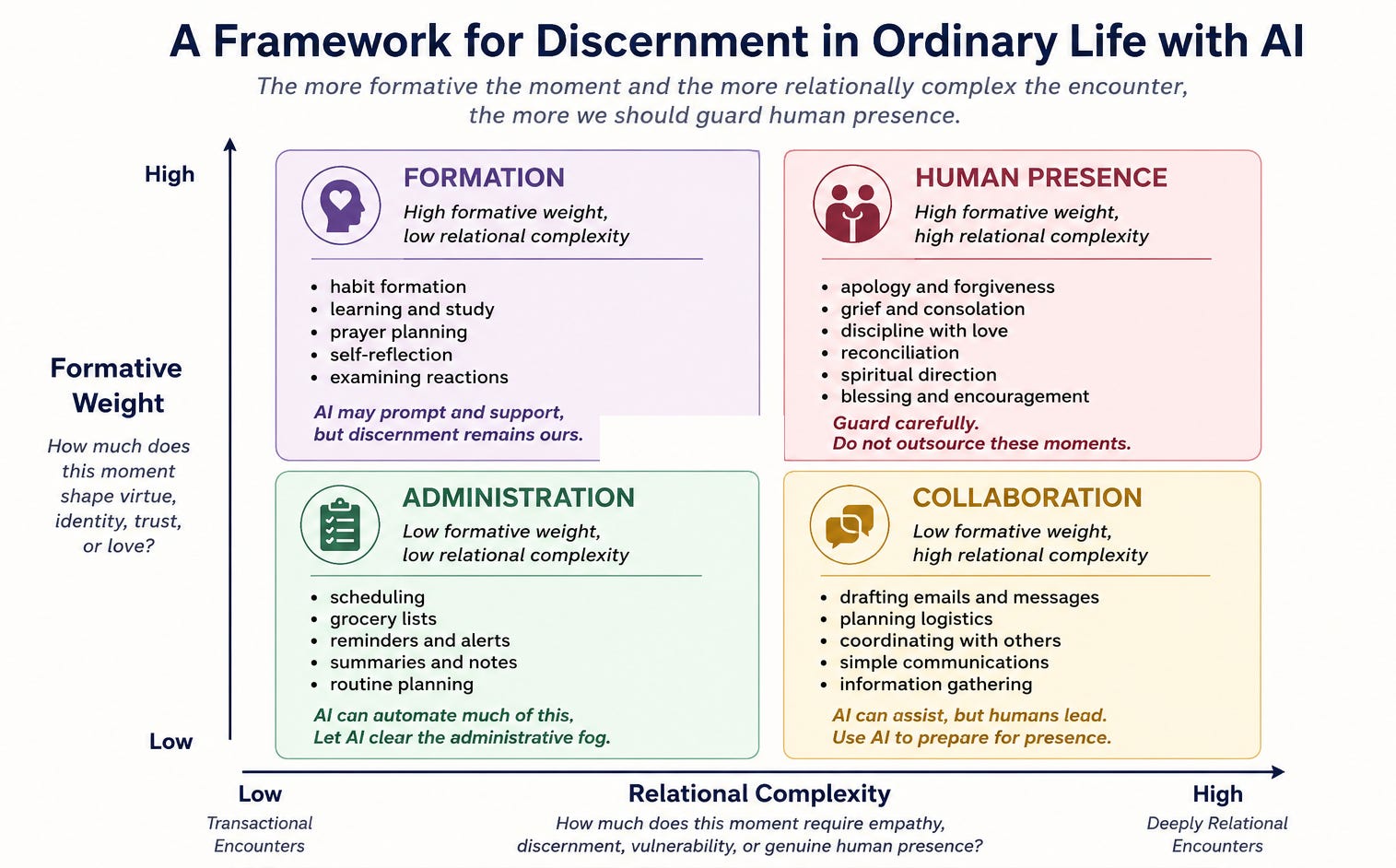
The first is Formative Weight: To what extent does this task or moment contribute to the formation of virtue, character, identity, faith, trust, or love?
The second is Relational Complexity: To what extent does this task require navigating human relationships, emotions, vulnerability, conflict, or communion?
My working assumption is:
The more formative the moment and the more relationally complex the encounter, the more we should guard human presence.
This framework is certainly not perfect, nor is it intended to provide definitive answers to every situation. Rather, it serves as a starting point for discernment, a way of thinking about AI that is guided not first by technological capability, but by our vocation to love.
With that framework in mind, my next posts will explore what this looks like in the various roles and responsibilities that make up our daily lives.
No posts
Comments
Nothing yet. Say the first thing.
Sign in to join the conversation.