
Shane is an artist, and sometimes writer who is from, and lives in the Caribbean. This is a letter from the road.
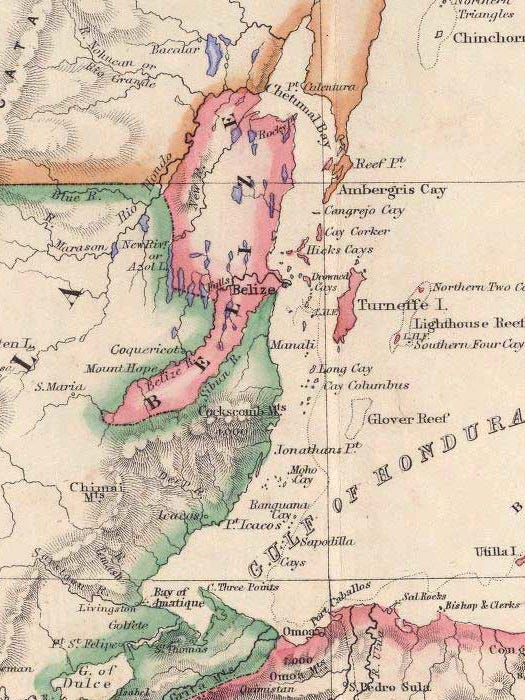
I had first arrived in Belize in time for a Christmas, in 1973, as a small boy: My father, and some friends, had bought themselves the ‘idea’ of a ranch, eh, the dream of one; they had bought something outlined on a piece topographical paper: bush that had yet to be bulldozed, developed, fenced, planted, created; a breeding herd that had yet to be bought, houses yet to be built, corrals made, horses found, stables erected.
And we were coming over, from Cayman, where he had been living, to see this.
‘Everyone has their own Rome,’ they say, and for the intervening years the Fort George Hotel was the centre of our Belize City; our point of transit, coming and going, and of lunch in town, on days when we came in, the 70 miles, to shop, to pick up the mail/post, to buy things the bush couldn’t provide, to get parts for tractors and trucks, and clear goods from customs; it and the Bellevue, but the Bellevue was gone now. And in the days after Belize, when my father was dying, in Guatemala, I would fly through Belize, stop at the Fort George, before going on to Flores in the Petén.
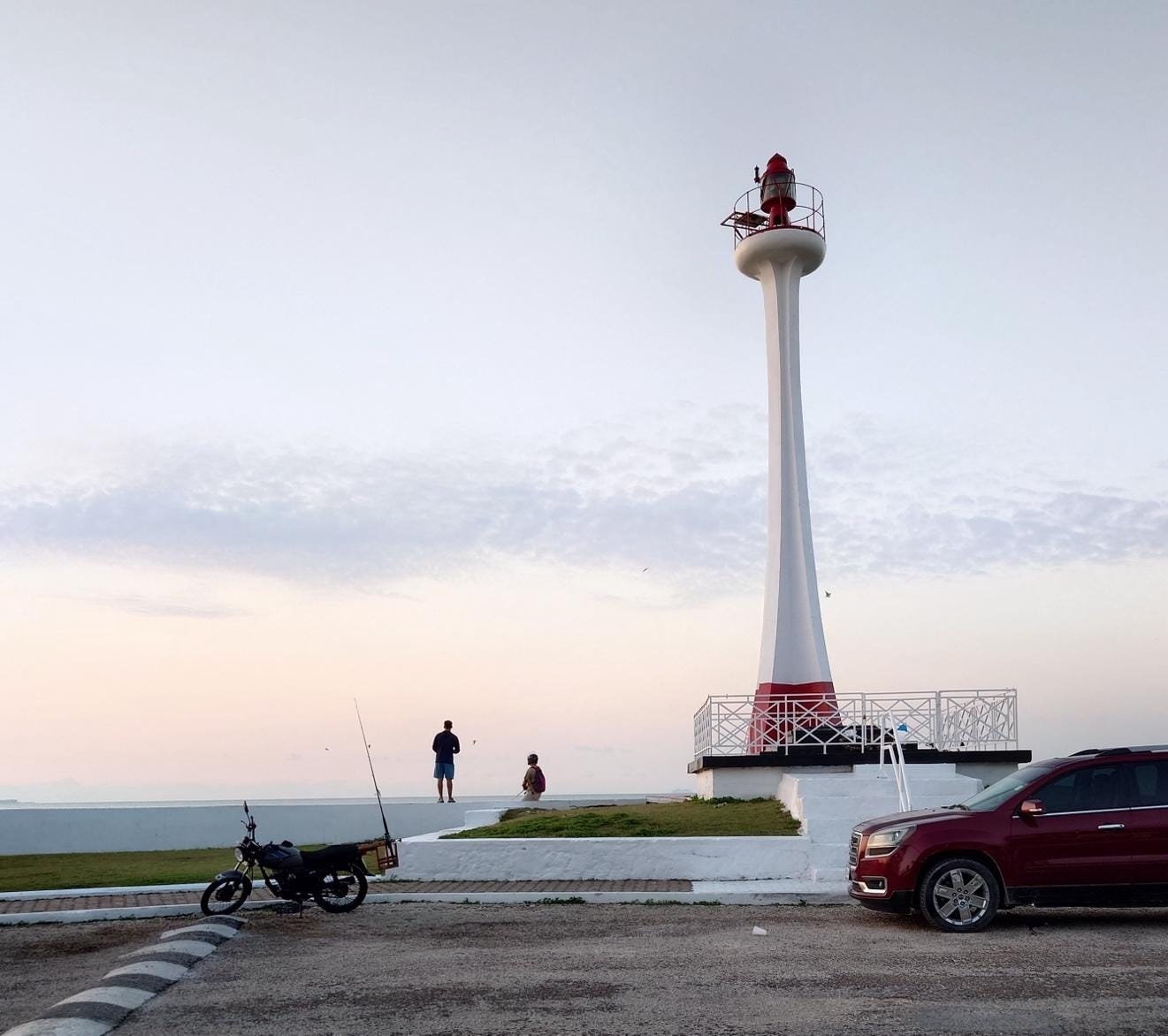
And so, that first morning back, with a cup of coffee from the room, I went for a wander, an amble around the point - stopping, I snapped a photo of the fishermen by the lighthouse – who, always there, never seem to have left – standing on the seawall, silhouetted against a blush of ‘atomic tangerine’ on the dawn sky - a slow circle of the historic wooden-ness of Fort George – Fort Street, North Park, Marine Parade - and back to its eponymous hotel.
I liked the old Fort George Hotel, and, you know, I like the new one.
I felt like I should have peed on a gatepost, to mark the edges of territory, like an old dog returning to his former haunts.
Boxed lunches from the marina’s cantina below the harbour master’s office, and opposite the dry dock out at Old Belize.
The whole northern verge of the docks had a vibe – gentle, relaxed; a series of cute, clean, small wooden cottages, bungalows, and a bigger ‘hostel’, lined the side of the piers. And at the canal’s end the two-storey harbour master’s office. The shopkeeper’s daughter was cooking the food, in the side room on a countertop two-burner gas stove, and he was serving the rice from an electric cooker, into the takeaway boxes, as we talked. The rice cooker was on a ‘sideboard’ beneath shelves that held a variety of t’ings that looked like they were lonely for other things: the bottom half of a blender, and not the top, the carafe of a coffee machine, half of an orange juicer. Two rooms; the interior walls were unlined, and painted a light turquoise blue (in most places), that was more like a wash than a paint job. A stack of woven baskets, a piece of a blender, some takeaway coffee cups, out but up too high to be of use … and there, far away from its mate, what might have been the other half of the blender from over ‘there’.
And at the back of the building a set of wooden stairs led up to the harbour master’s office. We paid our dock fee upstairs, while downstairs, under the overhang, in front of the cantina, the customs officers were giving two yachting Mexicans a hard time at the picnic table in the shade.
We had come with friends, and we met more friends, and a captain, and a boat, out at the Marina: the boat had a name, but no flag, no ensign flying; a 46 ft catamaran, which was like taking your living room on holiday, wide, stable, comfortable, no lean …
“okay to come aboard, Capt.?”
This was going to be new for me, yeah; in all my 30 years of being in and out of Belize, half a life really, I had never once been to the Cayes: whenever I came ‘home’ (home is a big word, it is, as it really wasn’t my home, but a place where my father lived. As Jamaica was, by then, only a place where my mother lived) I was required to work on the ranch – no holidays – far, far from the sea.
And I enjoyed every lovely minute of the work, yeah. And it kept me out of trouble I guess, kept me out of other people’s hair.
We bought 25 lb of ice, from the very kind miss N, at the Old Belize water park – and with lunch already in hand, off we went to ‘sea’.
Back behind us on the mainland, in the sweep of country between Belize City and Dangriga, was a vast, mostly empty area of low-lying land, salty soil, scrub oak, cashew trees, spindly pines hanging on for dear life; swampy, riverine systems with a wide band of mangrove at the sea, whose main features were the Northern and Southern lagoons.
And all that ‘environment’ helped to feed this semi-enclosed sea behind the reef, with nutrients, and ecological love love love.
Belize’s barrier reef is the largest reef system in the northern hemisphere, and it is the largest part of the Mesoamerican Reef system, which stretching 700 miles from Isla Contoy at the tip of the Yucatan Peninsula, down through to the Bay Islands, in Honduras, is the second largest barrier reef in the world. It is home to more than 60 species of coral, much of it laid down over the last 15,000 years, on top of a much, much older reef, after the end of the last ice age raised sea levels. It is also home to more than 500 species of fish; to turtle, conch, lobster, crocodile, whale shark, rays, and to one of the largest concentrations of manatee.
But … this reef system is, considered to be, under threat.
‘The unique array of reef types within one self-contained area distinguishes the BBRRS from other reef systems. The site is one of the most pristine reef ecosystems in the Western Hemisphere … [and] is comprised of approximately 450 sand and mangrove cayes.’ [UNESCO world heritage site]
Out ‘here’ we were in a cooling breeze, on a heading of 139° roughly, through the Spanish Cayes, the Bluefield range, past an area called The Triangles, and toward the reef: we sailed out for about four and a half hours, to the south-east, and we anchored there, behind Alligator Caye, less than 30 ft off the reef, close enough to touch(!); we were in 12 ft of clear, clear water, that had only the tiniest hint of blue to it …
At the end, and at the beginning of the world.
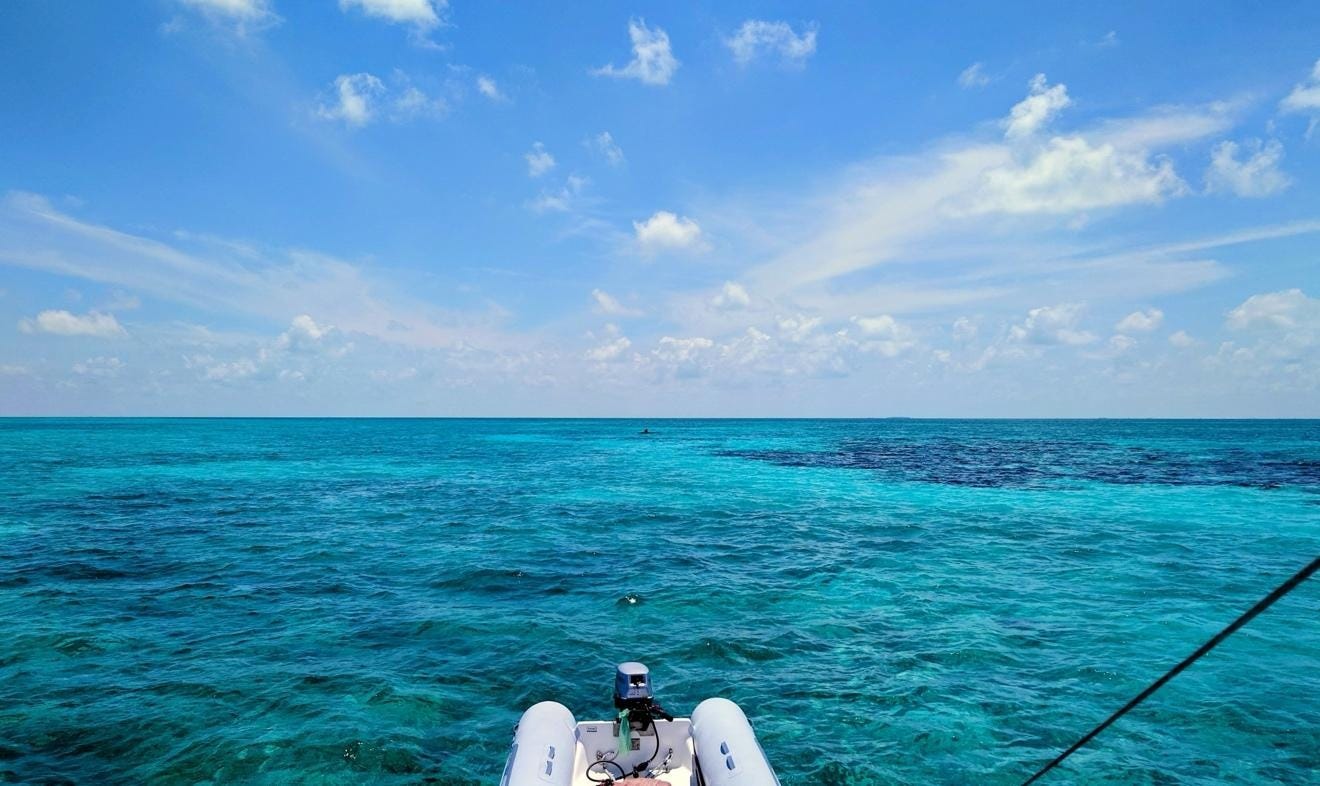
In all that sea we had seen no one; we saw no other boats, no other people, but for two small fishing boats, hazy outlines, at far a distance; our captain said they were down all the way from up in Sarteneja – I had been to Sarteneja once by boat, once by road – ‘gainst the Mexican border
“Hand-carved wooden sailboats are ubiquitous in Belize’s northern villages … and chances are they are all made in Sarteneja … fishermen set out from the northern villages to spend up to ten days out at sea in pursuit of, conch, fish and lobster [seasons permitting] …” [Oceana Belize]
One of the fishing boats – we would meet her later – was called Ubafu, which means ‘Strength’ in Garifuna.
The Garifuna are a mix of remnant indigenous Carib-Taino populations and transported African peoples, that came together on the Islands of St Vincent – which were, during settlement, in the 17th and 18th century, a non-plantation, neutral treaty island – But after the British took full colonial control, at the treaty of Paris, the Garifuna were exiled, and removed to Roatan and the Mosquito Coast of Central America.
“… In 2001 UNESCO declared Garifuna language, dance and music in Belize to be a “Masterpiece of the Oral and Intangible Heritage of Humanity … The Garifuna language belongs to the Arawakan group of languages and has survived centuries of discrimination and linguistic domination …” [UNESCO world heritage site]
Ubafu was to be a recurring theme over the next few days, appearing with the morning, from nowhere, lurking in the distant view with the day, and vanishing again come nighttime:
“She acts as a ‘mothership’”:
The mothership would drop the fishermen off, in small canoes, carried on the deck, in the morning and then travel downwind; the ‘boys’ would spearfish (or free dive for lobster and conch) down the reef for the day and meet back up with her.
One evening, later down the Cayes, as the sun was setting, Ubafu passed just off our stern, close in, to check us out I guess.
She was a ‘Lighter’, about 28 ft long, with sails – A red canvas jib, and a blue mainsail, both faded by time and sun – and an old Suzuki engine; offset, to her starboard, the companionway.
On her deck were the six little fishing dories (where everybody sleeps I dunno!) stacked three starboard, three port … Reg. No.CZL–0061 (CZL being Corozal).
Along with the captain, three others were on the deck; there must have been another three somewhere else, but I didn’t see them. The captain, at the tiller, was as dark as singed mahogany; he, like the old boat, and her sails, looked creased with the kind of character achieved through time in the sun, and hard, hard work.
Leaning slightly, to peer at us under the boom of the sail, he raised a hand, low, and almost tentative. We waved back.
Out to sea across the reef there was nothing; empty except in the far distance a hint of Turneffe Atoll as a deep green brush stroke across the darkening blue, in the setting sun – and beyond that, out of sight, Lighthouse Reef, the Blue Hole and to the south Glover’s Reef.
As night fell we could see, behind us in the other direction, the glows of Belize City to the North, Dangriga (formerly Stann Creek) almost directly west, and Hopkins village a little to the south. Sweet fuck-all else, except that somewhere, in that darkness, at least seven men were there aboard Ubafu, sleeping.
And in the sky the Southern Cross, the Big Dipper, the Plough – Ursa Major, Orion and his belt.
We went to bed.
And woke to a quiet dawn on the reef – E and I were up earlier than all and made coffee, and put the kettle on for tea … this was a good day.
“… islomania, a rare but not unknown affliction of the spirit – there are people for whom islands are somehow irresistible: the mere knowledge that they are on one; a little world surrounded by the sea, fills them with an indescribable intoxication.” [Lawrence Durrell]
A little like that, a little intoxicating …
Five frigate birds hung on the wind high above the island.
Tobacco Caye sits right, right, right on the reef … on topographical maps it is only a dotted red outline, as if it doesn’t exist differently from the sea around it … but it does.
I remember it now in vignettes:
A woman, with three children, who were soaking in the sea, at the foot of the dock while she kept an eye - she had beautiful, classical Mayan features and big gold earrings.
Two older men sitting deep in the shade, at the back of the Sunset Bar, at the Windward Lodge – whose turquoise blue paint shone in the sun – as if they were part of the furnishings, labrishing …
The shade of an incredibly large Seagrape tree, that must have survived many, many histories.
Two canoes tied up in the chiaroscuro, of an arbor of mangroves, in a tiny sheltered ‘cove’; eight ft wide, maybe, next to a pile, at water’s edge, four and a half ft tall, of conch shells, empty of their conch; harvests of a lifetime or two.
And a discarded Belikin bottle, strewn, not washed up.
The volleyball court at the very centre of the island.
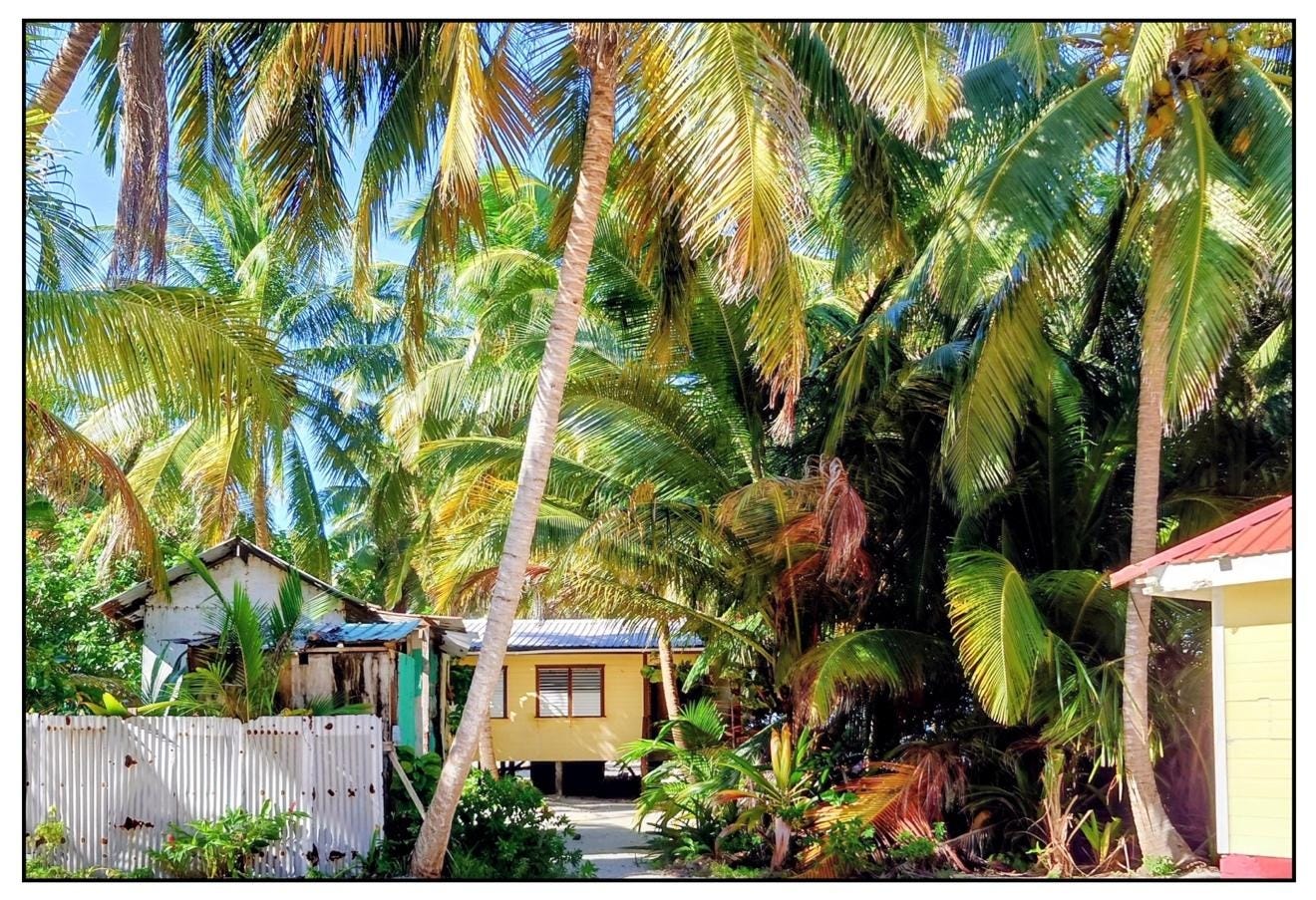
Hammocks strung, like washing lines, over by the strong yellow and deep red of Joe Joe’s, between so many coconut trees, whose trunks were painted white, up to two feet off the ground.
Like a little step back in time, but with anachronisms of good phone signal and high-speed WiFi.
To the south-east, the Caye is protected by a thin hook-shaped piece of exposed reef, and coral rock, with mangrove lining much of the inside shore, about 40 feet away … and on the Caye, inside the curve of the hook, nicely sheltered, sits the Reef’s End Resort’s restaurant and bar.
We bought beer.
We left, we came back later, we ate dinner.
The cooks were both Garifuna, the food was good. The black snapper was delicate like lobster, but without lobster’s clawing-ness, its over-richness …
We went back to the boat, and to bed
And woke to a quiet dawn on the reef – E and I were up earlier than all, and made coffee, and put the kettle to boil for tea … this was a good day.
Rain fell; it was like so many spilled diamonds falling onto an impossibly blue carpeted floor, and bouncing free again, to sparkle, en plein air, just for a moment; it was truly lovely, with the sun highlighting the large drops, as they bounced back off the surface.
I was feeling rich, and still dreaming of last night’s black snapper (Apilus dentatus): they spawn in February through April in a massive aggregation outside between Gladden Spit and Grover’s Reef, that draws the whale sharks; we had just missed this … Mutton snapper (Lutjanus analis) also have a large aggregation, in March to June, closer in against and inside the reef depending on the phases of the moon …
There were fish around, but we had only caught one so far, ‘yesterday’, M caught a nice little skipjack, but released it for being too small.
Phases of the moon … and here you are in a place where it matters not that men had just blown 93 billion dollars to see its backside.
The fish come, whether a man lands on the moon or not.
Or that the same people were seemingly wasting 25 billion, on a war someone talked them into, that seems to have no basis in reality … 120 billion or so, just there, in one month, on fuckries that matters not out here against the reef.
The change in the prevailing winds matter because islands, where people live, now erode.
Whether rains fall, or not, matters, because people need fresh water in their cisterns to survive on an acre and a half of sand and coconut trees out in the sea.
The sun hot, and the breeze blow matters.
That the sails can fill and not tear, that the blocks for your sheets work, that your engine runs, that there is rum and ice-cold beer, and propane gas to run the fridge – the moon matters because it creates patterns in life, and tide, and the spawning of fish …
it doesn’t matter that some people fantasise about spending another 100 billion dollars to land on that moon, and even more to populate it with space ‘Crueseurs’, to mine it for all it’s worth, rather than maybe to think about the fantasy of how wealth distribution, on that kind of financial level, reified, might-could feed the poor, elevate some humans, preserve some dignity … and perhaps even help stabilise an existing world, and its environment, so that one wouldn’t need to go to the moon.
My climate now is the marsh, the leaden
silver water that secretes in reeds
or moves with a monody that happily might deaden
endeavour and envy and the waste of noble deeds
for reputation’s sake, my frenzy is stasis,
like a shallop with a staved-in hull.
[Excerpt from Derek Walcott, White Egrets XI]
20 nautical miles off the coast of Belize headed south, on the ‘sand highway’ along the reef and then through the ‘badlands’ on a heading 149°; time of day was important because the light needed to be so that the captain could see the coral heads through the water … Back to land, behind us, you could see the Maya mountains, rising up in the South of Belize, looming blue in diffracted light – Rayleigh scattering – against the skyline; stacking up in a series of sharp ridges, to Victoria Peak.
And then A hooks into two skipjacks simultaneously on one line
… it was to be a good fish day as earlier E had caught a nice, big mutton snapper on whim and chance.
“yu still want to try buy fish from the fishermen?”
We did not,
we already had fish.
The sea was turquoise in every possible varying, Fauvist shade of it, as we were sailing toward some spot, between the Elbow and the Funk Cayes. A spot where no one else had ever been, because the sea, on its tides, refreshed the spot, resetting it completely anew every second to something unique; pelicans flew by down the port side, like a flight of Harrier jets, but with a lot less noise.
It was still. It was hot.
We were only making four knots under full sail.
“Hideaway, Hideaway, this is …” crackled on the radio
“This is Hideaway, go to Channel 67.”
We still had this little bit of the world mostly to ourselves; there were people out there, certainly, but not near, not around – And Ubafu was somewhere, shadowing us … off to the north, I think.
Foul Ground; and then an anchorage amongst the Gladden Cayes.
Capt. D fileted the jacks, A made a sauce, and we ate them as sashimi.
The snapper got stuffed with seasoning and herbs, wrapped in foil, and baked. It was good.
We went to bed.
And woke to a quiet dawn on the reef – E and I were up earlier than all, and made coffee, and put the kettle to boil for tea … this was a good day.
Capt. D said that when they were young, they used to find Maya artefacts all over these Cayes: obsidian knives, stone tools, Metate/Plancha (the long, bowl-ish shaped, stone bed, on which they ground stuff), and Metlapil/Mano the elongated, hand-grinding stone, that one rubbed on a Metate; they came out of the ground, whole and broken, chipped or smooth, old, old.
The coastal Maya had salt ponds, practiced fish curing, and had networks of trade deep into the interiors. (They did not have stone temples. Are temples to greedy gods really something one needs out here against the reef?)
At the Maya golden age city of Caracol, almost 100 miles away from the sea, overland, by what is now the Guatemalan border, there is archaeological evidence of some pretty large-scale live fish transport, from the coast, into the hinterland. And presumably the return journey was made of casava, and squash, beans, and avocado, and nixtamalised corn; ‘cause, Jah know, you can’t grow dem t’ings in sand and swamp!!!
These days on the sea were not days when much happened:
we got up we made coffee. The sun having just come up, we sat and admired a dawn; people trickled to life, waves gently lapped at the boat, one sat fore or aft and felt the gentle breeze, read a book, checked some emails. Breakfast was put out – we worked communally – anchored later again for a swim, lunch; up anchor, sail, fish, read. Some would do what work they could. Sunsets were absorbed, sundowners maybe, dinner would happen, then bed. They were days of gentle breeze, gentle passing of time, gentle conversations, casting lines, listening to music – There was no depredation, no war out there – They were days of pelicans, and laughing gulls, and frigate birds on thermals; of the tang of the sun, and the ‘burnt ozone’ smell of the sea … of peace.
It wasn’t till afterward I realized that the boat too was quiet, still; she made no effort of sailing – no reach, no sheets ‘cymballing’ their load against the mast, no aggression against rails when she tacked; sails unfurled, and winches tightened almost silently.
We stopped on Bottle Caye for a snorkel and an exploration; there was a decaying concrete dock, some lost folly to planned development, but here was only low bush, and shaded places under the plopnut, and amongst the mangroves; I snapped a photo of P in the shallow water, and one of J looking over a block wall, that came from, and went to nowhere, for nothing.
On Ray Caye there was a spot, by the dive shop, looking out from under the sheltered dock, across the little harbour, where A and I sat and I thought to myself, this is the kind of spot one might come, and never leave. But after lunch on land, we did.
On Drying Reef Flat, amidst a little group of three islands, called the Silk Cayes, inside the marine conservation zone, we dropped anchor. There, on those ‘flats’, the discussion, from earlier, about the changes in prevailing winds, met with some of the unhappy bits of its harsh reality: by putting in rock gabions, covered in coated wire, buried along the coast, and planting trees, plants, and Carpobrotus vine, the marine reserve had managed to hold their ‘visitors’ island in place, but Little Silk Caye, the private island, next door, was now only a stain of paler colour, just below the surface, to mark its place. “It was right there.” He points with a finger; “Now, now she gone, might never come back”.
We looked for Virgo, and for Leo, on the deck that night, and talked about how to find Polaris using the end stars of the scoop of the Big Dipper/the blade of the Plough, Merak and Dubhe.
We ate dinner, and we went to bed
And woke to a quiet dawn on the reef – E and I were up earlier than all, and made coffee, and put the kettle to boil for tea … this was a good day.
An osprey, that had been sitting atop the hand-painted ‘Gladden Spit and Silk Cayes Marine Reserve’ sign, as we approached, began worrying a bird, that had a nest in the Sea Mahoe tree (Talipariti tiliaceum) by the toilets. The Belize flag, ashore, was in full flutter with a nice breeze from the north-east – when we landed, jumping off the bow, a little like explorers in films, for this was a new world to us – our presence scared it off, while a pelican sat unperturbed by it all, as if watching adolescents frolic, on a limb of the first coconut tree … and unperturbed by us.
As we sailed we still had out empty fishing lines looking for fish; it had grown like a habit; we were now Sea-people:
There lies the port; the vessel puffs her sail:
There gloom the dark, broad seas. My mariners,
Souls that have toil’d, and wrought, and thought with me—
That ever with a frolic welcome took
The thunder and the sunshine, and opposed
Free hearts, free foreheads (lines 44-49)
[‘Ulysses’, Alfred Lord Tennyson]
We travelled on through that day, into and amongst an ever more frequent series of shoals, mostly mangrove islands.
And I realised that our time was coming to an end, and I began to think how I had missed this little country: the Maya had a philosophy called ‘Sak Nik Nahal’; this idea that the consciousness of people, of humans, was one with the world around them, and its spirits – my life here had been from other days; interesting yes, but superseded by other interesting days, in other places; I would miss it again, the old vibes and the new t’ings, when we had left – but even if I were never to come back, I would still be imbued with the spirit of this place, it was a big part of my making.
And through the bight at Fisherman’s Caye, and came to rest, with a nest of other boats inside a circle of island, islets and shallows.
“Hideaway, Hideaway, this is …” crackled on the radio
“This is Hideaway, go to Channel 67.”
Our last anchorage … We went ashore for dinner. And it was very good in all its ways: people, place, food, vibe, intangible feels … And then we went back to the boat and went to bed
And then we woke to a quiet dawn on the water – E and I were up earlier than all, and made coffee, and put the kettle to boil for tea … this was a good day.
Comments
Nothing yet. Say the first thing.
Sign in to join the conversation.