
The Tianxian View is the Pune International Centre’s (PIC) weekly newsletter on China. Each week, we bring you handpicked insights into the key developments shaping China’s politics, economy, defence, foreign policy, technology, and climate.

This week, Japan sounded the alarm, offering a fresh reminder of the Chinese threat. At the same time, China’s next-generation train sped toward the spotlight, while pecans became the latest flashpoint in trade tensions.
On August 11, China’s next-generation CR450 bullet train completed a 600,000-kilometre operational test and brought it closer to commercial deployment. The completion paves the way for final inspection and certification. CR450 is designed to operate at around 400 kilometres per hour (kph). It could further enhance China’s high-speed rail network and emerge as a competitive alternative to air travel on major domestic routes.
What does the CR450 mean for China’s High-Speed Rail Network?
The prototypes of the CR450—CR450AF and CR450BF—are manufactured by China Railway Rolling Stock Corporation. They have completed the 600,000-kilometre operational test. According to China State Railway, the trains had completed testing on a section of the Chongqing-Xiamen high-speed railway. They are also expected to complete the remaining mileage on the Xiong’an-Shangqiu high-speed railway. The prototypes have yet to undergo maximum-speed testing. If they achieve their designed operating speed of 400 kph, the CR450 would be 50 kph faster than China’s current fastest high-speed train and 100 kph faster than regular high-speed rail services.
China’s high-speed rail has transformed domestic travel in the country. It has connected major cities with a fast alternative to air travel on medium-distance routes. This rail network has gone beyond the borders and expanded into neighbouring countries. Though the CR450’s emergence represents the next step in this evolution, a 400-kph train still remains slower than commercial aircraft. This limits its ability to replace aviation on long-distance routes. Therefore, the CR450 may not replace air travel on long-distance routes, but its speed could shift the rail-air balance on major domestic corridors.
Text within this block will maintain its original spacing when published
Recommended Sources:Caixin Global - China Takes World’s Fastest Train One Step Closer to Market (Aug 10, 2026)
China Economic Review - China completes test of next generation of high-speed rail...Apple testing CXMT memory chips for iPhones and MacBooks...Beijing eases housing restrictions to stabilize property sector (Aug 11, 2026)
On August 11, China imposed provisional anti-dumping measures on pecan imports from the United States (U.S.) and Mexico. It highlighted another point of tension beneath the surface of the U.S.-China trade truce. Although the pecan trade is modest in economic terms, the move assumes political significance as Beijing and Washington prepare for an expected Xi-Trump summit.
What is behind China’s Pecan Crackdown?
The preliminary findings of China’s Ministry of Commerce indicate that U. S. and Mexican pecans were being sold below fair market prices, leaving Chinese producers at a disadvantage. Chinese importers will be required to pay a 54.3% anti-dumping deposit on US pecans, while Mexican exporters face rates ranging from 17.8% to 51.6%. Six Mexican companies that cooperated with the investigation received lower rates of 17.8% to 23%. According to Beijing, dumped imports increased by 104.56%, alongside a 9.69-percentage-point rise in their domestic market share. Their prices declined by 9.15%, remaining below those of domestic products. The measures are provisional, and affected parties have 10 days to submit comments before a final ruling is issued.
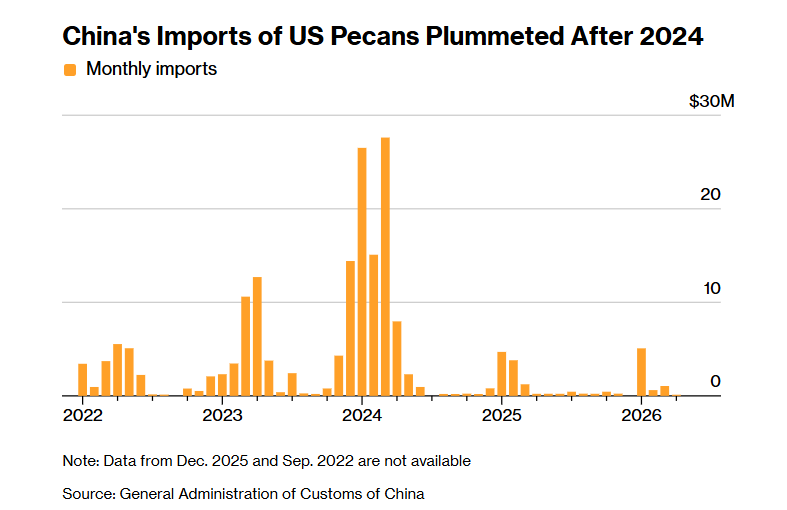
The probe was launched in September 2025 following Mexico’s decision to raise tariffs by as much as 50% on around 1,400 products. The list included Chinese vehicles, auto parts, steel and furniture, in response to U.S. pressure. The pecan measures add to China’s recent actions against the U.S., including sanctions on American entities and controls on drone-related exports. Meanwhile, China’s imports of American pecans have plunged from $77.2 million in the first four months of 2024 to $6.9 million during the same period in 2026. The decline has coincided with greater reliance on alternative suppliers, such as South Africa. Despite its limited economic impact, the dispute exposes the fragility of the trade truce and the use of third-country markets as levers of economic pressure.
Text within this block will maintain its original spacing when published
Recommended Sources:Bloomberg - China Hits US Pecans With 54% Levies Before Xi-Trump Summit (Aug 10, 2026)
Ministry of Commerce, People’s Republic of China - The Ministry of Commerce issued Announcement No. 32 of 2026, announcing the preliminary ruling on the anti-dumping investigation into imported pecans originating from Mexico and the United States. [Chinese Version] (Aug 10, 2026)
In its recently released 2026 Defense White Paper, Japan identifies China as an ‘unprecedented and greatest strategic challenge.’ The document cites Beijing’s expanding military capabilities and increasingly active operations around Japan, Taiwan and the South China Sea. The assessment comes as Tokyo steps up its defence capabilities and expands security partnerships with the U.S. and other like-minded countries.
What does Japan’s New White Paper Say about China?
Military expansion: Japan says China has expanded its military capabilities, both in quantitative and qualitative terms, particularly its nuclear, missile, naval and air forces. These capabilities are supported by high defence spending. Consequently, there is limited transparency regarding China’s defence budget.
Regional activity: China has increased its military presence around Japan, which extends from the East China Sea and the Senkaku Islands to the western Pacific and beyond the first island chain.
Air and maritime activity: Chinese aircraft accounted for 366 of Japan’s 595 fighter scrambles in FY2025. Japan also points to close encounters between the military aircraft of the two countries and increased Chinese carrier operations in the Pacific.
Taiwan: It highlights China’s military advantage over Taiwan and raises concerns over its grey-zone activities, including the potential deployment of a blockade.
South China Sea: Japan criticises China’s maritime activities and militarisation. It argues that Beijing seeks to alter the regional status quo through force or coercion.
China-Russia cooperation: Tokyo flags joint Chinese-Russian bomber flights and naval activities around Japan as a serious security concern.
Technology: China’s advances in AI, data, networks and other emerging technologies are also viewed as factors that could reshape the future security environment.
Beijing’s response presents a strong rejection of Japan’s assessment. It accuses Tokyo of hyping the ‘China threat’ and interfering in the country’s internal affairs, namely Taiwan. It also reiterates China’s claim to the Diaoyu Islands. In addition, Beijing has described the White Paper as a justification for Japan’s ‘remilitarization’ through high defence spending, long-range offensive capabilities, military expansion into space, and an expanding military-industrial base. It criticises Japan’s portrayal of defence expansion as an economic growth driver. The differing assessments underscore a security divide where Japan views China as its strategic challenge and Beijing is wary of Tokyo’s defence buildup as a threat to regional stability.
Text within this block will maintain its original spacing when published
Recommended Sources:Ministry of Defense, Japan - Defense of Japan 2026 (Digest) [English Version]
People’s Daily - A spokesperson for the Ministry of National Defense answered reporters’ questions regarding the Japanese government’s 2026 Defense White Paper. [Chinese Version] (Aug 6, 2026)
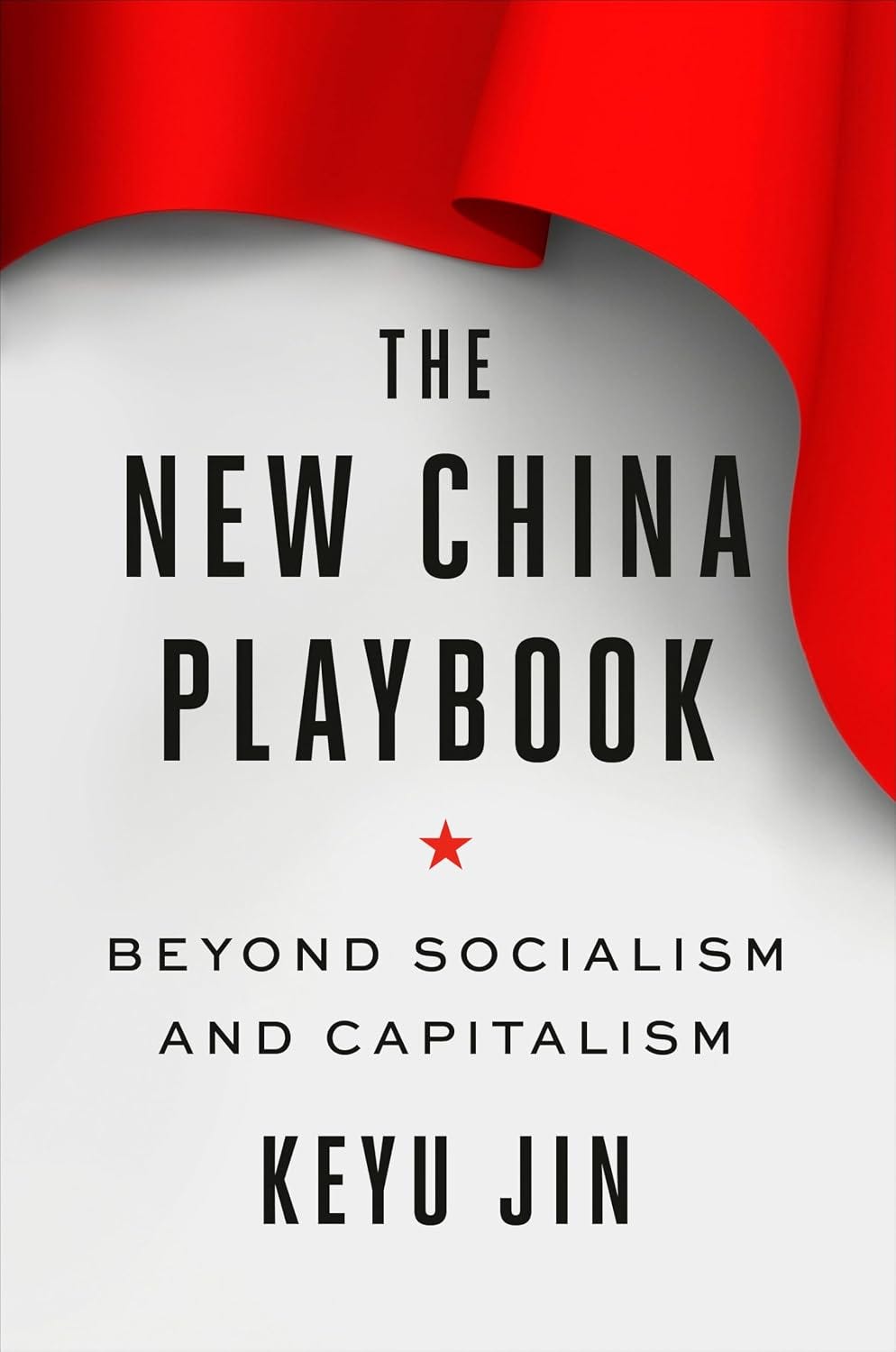
The New China Playbook: Beyond Socialism and Capitalism by Keyu Jin offers a fresh perspective on how China’s economy has evolved beyond the conventional divide between socialism and capitalism. Jin argues that China’s economic rise reflects a distinctive model in which the state, markets, businesses and households interact in ways that differ from conventional Western systems. The book traces how China’s economic approach, a mix of market reforms and state intervention, powered its economic and technological progress. It also considers challenges ranging from inequality and demographic pressures to debt and China’s changing role in the global economy. For those who are interested in China’s economic rise and future trajectory, The New China Playbook is a must-read.

秋天的第一杯奶茶
(qiūtiān de dì yī bēi nǎichá)
Qiūtiān de dì yī bēi nǎichá (秋天的第一杯奶茶), literally meaning ‘the first cup of milk tea of autumn,’ refers to a popular Chinese internet trend in which people mark the arrival of autumn by enjoying or receiving their first milk tea of the season. First popularised on Chinese social media in 2020, the trend is now in its seventh year and has come to symbolise affection, care, and the small pleasures of everyday life. It is often used humorously in posts and messages, with people hinting that they would like someone to treat them to a cup of milk tea. Beyond its literal meaning, the phrase has evolved into a seasonal ritual associated with companionship, gifting, and consumer culture. It remains popular on platforms such as Weibo and Xiaohongshu, where it reflects the growing role of food and beverage trends in shaping online social interactions.
Thanks for reading! This post is available for free. Please feel free to share it with others.
The Tianxian View is an initiative of the Pune International Centre (PIC), an independent and multidimensional policy think tank based in Pune, India. This newsletter aims to offer clear, contextual insights into China’s evolving trajectory.
To know more about PIC’s work and upcoming initiatives, follow us on our website and social media handles.
LinkedIn | X | Instagram | YouTube | Spotify
AI Disclosure Statement: Select Mandarin-to-English translations in this newsletter were produced using advanced large language models (LLMs), applying artificial intelligence and machine learning techniques for natural language processing.
Comments
Nothing yet. Say the first thing.
Sign in to join the conversation.