
Reese Witherspoon’s recent “Women, it’s time to learn about AI” reel was completely characteristically Reese — yet sparked a huge backlash. So much so that the preview for her video is now actually a “community note” warning about AI.
(It did also get 171k likes.)
The community note about the downsides of AI is valid. But Reese Witherspoon wasn’t defending AI - she was being pragmatic. She said: women’s jobs are at greater risk of AI disruption, yet (anecdotally and statistically) women lag in AI adoption, so let’s start learning.
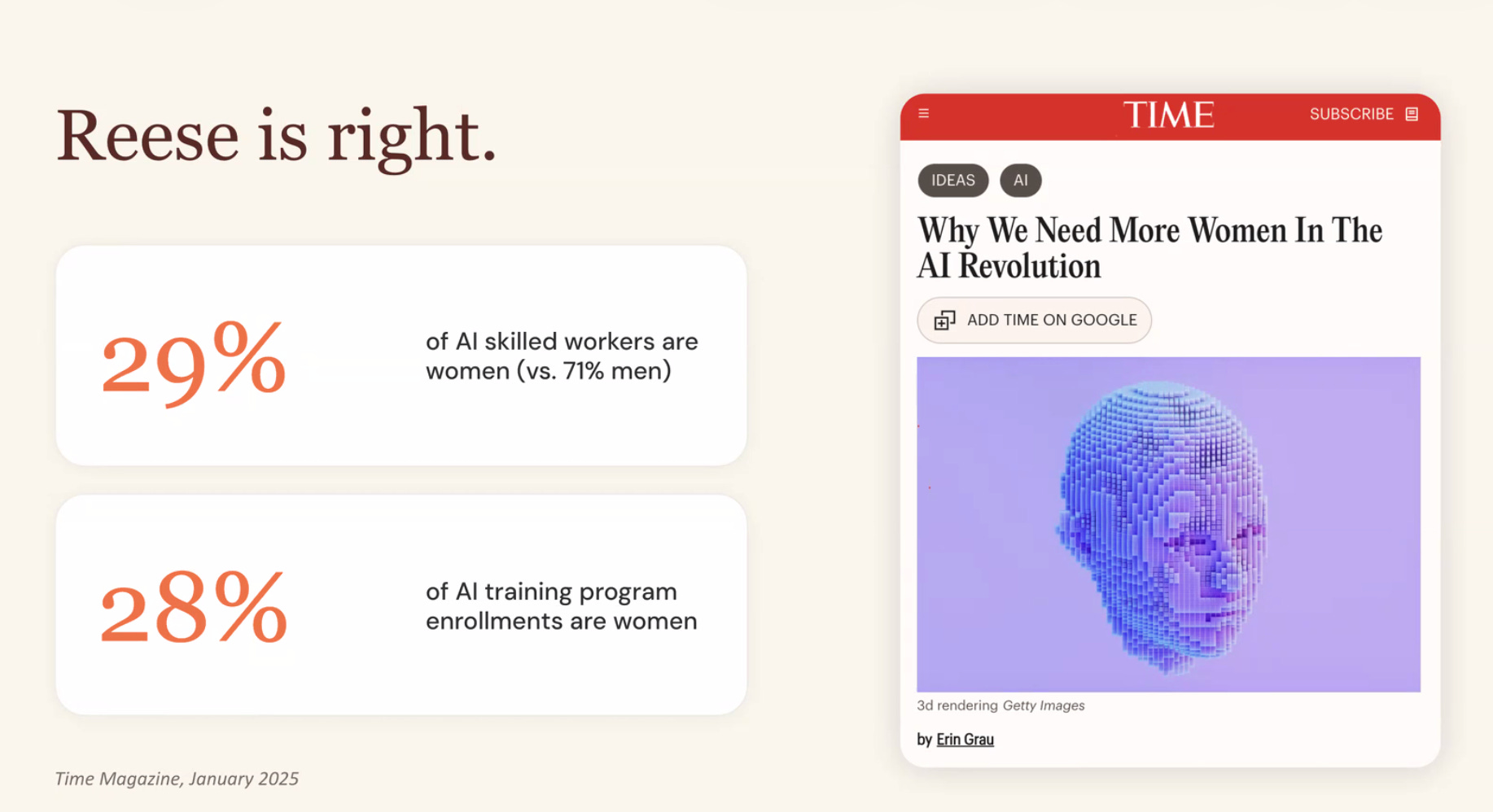
And that’s exactly what Danielle Matarasso, Booth MBA and founder of AI After Carpool, said about moms. A former tech executive, Danielle now helps small and medium businesses integrate AI into their operations. And she saw that women — especially mothers too busy to spend time “playing with it” or in a season of power pausing — risked getting left behind.
A core tenet at The Third Shift is focusing on what we can change to feel better today. So I was immediately drawn to how practical Danielle’s suggestions are. She’s not telling you to take a class or do theoretical readings. She’s talking about solving everyday parenthood pain points: where can I take my kids to play in nature? What’s for dinner? And of course, my favorite: how can I make delegation easier?
Plus: what could be more on-brand for us than talking about how to take a skill from your work life into your home life?
Whether you’re a total AI novice or sit at the top of an AI-filled org chart, you’ll almost certainly find at least one good idea in this conversation.
Core ideas:
No, you can’t let go of the mental load (sorry). AI at this stage requires a human-in-the-loop to work well. A human has to specify and quality-check the output. And often, iterate on the results until the directions are precise enough to yield something usable. (This is why I rave about services like Faye that use AI to augment humans, not replace them — and that does give me true mental load relief!)
AI doesn’t fully take the mental load off your plate — it makes the load legible, and legible things can be delegated. AI gets you to the handoff. It turns the list of everything rattling around in your head into something structured enough to give someone else.
The knowledge to delegate is already in your head. AI can get it out. Things that rely on your judgment or specific knowledge can actually be delegated. There is a decision algorithm living in your brain — you know a good lunch from a bad one, you have rules about protein and what goes in the morning snack versus the afternoon — you just haven’t stopped to articulate it.
Where it’s an off-the-cuff dictation or a series of photographs or just examples of the decisions you’ve made in the past, AI can take your knowledge and produce a standard operating procedure someone else can follow.
AI can remove decision paralysis. Danielle had been meaning to repaint her bathroom cabinets for four-and-a-half years. Not because it was a hard project — because every time she thought about it, she hit a wall around color and couldn’t generate the momentum to start. One morning she snapped a photo and asked for six coastal options. The decision paralysis was gone.
AI doesn’t just lighten the load you already have. It can restore the ambitions the load has been crowding out. Danielle’s friend is currently running three projects simultaneously: a cooking project, a kids’ newspaper, and a consulting practice. She has three kids. She says it’s all possible because of Claude.
AI can give back something the mental load may have sneakily taken from you — the sense that you contain multitudes, and there’s room not only for what you must do, but for what you love.
AI can give back something the mental load may have sneakily taken from you — the sense that you contain multitudes, and there’s room not only for what you must do, but for what you love.
Start by identifying where AI will give you the most leverage — this is more practical than downloading an app. AI apps are built around a specific set of use cases their designers anticipated. That's useful if your bottleneck happens to match theirs. But if you start with an app, you're letting someone else's assumptions define your problem. You’ll spend time learning the app, not (necessarily) solving your bottlenecks.
Danielle's advice: figure out where your personal points of leverage — where you’re blocked or dreading the work — and then bring AI to that thing. A general-purpose AI like Claude can flex to your specific bottleneck. A purpose-built app may or may not.
(Of course, it’s also true — if you're in casual exploration mode vs. my-life-is-on-fire-and-I-need-fast-relief mode — that a purpose-built app might be just the thing for you to experiment with. Thoughtfully-designed ones can introduce efficiencies and support you never even realized were possible.)
Pick one tool and stick with it. The benefit of using the same AI repeatedly is that its helpfulness compounds. It learns your kids’ ages, their sensory needs, your preferences, your context. Over time it gets more useful.
If you’re not sure where to begin, start with Claude — it’s more privacy-oriented than most of the alternatives, and the more you use it, the more it knows about your family without you having to re-explain every time.
Try a voice-note brain dump. Talk into your phone — Google Keep, Notes, a blank email, it doesn’t matter. Just talk. The transcription captures everything. Then copy it into Claude and request an output: prioritize this as a to-do list, turn this into a text I can send my babysitter, make this into instructions my husband can follow.
The only new tech in this workflow is the AI step. You don’t need a Notion template. You don’t need automations. You don’t need to test 5 different new apps. You need a voice note, an output idea, and copy-paste.
Ask it to think, not just retrieve. One Sunday, Danielle’s family was restless and she didn’t have a plan.
She’d lived in Chicago for eight years and assumed there was no accessible nature close to her home.
Typically, she might have done a Google search, which would have required her to assimilate results, filter out the visual noise of ads, learn about potential venues, and assess them against criteria in her head — using up playtime with research and analysis.
Instead, she asked AI to deliver not just search results, but a recommendation: find outdoor activities within 45 minutes of her zip code, rank them by suitability for her kids’ ages, and give her pros and cons for each. Shortly thereafter, her family was at a nature reserve twenty minutes from their house that she hadn’t known existed.
Use photos to capture what would be cumbersome in words. Voice notes work for capturing what’s in your head. Photos work for capturing what you’re already doing.
Danielle is photographing every lunch she makes over ten days so Claude can reverse-engineer a standard operating procedure from the images — one she can hand to her husband so he can take over lunch-making duties.
You can do the same thing with your fridge: snap a picture and ask what meals you could make tonight. Drop in a photo of handwritten notes you left your last babysitter and ask it to create a generic template for the next one.
One risk: AI could raise the expectations of/for moms, not lower them. If AI makes it easier to do more, the question becomes whether that capacity goes toward reducing the overall load or toward expanding it.
In other words, will we see economics concept of “induced demand” show up in the expectations we have for ourselves and each other?
(Induced Demand is the idea that increasing the supply of a good increases its consumption. For example, in urban planning it explains the paradox that expanding highways fails to reduce traffic congestion. Widening highways reduces travel time in the short term, but this temporary relief encourages more people to drive, leading to higher traffic volumes that quickly overwhelm the new capacity. In other words, adding more road induced more driving demand.)
The antidote: we have to be intentional about applying AI in ways that support spending less time on the things we don’t want to do — not on creating more obligations. The goal is presence and the time to fill your life with the things that actually matter to you (which might look like a walk in the woods or time with your books, not running 3 side-hustles at once — and that’s great.)
In other words: use your digital helper to reclaim analog time.
This post is part of the Mental Load Discussion Club, a subsection of The Third Shift where we engage with the books, scholarship, and wider conversation surrounding the mental load. (It’s also where On the Mental Load podcast episodes are shared with exclusive recaps and analysis, such as this one.)
If you prefer to focus on practical solutions for family operations and opt out of the mental load learning, you can unsubscribe from the Discussion Club while remaining subscribed to The Third Shift.
Episode 4 — April 29, 2026 Can AI Lighten the Mental Load? A Conversation with Danielle Matarasso, Founder of AI After Carpool
Jennifer Mickel sits down with Danielle Matarasso — Booth MBA, former tech executive, and founder of AI After Carpool — to talk about what AI can and can’t do for the mental load. They dig into why starting with a purpose-built app may actually work against you, the voice-note-to-AI workflow that makes delegation possible without a lengthy explanation, and what happens when you ask AI to think rather than just retrieve. Plus: the induced demand problem — if AI makes it easier to do more, will we just expect more of ourselves? — and why the goal is reclaiming analog time.
Guest
Resources Mentioned
Instagram: Reese Witherspoon’s AI Reel
Variety: “Reese Witherspoon Doubles Down on Telling Women to Learn AI”
Faye — findfaye.com (THIRDSHIFT20 for 20% off)
Ava — hiava.com
Ohai — ohai.ai
About the Show
The Third Shift: On the Mental Load is a podcast about the invisible cognitive and emotional work of running a family — why it’s so hard to see, so hard to share, and what it would actually take to change it. Hosted by Jennifer Mickel, JD-MBA, founder of The Third Shift and former BCG Principal.
Work with Jennifer
The Third Shift helps families get out from under the mental load. Learn more at thethirdshift.co.
Comments
Nothing yet. Say the first thing.
Sign in to join the conversation.