
The word authority elicits pretty strong emotions in the current parenting climate. As someone who intentionally and purposefully identifies with authoritative parenting, I often field the emotional backlash.
Some background if you’re not familiar with my work: I advocate for authoritative parenting patterns (defined as high expectation + high support), as opposed to using labels like gentle or conscious parenting. Not because I oppose those labels or styles, but because those ARE types of authoritative parenting if they are implemented properly.
However, authoritative parenting is not yet a term widely known outside of psychology and it’s regularly confused with authoritarian parenting (high expectation + low support). Fair mistake, the words are quite similar.
But this label confusion is not the only reason why mentioning authority gets me yelled at online fairly often. There is actually a small but growing group of parents that are deeply suspicious of authority in parenting at all.
Exhibit A:
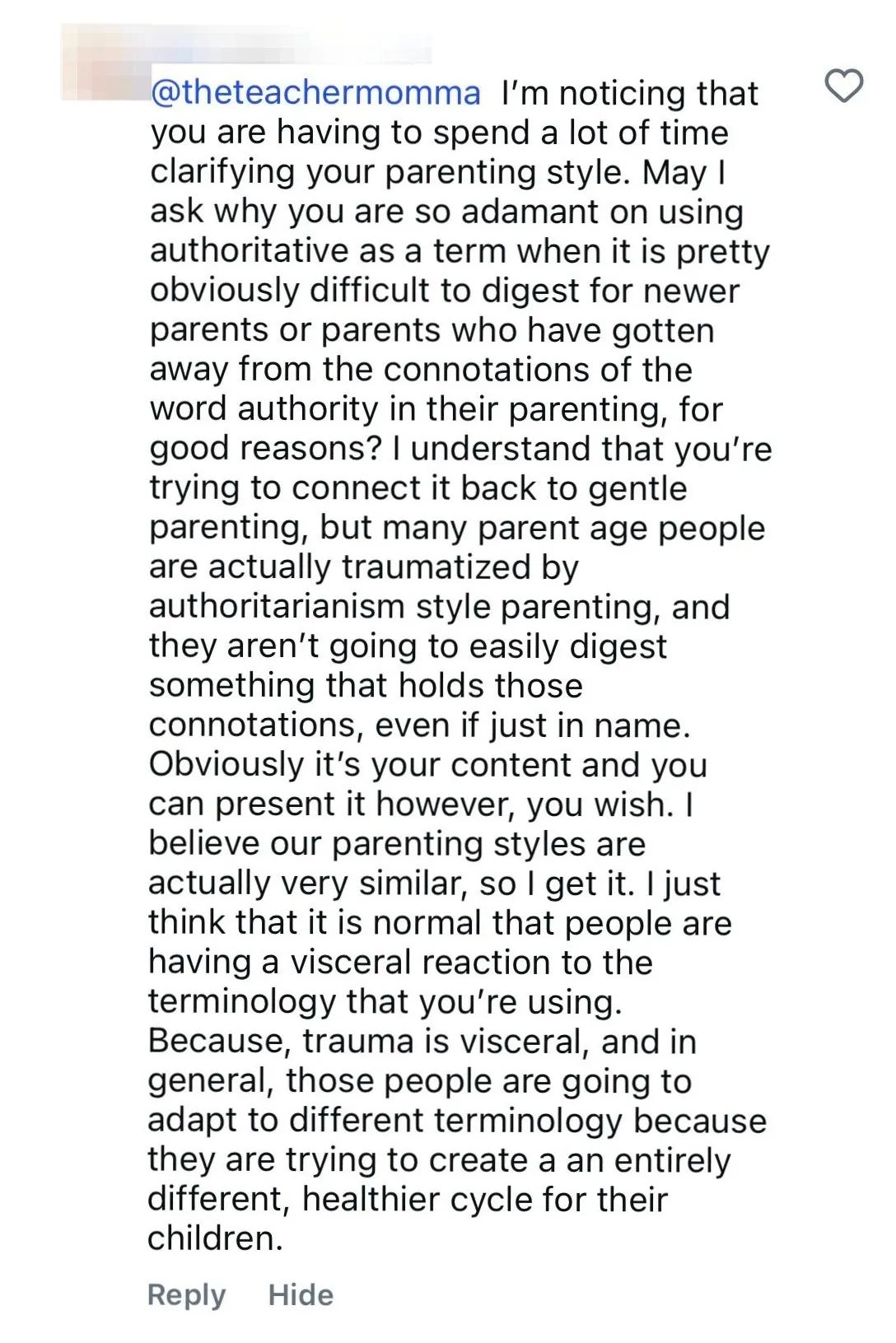
This is an example of one of the more thoughtful and polite responses I’ve received. Often, parents just hear “authority” and immediately assume I must be someone who advocates for harsh punishments and fear-based parenting.
And I get it. I understand why, as this commenter pointed out, many modern parents have “gotten away from the connotation of authority.” If the idea of parental authority brings up memories of abuse or mistreatment that was excused and disguised as parental authority, the whole concept understandably feels threatening and negative.
So why do I insist on using the term, even though it requires me to regularly educate and correct wrong assumptions?
Comments
Nothing yet. Say the first thing.
Sign in to join the conversation.