
It’s that time of year! Back-to-school content flooding into your feed, all the lists about how to prep your child popping up right and left.

As I’m getting my own kids ready to return to school, I’ve noticed something about these lists: they’re helpful guides for prepping neurotypical (NT) kids for school but they barely scratch the surface of the preparation I have to do for my neurodivergent (ND) child.
Let’s get into some examples.
Here’s a pretty standard list, all things I’m doing with my NT kids to help them adjust.
Neurotypical Child Prep
Wake up earlier bit by bit
Move up bedtime bit by bit
Clean out closets and shop for needed clothing items
Practice opening and closing their backpack, water bottle, and lunchbox
Practice shoe-tying and jacket-zipping
Practice independence with bathroom jobs
Remind them about classroom rules and how to be a helpful student
Go to meet-the-teacher night and walk through their classroom and the school
For my NT kids, these steps are really all they need. A total change in routine and daily expectations is something they can manage with just a bit of preparation. And even if they do struggle a bit with the transition, “struggle” for them looks like them being a bit more moody or tired than normal.
Now a list of the work I’m doing to prepare my neurodivergent child. This list is highly specific to my own child, but I imagine most parents raising ND kids have a list just as long, if not longer.
Neurodivergent Child Prep
All the items on the standard list, plus:
Figure out the perfect time to start talking about school stuff because talking about changes too early or too late sends them over the edge.
Start eating breakfast right after waking up even though that’s not their preference. Even little shifts in routine can be really dysregulating and need to be adapted to.
Visit multiple stores to find the exact sock variety that doesn’t cause a meltdown. Also scout online sales for the expensive tennis shoes because they’re the only ones they wear.
Buy 5 more of their preferred pants a size up because they’ve grown a bit and hope they tolerate the slightly different fit.
Set a timer for them to put on clean clothes every morning for at least 3 weeks before school starts to help them habituate to the stressful morning transitions again. Tolerate the meltdowns this adjustment causes so they can learn they are capable.
Set up breakfast and lunch menu systems to head off the meltdowns around food.
Practice handling sensory stressors that might come up throughout the day (bathroom tasks, recess, lunchtime, craft time, etc).
Roleplay how to ask for personal space, tell the teacher you’re overwhelmed, and cope with peer rejection.
Go to meet-the-teacher night knowing they’re probably more overwhelmed than excited. They might act out or meltdown and need extra grace or support.
Develop an after-school decompression routine to head-off the restraint collapse.
Meet with psychologist to discuss diagnosis information. Figure out if you need a formal 504 or IEP plan with the school.
Coordinate a 1:1 meeting with the teacher to discuss unique needs and accommodations. Work hard to establish a positive relationship because you know you’ll likely need to work together throughout the year.
And then once school starts there will be the intense job of staying in tune with their capacity levels, considering what additional supports they might need, thinking about how to adjust routines that are high-stress. It’s constant work and a massive mental load.
There’s a lot of conversation happening about capacity when it comes to neurodivergent children. How to make sure we aren’t pushing them too hard and causing toxic stress and trauma. How to make sure we aren’t expecting too little and assuming incapability and limiting their potential for growth. These are good conversations to have. Even as various parents and clinicians find themselves disagreeing about the particulars, these conversations need to continue because all of use care deeply about these children and want to do right by them.
But I hope we don’t forget that parent capacity is just as important to address when discussing neurodivergent kids. As my back-to-school list shows, supporting ND kids is intense and constant work.
Parents create a home environment for their child, but not inside a vacuum. Decades ago, Urie Bronfenbrenner penned one of the most influential theories in human development referred to as the ecological systems theory. He outlined how the systems we all live inside intersect and influence each other.
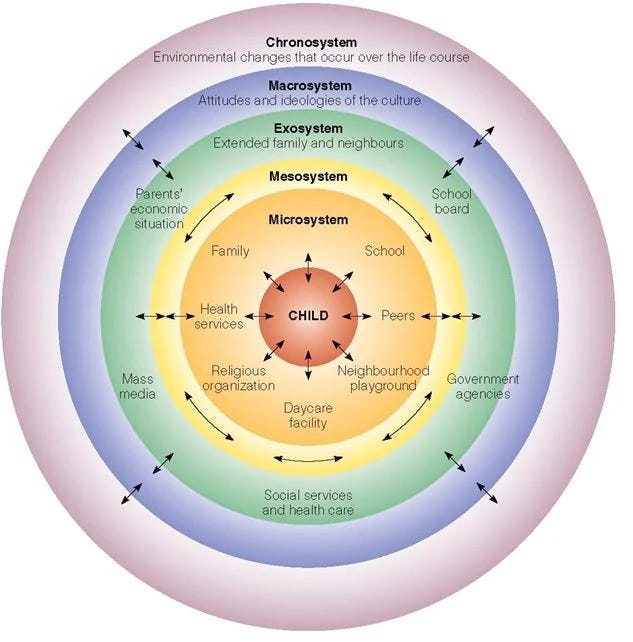
Bronfenbrenner, U. (1974). Developmental research, public policy, and the ecology of childhood. Child Development, 45.
Parents influence the child’s microsystem in a major way, but to understand the environment a child is living in, we have to consider all the intersecting systems and variables that add context to that environment. The neighborhood they live in, the family’s support system, the school environment and capacity and expertise of the teachers.
Then even broader: the systems the family operates inside of. If the parents have health insurance. If they received parental leave. If they’re working multiple jobs to cover the rent. If their race or citizenship status or gender identity or own neurodivergence mean they’re navigating discrimination and increased levels of fear, trauma, and stress.
All of this context has to be considered in any conversation about a neurodivergent child’s support system.
All too often, I see these conversations around the child’s capacity treat the child like an isolated variable and the parent like a robot who simply needs to follow the right protocol:
“5 signs your child is in burn-out. Stop doing all these things and start doing all these other things right now to save them from trauma” with no mention of what capacity the parent actually has to do any of that.
Or on the other side:
“Stop accommodating so much, tolerate their frustration instead.” Again, with no investigation of what capacity the parent actually has for doing so.
These conversations can’t go anywhere truly productive until we start considering the full family system and the context it’s navigating.
That list of things I do to prepare my neurodivergent child for school is as much a reflection of my own wellness and capacity as it is theirs. If I’m struggling, I’m not going to be able to manage all those supports for my child.
In the end, whether or not school is an accessible option for my ND child has as much to do with my capacity to support them as it does with their capacity to handle school. Parent capacity and child capacity are intricately linked, and if we want children to be well, we have to help parents be well first.
If you’re a professional or clinician who works with ND children and their families, I hope your practice and advice reflects this. And if you’re a parent raising a ND child, I hope you know your own wellness matters and deserves attention and support.
Comments
Nothing yet. Say the first thing.
Sign in to join the conversation.